


Likes
Comments
Share


@NorthernMonkeyzInc
Follow
1st week of flower, here is the blackberry moonrock by anesia seeds, moonwalker kush by spliff seeds and somango by seedsman seeds


Likes
26
Share


@Silverback_Guerilla
Follow
9/10:
New week, pictures are worth thousands of words.. will have more to say later-
9/11:
I waited to long to transplant them and they have root problems to some degree or another...too wet for too long.
I transplanted both of them into 3 gallon pots and observed about 50% brownish roots on both of them. 😕
I powdered the planting holes with myco, tricho, and other goodness.
I added two Mars Hydro 150w lights, and a 60w 6500k LED panel light since they are all spread out now. The average CCT is still a little over 4800k, even though the Mars are a little warmer color temp than the Viparspectras.
9/12:
Between the root problems and the transplant, they looked horrible, so I sprayed them with BoomBoom Spray today and will do a good root drench tomorrow with BushDoctor Boomerang.
They looked better by the end of day, but still have a ways to go to get back on track...
9/17:
I fed them boomerang only twice this week, and also gave them kangaroots yesterday. One of them is still kinda droopy looking..hopefully she snaps out of it soon.
I'll prolly flip to 13/11 with emerson effect in the next couple of days.
Likes
3
Share


@Lilith81
Follow
Cómo está cambiando el clima mi planta está floreciendo a buen ritmo,espero que no empeore con el invierno ya que no tiene ningún tipo de cubierta ni protección contra las inclemencias del tiempo

Processing
Likes
142
Share


@MadeInGermany
Follow
Hi everyone 🤗.
Everything is going great 👍.
There are no defects or anything unusual :-).
Today the Blue Cheese Pheno 1 became the first time rinsed, and now only gets 0.4 Ec water for the next 10 days ca :-).
Everyone else needs a while.
otherwise there is not much to report this week.
I wish you all a nice week, stay healthy 🙏🏻 and let it grow 🌱


Likes
18
Share


@eldruida_lamota
Follow
Esa familia, actualizamos las northern light xL, hay una de las 3 que destaca del resto por tamaño y flores, pintan muy bien, se ve buen color y bastante vigorosas, tutelamos 1.
Bajamos humedad y temperatura, a estas alturas estamos pensando en el siguiente proyecto con varias geneticas de zambezaseeds.

Likes
4
Share

@Leprechauns_Garden
Follow
So Update!
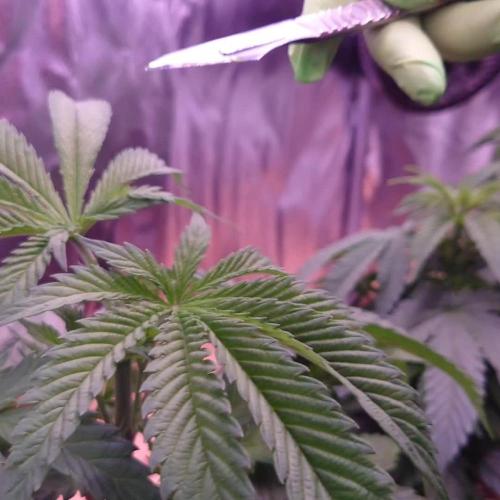
Ich habe alle leicht entlaubt und getoppt.
Sie haben das Toppen gut weggesteckt und wachsen weiter.
Ca 4 große Fächerblätter pro Pflanze entfernt die im unteren Bereich Triebe verdeckt haben.
Heute wird wieder gegossen. Die Töpfe sind sehr leicht und ich gebe heute auf jeden Fall 2 Liter Wasser und steigere dann nächste Woche auf 2,5 Liter.
Bis nächste Woche gehe ich davon aus dass sie dann den gesamten Topf mit Wurzeln erschlossen habe.
Werde nächste Woche mit leichtem LST beginnen um alle Triebe auf gleiche Höhe anzupassen.
Sonntag nächste Woche werde ich auf 12/12 umstellen und die Blüte einleiten.
Ab dann gebe ich ca 3-4 Liter pro Gießgang. Aber das wird sich noch zeigen.
Jetzt verwendet:
- Plagron Power Roots additive
- Plagron Pure Zym additive
- Plagron PH minus
PH angepasst auf 6,5
Ich habe sehr hartes Leitungswasser, daher muss ich selbst bei organischem Grow den PH anpassen. Die Erde alleine bekommt das auf lange Sicht nicht ausreichend gepuffert.
Nochmal zum Setup:
2x Prima Klima Lucilu Shuttle 6 - aktuell 70%
Ca 40 cm über den Damen - 550 ppfd im Durchschnitt
15 Liter Stofftöpfe
Plagron Royalmix
Bin gespannt wie es weiter geht.
Let IT Grow 💚🌱🌿

Likes
11
Share


@Mr_Motalovah
Follow
This adventure seems like it'll be zenzational!
These seeds were the first to burst and also first to sprout from soil out of all the other strain.
Ladies are on a mission, they stretched upwards and spread the first leaves fast!
My thoughts are they'll be some bushy ladies! 😍
I placed the seeds in 500ml cups with BioBizz Light Mix soil, beforehand I mixed 1 gram of Synergy per 4 liters of soil.
These are live microbes called Mycorrhiza which live in symbiotic association with the roots.
My idea is to leave them in this container for about 14-21 days until the roots develop correctly then transplant them to their final pot which will be an 11L fabric pot.
As the light mix soil comes blended for at least two week of life, no nutrients will be added until after the transplant.
Happy growing!
Processing
Likes
7
Share


@Acedily
Follow
Missed couple weeks of updating. Apologies.
K. Had to move the lady back under my homemade lights. The store bought just kept her trying to bunch up. Needed light through, didn't want to defoliate too much and she resisted opening up. She would actually straighten out the wire reaching for the SB.
Sooo, I spread my homemade apart more. I put her back under my direct wire, switchable lights, 5 settings from 2700k-5000k, 6 t8 tubes, 1800 lumens each.
Gave her a couple days. She opened right up for me.
The SB light high intensity, she was bushy, even after opening up, so at week 3, under homemade, she got some defoliation.
Learning more about light. I kept a minimal distance from top, center cola, to reduce it's stretch and allowed the trained limbs to catch up to it.
Now @12" from center cola, about 16" from rest of plant and light covers the entire plant. Using 1000w for her babies (clones.) They like it.
Using soil. And reading more. Prolly didn't need all the nutes I was giving. Doing well on 1nce weekly fish fertilizer and once weekly Gen Hydro Flora Series mixed for flower. The rest is ph'ed water.
Ozarka got expensive. Tried GV spring water. Has near 300 ppm, Ozarka <30. GV pH near and sometimes 10+. Ozarka 8.3 max. GV needs more pH down and it will rise again. I pH let set, then pH again. Pretty sure it's mostly calcium, since it's source is heavy with limestone. Calcium also appears to be a buffer. Ozaka's 8.3 mostly from the calcium, but ph's easily and holds well. Mixing = parts can get a ppm of 160 and pH of 8.7-9. then pH down. Saves a little money and some extra calcium. K done for the week. Bye, y'all.
Likes
7
Share


@SamDo
Follow
Week 19 of Vegetative Growth
(Transition Week – Pre-Flower Move)**
This week marks an important milestone for the Pineapple Upside Down Cake: she was finally moved into the tent where she’ll spend her entire flowering phase.
She’s not flipping yet — this stage is all about controlled acclimation before the real show begins.
Up until now, she was growing under a 5000K blue-leaning veg light at low wattage, which kept her compact and focused on structural development.
Inside the flowering tent, the lighting is completely different: a full-spectrum 3500K panel, warmer, broader, and naturally more stimulating.
A spectrum switch like this can easily stress a plant, especially in late veg, so the intensity was intentionally reduced to 300 PPFD to give her a soft landing.
Temperature conditions also shifted: about 21°C during the day and 17°C at night, with the light set to 25% power.
It’s a cool, stable environment — ideal for a plant adjusting to a brighter and wider spectrum.
The second key topic of the week was training strategy.
Her growth was accelerating fast, and the debate was wide open:
Should she be topped?
Should we go for a scrog?
Should we prune more aggressively?
In the end, the most coherent choice was a clean LST session.
Her main branches — roughly ten apexes — were gently bent and opened to create a wider, flatter canopy.
This approach keeps stress minimal while giving her a solid architecture to handle the upcoming stretch.
Over the next few days, she’ll naturally stand back up, and once she does, her true structure will become clearer.
At that moment, we’ll be able to judge whether she needs extra shaping: a light defoliation, selective pruning, or even a late top if it really makes sense.
For now, the plan is simple and strategic:
• monitor her adaptation to the new spectrum,
• watch how she reacts to the LST,
• keep the environment stable,
• and only move to flowering once she shows full vigor again.
Summary for Week 19 (Vegetative Growth):
– Successful transition into the flowering tent
– Spectrum shift managed smoothly with 300 PPFD
– Cooler environment helping with acclimation
– Clean LST performed on about ten apexes
– No visible stress, good potential for a controlled stretch
– Next step: wait for full adaptation before flipping
See you next week for the follow-up — the pre-flower phase is getting close.

Likes
18
Share


@TheGreenLeopard
Follow
Part of an 8pot tent. Sweet seeds always has been a great experience from seed to smoke. All the senses get a good dance when growing with this bank. So can’t say any better - looking forward to building a nice sweet seed variety. These are waiting for a Harvest in coming weeks so we have them around the place being looked after by spider leg LED fir the early stages. On mobile so will add nutrients to the diary as we go. Can’t have anyone thinking I’m feeding seed full clip lol.


Likes
11
Share


@Chow_13
Follow
July 1st germination day
Things went well. Started her in paper towel, She split the next day.
Had a tap root on day 4 and placed her in her forever home.
Popped out of the soil on day 6 and looks very happy.
Soil is Vegetable and Herb mix from the store with a bit of perlite mixed in for aeration.
Likes
47
Share


@rhodes68
Follow
11/3 Week 6
Watered roughly one gal each @6.5PH, Fish Sh!t 5ml - Karo 1 tps /gal
Flower Girl still in the pot, no deficiencies I can see, well new ones :)
Mag-Sulfur Foliar spray (Epsom Salt 1tbs/gal) on all as leaving cal-mag out this time
Moved the two healthy plants to the center of the light, they can use it, the others might respond well to lower levels.
11/4 Better pics uploaded
Placed Brandy on a block of coco coir to bring her canopy up to Layla's level.
Moved Maggie to the corner she has a stretch going that I HOPE is ending and I dont want to set the lights to her.
Watching that plant carefully
Considering a PK boost watching only Layla for that as the other two ... well hell what can they tell me?
11/5 Working to getting the canopy under control with one stunted plant and another stretching like crazy.
Put a block under Brandy to move her up level with Layla.
Trained down Maggie this growth needs to end, it was already stressed.
Still giving light pref to healthy plants.
11/6 Raised lights three clicks, increased extraction, showing some heat stress in those edges.
11/7 Good results on the heat stress curling has ended.
Noticed some improvement also in the tops of Brandy and Maggie, so raised lights another couple of clicks.
See if it continues, coming up on a make or break feeding in couple of days.
update
Foliar Feed All - Epsom Salt 1tbs/gal
Well Maggie's came today -
To runoff- 1% peroxide - 5ml CalMag - PH 6.8 Hitting Sulfur as hard as I can.
Before pics posted
Brandy not dry enough waiting
Layla just got fed but she got pics too as there are signs of Mag deficiency
1 gal 6.5 PH - CalMag 5ml - Fish Sh!t 5ml - Bio_Bloom 5ml as a PK booster JIC
11/8 Video of plants 24hrs after giving Maggie the h2o2 1% , think she looks better lets see how it goes
11/9 48 hrs after treatment and Maggie is showing great improvement, serious improvement in leaf structure and coloring.
Pics at lights out tomorrow new week anyway.
Brandy showing some improvement but its early.
Canopy is level now so lights set to Maggie being slightly taller
***Last update before the new week.***
May have found ONE of my problems,certainly not THE problem, but one.
I have been using lemon juice as a PH UP since we went organic late last spring.
Because of all the problems I have been looking into a lot of things further and found that lemon juice begins to degrade as a PH up after as little as an hour.
A 6.0 PH water gallon can go to 6.5ish in 24 hours simply sitting in a dark corner in a jug.
One can imagine the variances in soil.
Why I dont know but I am going back to chemical PH additives post haste in fact its already done.
Likes
26
Share


@BudBoutique
Follow
! this is my current status, gonna upload my last veg weeks within the next week - got a bit busy around Spannabis - thank you for your understanding! 💚
Welcome to Bud Boutique Grow Diary - really appreciate all your love and support :)
Dont forget to check out my other current grows!
🗓️ This Week:
after 48 hours of complete darkness (important for seedlings to make sure all plants switch into flower same time), I finally switched my lights to the 12/12 schedule and sent my ladies into the flower.
- This one Phenos super strong
- more than healthy and going well
- Day 3: Foliar spray with APTUS Regulator and APTUS Nutrispray to give them extra micronutrients and give them a little shell for protection.
! always use APTUS Regulator first and mix well with your water before adding any other nutrients for Feeding or Foliar!
Thank you for still staying with me 💚
___________________________________________
--- 🌱 Strain (Sponsor) ---
🏷️ Blue Cinderella 99 FF by MSNL
https://www.marijuana-seeds.nl/blue-cinderella-99-fast-flowering
--- 🥗 Nutrients and Feeding (sponsored by APTUS: APTUS Ambassador) ---
🍸 APTUS: full nutrient schedule extreme
-- Regulator, N-Boost, P-Boost, CaMg-Boost, K-Boost, Allin1 Liquid, Startbooster, Topbooster, Enzym+ every feeding
-- Fulvic-Blast, NutriSpray as Foliar each once a week
🔗 https://aptus-holland.com/
--- ♻️ Grow Control (Sponsor) ---
TROLMASTER: TENT-X + LM14 Light Adapter to dim/sunrise/sunset lights + Temp & rH Sensor all remote on App
🔗 https://www.trolmaster.eu/
--- 🏭 Grow Setup ---
💡LUMATEK Zeus Pro 600
* 🏠🌿 Indoor: Homebox 120x120x200cm (4x4)
* 📐🌀 PrimaKlima exhausting Fan 1180m3/h (running on 60-80%)
* 🌀 Can Light Filter 800m3/h & 1x Fanbox 1x Dyson fan for Air circulation
🔗 https://lumatek-lighting.com/zeus-600w-pro-29/
🔗 https://primaklima.com/de/shop/ventilatoren-de/ec-ventilatoren/pk160ec-tc/
🔗 https://canfilters.com/products/filters/
All Likes and comments are highly appreciated!!!
👨🌾 don't forget to check out my Instagram for daily educational content: budboutiquee
- Bud Boutique

Likes
32
Share


@Sadhus
Follow
A mon avis le boom florale arrive sur la fin et la maturation va commencer, l'odeur est vraiment incroyable !

Processing
Likes
9
Share


@Gardenergrower
Follow
hola colegas ,7 semanas de floracion dese el cambio a 12/12, seguimos con el engorde de mis nenas ,hasta el momento siguen bien y hambrientas
Processing
Likes
10
Share


@Fibro_Witch
Follow
Critical Cure is still happy and putting out good growth. Fertilized with a ring of the Coast of Maine around the base and watered it in with a little lime water. Bugs are getting hungry so the plants got some neem oil spray. Heat wave going through right now. Please forgive my slurring in the video, it's been a long week and my brain is addled😜
Likes
8
Share


@TightNugs
Follow
Flipped to 12/12 today with final trim b4 stretch.2 clones taken and both rooted in 7 days in the cloner.
Happy growing Nugz 🤞🏴🍁
🍁🍁🍁
Breeder-Mystery photoperiod
🍁🍁🍁
Light-Voost VST 120
https://voost.com/
Discount Code-TightNugs over £200
🍁🍁🍁
Seedbanks-Garden of green,Expert seeds
Likes
47
Share


@terpproducer
Follow
👇 This week:
--
- All plants were repotted in their final pots. Some 11l some 8l
- Watered again as usual with standard Plagron scheme + Calmag
- PPFD on canopy height approx. 350-400, (500 was too much, you can see it on a few leaf tips)
- Next update will be the autopot setup (incl. tutorial for you guys)
--
Happy Growing and thanks for checking out my report! 😁💪🙏
Likes
4
Share
@eldruida_lamota
Follow
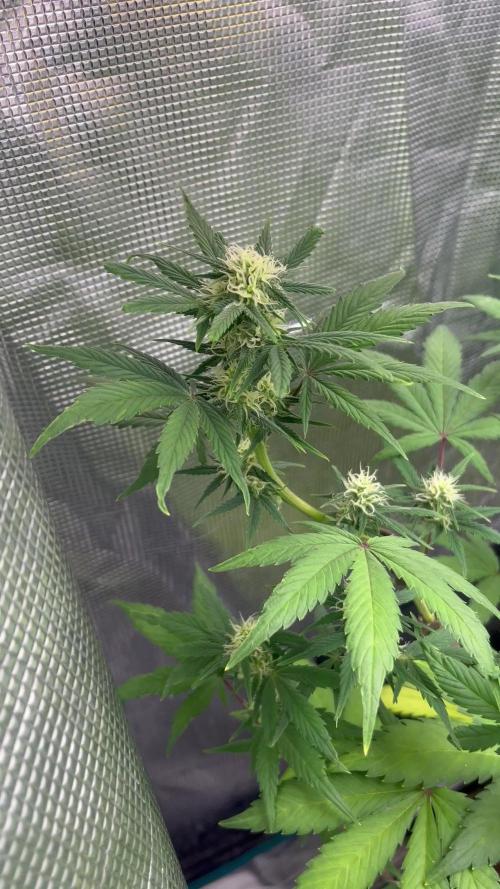
Que pasa familia, vamos con la segunda semana de floración de estas GG4 Autooreciente de MSNL.
Vamos al lío, lo primero comentar, que me dieron gato por liebre, porque esto tiene pinta de rudelaris que tira pa atrás…
Van en macetas de 7 litros negras.
El ph se controla en 6.0 , la temperatura la tenemos entre 24/20 grados y la humedad ronda el 50%.
El ciclo de floración puse 12 horas de luz, el foco está al 60% de potencia.
De momento van creciendo a buen ritmo y tienen un buen color, ya tiraron pelos blancos y van empezando a tricomar, estaban bien enraizadas al realizarle el trasplante se notaba la abundancia radicular.
Agradecer a todo el equipo de Agrobeta por el envío del kit gold series para esta temporada, soys unos jefes 🙏.
- os dejo por aquí un CÓDIGO: Eldruida
Descuento para la tienda de MARS HYDRO.
https://www.mars-hydro.com
Hasta aquí todo, Buenos humos 💨💨💨