


Likes
Comments
Share


@eldruida_lamota
Follow
Bueno familia, las prisas y demás quiero dejar el Piso en el que estoy y pues eso machete secado rápido en 23 grados y 40% humedad.
Flores no muy grandes pero si compactas. La verdad que sorprendido con la variedad.

Likes
1
Share


@Vincentmad
Follow
End of week 3, last week we removed bottom node and this week removed last node from bottom tpp, heavy lollipoping for pre veg for 2/3 weeks then flip to 12/12
Processing
Likes
16
Share


@Dunk_Junk
Follow
28cm vertical growth this week! Almost doubled her height!!!!!!!!
Powering through flowering :-)


Likes
3
Share


@Passionatos
Follow
I lost the pics for the first weeks of veg unfortunately but the most important time the flower is all on film;)

Likes
10
Share


@Gokou4OG
Follow
Super happy all is good . Girls are super happy and at ease . Can’t wait to harvest but patience is key .
Likes
13
Share


@igrowtomatoes
Follow
week 4ish.
the supercropping failed. the branches insisted on just coming back up no matter how much i pinched them back down ,probably had to tie them but.... fuck it.
so some burnt leave tips from being too close to the light.


Likes
44
Share


@RakonGrow
Follow
Note : Jegliches Equipment aufgelistet welches ich nutze findet Ihr in der Germinations Woche !!!
Day 15 :
ich weiss noch nicht ob der mineralische dünger wirklich sofort etwas gebracht hat . schauen wir was die zeitraffer so vermitteln. ist es seit gestern schneller am wachsen ?
Day 16 :
PPFD 275 * 20h = DLI 19.8
Day 17:
+ 0.5L Flaschenwasser (EC 0.26)
+ + Canna Rizothonic
+ + Canna Terrar Vega
+ = Total EC 0.68 (PH 7.2)
+ Final PH 6.15
Day 18:
es wächst
Day 19:
es wächst immer noch
ventilation übern blätterdach angemacht. ich glaub daher kommt das ruckeln im video
Day 20:
+ 0.5L Flaschenwasser (EC 0.26)
+ + Canna Rizothonic
+ + Canna Terrar Vega
+ = Total EC 0.68 (PH 7.2)
+ Final PH 6.15
+ 0.5L Leitungswasser (PH 8.0)
Der Stamm hat sich in den letzten 3 Tagen verdreifacht vom Volumen. Jetzt hat er so Bleistift dicke erreicht.
Day 21:
die temps und relative luftfeuchte sind hier zwischen 58%-68% und 23.5°-25.5°C . reguliert sich aber immer zu den höheren werten . ist hier halt so :))

Likes
32
Share


@Bud_Spencer
Follow
Hi Grower!!
Day 89 Complete
( 59 Days Flower)
Maybe I was too early to flush, but otherwise it looks really mega! I still think 5-7 days
Grown under Viparspectra P4000
CHECK YOUR DISCOUNT WITH THIS LINK
‐----------------------COPY&PASTE--‐-‐----------------
https://viparspectra.eu/?ref=budspencer
Or with my Coupon Code:
Budspencer420

Likes
2
Share

@eldruida_lamota
Follow
Que pasa familia, vamos con la séptima semana de floración de estas Gorilla Melon feminizadas de fastbuds.
Vamos al lío, de las 3 plantas, me quede con 2 por espacio, siempre pongo alguna semilla de más por si no abriese alguna por no perder ese hueco del indoor.
Y ya superaron el shock provocado por el mismo trasplante.
El ph se controla en 6.2 , la temperatura la tenemos entre 20/22 grados y la humedad ronda el 50%.
Ya empiezan a formarse las flores y progresan a buen ritmo.
Hasta aquí todo, Buenos humos 💨💨💨
Likes
41
Share


@MadeInGermany
Follow
Hey guys .
Finally the time has come .
From all 4 phenotypes the cutting was put into flower.
In the next 10-14 days I know which ones are female and which ones are male :-) .
A female stays here in the diary, all other females come back to the vegi tent because there is no space in the flower tent.
The males go to an extra location to collect pollen for crossbreeding.
was watered 3 times a week with 0.6 l each time.
Stay healthy 💚🙏🏻
👇🏼👇🏼👇🏼👇🏼👇🏼👇🏼👇🏼👇🏼👇🏼👇🏼👇🏼👇🏼
You can buy this Nutrients at :
https://greenbuzzliquids.com/en/shop/
With the discount code: Made_in_Germany you get a discount of 15% on all products from an order value of 100 euros.
👇🏼👇🏼👇🏼👇🏼👇🏼👇🏼👇🏼👇🏼👇🏼👇🏼👇🏼👇🏼
You can buy this strain at :
DJ Short
Water 💧 💧💧
Osmosis water mixed with normal water (24 hours stale that the chlorine evaporates) to 0.2 EC. Add Cal / Mag to 0.4 Ec Ph with Organic Ph - to 5.8 - 6.4
MadeInGermany

Likes
41
Share


@Thee_HoffGuyy
Follow
Well it was another great week for the Super Silver Haze sisters!! Day 28 for them and they are growing very well👌They have all grown about an inch in height in the last week. Plant #1 has a slight earthy/ fruity smell starting to come out. Her bud sites are slowly starting to fill in nicely. Plant #2 has really filled in and is just a very quick growing pheno. It had the onset of flowering very quick and has just kept going at the same rate since🙌 Only thing about that is she is using way more Phosphorous than the other 2 plants and was starting to show the beginning of a deficiency, luckily It was caught quick and is not affected any of the top new growth or bud site areas. So now she is getting her own nutrient solution with a slightly higher amount of phosphorous. She also has a Strawberry fruity like smell, it is very unique! Plant #3 Is doing great👍 She doesn't have to much of a smell yet, but it does have a hint of a skunky/fruity smell to it according to what my nose is telling me😂 Overall they are growing fantastic with the exception of the slight P deficiency that showed up on Plant #2, Like I stated earlier I believe it is due in part to how fast she is growing and me not thinking to add a little more knowing she was growing faster than the other plants, combined with her position in the tent. Where she is kinda in the overlap of the 1000w HPS lights even though the light is strongest directly under them. Where I have 2 running in a 5'x10' area. So the overlap of them into each other creates quite an even light coverage, most of the time. but sometimes can be stronger than directly under the light depending on the spacing of the hoods/reflectors and type of hoods/reflectors, and that is what was happening here. They where fairly close together so the edge of their light dispersion was reaching almost to the center of the other light creating a pretty intense spot of light in the overlap. So I moved the lights just a little further apart, but did not want to go to far because the plant was loving that much light. and really only wanted to reduce it to help it bounce back from the slight P deficiency, since the more light the more photosynthesis the more Phosphorous😊 Anyways Thanks for stopping by to check things out!!👊 Happy Growing an Plentiful Harvests to All!!🙏

Likes
4
Share


@WalachianGrowinDiary
Follow
Looking like she willl not bulk that much that i wish but quality Is different story. Frosted like snow and smell Is awesomly amazing 😍

Likes
81
Share


@NugLife420
Follow
I was finally able to sex them all. 1 Male/Hermie, and the rest have beautiful white pistles forming. They are starting to go through a stretch now as well. I also ordered some more grow lights 3 Mars Hydo TS1000's. I can't wait for those to arrive.)

Likes
10
Share


@KinoBudz74
Follow
Week 3 lookin good 🤟🏾 She stopped stretching and now starting to focus on buds 🌳 imma get a new co2 packet and have her get big. Also for the main stem I’m just going to buy electric tape or a plant tie around it. She’s getting to big 💪🏾 And my clones are doing good and growing real fast imma put them ladies outside 🔥🌳


Likes
4
Share
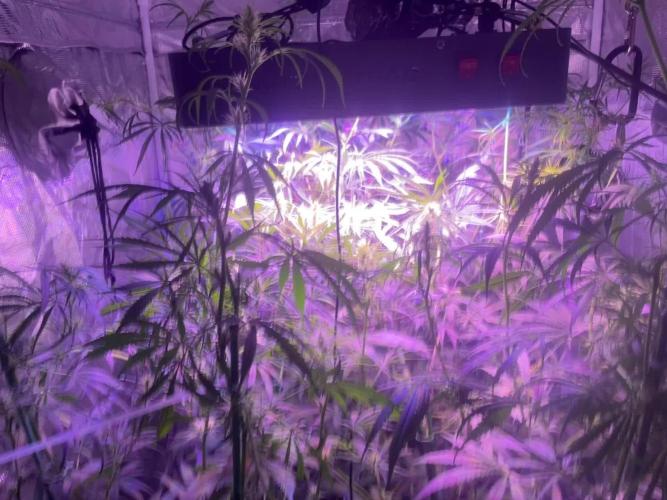

@RatmanJR
Follow
July 12, 28 days since flip
Clones:
So far all 3 remaining clones are growing well. Buds are really starting to form and getting a ton of pistals forming. Plants grew a little bit in the last week.
Ended up doing another aggressive round of super cropping to keep them from burning up. Some of the colas are above the light so may add supplemental lighting but honestly so many bud sites I’m not concerned about getting a large enough sample.
Began to notice some lower leaves dying and some spots on some upper leaves so top dressed both earth boxes with some craft blend, cow cal 24, big 6, some potassium and some epsom salts. Should make her nice and happy again.
At this point going to flower for a few months and drop individual updates as the plants stand out
Mothers and father:
Didn’t end up topping like I said I was going to last week so going to top this week. Just trying to stunt them a bit so they don’t get too large. No major updates other than this
God bless!

Likes
26
Share


Processing
Likes
4
Share


@Herbsman
Follow
This was a pretty stable week. I finally moved my flowers to the new growing area I’ve created. It’s powered by Gavita Pro fixtures and Phillips mastergrow bulbs. They have been in here for about 3 days at this point. From now on my future diaries will showcase more plants, larger scale, but still with artisan minded craft. Excited for what the future will bring, almost as excited as I am to cut down these plants when they take on their fall colors over the next 3 weeks! I’m
Expecting a harvest of 1-1/2 oz per plant, but may get more or less. Time will tell.
Likes
44
Share


@Cogollo_eu
Follow
With no doubt these plants have not produced much more quantity and density of buds due to the 2 serious mistakes I've made (those who have read the weeks will know what I mean). However, I can say that I am happy with the production obtained given the mistakes made.
Between the 2 plants, the one that has produced more and generated the most dense buds has been the Gorilla with the Man-lining technique applied, it has also loosed a bit less weight drying than the non man-lining one.
In comparison with the Money Makers with which they have grown the result is the same. Both Gorillas have each produced more than any of the Moneys comparing them 1 to 1. Also buds are a bit dense than the moneys, but none of them is really desde at all.
*****ESPAÑOL*****
Sin duda estas plantas no han producido mucha mas cantidad y densidad de cogollos debido a los 2 graves errores que he cometido (quien se haya leído las semanas sabrá a que me refiero). No obstante, puedo decir que estoy contento con la producción obtenida dados los errores cometidos.
Entre las 2 plantas, la que más a producido y ha generado cogollos más densos ha sido la Gorilla con la técnica de Man-lining aplicada, y también ha perdido un poquito menos de peso en el secado que la otra.
En comparación con las Money Maker junto a las que han crecido el resultado es el mismo. Las Gorillas han producido cada una más que cualquiera de las Moneys comparándolas 1 a 1. Así mismo, los cogollos de las Gorillas presentan un pelín más densidad que el de las Moneys, aunque realmente ninguna de las 4 plantas ha generado cogollos densos del todo.
