




Likes
30
Share


@Dunk_Junk
Follow
Day 91 - Getting very close to the end now. Some parts have been harvested already when I see an amber trichome. Those are in the dry net.

Likes
1
Share


@MaltedMadness02
Follow
Really coming along, I'm very happy to watch her do her thing in this second half of flower. She's very earthy with some notes of pine. Smells just like the dank stuff I've been smoking my whole life! Man I can't wait to keep growing. I hope to expand the grow operation here soon, hopefully with another tent. I want to keep autos in different stages so I can streamline everything, have a plant popping while one vegges, while another flowers. Keep the flow steady and my fridge full of weed lol. Speaking of, I am using my fridge to dry! The Lotus Method for anyone familiar.


Likes
8
Share
@ThatsmyGrow
Follow
🌸 Week 6 – Gorilla Cookies Auto Pheno Hunt
Another week is in the books and the differences between the phenos are becoming impossible to ignore now 👀🔥
Stretch has been very different across the plants and some phenos are clearly showing completely different growth patterns despite running under the same conditions. It’s getting easier every week to identify which phenos stay compact and bushy and which ones want to reach for the sky.
📈 Current observations:
Pheno #3 and #4 have stretched aggressively and are now above 70 cm
Pheno #5 took the lead and is currently sitting at around 101 cm 👀🔥
Pheno #1 and #6 are still in early flower / preflower and developing noticeably slower
Plant architecture is becoming very clear now — some phenos are growing dense and bushy while others are showing strong vertical growth
At this stage I already have clear favorites:
⭐ Pheno #4 and #5 are currently standing out the most for me in terms of structure, vigor, and overall development. But the real decision will come once the flowers fully build up.
🍃 Maintenance & development:
Canopy management continues and I’m still removing leaves only where necessary to improve light penetration and keep flower sites exposed.
📊 Current environment:
Temperature stable around 26°C
Relative humidity sitting around 67–70%
VPD target remains unchanged and is being monitored continuously
Light intensity continues to increase gradually as flowering progresses
The next weeks should become really exciting — structure is one thing, but now the buds will decide who becomes the real winner of this pheno hunt 🌸🔥
💬 Which pheno would you bet on at this point?

Likes
62
Share


@Natrona
Follow
Week 7 7/25-31
AUTO Pablo Escobar
7/25 2gal
TPS1 30ml
Cal mag 5ml
Recharge 5ml
Kelp 2 tbsp
PH 6.3
PPM 1010
Temp 73
7/28 2gal
TPS1 45ml
Cal mag 5ml
Recharge 5ml
Kelp 80ml
PH 5.7
PPM 1210
Temp 72
Auto Escobar bounced back nicely from last week's defoliation. Escobar's opening her structure to open the lower inner branches made her really wide. Bumping
Thank you @DivineSeeds for the opportunity to participate in not only the photo contest but also the auto grow contest.
Thanks for the visits, likes and comments; I appreciate all the plant love💚.
Have fun & love what you grow 💚
Sending you good vibes of love, light, and healing 💫
💫Natrona 💫

Likes
202
Share


@CrazyHorse
Follow
Hello my beautiful friends 😇 😇 😇
After 3 weeks on grow period flowering stage is here 💪 💪 💪
Day- 22
The girls started to be very bushy, as they start showing first sign of flowering I go into the action and I proceed a small defoliation 🙌
Nothing big just to maintain a healthy growth and airflow 😇 😇 😇
Day- 23
Around two or three days ago I make a new tank of 10l... Nearly entire solution goes 😇
I have got heavy drinkers here 😂 😂 😂
All the best, You Lovely Girls Growers 💪💪💪
Likes
38
Share


@Cremo
Follow
So here we are, at the end, a few months later. I was so happy that I'll finally grow a plant without any training at all, just to see the full and uninterrupted genetic expression. It was a blast to grow her, I can't wait for the plant to dry and give it a few weeks of curing but she smells great already.
I also wanted to thank Divine Seeds for the contest strain and Bio Tabs for great Bio fertilizer. You can judge for yourself because I'll let the photographs speak for themselves.
Speaking of photography, I went with a moody style this time, because she has a great structure. I've trimmed her a little bit here and there and I've left a few big fan leaves on both sides for better looks.
The big fan leaves reflect the light so well, it make the whole plant shine. Okay now head to the gallery and let all that sink in ;)
XOXO
Cremo


Likes
1
Share


@Pestitel
Follow
Amazing experience with the Mix Pack, I will try it again next summer for sure. Love the variety.
Likes
13
Share


@SecretC8keSociety
Follow
On 4th week. Using now Athena Pro Line. Easy to use and get it done faster. Let see how the girls react to it. They smelling skunk sweet and Apple Fritter. One pheno showing purple . Thinking it come from Forbidden Fruit and the smell Apple Fritter
Likes
7
Share


@Stickygreens420
Follow
Starting week 2, all of the plants are healthy. Added the barley straw, which is helping to keep the top of the soil moist. Also, threw a few worms into each bag and planted some white dutch clover cover crop. The Orange Bubblegum is still growing the slowest, but I'm going to ride it out. This is an auto, so it's a little concerning, but I've heard good things about Twisted Tree genetics, so I'm rolling the dice.
Watered 1 liter per pot of filtered water at 6.7 ph on 10/12/2022. Also have been slowly increasing the light intensity. Started the week at 300 PPFD and plan to be at 400 by the end of the week. The two bigger plants are just reaching their 5th node, so I started some LST on 10/16/2022. Also watered another liter per plant using ThremX-70 and Rootwise Mycrobe complete.
Avg. VPD: .75
PPFD: 400
DLI: 26

Likes
17
Share


@Dark_Shadow_420
Follow
Está genética ya la cosecha muchas veces teniendo muy buenos resultados en todas sus cosechas.
En el caso de este esqueje el resultado fue el correcto Aunque tuvo sus inconvenientes como la flora antes de tiempo la cual fue batalla con un sodio el cual me sirvió para poner a revegetar el mismo, el olor que presenta esta genética en la fase de floración es muy fuerte y rico. Es una de mi genética favorito la cual recomiendo para todos los cultivadores principiantes y más experimentados ya que es una planta Qué es fácil de cultivar y que tiene muy buenos resultados

Likes
2
Share


@simps
Follow
She is almost done man she is a lil tiny plant but jugging by the smell and how sticky the buds are looks like this lil plant packs a punch we will see
Likes
11
Share

@Bunterbiber
Follow
We just pushed through another absolute beast of a week, and the first half of it was pure survival mode. The temperatures peaked at a jaw-dropping 39°C, and even the nights offered zero relief, staying at a sticky 26°C minimum. It’s been an intense endurance test for an outdoor grow!
The Daily Hydration & Feeding Strategy: 💧
To keep them from turning into crisp, dry twigs, I had to switch to a strict every-single-day watering schedule. Missing even one day in that kind of heat wave would have been catastrophic.
Amazingly, the ladies are showing incredible resilience—they haven’t displayed any noticeable signs of distress or major issues so far. Development is moving along beautifully, though I'm keeping my fingers crossed that there won't be any delayed fallout from the extreme heat stress. Nutrient-wise I'm feeding them at about 75% of the recommended dosing plan to keep them happy without overdoing it in this heat.
The Strain Breakdown: 🌿
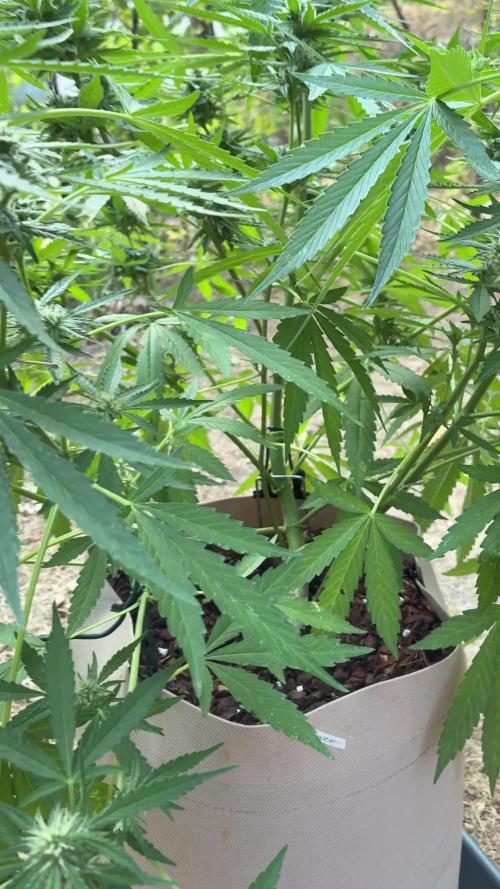
Lemon Cherry Cookies Auto: This girl is absolutely crushing the game right now. She is already stacking up some seriously decent, chunky buds, and the aroma is getting beautifully pronounced and loud! Every breeze brings a sweet whiff of what's to come. 😉
Amnesia Haze Auto: She has turned into an absolute monster! She’s gotten incredibly big and wide, taking full advantage of her outdoor space. You can definitely see that Sativa heritage shining through—judging by her progress, she’s definitely going to take a bit longer to cross the finish line compared to the quicker, Indica-dominant ladies like the Lemon Cherry Cookies.
Bruce Banner Auto & Banana Purple Punch Auto: These are the two shorter ladies of the group, but what they lack in raw height, they make up for in sheer health. Size aside, they are doing exceptionally well, looking super vibrant, healthy, and stacking their own flowers nicely.
All in all, I’m incredibly proud of how these genetics are handling a brutal summer. Now that the worst of the heatwave seems to be behind us, I can’t wait to watch these buds really start to swell!
Likes
180
Share


@SlowpokeFuegobud
Follow
DAY 65
Watered with a bit of Bloom as I see too much N in the plant locking out P slowly.. 💧
DAY 67
Watered with just Bloom. 💧
Caramelo is such a treat! 💚 I'm a bit gutted that 2 of the 3 seeds didn't sprout. I would have grown it again. The smell is fantastic!! Sweet walnuts. Never had that before.. 😃
LED running at 80%.
Have a great week!! 😘
__________________________________________________
SET UP
240W Fullspectrum LED 660nm 730nm 3500K dimmable
custom exhaust fan 270/320 m³/h
3x Garden High Pro fans 5W
tap water EC 0,25 - adding Calmag to EC 0,4-0,6 - adding pH minus Bloom (AHH) to pH 6,5
Plantaflor organic tomato soil 🍅


Likes
3
Share


@Canadian_Growology
Follow
This week has been excellent! Lots of new growth and almost time for a inside trim.
Gonna take a ton of clones. Thinking of starting a YouTube channel lol
Cheers

Processing
Likes
11
Share


@Luv2Grow
Follow
Day 57 - Starting week 9 and was gonna give the girl her first feeding today but soil was still a little damp so held off another day. She’s definitely looking better than I expected. Can’t wait to see her when she’s done.
Day 58 - She finally dried up after the flush and upped the cal-mag, hoping to correct her deficiency, so time will tell. Gave her the first feed of the week since flushing her. Looks like she might have a little PK deficiency as well so upped the PK as well. Bud are definitely looking pretty nice though.
Day 59 - Overall bud growth is looking good but I’ve upped the cal-mag and she’s definitely still spotting and yellowing. Thinking it might not be getting enough PK by looking at some deficiency charts but still a rookie and really am not sure. Gonna try upping the PK next feed and see what happens. Other than the leaves, buds are still fattening and smell amazing. Any experts have any input?
Day 60 - Gave the girl a healthy dose of water and cal-mag tonight so we’ll see what happens. Though just checked the trichomes and there’s not many clear left so I don’t know if she’s got more than two weeks or so left. Fingers are crossed that she makes it, think she’ll be ok.
Day 61 - Buds are still stacking and fattening so not too concerned anymore about the cal-mag deficiency. Think this girls got about 7-10 days left going by the trichomes.
Day 63 - End of week 9 and all looks good! Thinking about chopping this week sometime. Pistils are starting to shrivel and no new ones coming. Trichs look like it’s close to being ready too. All in all, even with the cal-mag deficiency, she’s looking good.

Likes
7
Share


@nectarinepasta
Follow
New leaves still discolored but growing apparently correctly. Possible reasons:
- genetics (?)
- heavy fertilized soil - Batmix from Plagron was used (?)