Likes
Comments
Share


@BigBaby420
Follow
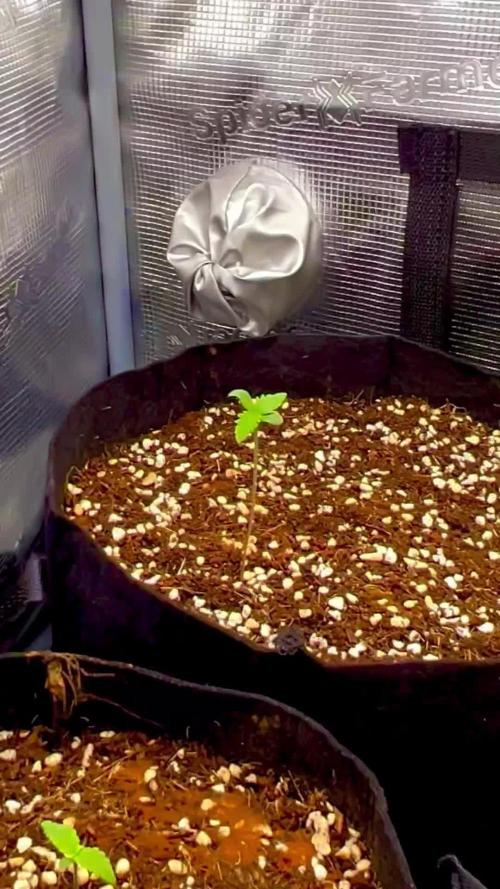
Started low stress training this week. Kind of in the style of mainlining, but I didn’t really start early enough for that. Tied all branches down to try and give all inside flowers some equal light. White widow leaves turned yellow and she just stopped growing. Need to figure out what I keep doing to kill my seedlings. Root system looked pretty healthy, not sure what was the culprit. Also used farmer freeman to determine sex since I used regular seeds. One male one female. And then there was one.

Likes
17
Share

@Kirsten
Follow
7.5.25:
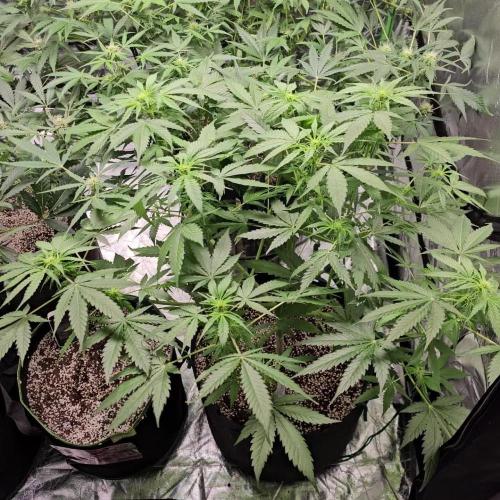
I retied down the branches on RQS Northern Lights auto.
I had to clean the tent, so the opportunity had to be taken, I hope not to have to move them again. I ended up snapping a small branch off another plant 😖
She is looking so big out of the tent, and even bigger than I thought! Now, having readjustmed, the fabric ties, and she is looking even larger still. This really is an absolute giant of a plant! 😱
I really am struggling to get them all in, I think the 8 gallon pots were a definite factor in that. They certainly are great for getting big plants, but be prepared if you have a small space.
She's still stretching and not really focusing on her bud development in these mid flowering weeks. I think we will be in for a long haul with this lady. I hope she doesn't get too much bigger.
I watered some bloom nutes after I top dressed, with Mega Crop Part A by Greenleaf Nutrients. I watered 3.2 litres
PPM:745
PH:6.0.
This time, I'm going to keep the top dressing moist. So as not to kill all the beneficial microbes. Other than that, I will wait until the pots are light again.
Overall, she is doing great, I wish she had stretched a little more evenly to catch up in height. I just can't even out the canopy anymore.
I'll leave it and hope she'll sort herself out 😅
I'm very excited to see what happens next! This is going to be crazy whatever happens! 😍😋
8.4.25:
Northern lights had dried out significantly, so I watered with 2 litres of dechlorinated water PH'd to 6.4.
Containing per litre:
♡ 1/4 tsp of Greenleaf nutrients Sea K(elp).
PPM: 800
PH: 6.4
I don't want the top dress to dry out too much, and the plants are starting to drink much more.
9.5.25:
It's a necessity to keep the soil moist. That means I need to water more often now.
Today I watered with 1.5 litres of dechlorinated water PH'd to 6.4 which contained:
♡ 1/5 tsp of Sea K(elp). By Greenleaf nutrients
♡ 1/4 tsp Ecothrive Biosys.
PPM: 564
PH: 6.4
12.5.25:
Northern Lights has been srayed with the foliar spray and all symptoms have resolved.
Due to having a few leaves burnt with that, I've decided to use the Ecothrive Trace in the water instead.
It left some orange spots of damaged leaves.
Thanks for checking out my diary and hanging out 😊💚🙌🍃✌️

Likes
5
Share


@LittleBigTrees
Follow
One week of 12/12 and there stretching out nice
I've defoliated the central cola to allow the side branches to catch up.
Will start to feed soon

Likes
23
Share


@MadeInGermany
Follow
Hey everyone 😀.
A lot has happened this week 👍.
Flowering day 28
Today 1.2 liters were poured.
(See nutrient table for nutrient addition).
The humidifier was refilled with an Ec of 0.4. The tent has been cleaned.
Flowering day 29
Today the plants and buds were checked for health and cleaned.
Flowering day 30
Today was poured again.
This mam she got 1 liter of water.
(See nutrient table for nutrient addition). Of course, the plant was checked for its vitality 🧐😅.
Flowering day 31
The humidifier was refilled a little and the tent cleaned 👍.
Days of flowering 32
Today 1.2 liters of water were poured. (See nutrient table for nutrient addition).
Fans, fans, electrics have been checked for functionality 😊.
Flowering day 33
The plant has been carefully checked for pests, etc.
Flowering day 34
Today 1.6 liters were poured, so that it had about 10% drain 👍
For nutrient addition, see the nutrient table.
The tent was plastered and rubbed with disinfectant.
The buds look beautiful, and already smell extremely tasty again 😍.
I wish you a lot of fun with the update, let it grow 🍀 and all stay healthy 🙏🏻
You can buy this Strain at
https://thecaliconnection.com/seeds/girls-scout-cookies-34.html
You can buy the fertilizer at
https://www.greenbuzzliquids.com/
Type:
Girls Scout Cookies
☝️🏼
Genetics:
GSC Tint Mint
👍
Vega lamp:
2 x Todogrow Led
Quantum Board 100 W
💡
Bloom Lamp :
2 x Todogrow Led
Cxb 3590 COB 3500 K 205W
💡💡☝️🏼
Soil :
Canna Coco Professional +
☝️🏼
Fertilizer:
Green Buzz Liquids :
Organic Grow Liquid
Organic Bloom Liquid
Organic more PK
More Roots
Fast Buds
Humic Acid Plus
Growzyme Big Fruits
Clean Fruits
Cal / Mag
Organic Ph - Pulver
☝️🏼🌱
Water:
Osmosis water mixed with normal water (24 hours stale that the chlorine evaporates) to 0.2 - 0.4 EC. Add Cal / Mag 2 ml per l water every 2 waterings . Ph with Organic Ph - Pulver to 5.8 .
Like
1


Likes
190
Share


@Ju_Bps
Follow
Hello growmies 👩🌾👨🌾🌲🌲,
👋 More and more frosty but I don't like how buds are turning, look a bit heat stress and turning too much foxtail, I don't like..
But ok, don't want said will be bad stuff.
Temperature are hot summer is there, sometimes I've peak to 32*C in box...
💧Give water each 2 or 3 days
1,5l Water + Nutri NPK Bloom
1,5l Water + Nutri NPK Bloom + Sugar Royal
PH @6
- Nutri NPK
Bloom
1/2 tsp for 1 gal.
💡Mars Hydro - SP 3000
100% 38 cm.
🔥 Thanks community for follow, likes, comments, always a pleasure 👩🌾👨🌾💚🌲.
Mars Hydro - SP 3000 💡💡
https://www.mars-hydro.com/sp-3000-samsung-lm301b-greenhouse-led-grow-light
NUTRI NPK 💥🔥
https://www.nutrinpk.com/product/npk-mix-pak-for-4-to-5-plants-cannabis-fertilizer/
Sweet Seeds - Mimosa Bruce Banner XL Auto 🌲🌲
https://sweetseeds.es/en/autoflowering-seeds/3232-mimosa-bruce-banner-xl-auto.html


Likes
32
Share


@LapsekiliTayfur
Follow
Day in and exit fan 15 min off 15 min on Van is full on
Night in and exit fan 30 min off 15 min on Van is off
Lst tranings return
Day 30 Grow powder 2gr/1L Short Flowering 2gr/1L 800ML Per Pot
Day 32 No Nutrients 800ML Per Pot


Likes
89
Share


@nonick123
Follow
Día 54 (10/03) Riego 1,25 Litro H20 + Wholly Base 2,5 ml/l + Solid Green 2 ml/l + Early Flower 1,25 ml/l de Gen1:11
TDS 1033 PPMs - pH 6,51
Día 55 (11/03) Defoliation time!
Con la increíble ayuda de @miyaguiokpolilla, @dogdoctorofficial y @growwithflow420 hice la defoliación recomendada exactamente después de 21 días cambiada a 12/12
Consejos de defoliación
- Elimine menos del 20% de las hojas de abanico y solo las hojas de abanico
- Retirar el tercio inferior de la planta, incluidas las ramitas.
- Retirar las hojas en forma de abanico dirigidas hacia el interior de la planta.
- Retire las hojas de abanico que dan sombra a los futuros cogollos.
Día 56 (12/03) Esperando algo de estrés tras la defoliación... Han crecido 2 centímetros en 24 horas 😍🚀
Día 57 (13/03) Riego 1,25 Litro H20 + Wholly Base 2,5 ml/l + Solid Green 2 ml/l + Early Flower 1,25 ml/l de Gen1:11
TDS 1043 PPMs - pH 7,0
Las plantas muestras una ligera deficiencia de CalMag. Voy a subir el pH a 7.0 en este riego para mejorar la biodisponibilidad
Día 58 (14/03) Siguen con su crecimientos, los cogollos formándose y las hojas de azúcar empezando a llenarse de resina
Parece que la corrección de la deficiencia de CalMag ha sido muy efectiva! No hay más manchas y las plantas no paran!
Día 59 (15/03) Como mañana me voy a Spannabis 😍 voy a adelantar 1 día el riego reduciéndolo a 1 litro
Riego 1 Litro H20 + Wholly Base 2,5 ml/l + Solid Green 2 ml/l + Early Flower 1,25 ml/l de Gen1:11
TDS 1080 PPMs - pH 6,57
Día 60 (16/03) Spannabis time! 🚀
Día 61 (17/03) Spannabis time! 🚀
💦Nutrients by Gen1:11 - www.genoneeleven.com
🌱Substrate PRO-MIX HP BACILLUS + MYCORRHIZAE - www.pthorticulture.com/en/products/pro-mix-hp-biostimulant-plus-mycorrhizae
🎚️Controlled by TrolMaster TCS-1 Tent-X System Main Controller - https://www.trolmaster.com/Products/Details/TCS-1

Likes
40
Share


@CampaCavallo
Follow
3ª VEGETATIVA :
La giovane BISCOTTI {ZAMNESIA} cresce bene nel nuovo vaso.
Abbiamo cambiato il ciclo vitale e siamo passati a 12/12(.. In realtà 13/11☺️)!
La MARS HYDRO TSL2000 è stata avvicinata alla cima ad una distanza di circa 30cm,dove cerchiamo di avere un 50000 lumen.
Attendiamo con pazienza i primi peletti bianchi 💐

Likes
33
Share


@PEAKYPLANTERS
Follow
Hello everyone, masters and beginner farmers!
welcome back to the enchanting gardens of Peaky


Likes
16
Share


@GreeneScene
Follow
Let’s see , humidity is an issue . It’s higher than I’d like it to be . I added drip pans & two different miniature forms of dehumidifiers one electronic and the other passive .
I need recommendations on affordable dehumidifiers before I run into mold issues .
After breaking the apical dominance there was one or two issues but it gave me all the more admiration for the genetics to take a beating and still remain unbothered & WHOLE .
A main top was bound too tightly & broke in half trying to pull itself back up . It remained broken and unnoticed for atleast 3 days before I saw the damage and taped it .
She is now almost fully scarred over & healed .
Vertical growth was decent this week I wouldn’t describe it as fast or explosive.
Still watering to activate the dry amendments I can tell they haven’t began taking it up quite yet.
Holy shit do they stink when not premixed into the soil before planting !
Just monitoring & trying to get as much dense continuous resin packed bud stacked up in there .

Likes
16
Share


@Love420bluedream
Follow
Hello, I will start the harvest on June 5th, a purple punch brings a week longer. 🔥💚🔥
Likes
23
Share


@Cannibalgardens
Follow
Well as always I'm super happy with what the team over at @fastbuds are doing ! To be honest they were my first auto flowering brand I tried and they sponsors that grow because they like helping growers.
Easy to approach and great customer service I have not been disappointed yet and this strain here is a keeper . I wish I could bottle the scent up and keep it forced 🙂.
In the beginning I wanted to grow her out in a Christmas themed container do she was put into a snowman ⛄ deal placed into a 2 gallon pot . The soil and all additives are organic , living soil a Canadian company blend . She honestly was knocked out twice from her container and her size is tall but not many buds I stressed her out a lot . If she wouldn't have fallen out and been in a 4-5 gallon container then I would be even happier .
The scent alone makes up for the size I could smell it all day . Never have I smelt an auto flowering strain like this before . Over fruity like ripened strawberries and lots of gas to be had as well .
Today I decided to chop her down and make room for the next generation a head . The fact is that I enjoy all strains and don't care whether it's an auto or a photoperiod this company makes some fine plants and have been in my garden for almost two years now they are my go to auto flowering company ..cheers
We got a smoke report going now and it's a bomb smoke I can't believe this was what I got . So much fruity and earthy undertones with such sticky buds I'm in love .. wish I had this whole plant in my garden it's fire smoke a great indica buzz
Likes
10
Share


@DoDrugs420
Follow
Prepare for a third eye-opening experience, like staring into a hypnosis wheel. Our Ice Eyes Auto cannabis strain will take hold of you and stimulate your senses. A delicious, and at the same time evenly-balanced hybrid Diesel cross with up to 22% THC is ready for harvest in around 9 weeks from germination. This strain is perfect for those looking for a potent and quick cultivar that’s easy to grow. It provides a hefty harvest of intoxicating buds.
Tech Specs
Gender Feminized
THC 17%-22%
CBD 1.40%
Flavor Bittersweet, Floral, Pungent, Spruce
Type 45% Indica / 55% Sativa
Flowering 8-9 Weeks From Germination
Indoor Yield 450-550 G/m2
Outdoor Yield 45-155 G/plant
Height 60-120 Cm
Effect Active, Cerebral, Energy, Sociable, Stimulation
Genetics Diesel X Autoflowering
---------------------------------------------------------------------------------------------------------------
Grow Sponsored by MARSHYDRO
HIGH EFFICIENCY WHITE LED LIGHT: Newest SMD LED technology provide highest PAR/LUMEN output(743umol@18"), designed to replace a single-ended 250watt HPS; MARS HYDRO TS 1000W Plants Growing lamp makes you get 30% higher yield compare OLD blurple led lights, Max 2.0g yield per wattage (power draw)
LOW ENERGY CONSUMPTION GROW LIGHTING : Consuming only 150W with 342 LEDS! It saves up to 50% energy than other led grow lights. Perfect for 2.5x2.5ft,Max coverage 3x3ft. Over 90% light energy can be absorbed by plants; higher intensity and more even coverage in a MARS HYDRO grow tent, reflective area, or by crossing over using multiple TS1000
SUNLIKE FULL SPECTRUM LED INDOOR GROWING: 660-665nm Red IR/3200-4200Knm/5200-6800Knm, infinite close to natural light, best for all plants all stages growing, rapid plant response from seed to flower and increase yield & crop quality
HIGH REFLECTIVE & NOISE FREE-Fanless LED GROW SYSTEM design will make your growing life easy and quiet, quickly heat dispersing material aluminum reducing light lost to aisles and walls, increase the light intensity up to 20%, allowing your plants receive more energy and without burning your plants for maximum headroom
Get your own at https://www.amazon.de/dp/B07ZVFBR34

Likes
7
Share

@GERGrowDesigns
Follow
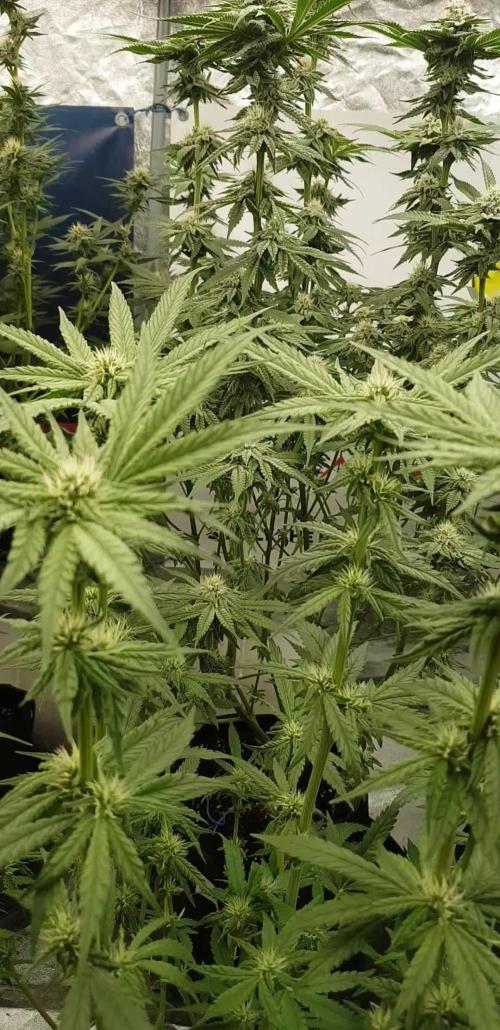
Welcome to Flower Week 3 of Fast Buds Papaya Sherbet
I'm excited to share my grow journey with you from my
FastBuds Project . It's going to be an incredible ride, full of learning, growing, and connecting with fellow growers from all around the world!
For this Project , I’ve chosen the Feminized Photo strain Papaya Sherbet :
Here’s what I’m working with:
• 🌱 Tent: 120x60x80
• 🧑🌾 Breeder Company: Fast buds
• 💧 Humidity Range: 50
• ⏳ Flowering Time: 58 Days
• Strain Info: 30%THC
• 🌡️ Temperature: 26
• 🍵 Pot Size: 16l
• Nutrient Brand: Narcos
• ⚡ Lights : 600W x 2
A huge thank you to Fast Buds for allowing me to try my Best with this amazing collection from Automatic and Photo Strains they managed to Sponsore . Big thanks for supporting the grower community worldwide! Your genetics and passion speak for themselves!
I would truly appreciate every bit of feedback, help, questions, or discussions – and of course, your likes and interactions mean the world to me as I try to stand out in this exciting competition!
Let’s grow together – and don’t forget to stop by again to see the latest updates!
Happy growing!
Stay lifted and stay curious!
Peace & Buds!
Likes
14
Share


@KannaKullektiv
Follow
Sie ist soweit. Die Farbe ist intensiv und sie richt verdammt gut.
Zum schnellen trocknen im Zelt, habe Ich jeden Zweig einzeln aufgehängt und versucht die Relative Luftfeuchtigkeit zwischen 58 - 62% zu halten und die Temperatur unter 18 Grad Celsius zu bekommen.
Sobald die Stängel knacken schneide ich die Buds runter und lege sie im Zelt in Pizzakartons damit sich die Feuchtigkeit gleichmäßig verteilt.