Likes
Comments
Share
@Mr_Gezeta
Follow
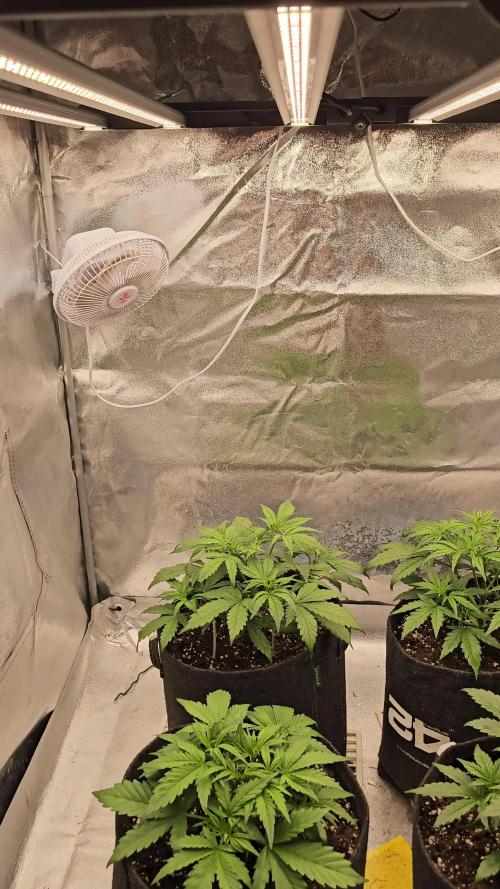
Día 73 Lunes 14 de Diciembre: -Las plantas están todas en floración. Me he dado cuenta de que debí haberlas regado más. Ellas estaban bien, no les faltó nada, pero pude haberlas explotado más. Es quizás la razón por la que creo que no voy a tener tanta producción como esperaba. -Sin embargo, una de ellas, una Gorilla Glue auto a la que le hice topping lo ha hecho bastante bien. Ella está en una maceta de 11 litros en lugar de los 18 litros del resto. Es la que está en una fase más avanzada y es posible que se pueda cortar antes de 2021. -Estoy teniendo problemas con el ph del agua. Hasta ahora siempre era de 6.7 directamente sacada del grifo y con nutes se ponía en 6.3 aproximadamente. Ahora cuando la sacas del grifo e incluso después de 24 horas está en un 6.2 y si le echo nutes se queda en un 5.6, es por eso que a partir de ahora las regaré con agua destilada, que tiene ph 7 para poder echarle los nutes que les quedan
Likes
245
Share
@Roberts
Follow
THC Bomb from bomb seeds has been steadily putting on weight this week. The bulking is happening now. I had to reduce my bloom nutrition a pinch was dragging my ph down it was too strong. So slightly backed off. Waiting to see how much she fills out in next 2 weeks. 🤞 a lot. Thanks again bomb seeds. 🌱🌱🌱 Thank you grow diaries community for the support. The likes, follows, and subscriptions on my YouTube channel are greatly appreciated 🤜🤛🌱🌱🌱 Happy growing If anyone is interested in purchasing a SF-1000 please follow links for your area US:https://amzn.to/396hXXb CA:https://amzn.to/3ol4oK4 DE:https://amzn.to/3q15SJT UK:https://amzn.to/2L7NVKN AU:https://amzn.to/3pZD6ZQ FR:https://amzn.to/2Xkomsi IT:https://amzn.to/3nk7A7h ES:https://amzn.to/2XhtGwB
Likes
13
Share
I switch to 12/12 last Wednesday. Everything is looking nice. Excited to see what comes next. The males and females will show themselves and I can start calculating and recording the best of them and the traits being shown. Stay tuned Check out my YouTube for long form content that I can't post here https://youtube.com/@aestheticgenetix?si=pSk5e-kvp-nVYccc
Likes
6
Share
@Dengued
Follow
Day 63...buds fattening up nicely...currently experiencing worst pollution on the planet with AQI of 300+ for most of the week which i fear is affecting growth..,..the buds look a lot browner in the pics, than i reality.. due to the post-apocalyptical tinge to the sky as the sun sets, though the smog
Likes
9
Share
@russrahl
Follow
First week of flowering went good, plants are not really starting to stretch to much yet, screen is pretty much full already so I will probably just fill the last few squares on each side then I’ll add the second screen and let them grow up into it. I did a heavy defoliation at the end of week 1 as the screen was way to crowded. I’m going to wait till the end of week 2 and clear everything under the first screen then. Plants were also showing a little bit of nutrient burn on some of the leaf tips so I added about 3 gal of fresh water to my reservoir to dilute the mixture a bit. Overall it’s a very robust and leafy plant so far, lots of shouts coming up into the screen, should be a pack tent anyway. I’ll add more pictures throughout the week as well. Cheers 💨
Likes
10
Share
Day 34 this lady is running, I can see flowers getting bigger every day, smell started really really soon this time so I already had to add the Carbon Filter. I’d like to close the cycle in less then 80 days. It would be great First flowering fertilisation Ph 6.2 Ppm 631 Day 37 - 9 of flower 🌸 Started blooming fertilisation, I’m keep Giving all-in one from aptus, i think I lm substitute with super pk and I stop all in one. Ph 6.2 Ppm 731 As I’m growing an solito in a 9.2 lt pots with all mix nutrients I’m slowing down with all in one and just giving base feedings, I ll decide later if I should give super-pk for the next weeks Day 40, tomorrow will be feeding days. Sge’s going really well, resin is already showing up on flowers that are several as and colorfull, smell is already there 🤤 Tomorrow update with feedings parameters. Day 41 feeding day Aptus regulator 0,15ml/1 lt Aptus all in one 1,25ml/1lt Aptus Topbooster 0,3 ml Aptus enzym + 0,5 ml Calmag 0,3 ml /L Ph 6,18 Ppm 756 Let’s see
Likes
21
Share
Day 43, pH is at 6.0 currently. Plants are praying towards the light so that’s a good sign. Some spots still show up on a couple leaves, just a couple small spots, could still be adjusting. Will know in another day or so if the problem has been corrected or not. Day 44, they seem to be responding better to the change in nutrients. They’re eating and still putting on growth. Some spots are appearing but that’s probably just still an affect of last weeks overload. Day 45, PPMs have continued decreasing and they have consumed about 1.5 gals of water over the past 72 hours. I topped off their res a little bit and readjust pH to 5.9 (it rose to 6.6 because they’re consuming a lot of nutrients) Day 47, Nutrients was almost gone, changed nutrients and bumped up to 800PPM (0.5 scale) Day 48, the nutrient solution inside the buckets gets up to 78-79° by the end of the day (lights on). When lights go off, they drop down to about 70-72°. I built some insulation sleeves out of double layer bubble foil. Should insulated them enough to maintain their lower temp without increasing throughout the day. You can see in photos but in the video I also created tops for each of the buckets to help reflect light and heat from the buckets. Day 49, plants are doing great PPMs are staying pretty stable meaning they have about the perfect ratio of nutrients which is 815PPM currently. Insulating the buckets was a great idea it’s kept the res temps stable and stopped them from rising throughout the day! Today marks day 14 of flower.
Likes
42
Share
Hi Growers, This week, every plant received its first and only topping, followed by more LST. They handled the training extremely well, recovered quickly, and are looking healthy with a nice, even structure. The plants are already starting to develop a noticeable aroma, and rubbing the stems releases an incredibly strong scent. I have a feeling we're in for something special. Next week will be the final week of vegetation. I'll continue with LST, perform a defoliation, and prepare the plants for the flip to 12/12. ------------------------------------------------------------------------------------------------------------------------------------------------ Tento týden všechny rostliny prošly svým prvním a zároveň jediným toppingem, po kterém jsem pokračoval v LST. Trénink zvládly výborně, rychle se vzpamatovaly a vypadají zdravě s pěkně vyrovnanou strukturou. Rostliny už teď začínají příjemně vonět a po promnutí stonku je aroma opravdu velmi výrazné. Myslím, že se máme na co těšit. Příští týden bude posledním týdnem vegetace. Budu pokračovat v LST, udělám defoliaci a připravím rostliny na přepnutí do květu. Peace and happy growing! ✌️
Likes
51
Share
Gracias al equipo de Anesia Seeds, XpertNutrients y Marshydro sin ellos esto no seria posible. 💐🍁 Smashberry Fumez: Adéntrate en la humeante bruma de nuestra nueva Smashberry Fumez, donde la dulzura de las calles se encuentra con el octanaje del oráculo. Esta iniciadora de incendios feminizada es una mezcla de Candy Fumez y nuestro éxito de ventas Oracle Octane, que logra una armonía increíble con un 60% de Indica que te permitirá relajarte profundamente mientras mantienes la cabeza en las nubes. 🚀 Consigue aqui tus semillas: 💡FC6500: Eficiencia líder en el mercado: la lámpara de cultivo LED FC-E6500, que ostenta un estatus líder en el mercado, es una solución rentable con un PPE de 2,8 µmol/J y un rendimiento máximo de 2,5 g/vatio. Ofrece un PPF alto de 2026 umol/S y es adecuada para una cobertura de vegetación de 1,50 m x 1,50 m y una cobertura de flores de 1,20 m x 1,20 m. Iluminación versátil y uniforme. https://marshydro.eu/products/mars-hydro-fc-e-6500-730w-commercial-led-grow-light/?gad_source=1&gclid=Cj0KCQjw1qO0BhDwARIsANfnkv9IIrYSbmJqz8PqpJOIyWwJfp5bc3SGJgUV68USLQ4tjmXDYwoBuAsaAue3EALw_wcB 🚥 MarsHydro ADLITE UV/IR/RED: Para lograr un crecimiento óptimo de las plantas y maximizar los rendimientos es un arte simple que depende en gran medida de las condiciones ambientales adecuadas. Reconociendo las limitaciones de la iluminación natural y las soluciones de iluminación tradicionales para satisfacer estas necesidades únicas, lanzamos ADLITE. Estas luces especiales UV, IR y roja están diseñadas para llenar áreas del espectro, proporcionando las altas longitudes de onda que las plantas necesitan para un crecimiento y desarrollo óptimos. 🚀 Consigue aqui tu Adlite: https://marshydro.eu/collections/adlite-supplemental-lights/ 🏠 : Marshydro 1.50 x 1.50 x 1.80, carpa 100% estanca con ventanas laterales para llegar a todos los lugares durante el grow https://marshydro.eu/products/diy-150x150x200cm-grow-tent-kit 🌬️💨 Marshydro 6inch + filtro carbon para evitar olores indeseables. https://marshydro.eu/products/ifresh-smart-6inch-filter-kits/ 🍣🍦🌴 Xpert Nutrients es una empresa especializada en la producción y comercialización de fertilizantes líquidos y tierras, que garantizan excelentes cosechas y un crecimiento activo para sus plantas durante todas las fases de cultivo. Consigue aqui tus Nutrientes: https://xpertnutrients.com/es/shop/ 📆 Semana 12: Última semana de lavado de raíces y cosecha la siguiente semana, ha quedado una planta muy compacta y totalmente cargada de resina.
Likes
4
Share
Excelente semana creo que dentro de poco empiezo a florar
Likes
39
Share
@J_diaz420
Follow
Como es un cultivo s.o.g hice el transplante rápidamente el día 12, para dejar crear raices ya que se pasará a floración tempranamente por el día 20 a 25 de vegetación, se transplanto de 1 a 5 lts. El día 14 se hará 1° riego con fertilizante y el día 15 ya se hará riego foliar con estimulador de floración delta 9 para próximamente pasar a floración ✌️🍀💚
Likes
7
Share
@For2itous
Follow
Just bending some branches and taking out a couple leaves. This plant is insanely vigorous its making the other plants jealous 😆 Can't wait to see how big the nugs get definitely some good genetics in these RF3. Happy growing 🌴
Likes
52
Share
Lacewings seemed to have mostly killed themselves by flying into hot light fixtures. I may have left the UV on which was smart of me :) Done very little to combat if anything but make a sea of carcasses, on the bright side its good nutrition for the soil. Made a concoction of ethanol 70%, equal parts water, and cayenne pepper with a couple of squirts of dish soap. Took around an hour of good scrubbing the entire canopy. Worked a lot more effectively and way cheaper. Scorched earth right now, but it seems to have wiped them out almost entirely very pleased. Attempted a "Fudge I Missed" for the topping. So just time to wait and see how it goes. Question? If I attached a plant to two separate pots but it was connected by rootzone, one has a pH of 7.5 ish the other has 4.5. Would the Intelligence of the plant able to dictate each pot separately to uptake the nutrients best suited to pH or would it still try to draw nitrogen from a pot with a pH where nitrogen struggles to uptake? Food for stoner thought experiments! Another was on my mind. What happens when a plant gets too much light? Well, it burns and curls up leaves. That's the heat radiation, let's remove excess heat, now what? I've always read it's just bad, or not good, but when I look for an explanation on a deeper level it's just bad and you shouldn't do it. So I did. How much can a cannabis plant absorb, 40 moles in a day, ok I'll give it 60 moles. 80 nothing bad ever happened. The answer, finally. Oh great........more questions........ Reactive oxygen species (ROS) are molecules capable of independent existence, containing at least one oxygen atom and one or more unpaired electrons. "Sunlight is the essential source of energy for most photosynthetic organisms, yet sunlight in excess of the organism’s photosynthetic capacity can generate reactive oxygen species (ROS) that lead to cellular damage. To avoid damage, plants respond to high light (HL) by activating photophysical pathways that safely convert excess energy to heat, which is known as nonphotochemical quenching (NPQ) (Rochaix, 2014). While NPQ allows for healthy growth, it also limits the overall photosynthetic efficiency under many conditions. If NPQ were optimized for biomass, yields would improve dramatically, potentially by up to 30% (Kromdijk et al., 2016; Zhu et al., 2010). However, critical information to guide optimization is still lacking, including the molecular origin of NPQ and the mechanism of regulation." What I found most interesting was research pointing out that pH is linked to this defense mechanism. The organism can better facilitate "quenching" when oversaturated with light in a low pH. Now I Know during photosynthesis plants naturally produce exudates (chemicals that are secreted through their roots). Do they have the ability to alter pH themselves using these excretions? Or is that done by the beneficial bacteria? If I can prevent reactive oxygen species from causing damage by "too much light". The extra water needed to keep this level of burn cooled though, I must learn to crawl before I can run. Reactive oxygen species (ROS) are key signaling molecules that enable cells to rapidly respond to different stimuli. In plants, ROS plays a crucial role in abiotic and biotic stress sensing, integration of different environmental signals, and activation of stress-response networks, thus contributing to the establishment of defense mechanisms and plant resilience. Recent advances in the study of ROS signaling in plants include the identification of ROS receptors and key regulatory hubs that connect ROS signaling with other important stress-response signal transduction pathways and hormones, as well as new roles for ROS in organelle-to-organelle and cell-to-cell signaling. Our understanding of how ROS are regulated in cells by balancing production, scavenging, and transport has also increased. In this Review, we discuss these promising developments and how they might be used to increase plant resilience to environmental stress. Temperature stress is one of the major abiotic stresses that adversely affect agricultural productivity worldwide. Temperatures beyond a plant's physiological optimum can trigger significant physiological and biochemical perturbations, reducing plant growth and tolerance to stress. Improving a plant's tolerance to these temperature fluctuations requires a deep understanding of its responses to environmental change. To adapt to temperature fluctuations, plants tailor their acclimatory signal transduction events, specifically, cellular redox state, that are governed by plant hormones, reactive oxygen species (ROS) regulatory systems, and other molecular components. The role of ROS in plants as important signaling molecules during stress acclimation has recently been established. Here, hormone-triggered ROS produced by NADPH oxidases, feedback regulation, and integrated signaling events during temperature stress activate stress-response pathways and induce acclimation or defense mechanisms. At the other extreme, excess ROS accumulation, following temperature-induced oxidative stress, can have negative consequences on plant growth and stress acclimation. The excessive ROS is regulated by the ROS scavenging system, which subsequently promotes plant tolerance. All these signaling events, including crosstalk between hormones and ROS, modify the plant's transcriptomic, metabolomic, and biochemical states and promote plant acclimation, tolerance, and survival. Here, we provide a comprehensive review of the ROS, hormones, and their joint role in shaping a plant's responses to high and low temperatures, and we conclude by outlining hormone/ROS-regulated plant-responsive strategies for developing stress-tolerant crops to combat temperature changes. Onward upward for now. Next! Adenosine triphosphate (ATP) is an energy-carrying molecule known as "the energy currency of life" or "the fuel of life," because it's the universal energy source for all living cells.1 Every living organism consists of cells that rely on ATP for their energy needs. ATP is made by converting the food we eat into energy. It's an essential building block for all life forms. Without ATP, cells wouldn't have the fuel or power to perform functions necessary to stay alive, and they would eventually die. All forms of life rely on ATP to do the things they must do to survive.2 ATP is made of a nitrogen base (adenine) and a sugar molecule (ribose), which create adenosine, plus three phosphate molecules. If adenosine only has one phosphate molecule, it’s called adenosine monophosphate (AMP). If it has two phosphates, it’s called adenosine diphosphate (ADP). Although adenosine is a fundamental part of ATP, when it comes to providing energy to a cell and fueling cellular processes, the phosphate molecules are what really matter. The most energy-loaded composition for adenosine is ATP, which has three phosphates.3 ATP was first discovered in the 1920s. In 1929, Karl Lohmann—a German chemist studying muscle contractions—isolated what we now call adenosine triphosphate in a laboratory. At the time, Lohmann called ATP by a different name. It wasn't until a decade later, in 1939, that Nobel Prize–-winner Fritz Lipmann established that ATP is the universal carrier of energy in all living cells and coined the term "energy-rich phosphate bonds."45 Lipmann focused on phosphate bonds as the key to ATP being the universal energy source for all living cells, because adenosine triphosphate releases energy when one of its three phosphate bonds breaks off to form ADP. ATP is a high-energy molecule with three phosphate bonds; ADP is low-energy with only two phosphate bonds. The Twos and Threes of ATP and ADP Adenosine triphosphate (ATP) becomes adenosine diphosphate (ADP) when one of its three phosphate molecules breaks free and releases energy (“tri” means “three,” while “di” means “two”). Conversely, ADP becomes ATP when a phosphate molecule is added. As part of an ongoing energy cycle, ADP is constantly recycled back into ATP.3 Much like a rechargeable battery with a fluctuating state of charge, ATP represents a fully charged battery, and ADP represents a "low-power mode." Every time a fully charged ATP molecule loses a phosphate bond, it becomes ADP; energy is released via the process of ATP becoming ADP. On the flip side, when a phosphate bond is added, ADP becomes ATP. When ADP becomes ATP, what was previously a low-charged energy adenosine molecule (ADP) becomes fully charged ATP. This energy-creation and energy-depletion cycle happens time and time again, much like your smartphone battery can be recharged countless times during its lifespan. The human body uses molecules held in the fats, proteins, and carbohydrates we eat or drink as sources of energy to make ATP. This happens through a process called hydrolysis . After food is digested, it's synthesized into glucose, which is a form of sugar. Glucose is the main source of fuel that our cells' mitochondria use to convert caloric energy from food into ATP, which is an energy form that can be used by cells. ATP is made via a process called cellular respiration that occurs in the mitochondria of a cell. Mitochondria are tiny subunits within a cell that specialize in extracting energy from the foods we eat and converting it into ATP. Mitochondria can convert glucose into ATP via two different types of cellular respiration: Aerobic (with oxygen) Anaerobic (without oxygen) Aerobic cellular respiration transforms glucose into ATP in a three-step process, as follows: Step 1: Glycolysis Step 2: The Krebs cycle (also called the citric acid cycle) Step 3: Electron transport chain During glycolysis, glucose (i.e., sugar) from food sources is broken down into pyruvate molecules. This is followed by the Krebs cycle, which is an aerobic process that uses oxygen to finish breaking down sugar and harnesses energy into electron carriers that fuel the synthesis of ATP. Lastly, the electron transport chain (ETC) pumps positively charged protons that drive ATP production throughout the mitochondria’s inner membrane.2 ATP can also be produced without oxygen (i.e., anaerobic), which is something plants, algae, and some bacteria do by converting the energy held in sunlight into energy that can be used by a cell via photosynthesis. Anaerobic exercise means that your body is working out "without oxygen." Anaerobic glycolysis occurs in human cells when there isn't enough oxygen available during an anaerobic workout. If no oxygen is present during cellular respiration, pyruvate can't enter the Krebs cycle and is oxidized into lactic acid. In the absence of oxygen, lactic acid fermentation makes ATP anaerobically. The burning sensation you feel in your muscles when you're huffing and puffing during anaerobic high-intensity interval training (HIIT) that maxes out your aerobic capacity or during a strenuous weight-lifting workout is lactic acid, which is used to make ATP via anaerobic glycolysis. During aerobic exercise, mitochondria have enough oxygen to make ATP aerobically. However, when you're out of breath and your cells don’t have enough oxygen to perform cellular respiration aerobically, the process can still happen anaerobically, but it creates a temporary burning sensation in your skeletal muscles. Why ATP Is So Important? ATP is essential for life and makes it possible for us to do the things we do. Without ATP, cells wouldn't be able to use the energy held in food to fuel cellular processes, and an organism couldn't stay alive. As a real-world example, when a car runs out of gas and is parked on the side of the road, the only thing that will make the car drivable again is putting some gasoline back in the tank. For all living cells, ATP is like the gas in a car's fuel tank. Without ATP, cells wouldn't have a source of usable energy, and the organism would die. Eating a well-balanced diet and staying hydrated should give your body all the resources it needs to produce plenty of ATP. Although some athletes may slightly improve their performance by taking supplements or ergonomic aids designed to increase ATP production, it's debatable that oral adenosine triphosphate supplementation actually increases energy. An average cell in the human body uses about 10 million ATP molecules per second and can recycle all of its ATP in less than a minute. Over 24 hours, the human body turns over its weight in ATP. You can last weeks without food. You can last days without water. You can last minutes without oxygen. You can last 16 seconds at most without ATP. Food amounts to one-third of ATP production within the human body.
Likes
15
Share
Weather Continuos Cool And Wet Beautiful Bubs Forming In Black Cream Wedding Cake Gone Full Bloom. Discoverd Source Of The Yellowing.... Red Led From My esp32.... BomBerry Shes a Later Late VegBoom Late Full Bloom If Shes Continuos To Grow I Dont Have More Space For Her Couskush She Isnt So Big as The Other. The Other Are More Evolued I Think. Shes Now Starting To Go Full On Bloom. Chears BrotherHood
Likes
4
Share
Likes
13
Share
Likes
6
Share
@3rnest
Follow
Die 6. Woche ist abgeschlossen und die Pflanzen haben sich gut entwickelt. Die Leistung der Lampe wurde im Laufe der Woche schrittweise erhöht. Aufgrund der steigenden Temperaturen im Zelt musste die Leistung jedoch wieder etwas reduziert werden, da die Pflanzen bereits begannen, ihre Blätter hängen zu lassen. Die drei Pflanzen haben inzwischen eine Höhe von etwa 25–28 cm erreicht. Ab der kommenden Woche werde ich damit beginnen, die Beleuchtungsdauer schrittweise zu reduzieren.
Likes
94
Share
Hello to all padawans and Jedi masters What a week! The last 2 plants of this magnificent diarie are simply sumptuous 😉 A treat for the eyes and for the olfactory system! Nothing to say about the techniques used this week because I do nothing more than water them. 😊 Blueberry attacks senescance her trichomes are amber to the tune of 10% I think I'll harvest it this week Bubblegum is in full bloom I expect a very big yield For an autoflowering See you soon Bonjour à tous les padawans et maîtres jedis Quelle semaine ! Les 2 derniers plants de ce magnifique diarie sont tout simplement somptueux 😉 Un régal pour les yeux et pour le système olfactif ! Rien à dire sur les techniques employés durant cette semaine car je ne fais rien de plus que les arroser. 😊 La blueberry attaque la senescance ses trichomes sont ambrés à hauteur de 10% je pense la récolter cette semaine La bubblegum est en pleine floraison Je m'attends à un très gros rendement Pour une autofloraison À bientôt
Likes
4
Share
Waiting till she's big enuf to clone a whole tribe from her next big run only freak show
Likes
81
Share
~_~_~_~_~_~_~_~_~_~_~_~_~_~_~_~_~_~_~_~_~_~_~_~_~_~_~_~_~_~_~_~_~_~_~_~_~_~_~_~_~_~_~_~_~_~_~_~_~_~_~_~_~_~_~_~_~_~_~_~_~_~_~_~_~_~_~_~_~_~_~_~_~_~_~_~_~_~_~_~_~_~_~_ 💪😺 5th week of flower!!! Things are going great in this tent, a couple brown calcium def spots forming in a few areas and as it goes we're currently out of cal-mag lol, we should have more delivered in about 2 days...I really like the structure of these plants, a few long (fat) colas always make for easy cleaning/drying and the SP-3000 gets in there deep..we could never run this close together under our old LEDs or without bending them sideways but we've had no issues yet keeping everything vertical under the MarsHydro...The temps are a little high and we're still watering this tent more than the others but airflow is really good and the plants seem happy for now....we removed a bunch of lower growth from most of them this week so they'll put that energy towards the stuff on top and minimize "popcorn"..the smell is just amazing, this is a very hearty and beautiful strain..I'm happy we were able to grab a half dozen clones..all the Widow clones we took are well into veg at this point ...💪🐱🌱....we live in zone 5 (US) and are limited on what we can grow outdoors but I think with these being a "fast" strain we could flower them all outside..we'll play it by ear lol..well thanks for taking the time to read my ramblings, we'll update if anything exciting happens midweek...have a safe and happy Memorial Day (US) Growmies!! ❤️💡🌱😽💨 ~_~_~_~_~_~_~_~_~_~_~_~_~_~_~_~_~_~_~_~_~_~_~_~_~_~_~_~_~_~_~_~_~_~_~_~_~_~_~_~_~_~_~_~_~_~_~_~_~_~_~_~_~_~_~_~_~_~_~_~_~_~_~_~_~_~_~_~_~_~_~_~_~_~_~_~_~_~_~_~_~_~_~_