Likes
Comments
Share
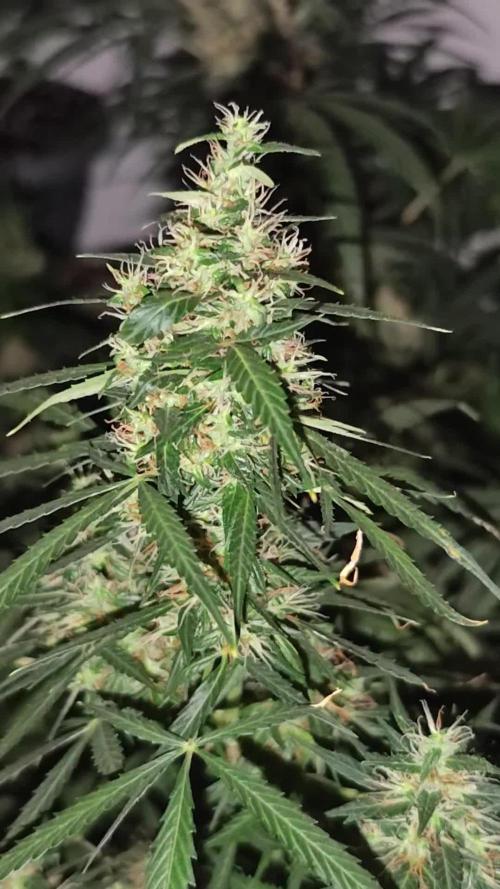
Very easy strain to grow. I grew the White Critical Express previous to this grow, I really liked it and wanted to try growing an Autoflower so I went for the Critical 2.0 and it was worth the grow.
Likes
36
Share
@rhodes68
Follow
9/28 Week 5 and hanging onto veg by a "hair" She is transitioning so doubt the week will be veg for long we will see. Introducing Bloom tonight at 2.5ml/gal increasing from there till 50% 9/29 Still technically in veg as no colas are forming yet but any day now. Will continue to increase Bloom while decreasing Grow WHEN it looks needed. Currently 6ml/gal each of Grow and 2 ml/gal each of Bloom Next step will be 5 each of Grow and Bloom keeping that EC kind of stable. Update: Her stretch has begun so should be seeing some real changes now. 3 inches in one day. pics 10/1 Pic In transition fully, growth tips getting hairy and changing Few more days be in full flower The transition feed is as shown 50% grow and bloom 10/2 27" not quite into flower completely 10/3 dropping lights to 20 hrs she seems to healthier with that schedule Getting a little worried about her stretch, increasing Si 3 fold and dropped lights Hit 29 inches at lights on.
Likes
7
Share
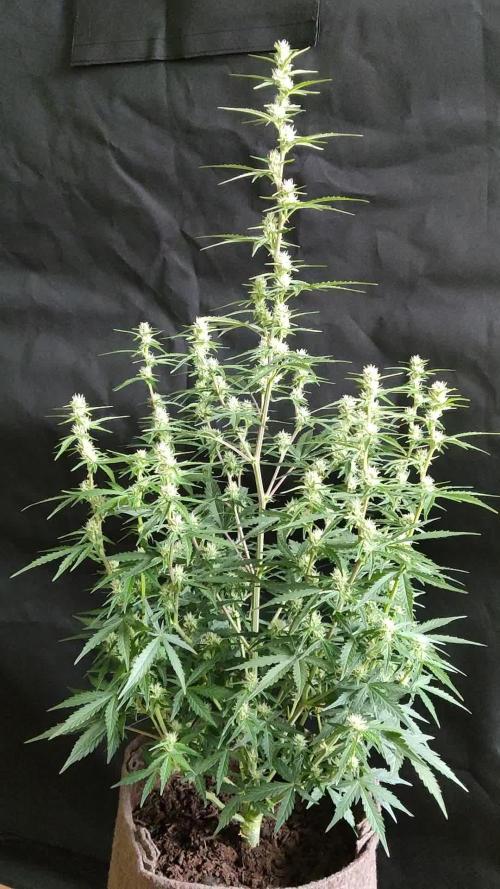
Ende ersten Woche Flower und Start der Zweiten, ich hatte wieder ein Problem mit Trauermücken und habe diese jetzt mit Neemöl bekämpft und die erste mit Sand bedeckt. Dadurch trocknet diese nicht so schnell aus und die Mücken können ihre Eier nicht in die Erde setzen, ich hoffe mal, das hilft. Die Pflanzen haben einen mächtigen Schub gemacht und sind min. 10 cm gewachsen, man erkennt schon kleine anzeigen von Härchen. Tag 4 von Woche 8: Heute habe ich das Netz gespannt und stark erlaubt sowie triebe raus genommen die nicht mindestens durchs Netz gingen oder kein Licht bekamen. Ich bin gespannt wie gut die anderen jetzt davon Profitieren werden .
Likes
9
Share
8/4 the plants are looking great. Was able to use listing and get bunch on bud site to come out. No discoloration. Things going well. Might need flipped soon. 8/6 the second topped plant looking good. Did some defoliation. Think going to flip soon. They looking good with a nice top canopy forming, have lot of bud site at close the same height. 8/8 plants look great and ready to switch to flower. Did some more defoliation to get ready for flower. Setup scrog net and seems to be filling up nice. Going to do 36 hours of darkness to quicken the flower process (or so I read). Excited to start flowering.
Likes
9
Share
@Rizik86
Follow
Day 1 - TC600 is 36 inches from seedling. Veg 100% Flower 100% 17 hours on 7 off. PAR/PPFD 170 DLI 10.05 Day 2 - Mylar Emergency Blanket DIYed into 2 by 3 foot tent. PAR/PPFD 240 (41% increase) DLI 14.5 (44% increase) Nutrients: Advanced Nutrients 2 mL of each Micro Grow Bloom Base Nutrients and 2 mL BotaniCare CalMag. 3 Gallon bucket filled with 2 gallons of RO water. No more notes for rest of the week. The TC600 is 260w from the wall. Not 600w.
Likes
27
Share
Bueno pues ya llegamos al final familia, do sweet dos es una variedad bastante productiva. De cuatro plantas casi 180gs y la verdad que bastante contento, no tuve tiempo para poder hacer más fotos y trabajar más este post pero con la prisa y la mudanza pues bueno, bastante e cosechado. Humedad en el secado relativamente baja al 40% y la temperatura estuvo entorno a 23 grados ambientales. Hasta aquí todo familia, os recomiendo también la gama de productos de agrobeta, ya que los resultados son llamativos.
Likes
5
Share
@Xpie77
Follow
Strain: 24K Kush (Seeds Genetics) – ook bekend als 24K Gold of Kosher Tangie (Kosher Kush x Tangie) Genetica: 60% Indica / 40% Sativa Type: Feminized Photoperiod Aantal planten: 4 Medium: Potgrond (organisch/basic soil) Potten: 7 liter fabric pots (stofpotten) – uitstekende drainage en wortelbeluchting Belichting: 415W Bestva LED full-spectrum, overgeschakeld van 18/6 naar 12/12 na week 4 veg Setup: Indoor in 120x120 cm tent (1.44 m²) – ruime tent voor 4 planten met LST, goede spreiding en stretch-ruimte Week: Week 4 Vegetative (eind) + Week 1 Flowering (eerste week bloei na flip) Update Week 4 Vegetative (eind) De veg-fase eindigde sterk! De 4 planten stonden aan het einde van week 4 op 25-40 cm hoog (gemiddeld ~30-35 cm). Perfecte timing voor de flip: ze waren bushy, met brede donkergroene fan leaves, dikkere stengels en ontwikkelde zijtakken dankzij LST. De indica-dominantie hield ze compact, terwijl de Tangie-vigor zorgde voor extra side branches – ideale basis voor bloei in deze 120x120 cm tent. Hoogte: 25-40 cm Structuur: Brede canopy, nodes dichterbij, LST in volle gang voor vlakke top en betere lichtdekking. Gezondheid: Diep donkergroen blad, geen issues – fabric pots deden top werk met wortelgroei. Belichting: Bestva op ~40-55 cm, 18/6 schema tot flip. Water/voeding: Elke 2-3 dagen water (pH 6.2-6.8), lichte veg-voeding (50-75% sterkte hoog-N). Omgeving: Temp 22-26°C, RV 50-60%, airflow goed. LST was key deze week: top gebogen en vastgezet – canopy vulde de tent mooi op zonder overlap. Update Week 1 Flowering (eerste week bloei na flip naar 12/12) Flip uitgevoerd aan het einde van week 4 veg – en de stretch is begonnen! In de eerste week bloei (transition/stretch-fase) groeien de planten snel in hoogte, typisch voor deze hybrid (60/40 indica/sativa). Ze zijn nu 35-55 cm hoog (gemiddeld ~45 cm), met een stretch van ~30-50% al zichtbaar. De Tangie-genen zorgen voor wat extra lengte, maar de Kush-kant houdt het beheersbaar (geen extreme legginess). Pre-flowers (pistils) verschijnen bij de nodes – witte haartjes duiken op, en de planten schakelen over naar bloeimodus. Hoogte: 35-55 cm (stretch ~10-15 cm deze week, verwacht meer in week 2-3) Structuur: Stretch in actie: internodi afstand groter, side branches rekken uit. Canopy nog vlak door LST, maar top groeit sneller. Brede bladeren blijven donkergroen, nieuwe groei met meer pistils. Gezondheid: Gezond en groen – geen stress van de flip. Fabric pots helpen bij snelle aanpassing. Check op mogelijke nutrient shift: start overgang naar bloom-voeding. Belichting: Bestva LED nu op 12/12 schema, afstand ~40-50 cm (iets hoger tijdens stretch om burn te voorkomen). Goede dekking in 120x120 cm. Water/voeding: Waterfrequentie iets hoger door stretch (elke 2 dagen checken). pH 6.0-6.5 voor bloom. Overgang naar bloom-voeding gestart (hoog P/K, bijv. NPK 2-3-4 of 1-3-2 op 50-75% sterkte, plus CalMag als nodig). Potgrond bufferde nog, maar extra fosfor boost pre-buds. Omgeving: Temp 20-25°C (iets lager in bloom), RV verlagen naar 45-55% om schimmel te voorkomen bij dichte buds later. Airflow cruciaal tijdens stretch. De planten reageren positief op de flip – pistils overal, geur begint citrusachtig te worden (Tangie-invloed). Stretch zal pieken in week 2-3, dus blijf LST aanpassen en ruimte monitoren in de tent. Foto's (voor upload naar GrowDiaries) Bovenaanzicht canopy: LST-getraind, stretch beginnend in week 1 bloom Close-up nodes/pre-flowers: Witte pistils en nieuwe groei zichtbaar Volledige plant shot: 35-55 cm hoogte in fabric pot, stretch duidelijk Tent overview: 4 planten onder Bestva LED op 12/12, ruimte benut met LST Vooruitblik Week 2 Flowering Verwacht piek-stretch (mogelijk tot 60-80 cm totaal, afhankelijk van genetica), meer pistils en beginnende bud sites. Blijf LST/supercropping toepassen om hoogte te controleren. Voeding opbouwen naar volle bloom-dosis. Deze strain flower ~9-10 weken, met potentie voor dense, harsrijke citrus-Kush buds en yield 450-550 g/m² in deze setup! Run gaat fantastisch – sterke overgang en gezonde stretch. Volgende update met week 2 bloom pics, stretch progress en training! 🌱 Tags voor GrowDiaries: #24KKush #SeedsGenetics #IndoorGrow #FabricPots #BestvaLED #Flowering #LST #OrganicSoil #IndicaDominant #120x120Tent #Week1Flower #Flip
Likes
5
Share
@Chubbs
Follow
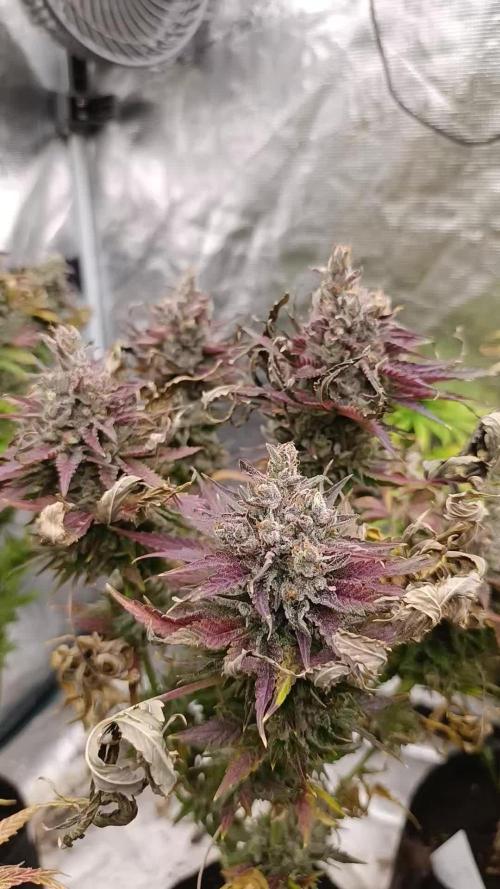
These girls are progressing absolutely beautifully. I'm excited to see as it looks like there might be a purple pheno as I've never had that one grow before. No issues and the flowers are getting bigger daily. I did a defoliation and lollipopped up to maybe the 2nd-3rd node. All in all Happy Growing.
Likes
7
Share
@Grisly
Follow
Harvest 2024 Total Hash: 102g Total Kief: 95g Total Flower: 3868g/138oz/8.6lb Total Yield: 4065g/145oz/9lb/4kilo ———-/-////////—vs———-/////————/ Sugar Diesel #1: 117g Sugar Diesel #2: 313g White widow Clone: 14g Dual OG: 112g LA Affie North Field: 248g Granddaddy Purple N: 63g Black Raspberry Kush N: 210g ————————————————- Total North: 1077g/38oz/2.5lb ————————///——/—————-/ Fruity Pebbles: 184g Granddaddy Purp S H2: 54g Granddaddy Purp S H1: 275g Granddaddy Purp Total: 329g/12oz Black Rasp Kush S H1: 160g Black RaspKush S H3: 70g Black Rasp Kush S H2: 511g Black Rasp Kush S H4: 17g Black Rasp Kush S: 758g/27oz Blue Cheese S H1: 281g Blue Cheese S H3: 83g Blue Cheese S H2: 285g Blue Cheese Total: 649g/23oz Dr Grinspoon S H1: 485g —————————————————- Total South: 2405g/85oz/5.3lb ————————///——/—————-/ North Popcorn: 148g BC Popcorn: 100g GP Popcorn: 73g BRK Popcorn: 65g —————————————————- Total Popcorn : 386g/14oz/0.9lb ————————///——/—————-/ Trim: 8lb ————————————————— ————————///——/—————-/
Likes
115
Share
Greetings, fellow cultivators! Week 2 in the flower chronicles of our majestic Cherry Cola Auto is unfolding, and the botanical saga continues with astounding vibrancy. Our green queen, having transitioned seamlessly into the flowering stage, is unfurling her blossoms with an elegance that's truly mesmerizing. Last week, the anticipation for flowering reached its peak, and oh, what a sight to behold! The once-prominent bush has metamorphosed into a lush haven of blossoms. The topping technique from earlier weeks worked wonders, and the result is a dense and intricate network of bud sites, promising a bountiful harvest. The freedom granted to our Cherry Cola as we removed the training supports has allowed her to grow wild, like a botanical ballet of branches reaching for the heavens. The bushy bliss is a testament to the success of our training endeavors, creating a flourishing green symphony. Speaking of success, the decision to venture into topping during the vegetative phase is proving to be a game-changer. The multiple colas that have emerged are like a crown atop her green majesty, and I find myself in awe of the structural beauty it has introduced to the plant. In the nutrient department, the shift to P-Boost and Topbooster has been a key player in this unfolding floral tale. The phosphorus boost is working its magic, contributing to the formation of robust buds, while Topbooster continues to enhance the overall flowering response, promising an end product that's nothing short of spectacular. I can't help but marvel at the visual delight our Cherry Cola presents. Every day brings new growth, and the energy in the tent is palpable. It's not just a plant; it's a living masterpiece in constant evolution. As Week 2 in the flowering stage comes to a close, the Cherry Cola Auto stands as a testament to the joy of cultivation. Topping, training, and nurturing have led to this vibrant spectacle. Stay tuned, green enthusiasts, as the floral drama unfolds in the coming weeks! Genetics Cherry Cola Auto @Fast_Buds @fastbuds_genetics_official @fastbuds_official @fastbuds_espana Nutrition: @aptusholland @aptus_world @aptus_ Love, Care, and Attention: @dogdoctorofficial As always, thank you all for joining me on this journey, for your love, and for it all. My horticultural odyssey would never be the same without you. Your love and support are cherished, and I feel both honored and blessed to have you in my life
Likes
44
Share
Waiting on a full plant hang dry so will wait at least two weeks maybe three hope ma vegging station holds up n can dae tge damage the now as av said guys this is definitely not the perfect set up am not on good terms with land lord so basically squatting here lol and growing and a got caught with one in this house the land lord doesn’t even know lol 😂
Likes
6
Share
Been a slow week. Been trying to fill out as much of the Scrooge as I can. I will be defoliating in a couple days. I still want to see if any more sites will reach above the trellis. The feeding is still the same 4g B1/B2 of Floraflex and 2gs of Bulky B per gallon. Thank you all again for tuning in to my diary see you all again next week.
Likes
20
Share
9/27 - start day 43 - So, the other day, I tried running the thing sealed at 1100-1500 ppm and temps got to 95 with RH at 75% and the walls were straight sweating nuts....dripping...puddles.... that tiny dehumidifier wasn't doing jack. Since, I have managed to tap into the central ac with some makeshift ducting, which now supplies my spot with a nice cool, dry breeze every so often. With this, I have managed to maintain a temp of 88-91 with a RH of 37-50% at 750-950 ppm. I can keep the 750-950 ppm with a flow rate of about 1 cfh, which only goes off roughly 10 minutes every hour. probably will try it and run the temps a little high. ya, can't seem to stay consistent. i swear, it'll stay at that ppm after it all leaks out and the surrounding room is sitting at the same ppm maybe, lol … should probably drop temps and the co2, but hey, might as well gas em out while its there …. hey, maybe they'll return the favor and gas me out after harvest😁 that little square light looks like it should be lighting a lizards cage or some shit …. I swear the thing probably only pulls 30 watts, if im lucky. It didn't come with a book or directions or any type of specifications.... said 3000 watts,....id give it 30. If that's the case, im banking on the other 2 lights to cover that little red spot. Oh, and those little side lighting things suck. the stupid remote/timer thing is ….. garbage timer thing 9/28 - 44 - I tossed a HID in there for a bit for the hell of it....I really wasn't digging the "reptile light", but its still in there. I went ahead and tossed a window ac unit in my "window". it was again TOO warm with the HID cooltube and all. Was hangin around 94-97 degrees!!!! ac there, now I need to make some makeshift ductingand vent the ac exhaust outside
Processing
Likes
13
Share
@Prozak
Follow
to mutch cold here 2 week with low temps at night cicle betwen 12 &16 graus in europe. maybe this is the reason of that purple orange colors (:
Likes
32
Share
This little monster is shaping up nicely. This is the budget tent and she is directly under a single 60 watt HLG 3k panel now. There is a mars hydro 300 on the other side of this 2x4’. So far it looks like I’ve got 8 or 9 cola sites and I can’t wait for the stretch. My nutes are nectar for the gods organic and I’ve been giving her full strength veg on the intermediate schedule. Next watering I’ll switch up to the flower at half strength. I’d like to note that I’ve also been using bloom khaos in that line as a foliage spray but like with my other diary I’ll probably have to finish with kool bloom powder to get any sort of swelling. #dinafem # HLG #foxfarms
Likes
52
Share
You don't become confident by shouting affirmations in the mirror, but by having a stack of undeniable proof that you are who you say you are, outwork your self-doubt. Nitrogen fixation is a chemical process by which molecular nitrogen (N2), which has a strong triple covalent bond, is converted into ammonia (NH3) or related nitrogenous compounds, typically in soil or aquatic systems but also in industry. The nitrogen in air is molecular dinitrogen, a relatively nonreactive molecule that is metabolically useless to all but a few microorganisms. Biological nitrogen fixation or diazotrophy is an important microbe-mediated process that converts dinitrogen (N2) gas to ammonia (NH3) using the nitrogenase protein complex (Nif).[2][3] Nitrogen fixation is essential to life because fixed inorganic nitrogen compounds are required for the biosynthesis of all nitrogen-containing organic compounds, such as amino acids and proteins, nucleoside triphosphates and nucleic acids. As part of the nitrogen cycle, it is essential for agriculture and the manufacture of fertilizer. It is also, indirectly, relevant to the manufacture of all nitrogen chemical compounds, which include some explosives, pharmaceuticals, and dyes. Nitrogen fixation is carried out naturally in soil by microorganisms termed diazotrophs that include bacteria, such as Azotobacter, and archaea. Some nitrogen-fixing bacteria have symbiotic relationships with plant groups, especially legumes.[4] Looser non-symbiotic relationships between diazotrophs and plants are often referred to as associative, as seen in nitrogen fixation on rice roots. Nitrogen fixation occurs between some termites and fungi.[5] It occurs naturally in the air by means of NOx production by lightning.[6][7] All biological reactions involving the process of nitrogen fixation are catalyzed by enzymes called nitrogenases.[8] These enzymes contain iron, often with a second metal, usually molybdenum but sometimes vanadium. Green clover (Fixation) White clover (Fixation) Red Clover. (Fixation) Yellow Clover. (Fixation, deeper roots) Sweet Thai Basil. (Terpenes) Italian Basil. (Terpenes) Chamomile.(Oil production) Borage.(Pest attraction taste) Lavender.(Pest attraction smell) Marigold(Pest attraction visual) Mycorrhizae are beneficial associations between mycorrhizal fungi and a plant’s root system. Mycorrhizal fungi spores germinate in the soil, creating filaments (hyphae) that penetrate the root cells, thus establishing a symbiotic relationship. This collaboration leads to the development of both intra-radical and extra-radical networks of filaments, enabling efficient exploration of the soil for enhanced access to nutrients and water. Consequently, these vital resources are transferred to the plant, resulting in numerous benefits for crop cultivation. Various mycorrhizal products are available in diverse formulations (powder, granular, and liquid), concentrations, and qualities. Ongoing advancements in products, technologies, and research are reshaping our understanding of mycorrhizae. Despite these positive developments, certain misconceptions persist. In the following discussion, we aim to clarify the truths and dispel the myths surrounding mycorrhizae products. MYTH #1 A HIGHER NUMBER OF MYCORRHIZAE SPECIES MEANS BETTER RESULTS. Contrary to common belief, having a higher number of mycorrhizae species in a product does not translate to better results; in fact, it often yields the opposite outcome. A plant can sustain only one association with a particular mycorrhizal fungi species. Introducing multiple species creates competition among them, which is not advantageous for the plant. The initial colonizer does not ensure the highest success; instead, it gains precedence. It is recommended to select a product with a concentrated presence of a single mycorrhizae species known for its effective performance, rather than opting for a product with multiple species at lower concentrations. MYTH #2 ECTOMYCORRHIZAE ARE EFFECTIVE FOR CANNABIS PLANTS. Although ectomycorrhizae can colonize five to ten percent of plant species, cannabis is not among them. Ectomycorrhizae do not penetrate the root cells; instead, they develop around the roots and on the exterior. For cannabis plants, it is essential to seek out endomycorrhizae. Endomycorrhizae are capable of colonizing 70% to 90% of plant species, including cannabis. Unlike ectomycorrhizae, endomycorrhizae penetrate the root cells, forming structures like arbuscules for the exchange of nutrients and water with the plant. MYTH #3 WHOLE INOCULANT (PROPAGULES) PERFORM BETTER THAN ONLY VIABLE SPORES. The propagule count specified on most mycorrhizae products indicates the presence of spores (viable and unviable), hyphae, and root fragments. However, it is crucial to note that only viable spores, those with the capacity to germinate, can successfully colonize a plant’s root system. Spores are to mycorrhizal fungi what seeds are to cannabis plants—a fundamental component enabling fungi reproduction. Consequently, even if a mycorrhizal product boasts millions of propagules, its effectiveness hinges on the presence of viable spores. Without viable spores, the product will not contribute to plant development. Therefore, the genuine value of a mycorrhizal inoculant lies in the quantity of viable spores it contains, as only viable spores can efficiently initiate symbiosis. MYTH #4 ALL METHODS OF APPLICATION YIELD IDENTICAL RESULTS. To establish the symbiosis, mycorrhizal fungi spores must be close to the plant roots. The optimal recommendation is to directly apply mycorrhizal inoculant to the roots, either in powder, granular or slurry form. This method ensures maximum proximity between the spores and the roots, facilitating a rapid establishment of symbiosis. Particularly with crops like cannabis, which have a short growing cycle, employing this technique is the most effective way to obtain optimal benefits. Alternatively, techniques such as blending the inoculant with the soil are effective, but there may be a delay in the establishment of symbiosis. This is because the roots need to grow and come into contact with the dispersed spores throughout the growing media. MYTH #5 MYCORRHIZAE CAN ONLY BE GROWN ON LIVING PLANTS. While the predominant method for commercially producing mycorrhizae involves growing them on the root systems of living plants (in vivo production), it is not the exclusive nor the optimal technique. In fact, this production approach has notable drawbacks that the “root organ culture” method just does not have (in vitro production). In vitro production occurs in meticulously controlled, aseptic laboratory conditions, allowing for the consistent generation of products that are viable, highly concentrated, species-specific, and free from pathogens. Achieving such precision and quality is impossible when relying on the cultivation of mycorrhizal fungi on plants exposed to external conditions. In conclusion, it is crucial to take all these factors into consideration when choosing the appropriate product for your crop to fully harness the wide array of benefits provided by a high-quality mycorrhizal product. STRONGER PLANT – Stress resistance. FASTER GROWTH – Improve plant structure and shorter veg time. INCREASE YIELD – Overall more biomass. IMPROVED QUALITY – Increase cannabinoids and terpenes content.
Likes
27
Share
🥊 🍼Greenhouse Feeding BioGrow & Bio Enhancer ⛺️MARSHYDRO The ⛺️ has a small door 🚪 on the sides which is useful for mid section groom room work. 🤩 ☀️ MARSHYDRO FC 3000 LED 300W ☀️Also special thanks to VIPERSPECTRA P2000 (200W) & XS2000(240w) LED growlights 🌱 FASTBUDS 420
Likes
5
Share
@Aleks555
Follow
Everything is going well with her growth — she's just getting used to being outdoors. We bent the main top a little. She handled all the stress, cold weather, and rain really well. The temperature dropped to as low as 7°C (45°F), and we had heavy rain, but she's a strong girl and managed to withstand everything. 😊🌱💪🏻
Likes
6
Share
Another straightforward week in the grow room. All three Phenos continue to look fine with good leaf color. I've been working on this super soil recipe for three grows now. I learn a little more with each attempt and come to find this particular blend in larger 7 gallon grow bags IMHO is passing the eye test. All three are in stretch, so I'll continue to keep an eye out over the next 2-3 weeks. In the 3x3, I have manage height. No additional feedings just watered ph'd between 5.8 and 6.2. I do water at top as well as bottom (wicking). These girls are already beginning to exhibit a loud smell. Just bought a new carbon filter, which I will swap out today. This closes out the week. Thanks for stopping by.
Likes
43
Share
This was a beautiful week. The girls started to flower, they feel really nice. There were no significant changes, everything goes as expected. A ladybug visited my garden, I decided to keep her as protection from mites. I never had problems with them, but we can never know. :)