


Likes
Comments
Share


@Venabr96
Follow
Planta linda, com buds com tons de laranja muitos lindos. Com muito polem, deve ser muito boa para fazer haxixe com dry-ice e sobre tudo muito resinosa. Tocar nela é ter certeza que ficara com a mao colando.
Pelo contrario sinto que os buds estao piquenos...
Nao sei se é por causa da minha lampada pois sinto que os tricomas estao ficando leitosos só que os buds nao engordaram...

Likes
32
Share


@Roberts
Follow
Critical x Animal Cookies is growing good under the Hortibloom Solux 350. She is just behind the others in the run from being stunned at start. She is doing good now, and hopefully she should start developing very soon. Thank you Hortibloom, and Ripper Seeds. 🤜🏻🤛🏻🌱🌱🌱
Thank you grow diaries community for the 👇likes👇, follows, comments, and subscriptions on my YouTube channel👇. ❄️🌱🍻
Happy Growing 🌱🌱🌱
https://youtube.com/channel/UCAhN7yRzWLpcaRHhMIQ7X4g


Likes
13
Share


@Canadian
Follow
I will continue to update once they are dry and ready for cure .
I have cut down in jar everything the wait was 114 grams please consider that when it comes to my weight I wait until the main stem breaks with a loud crunch and the buds are really dry to the touch reason for it I have a very busy life and at the end of the day this is just a hobby so I cannot be opening those jars many times a day at most one in the morning and one in the night so I want to avoid mold on them so I push in a Boveda pack to keep them nice . I will update with flavours and other details once I try it I've I have been smoking a different strain that I will review today .
After 4 weeks curing in jars the smoke it is very smooth very nice taste like tropical citrusy with a hint of skunk buds are very smelly and hybrid density to them very enjoyable to have .
thank you for reading have a happy grow

Likes
11
Share


@GREENPHOENIX6262
Follow
*Week 5 Flower 09/24*
Thus far both both plants are flowering and budding nicely, Trichomes are setting in accordingly, Increase in Phosphate and Potassium nute feeds.
Both plants have appeared to stop growing in height settling in at 48Inches.
Top COLAS are pretty dense and the aroma coming off both of them is bright and vibrant
White Hairs are starting to turn bright orange.
*Week 5 Flower Mid week update - 09/28*
Both plants have reached max height (48 Inches)
Bud sites are filling up and have become more dense with trichomes cover through the flowered bud.
60% orange hair coverage - Nearing harvest
*Week 5 Flower End week recap 09/30*
Both Apple Fritter and Critical+2.0 nearing harvest
Cutting back on nute feeds starting tomorrow and will increase clean water feeds
Flushing will begin in a week - both will be harvested in 2 weeks.

Likes
13
Share


@CBDezz
Follow
Growing these ladies was great and super easy. I ran into a problem early on from not using the correct PH when watering and they bounced back nicely. Seed to harvest in 10 weeks probably could have went another week.
Likes
5
Share

@GnarlySeedGenetics
Follow
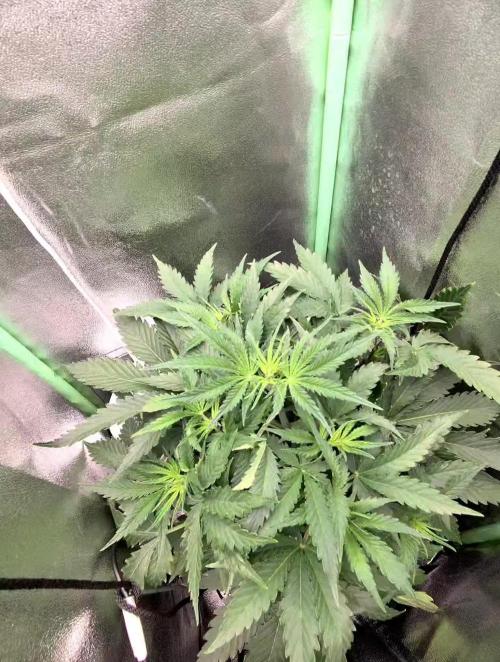
Lights got put up to 75% on the xs1000 as I saw signs of pre flower at the start of the week, and then she shot up 10cm overnight and carried on growing pretty quickly.. soon filled out the 45cm x 45cm space to the point I started to consider a little bit of training.. I ended up getting some pipe cleaners and pulled the side stems apart a little for air movement and light to penetrate better but I feel some light defoliatuion may be needed?
She got her first feed of bloom and top max aswell as removed the first set of leaves after the cotlydons as they had finally shrivelled up and gone crispy.. thinking of stripping the lower 3rd of the plant soon as the stretch is over but unsure as its an auto and I wanted to keep her completely natural and hands off as I can, a few of the true leaves are starting to die off at the bottom which I probably will remove as they get to more than 50% brown but unsure of whether to remove some green growth or not...
Processing
Likes
3
Share


@Simon_Says_Smoke
Follow
10 November 2020
SunSet-Sherbet
Well this week is just another week by now, this lady has been threading through the scrog throughout the week and I believe this lady has finished here stretching and is in full on flowering mode now. Normally a plant stretches the first few weeks into flower to stop the growth and use the nutrients it’s getting now is used to store in the nugs and not the growth anymore.
Each cola of each branch has reached the scrog net and has a decent amount of light exposure due to the fact that I only has one light for 2 plants and the spread of the light isn’t the best.
Started making actual looking hairy heads with the on them 😁 the leaf spread is just getting a lot.
Do-Si-Wine
This plant is doing splendid due to fact that the long and stretchy-ness of these branches has reached the scrog net above and beyond which makes it a lot easier to thread through the scrog and to get as much light exposure as possible for more thicker nugs 🤓
The heads on this lady has started making THC 😁 the nugs are starting slowly to turn white which is very cool, because the plant is a dark green with WHITE nugs.
One branched has snapped which is quiet delicate and grows above the rest if the canopy and causes shadow from on
the bottom branches.
Likes
2
Share


@PatriciaGant
Follow
now time to harvest gets closer every day and time feels now as if she stands still, holy i cant wait to finaly taste this sweet buds. have a beautifull day.
Likes
3
Share


@Xebediah
Follow
Bumped up the nutrients this week. not by much, though. Just enough to top off. I prefer to make gradual increases and underfeed rather than overfeeding. To me it's easier to correct problems of underfeeding than to correct the problems from overfeeding.
Likes
34
Share


@Canna96
Follow
Hey now, hope everyone is having a great week. The Glueberry OG is doing well, but it has been a struggle dealing with the heat and humidity in my region during late flower. I have 2 full size basement dehumidifiers running 24X7 and am able to maintain between 42-48% RH in the tent, however the tent is running between 68-80 degrees F, and I would definitely prefer slightly cooler. It is also a bitch to empty both humidifiers twice a day to prevent them from filling up and shutting off. I could build a reservoir and run lines, but I am just done flowering in the summertime, although I said the same thing in summer 2021.
I was hoping to harvest her on 4th of July of Weekend, however her trichomes are just not ready. She is literally covered in triches, but not seeing any amber on the colas, just a couple on the leaves. So I will giver her at least another week, and hopefully harvest the following weekend. I check the trichomes every day or two and my new plan is hopefully to start the flush by the 4th depending on the trichomes and harvest the following weekend. Since I am harvesting 3 plants, if I can't get them all trimmed in a day, I plan to just go lights off for the next few days and have an auto or two still in the tent auto feeding on water only, while the Glueberry OG starts to dry, and then harvest the other's in the next couple of days. I figure as long as everything is in complete darkness, and the temp and humidity are stable, it should be fine, as some people swear by a darkness period anyways, although I have never tried it. If anyone has any experience/advice with this hit me up!
I am trying to stay patient with this lady, but I am super excited to harvest her. Her Colas just started falling to the floor of the tent yesterday as they continue to pack on weight, Fortunately I saw it via Wyze Cam and was able to tie them up before they reached the floor. This lady smells absolutely amazing, this lady reaks of earthy diesel, and juicy fruit...Super excited to smoke and squeeze some of these nugs.
The Glueberry OG Auto is the second auto I have run by Dutch Passion, the other was their Auto Blueberry which was a MASSIVE plant. I definitely prefer Photos as I enjoy mainlining etc, but as far as autos go, I have not seen any stronger genetics than Dutch Passion. I don't want to speculate on a final weight, but she has 12 mains, and I am estimating each main will be in the 1-2 zip range, and that's not even counting all the side branches. I know some people lollipop all the lower branches, but I will be happy to turn the lowers into half melt, canna-sugar,, bubble hash, full melt, rosin, etc.
I am still running the Medic Grow Spectrum X at 100% in the F1 mode and running the UV/IR bar for 120 minutes prior to lights off. So far I am super pleased with this light, for the amount of PAR she puts out, she definitely runs cool comparatively to other LED's.
Thanks for stopping by, Stay Safe and Blaze On!!! 💪
Website: https://medicgrow.com/
https://growdiaries.com/grower/medicgrowled


Likes
9
Share


@Grileon
Follow
Hello there.
Got a powerful strain from Super Sativa Seed Club for their ongoing contest.
It's honor to be one of the participants. Thanks a lot to the SSSC team.
Will be growing it in 20 l hydroponics, with some GHE nutrients.
Also have some new amazing led light: TS 1000 from Mars Hydro.

Likes
2
Share


@Ultraviolet_
Follow
Not all minds think the same; it's a hard concept to grasp for one who has only ego. When someone operates solely from the ego, they tend to view their own perspective as the objective truth. To them, if someone else thinks differently, it is seen as a flaw, a lack of intelligence, or a personal affront, rather than simply a different, valid experience. The ego assumes that others are just extensions of itself. It cannot easily differentiate between "I think this" and "This is the universal truth". This is called the Mirror Fallacy. True understanding of another mind requires stepping out of oneself. The ego, by definition, is obsessed with self-preservation and being "right," which blocks empathy. Different perspectives are interpreted as attacks on the ego's stability. Instead of curiosity, it feels defensive. Acknowledging that others have entirely different internal worlds—with unique motivations, fears, and histories—requires dismantling the illusion that the world revolves around one’s own viewpoint. It’s a shift from "Why are they wrong?" to "How did they get to that perspective?"
Gospel of Thomas #17 "I shall give you what no eye has seen, what no ear has heard, and no hand has touched, and what has not come into the human heart." precedes saying #18, which questions the "beginning" and "end".
First, you need The Eyes to See, The Ears to Hear & The Mind of the Heart.
"Alpha to omega" refers to the first (Α/α) and last (Ω/ω) letters of the Greek alphabet, symbolizing "the beginning and the end". It represents totality, eternity, or the entirety of something.
Revelation 22:13, "I am the Alpha and the Omega, the First and the Last, the Beginning and the End" (NKJV, NIV).
Both originate from Greek. Alpha (Α/α) is the first letter of the Greek alphabet (representing the beginning). Atom comes from atomos, meaning "indivisible," often seen as the foundational "first" particle of matter. In some esoteric and linguistic theories, the biblical name "Adam" (Hebrew for man/earth) is connected to "atom" because both represent the original, foundational unit (the first man vs. the first particle). Alpha Particles are particles emitted during radioactive decay, named "alpha" because they were the first type of nuclear radiation discovered. They are atomic nuclei consisting of two protons and two neutrons.
The study of the atom often deals with the "beginning" (alpha) of chemical reactions and fundamental building blocks. The terms are linked primarily as symbols for "the beginning" (Alpha), the "fundamental unit" (Atom), and the "original man" (Adam).
The uppercase symbol Omega (Ω/ω) is primarily used in electronics and physics to measure electrical resistance in ohms, representing how materials resist electron flow. It is also used in various fields to represent the density parameter in cosmology, solid angles in physics, and special constants or asymptotic growth rates in mathematics.
In quantum mechanics, "Omega" (Ω/ω) can refer to several concepts related to measuring or representing quantum coherence, generally categorized into dynamical, mathematical, or physical parameters:
Dynamical Coherence Measures
Omega Pattern (Superconducting Circuits)
Coupling Strength
Angular Frequency
Quantum Coherence Framework v24.0
Electron flow is not the same as electrical conductivity, but they are intimately related. Electron flow is the physical motion of electrons, while electrical conductivity is the material property that determines how easily that flow can happen.
Electron Flow (The "What"): The physical movement of negatively charged electrons through a conductor (usually from negative to positive). It is the act of carrying a charge.
Electrical Conductivity (The "How Well"): An intrinsic material property that measures how easily a material allows electrons (or other charge carriers) to move through it.
Electron Flow (The Action): The actual physical movement of electrons from one molecule (donor) to another (acceptor) in a pathway, such as the photosynthetic electron transport chain or cellular respiration. The current itself (dynamic electricity).
Electrical Conductivity (The Property): An intrinsic property of a material (like copper,glass,soil) that measures how easily it allows electric current (electron flow) to pass through it. A measure of ease. A high-conductivity material has low resistance and lets electrons move freely.
Electron transport rate (ETR), the rate at which electrons travel through the chain.
You can have Electron Flow occurring (electrons moving through the chain), but a very low Electron Transport Rate if the plant is in the shade. If light increases, the Electron Flow still follows the same path, but the Electron Transport Rate increases because more electrons are moving per second. In summary, ETR is a quantitative measure of electron flow. Think of "Electron Flow" as the movement itself, and "Electron Transport Rate" as the speed or quantity of that movement.
Photosystem II (PSII) is a critical multi-subunit protein complex in thylakoid membranes that initiates photosynthetic light reactions by splitting water and transferring electrons.
"IVM Matrix" or Isotropic Vector Matrix, a fundamental 3D grid of tetrahedra and octahedra described by R. Buckminster Fuller, representing an "isotropic" or uniform-distance, space-filling coordinate system. A structure where every vertex is equidistant from its neighbors, forming a network of triangles. Composed of 64 tetrahedra (often known as the 64-tetrahedron grid), 12 octahedra, and 6 octa-tetrahedra. It is a vector equilibrium, meaning it is the only geometric form where the distance from the center to its vertices is the same as the distance between its vertices. Considered a, if not the, fundamental geometry of space in synergetic geometry, often used to map quantum energy flows, such as in the 64-tetrahedron grid.
Likes
6
Share


@MisterFlavonoid
Follow
This one was In-Z-Air by PerfectTreeSeeds, grown with GreenPlanetNutrients only! Check the other weeks to see the ones with AptusPlantTech!
Great zkittles terpz, awesome structure, beautiful colours!

Likes
15
Share


@MG2009
Follow
04/03/2020
All are doing well. #5 (Male) has gotten a lot more sturdy, all other will be
Given numbers when Repotted to final pots.
Today is day 21 and will be first real week of veg at 18-6 will veg until mature enough to flower, 55 days maybe?, that will give me time figure out how many males and females I got to work with. I will most likely pollinate a branch of each female to try and isolate some cherry vanilla terps mmm!
Ps.
As soon as they are big enough I will get one clone of each female and male.
(Future Breeding ideas). And save to compare with the next 5 beans out of my 10 pack. I'm dreaming of cherry cheese cake flavor, or cherry lifesaver.
Likes
10
Share

