


Likes
Comments
Share


@russrahl
Follow
Last Obi-Wan girl was left in dark for 3 days and then chopped on day 66 and is now drying. She was definitely the largest of all 4 plants in the tent. Cant wait to see the dry weight on this girl! Next update will be when all the bud is dry and we have a final weight for all 3 together. The first one we chopped only gave us just over 4oz dried but she was half the size as the other 3 girls and kinda lower in the corner. Pulled 7.4oz off the Wedding Cake in the same tent/setup and these last 2 Obi-Wan’s that are still drying are bigger then she was by a lot I think. Cheers 💨

Likes
7
Share

@Bunterbiber
Follow
Hey my friends!
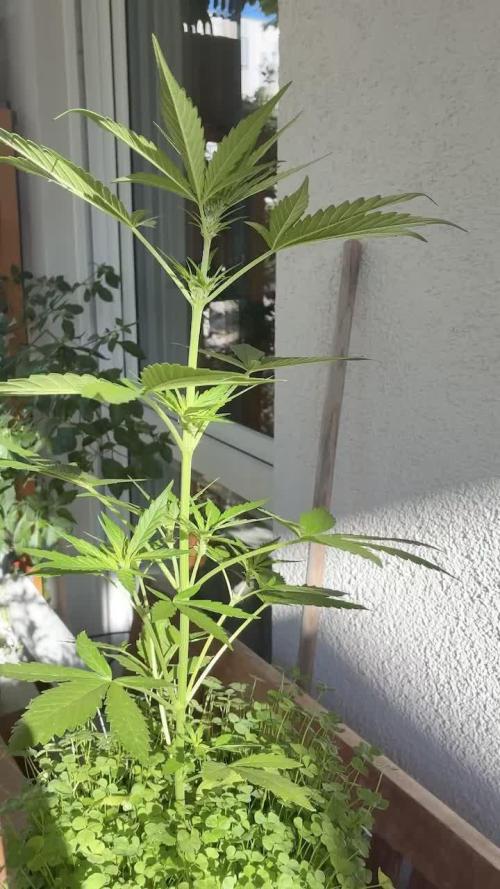
Overall, things are going quite well with the little lady. The summer heat has returned, bringing maximum temperatures between 26°C and 35°C over the past week, but she's handling the warmth well. The very slight signs of nutrient burn on the leaves haven't progressed at all—so everything is completely under control and looking fine.
Exciting developments on the growth front: a few days ago, the pre-flowers made their appearance with those characteristic little white hairs. The stretch has definitely kicked off, and she's visibly gaining height day by day.
Looking ahead to next week (entering the 2nd week of flowering), I’ll be introducing Bio PK-5-8 according to the Biotabs schedule to support her through this next phase. Staying the course and letting her do her thing!

Likes
4
Share


@eldruida_lamota
Follow
Que pasa familia, vamos con la tercera semana de vida de estas Tropicana poison F1 de Sweetseeds.
Vamos al lío , las 3 plantas seleccionadas fueron trasplantadas a su maceta definitiva, tiene algo de shock por el trasplante, pero esta semana las recuperamos todas.
El ph se controla en 6.2 , la temperatura la tenemos entre 20/22 grados y la humedad ronda el 50%.
El ciclo de crecimiento puse 18h de luz, el foco está al 75% de potencia.
Hasta aquí todo, Buenos humos 💨💨💨

Processing
Likes
16
Share


@blendmedmedman
Follow
seed was put in to a root riot cube that was soaked witht he clonex water. now i wait to see what happens

Likes
61
Share


@Esoteric_growing
Follow
Pics taken right before chop, currently hanging for the next 8-12 days and then a cure for a good few weeks.
Pictures speak for themselves, I had high temps, supercropped the help out of them and yet are still the nicest looking bud I have ever grown since I started in 2003.
Can’t wait to test how they smoke. I have two phenos but off to buy some more to do a more in depth pheno hunt.


Likes
3
Share


@Jeekk
Follow
Spiderfarmer humidifier got my 2x4 dialed in almost immediately. If it performs this well over time I'd recommend it greatly. Had some trouble with light burn because I briefly cranked up my light and uv at the same time lol. I stopped that. Thinking about flowering soon. If anyone sees this, what do you think?

Processing
Likes
Comments
Share


@Amiro0o
Follow
Grows very fast in compare to other special queen's that i started 2 weeks earlier.
Its 25 days from seed.and much bigger than the others..
Im going to try low stress training but i dont know if its a right time or not.
It s my first grow indoor And i will be happy with some help from old Growers..
Likes
5
Share


@CanarianGrow92
Follow
First week for our strawberry gorilla from fastbuds 420
We are using the whole feeding schedule from Xpert Nutrients!! Lets see the results from this amazing nutrients!!!
We are using 7 liter pots and doing some defoliation and lollipop the next weeks


Likes
33
Share


@nonick123
Follow
Día 57 (10/03) Riego con 400 ml H2O EC 0,45
Día 58 (11/03) Los cogollos no paran de engordar y ponerse duros como rocas 😍💥
Riego con 500 ml H2O EC 0,45
Día 59 (12/03) Se muestra llena de tricomas! Espectacular!
Riego con 500 ml H2O EC 0,45
Día 60 (13/03) Riego con 500 ml H2O EC 0,45
Inicio un experimento a ver cuantos días aguantan sin regar habiendo regado dos días seguidos con 500 ml, ya que voy a estar 3 días fuera la semana próxima....
Día 61 (14/03) No riego
Día 62 (15/03) A las 48 horas las macetas empiezan a estar ligeras, aunque no secas, pero NO van a aguantar 3 días sin riego
Riego con 350 ml H2O EC 0,45
Día 63 (16/03) Aplicación de 0,5 Litros de PK Booster Compost Tea de nuestros increíbles amigos de BIOTABS
🚀 FastBuds 15% DISCOUNT code "NONICK" 2fast4buds.com @fastbuds.official
💦 BioTabs 15% DISCOUNT code "GDBT420" biotabs.nl/en/shop/ @biotabs_official
🌱Substrate PRO-MIX HP BACILLUS + MYCORRHIZAE @promixmitch @promixgrowers_unfiltered
💡2 x Mars Hydro FC1500 EVO Led Grow Light (2024 NEW FC 1500-EVO Samsung LM301H 150W LED) - https://marshydro.eu/products/fc1500-evo-led-grow-lights/ - https://www.amazon.de/dp/B0CSSGN5D8?ref=myi_title_dp
Likes
3
Share

@Cannarich
Follow
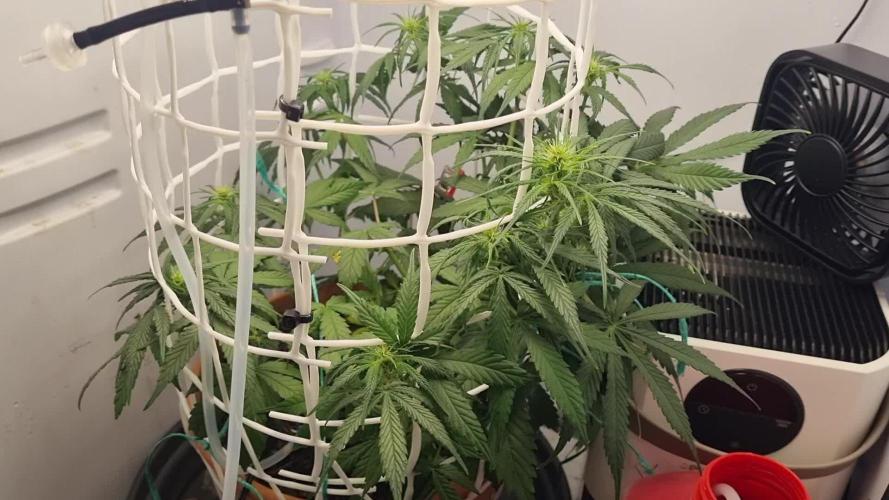
Growth spurt slowed. Starting to fill. Less worried about it getting out of control now. I should have used a more conventional training and topped it. The one advantage I'll have, because it's never been topped, is the shortest time to harvest the way I have done it. Accidental HST on one branch yesterday, so it'll be interesting to see what that brance does now.

Likes
7
Share


@RivenWaters
Follow
Seeing the frosty goodness for the first time this week. I’m still giving the girls two caps of h2o2 to every gallon of water and so far it’s working as expected! They seem very healthy with no signs of pests or PM (knock on wood). I also forgot to mention that I flushed them once this week and couldn’t believe the amount of water a 5 gallon pot can handle! must be the coco.

Likes
Comments
Share

@Eojburnner420
Follow
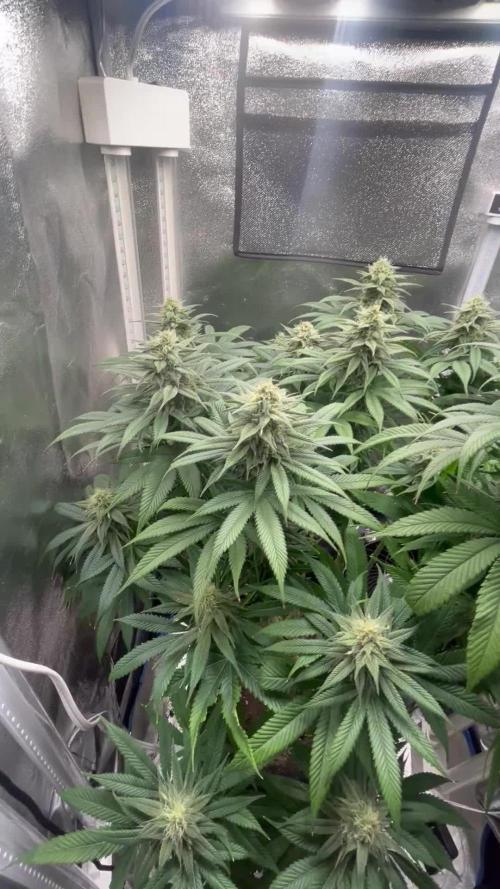
She smells awesome and getting sticky
6.3 on the water and singing to her merry Jane
By Rick James Bitch
Likes
2
Share

Likes
11
Share


@KushManF
Follow
No nutrients this week. Just added some top soil of living soil to help with growth and get the essential nutrients as a seedling. But so far good Growth, I just hope it’s a female 🤞🏾
Likes
20
Share


@Susquihanna
Follow
Frosty Frostbanger isn't growing any taller. I started measuring the cola today for height and width. It is 10 inches tall and I am not really sure how one determines its width. I took a picture and will ask a question to someone who is more experienced than me. I plan on entering this cola in a contest, however, I don't really know what I am going up against. :)😬
I have continued to feed my plant on a regular basis. It has been hot enough here in this area that I water/feed on a daily basis.
We have a few more weeks to go until its harvest time. I am curious to see how big the buds are going to get.
I can definitely see the dense, tight, resin-soaked buds that glitter like fresh snow in a sparkling winter wonderland as per its description of Fast Buds. . Buds also appear to be very compact. And, it is definitely putting of a super strong smell.
That's all for now, Stay tuned for more news next week.
Susquihanna
Likes
11
Share


@JohnnyBarrel
Follow
Week 16
Nothing really moved this week. It’s something like between low tide and high tide: not my favorite moment … waiting for blossoms and flowers 🙄🙏.
Good point is that every plants are healthy ( except a parasite problem on Psicodelicia) and well
prepared for flowering.
For now it’s bad weather outside: 20 degrees max, with lot of wind and rain (cf video). The green house is the best option despite of less exposure.
Morning soon I moved the plants outside to sprayed them with potassium soap (natural insecticide). I cleaned the grow space inside the greenhouse (didn’t touch spiderwebs…good insecticide too).
I removed the automatic watering and get a few liters of rain water during this days.
Watering 1L every 3 days
-Calmag + Cannazym + Alga mic + Root booster
-Flora Series: preflowering quantities.
Daylight 14h30: 6h50/21h20
Blackberry Moonrocks is still healthy; no problem of deficiency or pests, diseases. This strain is resistant and vigorous: no more stretch, waiting for flowering.lot of blooming sites along the branches.

Likes
24
Share


@m0use
Follow
***Sponsored Grow*** = Medic || https://medicgrow.com || Grow = ***Sponsored Grow***
Ok, so bigger news this week, I got rid of one of the plants in the tent as it was an auto vs fast flower :/ and I performed a bunch of LST and some Defoliation to all the plants. This plant was not to bad in terms of lst needs and defoliating needs as much as the other ones. This will be the last week they are in Veg and switching to flower cycle next week with a 12/12 photoperiod. I was going to try a 13/11 but I wanted to test out the automatic light functions on the Medic Grows Minisun-2, So this will be relieved next week.
Been having issues with PH in the medium again and some nutrient uptake. I am thinking I will switch to another brand I have to use up, trip tonic from my last grow on the balcony. Its a bit more complex and not as easy as mix into water and feed but I think its going to help me solve a lot of the issues I am getting. Given this update is a few days late some of these pics are not from today. the clones in the photos above are from the beginning of the week when I potted them up. They have not done well at all and may not make it. can only hope for the next few weeks they pull through.
Till next week.
***Sponsored Grow***
Official Website:
https://medicgrow.com/
+
https://www.emeraldtriangleseeds.co.uk/
Facebook:
https://www.facebook.com/medicgrowled
+
https://www.facebook.com/OriginalETS/
Twitter:
https://twitter.com/medicgrow
+
https://twitter.com/emeraldseeds
Instagram:
https://www.instagram.com/medicgrow420/
+
https://www.instagram.com/emeraldtriangleseeds/
YouTube:
https://www.youtube.com/channel/UCNmiY4F9z94u-8eGj7R1CSQ
Growdiaries:
https://growdiaries.com/grower/medicgrowled
https://growdiaries.com/grow-lights/medic-grow
+
https://growdiaries.com/grower/emeraldtriangleseeds
https://growdiaries.com/seedbank/emerald-triangle-seeds

Likes
9
Share


@Herbz_Unkraut
Follow
another resin monster from seedstockers, with a very special scent, full of flavors! grinded it smelled like peppermint, and vaped it has a great sweet creamy taste!


