




Likes
32
Share


@Sejnik
Follow
Dnes jsem s nimi byl u kadeřníka a odstranil jsem velké množství vějířovitých listů aby se světlo dostal i na spodní květy. Zároveň jsem tím chtěl podpořit proudění vzduchu protože jsem v jednom vrchním květu objevil plíseň šedou. Příští vikend to vidím na sklizeň 🙂

Likes
3
Share


@blacknpearl
Follow
june 16. 4th megacrop feed.1 gr/litre. Ph 7.05
june 20. Megacrop feed number 5. 1gr/litre. ph 5.85. Started LST. Check cool timelapse.


Likes
77
Share


@Ukfarmer420
Follow
Hi guys, so I chopped the little gelatocake 3 days ago and its hanging in 55% humidity and 15°f, I have taken a sample bud, you no how it is lol.
Sherbert mimosa are struggling along and going purple 💜 bit cold here lately, starting to fatten up a bit now, the baby photos are growing fast but need repoting.
Happy growing guys 💜💚💪


Likes
169
Share


@DeepWaterGrower
Follow
⭐ TrolMaster tracking ⭐
I started to track my crop during week 15, when I got the Tent-X TCS-1 by TrolMaster. First impression was: this is too professional for me, I can't handle setting it up and using it well. Then I started reading some posts on Instagram, I visited their site and in 5 minutes my cultivation experience took a huge step forward with disarming simplicity, I couldn't believe it.
I have uploaded tracking videos from the TrolMaster app for each week from the 15th to the 19th, as well as the two weeks of drying stage.
⭐ Controller Chronicles ⭐
Day after day I appreciated the clarity and precision for data, access to all settings and instant readings by connecting a WIFI router to the controller's LAN port. I loved the possibility to dim my lamps remotely, or even automatically based on the temperature in the box!
🌱 GERMINATION (2 days)
Seeds in a glass of EC 0.4 tap water for 10 hours, then in root riots and under the lamp. They sprouted after 48 hours from dry seed.
🌿 GROWING STAGE (10 weeks and half)
I decided to give these plants a long vegetative growth and this allowed me to do a lot of training on both.
Starting from the 4th veg week I started with defoliation sessions every two weeks, for a total of four during the entire vegetative phase. The last defoliation was done a couple of days before the switch, in order to allow the lower parts of the plant to get as much light as possible.
Furthermore I did Topping on week 6, cutting the apical branch, then on week 8 I did Topping again on several sites, as well as SuperCropping on the highest branches to make the canopy uniform.
The light cycle I used is 18/6 and the last two veg weeks I lowered the light hours to 16/8 first and 14/10 then.
During the veg stage I made 4 DWC change, PH was always between 5.5 and 6, about EC I started with 0.6 and was 1.4 on the last veg week.
🌸 FLOWERING STAGE (9 weeks)
I started this phase after 36 hours of darkness, I then changed the DWCs solution (adding a flowering stimulator).
Then I mounted the ScrOG-net about 50 cm from the base of the plants and I wove the phenotype #1 through the net occupying at least 60% of the available space; the phenotype #2 stretched shortly after the switch and I used the net only to widen the central branches.
They showed the pre-flowers two weeks after the switch, then I made two defoliations on week 3 and 5 flo.
During the last four weeks of flowering (weeks 6-9) I simply paid attention to the PH-EC levels to provide the roots with optimal conditions. I then kept the TEMP-RH-VPD-PPFD values under control and this also thanks to the Tent-X controller by TrolMaster which allows me to provide optimal conditions also above.
I chopped them when trichomes were about 85% milky and 15% amber.
During the flowering stage PH was always between 5.8 and 6.2, about EC I started with 2 and was 2.3 on the last week before flush.
✅ HARVEST
- From dry seed to harvest: 140 days (2 days germination + 75 days veg + 63 days flo).
- Chopped after 4 days flush and 48 hours in dark;
- Wet trim, removed fan leaves.
✅ DRYING STAGE
- Time: 14 days;
- Average: 20° C - 50% RH.
- After that I made a dry trim, removed branches and sugar leaves.
⚖️ DRY WEIGHT
- Phenotype #1: 230 gr buds + 25 gr larf;
- Phenotype #2: 105 gr buds + 50 gr larf.
So, the overall dry weight is: 335 gr buds + 75 gr larf.
✅ CURING STAGE
- Curing is done after 30 days with Boveda 62%.

Likes
8
Share


@Chubbs
Follow
Weekly update on these gorgeous girls. Was gone for 9 days so wasn't sure how they'd look when I returned. Wow did they take off into full flower. They're all looking amazing, it looks like two different phenos which is awesome. Over all excited to see them progress as the flower period just started.
Likes
3
Share

@WetWillie
Follow
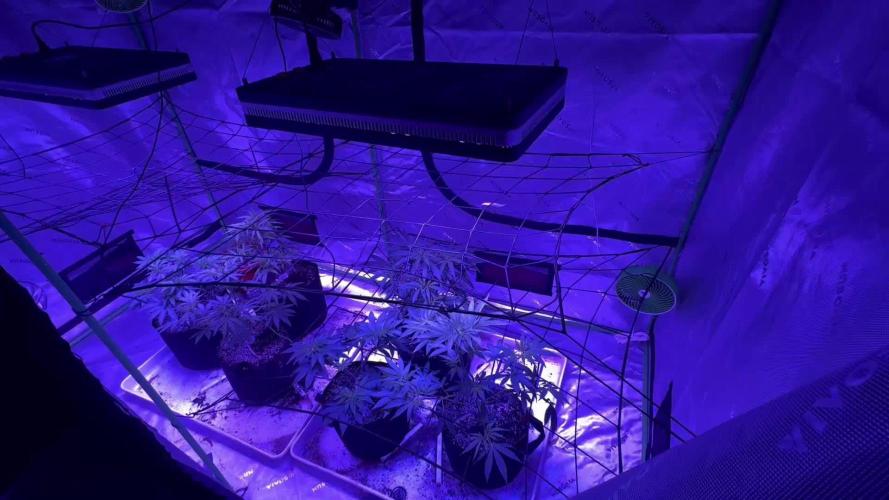
Defoliation and LST performed 12/31/2025, flipped to 12/12 lighting on 01/01/2026 (35 days from germination).

Likes
4
Share

@he110adm1n
Follow
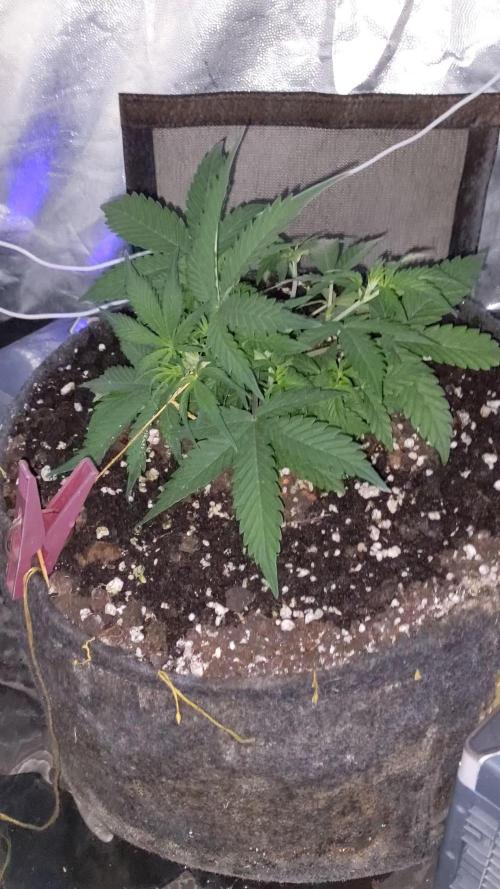
The sixth week has begun. Its color and leaf turgor are perfect; there are no signs of stress, and everything is going well—it is simply lagging behind in size. I’ve started LST. I hope I’ll have the time to carry out the LST properly.
Likes
18
Share


@DevilDice
Follow
Final Week
Freunde es ist so weit.
Viel gibt es nicht zu berichten nur etwas zum Prozess.
Anfang der Woche wurde gehörig geflushed. Im Anschluss gab es noch ein paar Tage Licht und wenig klares Wasser.
3 Tage vor der Ernte war komplette Dunkelheit angesagt Damit sie schön Terpene schießt. Kleiner Spoiler, heute ist Erntetag 😊
Wahrscheinlich hätte sie noch länger gekonnt ich wollte aber keine zu große schimmel Gefahr eingehen.
Und selbst beim Entfernen der großen Blätter harzte sie als ob es keinen Morgen gibt 😂
Das Werk ist vollbracht! Nun hängt sie da und wir schauen mal wie viel nach dem snap und anschließendem trim übrig bleibt.
Das nächste Mal berichte ich nach dem Trim und Wiegen! Einen Rauch Bericht reiche ich nach. Ich bin jetzt schon gespannt 🤩
Einen schönen Sonntag liebe Community.

Processing
Likes
93
Share


@MadeInGermany
Follow
Welcome to the Zamnesia Spring Cup 🏆
Hi everyone 🤗.
This week she gave an extreme boost after topping :-), so I defenetively do it again completely top 😍.
Last week it was a bit dark from the Monster Bud Mix 😅, but this week it turned back into posetive, the new shoots all have a perfect leaf green 👍.
I think I will give her another 3-4 weeks of vegi phase that it will be a real bush 😍.
I wish you all a nice week, stay healthy 🙏🏻, and let it grow 🌱
The Strain Runtz is available at
www.Zamnesia.com
☝️🏼☝️🏼☝️🏼☝️🏼☝️🏼☝️🏼☝️🏼☝️🏼☝️🏼☝️🏼☝️🏼☝️🏼
Zamnesia Spring Cup 🏆🏆🏆
Type:
Runtz
☝️🏼
Genetics:
Zkittlez x Gelato
👍
Vega lamp: 2 x Todogrow Led
Quantum Board 100 W
💡
Bloom Lamp : 2 x Todogrow Led
Cxb 3590 COB 3500 K 205 W
💡💡☝️🏼
Soil : Canna Bio
☝️🏼
Nutrients : Monster Bud Mix
☝️🏼🌱
Water: Osmosis water mixed with normal water (24 hours stale that the chlorine evaporates) to 0.2 EC. Add Cal / Mag to 0.4 Ec Ph with Organic Ph - to 6.0 - 6.3
💦💧
Likes
2
Share


@Ninjabuds
Follow
Bubble og man these ladies loved being topped they were not growing the fastest before topping but after getting topped they have really been stretching out they very much have a scrog potential the branchs bend easily and have good distance between nodes to work with
The day has come and it's time to flip these ladies to flower. I was planning on letting them go untill Friday and let the smaller ones grow just a bit more but they will be fine. I have the eternity cup contest in mind and I'm thinking timing so I need to get these lady done and out my tent lol. This past week I turned the light up alot getting them ready to flower they have grown a bunch inhavendone lst maybe 5 it 6 times on the branchs and they arw nit bendy anymore that will help durring flower.

Likes
13
Share


@DaisyNabis
Follow
ya no crecen mas mis bellas, comenzaron su periodo de engorde, sus flores comienzan a engordar y dar forma a este oasis con un cálido aroma.

Likes
3
Share


@Adkguerrilla44
Follow
Such an amazing plant ,the smells coming out of my dry tent is insane i can smell the gg4 over the other 6 stains in there which is insane because i have some f1 strains that are super dank but i think this one beats them!! If your not growing gps's gg4 auto your definitely missing out on something very very special

Likes
6
Share


@Skinnytalls420
Follow
Day 32-26/08/22 well it’s been a while since I’ve updated cos I haven’t been well and then I had the product earth festival!!! But should be able to get on track from now!!!! These 3 cheese baby’s are doing good!! One of them had topped itself!!! So should get two nice colas there!! Still only giving biobizz grow 1ml/l but will start to give bloom this week!!!
Likes
29
Share


@Seldom_Seen
Follow
Day 8: Dampened down around soil again and continued to use the Force to make the plant grow.
Day 9: Nothing to report. Mr.Nelson played me songs he wrote. He’s not very good and all his songs sound the same. He should probably stick to just growing weed and leave the singing to the professionals.
Day 10: Dampened down around stem again. Looks like it will need a full watering in the next few days. R2 laid down some beats today while Mr.Nelson played us more of his songs.
Day11: Gave full watering today. It took 3ltrs to run off.
Day 12: There’s continuous obvious growth every day. It was just me and R2 today. It was nice to get a break from Mr.Nelson’s songs.
Day 13: Continued to use the Force to make the plant grow. No need for watering. Found myself humming Mr.Nelsons song ‘City of New Orleans’ all day. Catchy tune. 🎶
Day 14: Two weeks old today. Mr.Nelson thinks this is a good reason to have a Rainbow 🌈 Party. Plant looks okay for water. Moving it a little further from the light today.

Likes
7
Share


@caliriot73
Follow
the lady are feeling good seems to
be promising and start to form the bud structure and begin the trichomes production whit loud terps

Likes
Comments
Share


@guitarrasrockeras
Follow
comenzamos con la primera semana de vegetación de estas muchachas, hasta ahora todo bien con el proceso, trato que reciban su buena dosis de humedad gracias al Humidificador humipro 4 litros de Garden HighPro. cualquier consulta o recomendación por favor háganmela saber en los comentarios. Saludos!!

Likes
3
Share


@GarciasGarden
Follow
Stressful grow honestly I have ptsd from my last grow being a complete Hermie den I literally had to check them every single day wondering if the swollen ovule’s were actually seeds lol well anyway I had to harvest at week 6! And this shit still came out ridiculously good smell✔️Taste✔️Bag appeal✔️✔️✔️ Great strain can’t wait to grow it again !

Likes
13
Share


@userflp
Follow
harvesting due to the beginning of the spring equinox in the southern hemisphere and so the days have more than 12 hours of light. The plant showed signs of revegetation in recent days, the same occurred with two other plants that will make the posts and give continuity to the revegetation diaries of the plants. Att
colheita realizada devido ao ínicio do equinocio de primavera no hemisferio sul e com isso os dias tem mais de 12 horas de luz. A planta apresentava sinais de revegetação nos ultimos dias, o mesmo ocorreu com outras duas plantas que realizarei as postagens e darei continuidade aos diarios de revegetação das plantas. Att
👽
***update on effect after two weeks of healing;
ironically, even though I had harvested early due to revegetation, after 2 weeks of healing the herb shows strong citrus and herbal taste and smell. about the effects ... The wave is insane, almost completely cerebral, too strong. It was a good choice to keep it in revegetation and not pick up the other copy which I also let revegetate and make a diary. Att
Likes
3
Share


@Flako1985
Follow
Transplanting on 05/30/2019. That when I'll turn on the 600w MH. Germinated on May 12,2019. Popped and Planted with 24 hrs.


