Likes
Comments
Share
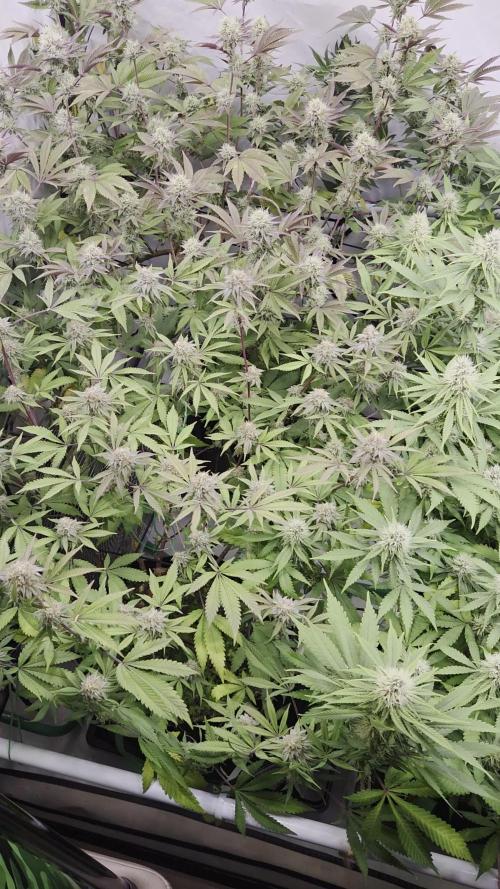
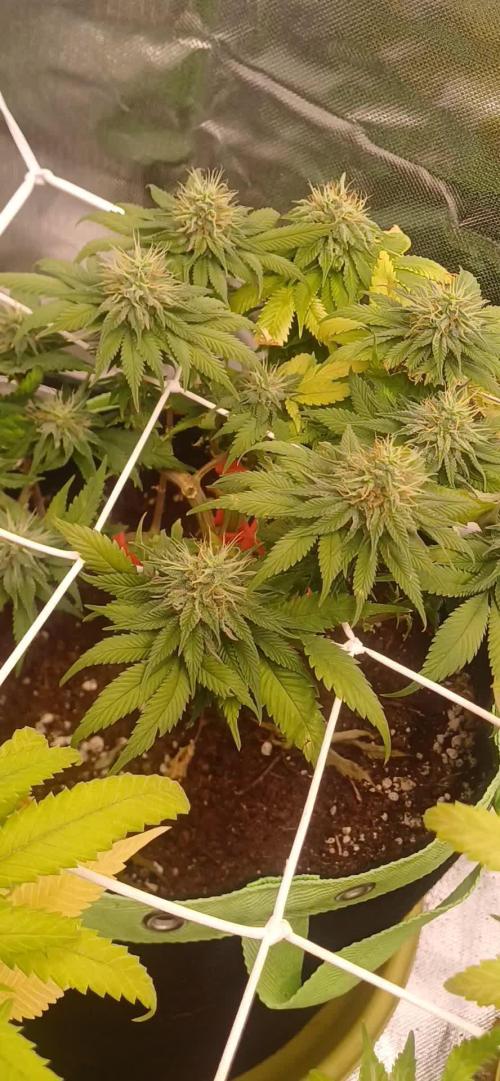
Week 8 night fro day 1 in to day 2 and all is going as planned 😁 i broth down my lights to a 50% power, this gives me a 500 ppfd, also reduce the shedule to 9h light. Hoping for great medicine on this run 🙏 5x White Mango WM 5x Alasken Purple AP 4x Blueberry BB 3x SAD S1 2x Badazz Cookies BC 19 in total for a 4x8x6 - 1,2x2,4x2 Light Lumatek Zeus 465W compact pro 2x at 50% All i Grow is medicine for myself, Stay safe, stay tuned and B Happy and do it for the love Peace ✌️ D
Likes
6
Share
@Dabking
Follow
Defoliated a bit more. Trimmed the nuts
Likes
2
Share
@smoker420
Follow
got bud rot on top head had to chop her down last time im doing a auto next to veging plants could not keep humidity down at last 2 week
Likes
6
Share
@Ts1Ko
Follow
Feb 25 watered with nutrients, everything seems to be going fine. Had problems with some COB lights, but fixed everything today. Feb 27 got another feeding Mar 1 flushed with clean water
Likes
4
Share
The buds start getting thicker and thicker. Currently I feed the plant with 1.5 EC. This trichomes are mostly clear and starting to get cloudy. Here and there are some amber one's, but they look tiny and old, not sure what happend there. As of now I am planning to give the nutrient solution for at least a couple of days, but I also want to make sure there is one week where I can only give water to maybe get some more colours out of the plant (I really hoped for it to be purple?).
Likes
19
Share
@lakocinka
Follow
hello, quick update.. I got another fan which is amazing.. čubičky (my plants) looks healthy and that's most important.. <3
Likes
12
Share
@K8420
Follow
Good week for the girls. Stretching and growing well. Was busy this week with work and didn't have time for lots of photos. More to come next week.
Likes
2
Share
Transplant dem girl also things been a bit rocky with climate change n want not got another pheno of the mcm ....jus keep pushing fittest of the fittest
Processing
Likes
54
Share
@SAC87
Follow
Day 15-Day 21 Day 21: I am ready to cut this down and start over with some plants I have in veg. The video is of today and I think the buds being nonexistent at day 21 of 8-10 week strains is a bad sign and shouldnt waste my time and money trying to nurse it into something. I have 2-4 20” plants taken for clone practice from these plants. I could easily have a 10-12 plant sog. If you’re reading this please weigh in honestly if you think this is a waste of time to finish flowering. It’s incredibly discouraging to not have a clue what is wrong, but by this time there should be more than what there is. I have the light at 50%, at about 42” above the canopy. All I know is I’m 10/10 pissed off. I also gave a Pk booster at one pinch per gallon
Likes
4
Share
Hola a todos ,ya desde la semana pasada que vengo regando solo con agua porque no falta mucho para el corte aproximadamente 10 días. Los cogollos no han engordado como lo que esperaba, en comparación a la misma "genética " del año pasado.Tambien he notado que el tamaño de los cogollos es menor, pero si son más compactos y más densos. Esta semana empezaron a tornarse la mayoria de los cogollos en un tono purpura, como así también algunas hojas, también indicadores de que el final ya se aproxima, a todo esto hay que sumarle el descenso de la temperatura también es un factor para que los cogollos y hojas se pongan de ese color. Así que de aquí a que llegue el día del corte solo regare con agua.
Likes
47
Share
May 25: looking healthy and happy. Nice progress considering it’s another week until the end of May. May 26: raised soil level using Pro-Mix and compost. Got rained on a bit but moved beside house to avoid the heaviest rain which verged on being hail. May 27: topped in morning. First round of topping in what will be a 16 cola manifold. Looking good as we’re about two weeks ahead of schedule. May 31: been cool the last few days since the toppping. Watered this morning with Monster Maxx. Slow going since the topping but she’ll be fine. Note that for all my diaries, I do pH adjustment with apple cider vinegar and add a dab of Dr Bronner’s Peppermint soap as a surfactant. That lowers the surface tension of the water allowing it to penetrate the soil more evenly. Also I’m always warming the water to help keep the roots happy in the cool weather. #seedsman420growoff #seedsmanseeds
Likes
26
Share
Day 106 14/10/24 Monday Their colours are really coming through now 🤩 Nearing their end now, possibly another week after this ✌️💚 Picture and video update 📸💚 Day 108 16/10/24 Wednesday Another run through of de-chlorinated tap water and flawless finish all to pH 6.3. Giving 0.3L again daily as there not drinking half as much now. Picture and video update 📸💚 Day 110 18/10/24 Friday Divine Seeds Overdose has been Harvested. Check her own diary on my page for full results. I moved the others into my now cleaned down 1.2m x 80cm under 660w hps to finish off. Day 111 19/10/24 Saturday De-chlorinated tap water and flawless finish at pH 6 today.300ml Day 112 20/10/24 Sunday De-chlorinated tap water and flawless finish at pH 6 again 300ml. I have had an extremely busy week. I'll upload videos and pictures tomorrow on a fresh week... Wait and see the colours 😋💚
Likes
56
Share
What's in the soil? What's not in the soil would be an easier question to answer. 16-18 DLI @ the minute. +++ as she grows. Probably not recommended, but to get to where it needs to be, I need to start now. Vegetative @1400ppm 0.8–1.2 kPa 80–86°F (26.7–30°C) 65–75%, LST Day 10, Fim'd Day 11 CEC (Cation Exchange Capacity): This is a measure of a soil's ability to hold and exchange positively charged nutrients, like calcium, magnesium, and potassium. Soils with high CEC (more clay and organic matter) have more negative charges that attract and hold these essential nutrients, preventing them from leaching away. Biochar is highly efficient at increasing cation exchange capacity (CEC) compared to many other amendments. Biochar's high CEC potential stems from its negatively charged functional groups, and studies show it can increase CEC by over 90%. Amendments like compost also increase CEC but are often more prone to rapid biodegradation, which can make biochar's effect more long-lasting. biochar acts as a long-lasting Cation Exchange Capacity (CEC) enhancer because its porous, carbon-rich structure provides sites for nutrients to bind to, effectively improving nutrient retention in soil without relying on the short-term benefits of fresh organic matter like compost or manure. Biochar's stability means these benefits last much longer than those from traditional organic amendments, making it a sustainable way to improve soil fertility, water retention, and structure over time. Needs to be charged first, similar to Coco, or it will immobilize cations, but at a much higher ratio. a high cation exchange capacity (CEC) results in a high buffer protection, meaning the soil can better resist changes in pH and nutrient availability. This is because a high CEC soil has more negatively charged sites to hold onto essential positively charged nutrients, like calcium and magnesium, and to buffer against acid ions, such as hydrogen. EC (Electrical Conductivity): This measures the amount of soluble salts in the soil. High EC levels indicate a high concentration of dissolved salts and can be a sign of potential salinity issues that can harm plants. The stored cations associated with a medium's cation exchange capacity (CEC) do not directly contribute to a real-time electrical conductivity (EC) reading. A real-time EC measurement reflects only the concentration of free, dissolved salt ions in the water solution within the medium. 98% of a plants nutrients comes directly from the water solution. 2% come directly from soil particles. CEC is a mediums storage capacity for cations. These stored cations do not contribute to a mediums EC directly. Electrical Conductivity (EC) does not measure salt ions adsorbed (stored) onto a Cation Exchange Capacity (CEC) site, as EC measures the conductivity of ions in solution within a soil or water sample, not those held on soil particles. A medium releases stored cations to water by ion exchange, where a new, more desirable ion from the water solution temporarily displaces the stored cation from the medium's surface, a process also seen in plants absorbing nutrients via mass flow. For example, in water softeners, sodium ions are released from resin beads to bond with the medium's surface, displacing calcium and magnesium ions which then enter the water. This same principle applies when plants take up nutrients from the soil solution: the cations are released from the soil particles into the water in response to a concentration equilibrium, and then moved to the root surface via mass flow. An example of ion exchange within the context of Cation Exchange Capacity (CEC) is a soil particle with a negative charge attracting and holding positively charged nutrient ions, like potassium (K+) or calcium (Ca2+), and then exchanging them for other positive ions present in the soil solution. For instance, a negatively charged clay particle in soil can hold a K+ ion and later release it to a plant's roots when a different cation, such as calcium (Ca2+), is abundant and replaces the potassium. This process of holding and swapping positively charged ions is fundamental to soil fertility, as it provides plants with essential nutrients. Negative charges on soil particles: Soil particles, particularly clay and organic matter, have negatively charged surfaces due to their chemical structure. Attraction of cations: These negative charges attract and hold positively charged ions, or cations, such as: Potassium (K+) Calcium (Ca2+) Magnesium (Mg2+) Sodium (Na+) Ammonium (NH4+) Plant roots excrete hydrogen ions (H+) through the action of proton pumps embedded in the root cell membranes, which use ATP (energy) to actively transport H+ ions from inside the root cell into the surrounding soil. This process lowers the pH of the soil, which helps to make certain mineral nutrients, such as iron, more available for uptake by the plant. Mechanism of H+ Excretion Proton Pumps: Root cells contain specialized proteins called proton pumps (H+-ATPases) in their cell membranes. Active Transport: These proton pumps use energy from ATP to actively move H+ ions from the cytoplasm of the root cell into the soil, against their concentration gradient. Role in pH Regulation: This active excretion of H+ is a major way plants regulate their internal cytoplasmic pH. Nutrient Availability: The resulting decrease in soil pH makes certain essential mineral nutrients, like iron, more soluble and available for the root cells to absorb. Ion Exchange: The H+ ions also displace positively charged mineral cations from the soil particles, making them available for uptake. Iron Uptake: In response to iron deficiency stress, plants enhance H+ excretion and reductant release to lower the pH and convert Fe3+ to the more available form Fe2+. The altered pH can influence the activity and composition of beneficial microbes in the soil. The H+ gradient created by the proton pumps can also be used for other vital cell functions, such as ATP synthesis and the transport of other solutes. The hydrogen ions (H+) excreted during photosynthesis come from the splitting of water molecules. This splitting, called photolysis, occurs in Photosystem II to replace the electrons used in the light-dependent reactions. The released hydrogen ions are then pumped into the thylakoid lumen, creating a proton gradient that drives ATP synthesis. Plants release hydrogen ions (H+) from their roots into the soil, a process that occurs in conjunction with nutrient uptake and photosynthesis. These H+ ions compete with mineral cations for the negatively charged sites on soil particles, a phenomenon known as cation exchange. By displacing beneficial mineral cations, the excreted H+ ions make these nutrients available for the plant to absorb, which can also lower the soil pH and indirectly affect its Cation Exchange Capacity (CEC) by altering the pool of exchangeable cations in the soil solution. Plants use proton (H+) exudation, driven by the H+-ATPase enzyme, to release H+ ions into the soil, creating a more acidic rhizosphere, which enhances nutrient availability and influences nutrient cycling processes. This acidification mobilizes insoluble nutrients like iron (Fe) by breaking them down, while also facilitating the activity of beneficial microbes involved in the nutrient cycle. Therefore, H+ exudation is a critical plant strategy for nutrient acquisition and management, allowing plants to improve their access to essential elements from the soil. A lack of water splitting during photosynthesis can affect iron uptake because the resulting energy imbalance disrupts the plant's ability to produce ATP and NADPH, which are crucial for overall photosynthetic energy conversion and can trigger a deficiency in iron homeostasis pathways. While photosynthesis uses hydrogen ions produced from water splitting for the Calvin cycle, not to create a hydrogen gas deficiency, the overall process is sensitive to nutrient availability, and iron is essential for chloroplast function. In photosynthesis, water is split to provide electrons to replace those lost in Photosystem II, which is triggered by light absorption. These electrons then travel along a transport chain to generate ATP (energy currency) and NADPH (reducing power). Carbon Fixation: The generated ATP and NADPH are then used to convert carbon dioxide into carbohydrates in the Calvin cycle. Impaired water splitting (via water in or out) breaks the chain reaction of photosynthesis. This leads to an imbalance in ATP and NADPH levels, which disrupts the Calvin cycle and overall energy production in the plant. Plants require a sufficient supply of essential mineral elements like iron for photosynthesis. Iron is vital for chlorophyll formation and plays a crucial role in electron transport within the chloroplasts. The complex relationship between nutrient status and photosynthesis is evident when iron deficiency can be reverted by depleting other micronutrients like manganese. This highlights how nutrient homeostasis influences photosynthetic function. A lack of adequate energy and reducing power from photosynthesis, which is directly linked to water splitting, can trigger complex adaptive responses in the plant's iron uptake and distribution systems. Plants possess receptors called transceptors that can directly detect specific nutrient concentrations in the soil or within the plant's tissues. These receptors trigger signaling pathways, sometimes involving calcium influx or changes in protein complex activity, that then influence nutrient uptake by the roots. Plants use this information to make long-term adjustments, such as Increasing root biomass to explore more soil for nutrients. Modifying metabolic pathways to make better use of available resources. Adjusting the rate of nutrient transport into the roots. That's why I keep a high EC. Abundance resonates Abundance.