


Likes
Comments
Share


@ChitownCannaChica
Follow
Really digging the resin production on this haze baby. She is sticky, pungent, and greasy! Easy to grow and producing for mommy. 💚🌿💚🌿. Love this plant!

Likes
20
Share


@medicinaltomatoes
Follow
Finally, she has come to a finish with the three ladies coming out to a total of 60.8G. I would say I'm slightly proud of this grow, if only it weren't for the hiccup I had during mid flower. The buds are a little airier than I like, however she smokes like a charm and I would definitely recommend this strain to anyone looking for a high CBD dominant strain. Thanks for all the support this run; seeing as it was my first attempt to hydro it is very much appreciated! Til' next time

Likes
6
Share


@Elcoquigrow
Follow
Primera vez cultivando clones, me fue mejor de lo que esperaba gracias a una buena iluminación, excelentes fertilizantes y un poco de experiencia que vamos adquiriendo con cada cosecha ✌️🏾

Likes
37
Share


@DaddyPrime2
Follow
5/5/2024
Pistils pistils pistils
5/8 these plants are fucking exploding! Super exciting to see them like this. Pistils everywhere and they’re just STACKING! don’t even see budlets yet, just pistils. The structure of these plants is beautiful. They handle training fairly well. I topped one and super cropped it and did a bit of lst. I was feeling impatient so I decided to see what happened if I pushed the one a little harder and left the other to grow naturally.

Likes
12
Share


@BloodBath
Follow
Everything bounced back to normal. These smoothies want a bit of nitrogen throughout veg. 90% of the time when I have an issue it’s because PH or PPM being too high. This wasn’t the case as I ran two tests on my medium and everything was fine. Once i fed them twice with some higher nitrogen levels and some kelp n algae they bounced back in a week. After the first feeding I could notice a nice green coming back into the leaves. I have not flushed once since then. I’ve been feeding a tea every two weeks instead to break up whatever’s left behind. I plan to do one more feed in a couple days and I’m gonna do a light flush with SLF and then continue feeding nutes and teas until she’s ready to be flushed towards harvest.
Likes
47
Share


@Northern_Ent
Follow
Aug 17: gotta love big fast plants. This is a nice big plant and the buds are forming very quickly.
Added a scrog net layer because I realized the buds are getting heavy already and will likely want more support. These loosely placed Scrog nets are working great and they make it easy to expose buds while tucking fan leaves out of the way.
Honestly, I can hardly believe how fast these buds are maturing. Very impressed.
Aug 18: another cool and slightly rainy day but at least it’s not so smoky. This new normal of ‘which town is gonna get burned this year?’ Is not fun at all. This year is was a third of the town of Jasper which is inside a national park.
Aug 21: this plant is awesome with really big buds forming quite quickly. The buds are starting to put on weight and the UV light is definitely helping to produce trichomes. 👍👍 I love this plant.
#seedsman420growoff
#seedsmanseeds




Processing
Likes
3
Share


@Barcelona_Farmers710
Follow
Booom! Ya tenemos los cogollos formandose Farmers!! Ya casi no se nota la falta de magnesio por problema con el humidificador pero en breves ya empiezo lo buenoo!😜 mis favoritas las de Barneys Farms!!! espero que os guste farmers buen comienzo de semana!!💚

Processing
Likes
11
Share


@kcartel
Follow
growing rapidly, next week I plan to add fertilizers, at the current stage the plant has gone through LST and topping and pruning large fan leaves, in my opinion this stress did not affect the growth this is my first experience in the style of Maine Lining, waiting for 4 week!
Processing
Likes
21
Share


@LittleBigTrees
Follow
Fed once this week with a weak feed including top max.
I use kombucha vinegar as pH down. Water from my tap is ph6.8-7.0 and 38-42ppm so I might start using calmag supliment as the ppm at my old house used to come out of the tap at ph7. 2 and 200-220ppm.
I had 2 plants that didn't like the light at 30000 lux and started bleaching so I took them out.
I've defoliated today day 35 as humidity was getting over 80% and also to let light to the lower bud sights.
Pre flower pistils showed on some plants around day 33 (some still have none) so I'll consider this the end of veg start of flower. The kalimist indica pheno is still not showing pre flower pistils but is always hard to force flowering when it's not mature for some reason. It's always 7-14 days behind everything else 🤔
Likes
25
Share


@Le_Duc_Du_Bud
Follow
Salut amis cultivateurs ✌️✂️🌿
Aujourd'hui je pose la nouvelle semaine 🗓️
Comment vous dire que je suis impressionnée ❗
Les plante ce développement a merveille voyait par vous même 🙏
Elles ont fortement grandi, je suis monter a 1.5L par plante, elle consomme la totalité des nutriments et me le montre très très bien 😍🤗
Merci Kannabia 🙏 encore des variétés merveilleuses 😊
J'espère que dame nature sera me récompense 🌿🍁
Pour plus d'informations par rapport à ces génétique, je vous laisse cliquer ici : https://www.kannabia.com/fr

Likes
4
Share


@Elguacho420
Follow
Buenas a tod@s... Otra semanita más ya en flora, van creciendo muy bien, uniformes, hermosas y fuertes... Ricos aromas ya están formándose los cogollos de a poquito, van tomando forma de a poco, me encantan, se las ve muy bien y aguantan muy bien la temperatura ya q hay veces q hace bastante calor, se toman otras medidas en ese caso pero de momento van muy bien... A seguir creciendo, me está gustando la evolución de este cultivo, y el siguiente, mejor... 💪🏻⚡💀😎
🇦🇷🤝🏻🇪🇦
Likes
62
Share


@Reyden
Follow
🔸Davvero una grande notizia! Una nuova collaborazione con @Spiderfarmer è iniziata e sono felice di poter creare dei contenuti per una azienda seria come la loro!!! Questa mattina è stata montata questa bellissima #SF2000 nella tenda da coltivazione più grande dove dovrà lavorare per far fiorire tutte le signorine che passeranno di qui prossimamente 😁😎🔥
Voglio fare i complimenti perché siete riusciti a creare veramente una luce bellissima con materiali super leggeri ed esteticamente geniali ❤️🔥oltre che consumare veramente poco (2.7 Umol/J)per il raggio di copertura ( 4x3 in crescita )(4x2 in fioritura ) e intensità uniforme in PPFD
Mi piace molto anche il fatto che monta anche diodi IR utili per accelerare la fase di fioritura e aumentare la resa 💡
Ci saranno diversi aggiornamenti rimanete connessi e grazie ancora per essere passati a trovarmi 😃
https://www.instagram.com/reel/Cl_EEAbu_vQ/?igshid=YmMyMTA2M2Y=
Funzionalità principali
2022 NUOVA VERSIONE COSTI DI ESERCIZIO INFERIORI E RENDIMENTI DI QUALITÀ SUPERIORE: Le luci progressive a LED SPIDER FARMER SF2000 utilizzano la più recente tecnologia LED ad alto rendimento oggi: diodi Samsung LM301B, alta efficienza energetica con 2,7 umol/J, creano la migliore penetrazione della luce del baldacchino. Copertura vegetale 3 x 4 piedi, fiore 2 x 4 piedi. Potenza estremamente elevata ma consuma solo 200 W di elettricità, rendendola più efficiente delle tradizionali lampade HID e di altre lampade per piante sul mercato.
NUOVO DISPOSIZIONE DEI DIODI E DESIGN DIMMERANTE: Luci crescenti SF2000 aggiornate. Più perline leggere ai bordi, meno al centro. Aiuta a ottenere una PPFD più uniforme. e la manopola di regolazione della luminosità regola liberamente l'intensità della luce. Connessione multi-luce con regolazione unificata particolarmente vantaggiosa per un'ampia area di coltivazione indoor e piantagione commerciale.
IDEALE PER TUTTE LE FASI DI CRESCITA: Eccellente spettro completo: bianco, blu, rosso e IR (3000K, 5000K, 660nm e IR 760nm). Diodi 3000K che forniscono più luce rossastra e 5000K che forniscono più luce bluastra. La luce rossa e IR da 660 nm è particolarmente utile durante la fioritura, dove accelera i tempi di fioritura e aumenta i raccolti. Trasforma i tuoi semi nella tua scorta. E la luce sembra abbastanza naturale, quindi è utile per monitorare accuratamente la salute delle piante.
COSTRUZIONE BEN FATTA E SOLIDA: nessuna ventola senza rumore. Il driver ad alta efficienza, affidabile e staccabile ha un'ottima dissipazione del calore. Il dissipatore di calore in alluminio è spesso e robusto, coperture protettive per i cavi; Imballaggio intuitivo. Componenti di qualità significano che la luce dura più a lungo, SF Light si prende cura di te con un design più attento, puoi facilmente risparmiare denaro senza acquistare frequentemente luci.
In qualità di produttore professionale di luci di coltivazione a LED da oltre 10 anni. Spider Farmer ha sempre insistito per creare attrezzature per la semina domestica più efficienti, adatte e di alta qualità per la crescita delle piante e si impegna a diventare un partner fidato per ogni coltivatore! Riceverai una lampada da coltivazione Spider Farmer SF2000, un manuale di istruzioni, un paio di ganci d'argento, un paio di ganci neri.


Processing
Likes
10
Share


@Loudcloud514
Follow
I changed my mind so instead of 10 weeks it will be finished in 9 weeks so I changed the feeding to Week 6 I just feed remos nature's candy and the girls got fatter. Starting week 7 to week 9 I will just feed ph'd water for a 3 week flush

Processing
Likes
12
Share


@DudeGrowsWeed
Follow
March 27, 2019:
For the most part everything is moving along nicely. The CBD Medi Kush has taken off in the flower room. She is 30 inches tall now and showing lots of nice bud site development.
So far I have to say I'm impressed with how things are going in the flower room. The organic methods appear to be working very well. The plants all look super healthy, no signs of any deficiencies and the leaves are all the perfect shade of green - not too dark and not too light.

Likes
3
Share


@camo420
Follow
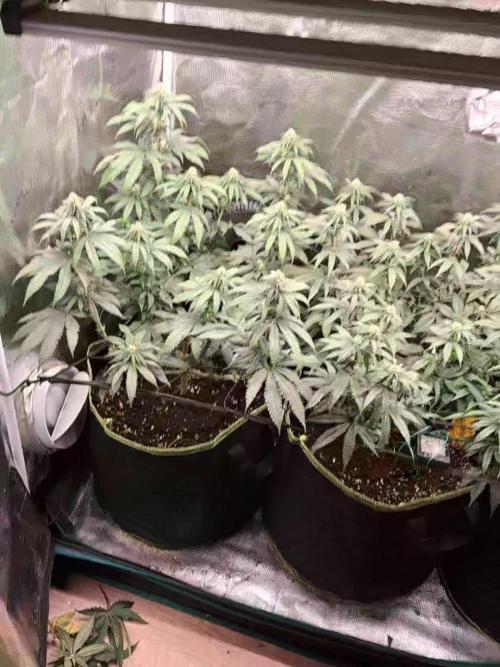
NEW BOX: 130x60x120
DIY: storage shelf, solid sheet metal
ELECTRO ################################
thermometer top
thermometer bottom
hydrometer
wlan ip cam (+ir filter)
----------------------------------------------------------------
input: x2 USB PC fan
exhaust: x2 USB PC fan
circulation: x2 USB fan
----------------------------------------------------------------
led panel 1: 300W ASUNDOM LED (Veg/Bloom/Full)
led panel 2: 300W XHGrow Reflector-Series LED (Full)
----------------------------------------------------------------
studio light 1 (vegetation): 36W TaoTronics LED Gold
studio light 1 (vegetation): 50W Balai LED full
studio light 2 (vegetation): 8W VINGO LED blue ligh
studio light 2 (vegetation): 50W Balai LED full
----------------------------------------------------------------
studio light 1 (bloom): 36W TaoTronics LED Green
studio light 1 (bloom): 36W TaoTronics LED Gold
studio light 1 (bloom): 50W JADIDIS LED IR full
studio light 2 (bloom): 36W TaoTronics LED Green
studio light 2 (bloom): 36W TaoTronics LED Green
studio light 2 (bloom): 36W KINGBO LED Deep red 660nm
3x PLANTS ###############################
FastBuds Girl Scout Cookies
pots: 14L
soil: plagron grow mix
Likes
31
Share


@Hempface86
Follow
Well here we are day 78 and she looks like she's got probably three or four weeks left.. I will say this she's starting to give off a smell that smells exactly like real blueberries.. I never thought I would say that but it literally smells like blueberries unbelievable I can't wait for this harvest to come.. I don't know if it's because I'm doing such a small pot grow but she's showing lots of deficiencies of everything I try flushing thinking possibly a nutrient lockout but then again I always feed to run off.. so what I'm going to do is just feed her for the next week week and a half and then just give her water for a couple weeks I feel like she's going to flush very quickly due to the small amount of medium.. hope everyone's having a great day and their plans are thriving .. Happy growing ✌️😎.
Day 82 and today I gave her 3 gallons of water to give her a real good flush as I see about 5 to 10% Amber.. I might give her one more 3 gallon flush and a couple days and then chopper after she dries.. hope everyone's doing great and their girls are doing great as well happy growing ✌️
Processing
Likes
2
Share


@QoverQ
Follow
Hi guys
Its the 3rd week of Flowering its doing much better than in Veg! The smell is starting to get intense :)
Im slowly adding some Big Bud into the nute mixture as it gets more flowers
The light is on 100% about 300W‘s


