


Processing
Likes
Comments
Share


@Tazard
Follow
She is off to a great start.
I sprouted her right in the rockwool in the DWC. Looking forward to see what we can make this lady do for us. My tent seems to work best with mature plants in the 36” range although my setup can handle 60” in height the width becomes an issue. I plan to flower her when she is about 16” tall.


Likes
28
Share


@GodZilla_Owner
Follow
The plants were repotted in their final pots of 7l. Growth has continued to increase strongly and I will top them all tomorrow. I have decided to keep all the plants.
I haven't fertilized them yet but I will start this week. The watering water has only been slightly adjusted with Epsom salts and CalMag and the pH value lowered from 7.5 to 7.0.

Likes
27
Share


@R_Dank
Follow
Nice to get the first month of flowering done! I believe these females will take just over another month, last 2 weeks of additives..

Likes
6
Share


@Mr_Height
Follow
Producing buds nicely this week - despite it being more susceptible to light burn than the other pheno. I had a similar plant but in auto form that went from green to yellow over night. It is just the genes. It looks sick but that's how it actually grows, I've learnt to accept the fan leaves don't stay looking green and lush for long from this pheno. It is still producing goods non the less!
Happy growing 🌱💚

Likes
11
Share

@MistaOC
Follow
Biotabs Interview
1. Tell us a bit about yourself: who are you, where are you from, and what do you do outside of growing?
I’m 40 years old and based in the western part of Germany, living a grounded life as a family man. My main profession is in sales within the automotive spare parts industry, operating in a large-scale B2B wholesale environment across Germany.
We work with around 7,500 active business clients, and my role is less about day-to-day orders and more about the bigger picture. I’m the first point of contact for business-related matters — handling contracts, partnerships, and acting as the face of our department. It’s a role that requires structure, reliability, and a strong sense for communication.
Outside of that, I’ve always been someone who works with his hands. I take on a wide range of manual projects — from tiling and drywall construction to more specialized work like sealing fire protection openings. I enjoy creating things, improving spaces, and paying attention to the small details that make the difference.
That mindset follows one simple rule: all or nothing. If I do something, I do it properly. This attitude has shaped me for over 40 years — and it naturally carries over into my grows and the way I document them. I put a lot of care into every step, from the grow itself to how I present it in my diaries.
If I had to describe my life in a few pillars, it would be four: my family, my main job, my hands-on side work, and growing. And growing isn’t just a hobby for me — it’s a real passion that ties everything together. 🌱
2. How did you get into growing? Tell us about your very first steps.
My first contact with cannabis goes way back to when I was around 14. Back then, there was no WhatsApp or social media — if you wanted to meet people, you’d call them or maybe send a (pretty expensive) text, and then everyone would just hang out in the same spot. For us, that place was simply “the street.”
I was one of the younger guys in the group, hanging around with a few older ones, maybe 17 or 18. One of them used to disappear into a nearby field every now and then — everyone knew what he was doing, even if it wasn’t really talked about. At that age, I was curious, but also a bit hesitant.
At the same time, I was heavily into football, and most of my circle came from there. One day, during some kind of event at the sports ground, I ended up trying it for the first time with some of the older guys. It wasn’t the smoothest experience, especially mixed with alcohol, but it stayed with me.
After that, things developed naturally. Our small circle grew, especially through school, and we became what you’d probably call a typical smoker group. The real turning point, though, was when one of the guys — who had just moved to our area — showed me his hidden grow in the attic. It was a super basic setup with fluorescent tubes, no real climate control, no deep knowledge — but he was growing his own plants.
That moment stuck with me. It sparked something. Even back then, I knew I wanted to do it myself one day.
That chance came years later. When I was around 22, I moved into my first apartment with my girlfriend — who is now my wife. For the first time, I had my own space, and that’s when I started my first real grow. I converted an IKEA cabinet in a spare room into a small grow space, just big enough for two indica plants. Nothing fancy, but it was mine.
I got my seeds from the Netherlands back then, and I kept growing for about two to three years. My setup evolved over time — back then it was all HPS lamps and fluorescent tubes, long before LED became what it is today. I still have my old Homebox tent from that time, and it’s funny — it still looks almost brand new.
At some point, life changed and we moved into a place where growing just wasn’t possible anymore. So I had to stop, even though the passion never really left.
Then came 2024 and the partial legalization in Germany. For me, that was the moment everything came back. It’s still far from perfect, but for growers like us, it opened the door again to follow this passion a bit more freely — and that’s when I picked it back up.
3. What role does cannabis play in your life – personally and as a grower?
Cannabis has fascinated me from the very first moment — whether it was the smell, the experience, or just the whole vibe around it. For me, it was never really about medicine in the beginning. It was more like a way to unwind, almost like a switch that brings you into a different, more relaxed state.
What always stood out to me was the feeling — that deep physical relaxation and the sense of connection. It was never something negative in my life. In fact, I’ve always preferred it over alcohol, both back then and still today. It just fits me better.
Depending on the situation, it can even sharpen my focus. Of course, it can also do the opposite if you overdo it — but used the right way, it helps me slow down, reset, and find that “end of the day” feeling.
Over time, though, my perspective has evolved. As you get older, your body starts reminding you that you’re not 20 anymore. I recently had a shoulder tendon injury, and that was the first time I really experienced the medical side of cannabis in a noticeable way. It helped reduce the pain and even improved my mobility — something I hadn’t really thought about before.
But as a grower, cannabis means something even deeper to me.
Growing is a true passion. It’s not just about consuming — it’s about the entire process from start to finish. Watching a plant develop, learning from each cycle, improving step by step — that’s what really drives me.
It’s not about being better than anyone else. It’s about becoming better than I was before. That mindset carries over into other areas of my life as well — always refining, always learning.
At the same time, growing teaches discipline. You can’t just let things run and expect great results. Timing, care, consistency — all of that matters. If you don’t put in the effort at the right moments, the outcome won’t be what you’re aiming for.
That’s why I don’t see it as something lazy or passive at all. For me, it’s the opposite. Growing brings structure, focus, and a certain calmness into my life. It grounds me — and that’s what makes it so valuable to me. 🌱
4. What growing method do you prefer and why?
I’ve always preferred indoor growing over outdoor. It comes back to my mindset — all or nothing. In my opinion, especially here in Germany, outdoor simply doesn’t give me the level of quality I’m aiming for. Indoor gives me full control, and that’s exactly what I want.
At the same time, I’m someone who constantly experiments. Even if I know it might cost me yield, quality, or cause stress to the plants — I still do it. That’s how I improve. I need to see things with my own eyes and learn from my own experience to really understand what works best for me.
I’ve always grown in soil. Over time, my setup has evolved a lot. I started with simple plastic pots, switched to fabric pots after legalization, and now I’ve come full circle back to plastic pots — mainly because I moved into an AutoPot system, which fits my current approach better.
My goal today is to keep everything as efficient and stable as possible. I run an automated watering system connected to a 50-liter tank, which is filled through an RO system that I can control via app. The water runs through a calcium filter to help stabilize the pH. I’m not chasing perfect numbers anymore — as long as it’s stable and within a good range, that’s what matters more.
In general, I prefer working with organic nutrients. For me, it’s important to know that the final product is as clean and natural as possible. I’ve gone through all the typical struggles before — adjusting pH, dealing with deficiencies, spending hours mixing water — and over time I’ve simplified my system more and more.
That’s also where Biotabs fits perfectly into my setup. It’s a very natural match — simple, organic, and reliable. It allows me to focus more on the plants themselves instead of constantly adjusting inputs.
My standard setup is pretty consistent: a 1.2 × 1.2 m tent, around 480W LED, AC ventilation with a carbon filter, and usually five plants. I top every plant at minimum, veg for about five weeks, and often run a SCROG net to maximize the canopy.
But even here, I keep testing things. For example, I’m currently experimenting with and without a SCROG to see how it affects yield — because in the end, I’m not only chasing quality, but also efficiency.
That’s really my approach in a nutshell: build a solid system, keep it simple, but never stop refining it. 🌱
5. Which strain is closest to your heart and what fascinates you about it?
That’s a tough one — I don’t think there’s just one single answer.
In general, I’ve always been a fan of fruity, citrus-forward strains. Every now and then I also enjoy something more gassy, but if I had to go with what naturally comes to mind, it’s actually the very first strain I ever grew.
Back in 2012, during my first grow, I ran Super Skunk from Vision Seeds — and to this day, that one stands out. Funny enough, that first grow was probably my best one in terms of how it felt at the time. Everything was new, exciting, and that final product just hit different. Grown under a simple 400W setup, nothing compared to what we have today — but it was, without a doubt, the best weed I had smoked up to that point.
It’s not just about the strain itself — it’s about the moment, the experience, and what it represented.
At the same time, there’s another one I have to mention: Amnesia Haze (Core Cut). That strain is pure nostalgia for me. It was everywhere when I was younger — that classic haze we all knew. Growing it myself today brings back a lot of memories. It’s like a throwback to those early days, but now with the knowledge and control to really do it justice.
So if I had to sum it up: one strain represents where it all started for me, and the other connects me to the roots of the scene I grew up in.
6. What has been your biggest learning moment as a grower – a mistake or a success that helped you grow?
One of the biggest lessons I’ve learned as a grower is that routine can become your biggest enemy.
When you grow consistently over time, you start to build confidence — and that’s a good thing. But at some point, that confidence can turn into complacency. You think you’ve seen it all, you start skipping small steps, and you tell yourself, “it’ll be fine.”
That’s exactly where problems begin.
Looking back at my earlier grows, especially before my longer break, my setup simply wasn’t good enough. I was growing under the roof with temperatures easily hitting 30°C, humidity was all over the place, and the environment just wasn’t dialed in. On top of that, I started letting things slide because I thought I had it under control.
That combination was my wake-up call.
Since getting back into growing after legalization, I’ve taken a completely different approach. I take it seriously now — not just as a hobby, but as something I want to master. And I also recognize that being able to grow under good conditions is a privilege. There are a lot of factors that need to align — your environment, your living situation, responsibility, especially with family — it’s not something you can take for granted.
What really keeps me hooked is that growing never gets boring. I’ve had many hobbies in my life, but this is the only one that never lost its appeal. Even the “dirty work” — cleaning the tent, dialing everything in — it’s all part of the process.
Of course, I’ve made every mistake you can imagine. Overfeeding, underfeeding, overwatering, underwatering — pests like aphids and thrips, and currently my biggest challenge: powdery mildew.
That has been my toughest opponent so far. Even with controlled humidity, it can still show up, and it forces you to really understand your environment and your plants. The difference now is: I know how to deal with it. It’s under control, and that’s what growth is about — not avoiding problems, but learning how to handle them.
Every mistake teaches you something. And over time, you build the confidence that no matter what shows up, you’ll find a way to fix it.
7. What does your typical grow routine look like – how much time do you invest and what do you enjoy most?
My routine is pretty structured — I like to keep things consistent, but still leave room for adjustments when needed.
It all starts with popping seeds. I usually germinate around five to six and then select the strongest five to continue with. They begin in small 0.2L pots under a humidity dome, using Canna Professional soil enriched with Biotabs Startrex according to the feeding schedule.
After about two and a half weeks, I transplant them into 15L AutoPot containers. At that point, I water them in manually — first with about one liter of RO water, followed by another liter mixed with nutrients according to the schedule.
After that, I give them a few days to settle before watering again — usually around five to six days later, again with RO water. This approach has worked well for me to avoid overwatering and to let the roots establish properly in the new medium.
Even though the AutoPot system is already set up, I don’t activate it immediately. During the vegetative phase, I prefer hand-watering to encourage strong root development and avoid overwatering early on. Once I’m close to flowering, I switch the system on — basically just opening a valve, and everything runs automatically from there.
From that point on, the workload drops significantly. I don’t really have to worry about watering anymore. Nutrients are kept simple as well — every couple of weeks I add a small top feed, and that’s basically it. Compared to how complicated things used to be, it almost feels like it runs by itself.
That allows me to focus on what really matters: the plants.
I still check on them regularly, usually every evening when I’m home. Not because I have to, but because I want to. Instead of mixing water or adjusting pH, I can actually observe — the leaves, the structure, the bud development. That’s where the real connection happens.
That’s also when I decide what to do next — defoliation, LST, sometimes HST, or working with a SCROG net. It’s not always a fixed plan, more a combination of experience and feeling in the moment.
Environmental control has also become a key part of my routine. I start with around 70% humidity during germination, then gradually bring it down — around 65% in early veg, and closer to 55% after transplant. Keeping things stable has made a huge difference for me.
After roughly five weeks of veg, I flip to flower. From there, it’s about maintaining the system and letting the plants finish strong. Flowering usually runs around 8–10 weeks, depending on the strain.
And then it all starts over again.
What I enjoy most is exactly that balance — having a system that runs smoothly in the background, while I can fully focus on the plants themselves and the craft of growing. 🌱
8. What advice would you give beginners who are just stepping into the world of growing?
If I had to give one piece of advice, it would be this:
The rule is…there is no rule.
That’s my mindset, and it’s something I truly believe in. Of course, there are guidelines, best practices, and a lot of information out there — but in the end, every grow is different, every environment is different, and every plant reacts in its own way.
So instead of trying to follow everything blindly, sit down, observe, and learn from the plant.
Growing is a process. You won’t get everything right from day one — and that’s completely normal. Mistakes are part of it. In fact, they’re one of the most important ways to learn.
Today, it’s easier than ever to get into growing. There’s endless information online, tutorials, perfect pictures, and step-by-step guides. But that can also be misleading. You see these flawless results and think that’s the standard — but what you don’t see is the experience behind it.
When I started, it was completely different. There were forums, very limited pictures, and you had to figure out a lot on your own. That forced you to really pay attention and understand what was happening in front of you.
And that’s still the most important skill today.
Look closely at your plants. They will tell you what they need — through their leaves, their structure, their growth. Once you start understanding that, everything else becomes much easier.
So don’t chase perfection. Learn, adapt, and enjoy the process.
And most importantly — enjoy the grower’s life. 🌱
9. How did you first hear about Biotabs and what made you want to try it?
I’ve actually known about Biotabs for a long time.
Back when I first started growing, I was running a fully mineral setup — using products like Canna Vega and Flores. At that time, the market wasn’t nearly as saturated as it is today, but brands like Hesi and Biotabs were already around. I remember seeing Biotabs on the shelves back then, but I never really made the switch. I just stuck to what I knew.
My first real contact with Biotabs came much later, when I started diving deeper into soil biology — things like mycorrhiza and trichoderma. I became more interested in how the soil itself works and how to build a healthy microbial environment.
That’s when I came across Bactrex.
Funny enough, looking back now, I was using it completely wrong. I treated it like a different product and just added it straight into the planting hole, thinking that’s how it’s supposed to be used. Whether that was beneficial or not… I guess only the plants know.
But that was my entry point into the Biotabs world.
From there, I started learning more, testing different approaches, and understanding how the system actually works. Over time, I moved further and further away from mineral feeding and more towards a biological approach.
And the more I experimented, the clearer it became to me: the combination of organic growing with a simplified system is exactly what I was looking for.
10. How has Biotabs influenced your grow and what do you appreciate most about the product?
Biotabs has made my grow simpler, more stable, and overall more controlled.
Before, I spent a lot of time adjusting things — mixing nutrients, checking pH, reacting to problems. With Biotabs, that complexity is reduced to a minimum. The system is straightforward: prepare the soil, add the tabs, water it in properly — and from there, it’s mostly just water.
And the surprising part is: it works. Really well.
For me, it fits perfectly into my current setup and mindset. I’ve built a system that is as efficient and automated as possible, and Biotabs complements that in the best way. It allows me to focus on the plants themselves instead of constantly managing inputs.
That’s what I appreciate the most — the balance between simplicity and performance. You don’t have to chase numbers or overcomplicate things to get great results.
At this point, it feels like a natural fit — almost like a symbiosis between my way of growing and the product itself. And once you find something that works reliably on that level, there’s really no reason to change it.
For anyone who wants to grow organically and take their setup to the next level, it’s definitely worth exploring. 🌱.
Likes
4
Share


@Skinnytalls420
Follow
Another easy auto to grow looks like she’s gonna come out amazing
When dried let’s see how it goes!!!


Likes
18
Share


@rhodes68
Follow
Adjusted the nuet list to reflect reality at this point dont see need for anything else.
8/31 Still building and looking well so will keep doing what we are, just keep her happy for a few more weeks ;)
9/1 Still not feeding till tomorrow thinking last use of Recharge and Bio-Bloom
9/4 Day 61 Looks good this morning pics later
9/7 Re-adding Big Bloom (Fox Farms) to nuet mix, plants seem to be missing it and I agree. Once a week at 3 tps/gal

Likes
17
Share


@CanabisLoverHobbyGrower
Follow
Zkittles defo hit stretch this week and started showing more bud sites, smoothie has been as straight forward as always ,.. everything looks good to me, defoliating zkittles is crazy, the rate the leaves grow back I've never seen anything like it but hopefully now will start putting the effort into the bud sites,... roll on next week 👌
Likes
14
Share


@MUSRIME_supreme
Follow
В нашем регионе, аутдор бесполезен :)
Проще было все эти семечки вырастить в индоре.
Всем спасибо за просмотр =)
Likes
7
Share

@jellyjelly
Follow
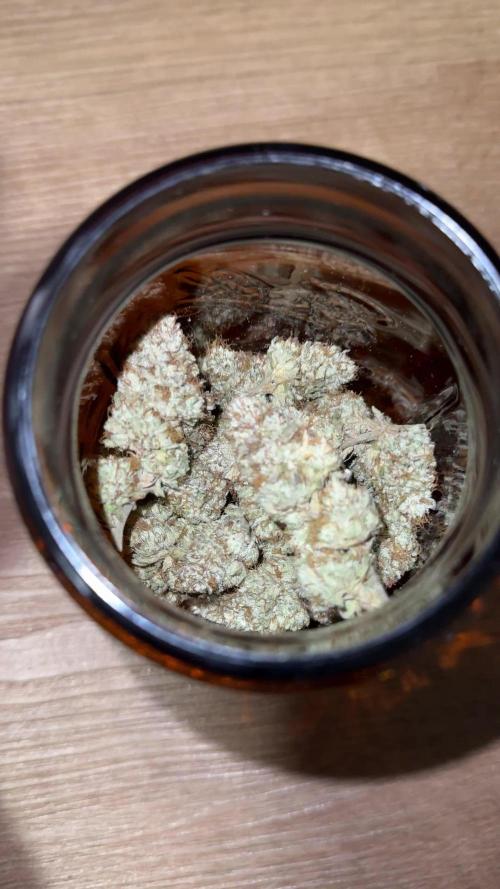
Harvest and cure complete!
These turned out so frosted and much better than I expected. I grew to phenos.. both smell light like berry followed by either heavy creamy gas or straight gas.
Pheno 1 (creamy was the darker of the two plants)
While I think the small pots prevented this from being even more loud, along with my watering mishaps, I’m very content with the terpiness and yield!
Likes
58
Share


@GermanGrow182
Follow
Wetter war gut, nur einmal Regen, 3 fat banana sind im trockenraum, die anderen beiden kommen in den nächsten Tagen dazu.sind fast fertig. Die zz legen an buds zu, wie sie sollen, Nr.5 schon im fading... special queen macht sich langsam. Toppen war die richtige Entscheidung. Critical verzweigt sehr gut 👍. Lst funktioniert. Nächste Woche kommt der erste erntebericht... ich freu mich. Bis nächsten Freitag ✌️


Likes
26
Share


@Ukfarmer420
Follow
So I am entering week 2 of the 12/12 flip, the ladys are showing sex so hopefully later in the week I will get actual pistils so I can start counting down flower days.
Day 9 seen pistils but I had to perform a major defoliation as under the canopy was bad and I didnt want powdery mildew due to leafs sweating ect.
Day 10 24 hours after defoliation, you could not tell I done a thing to them, im hoping its just a odd leaf now and then thru the rest of the flowering period.
Any advice is welcome guys 🙏
I will be adding more fans for airflow.
Day 12 of the flip and the girls are on there way to becoming ladys lol I think there's going to be a few nice kolas in there when done, ordered the new box fan for the floor to create more airflow to reduce the risk of pm and mold.
I need to top up soil as roots are showing so under the net I go again. Wish me luck.
Likes
246
Share


@mcflow
Follow
Im super happy with this week, buds keep growing, i cuttet off some leaves here and there but no huge amounts, only to keep it well circulated and lower the risk for mold and stuff. If it keeps growing at this rate im gonna end up with some really huge main colas


Likes
4
Share


@Brentb2607
Follow
10 days of darkness during the flush begins. Had great results with Wanda and her genetics. Blessed for a first grow. Cut Wanda down at the end of the week. She’s now drying. I will be giving a thorough review for my harvest diary. Excited to share what I’ve experienced and learned from this grow.

Likes
11
Share


@Rko41
Follow
Beau bebe de 2,04 m il se plaît bien je pense qu’il a fini de stretch beaucoup de soleil cette semaine il a apprécié j’ai appliqué un peu de guano de chez top crop en griffage avec un peu de sel d’epsom


Processing
Likes
49
Share


@Kambi
Follow
Starting to see the preflower and one of 3 is asymmetrical... worried it might turn out to be a hermaphrodite plant.
Also scared to bend the stem to lst, don’t wanna snap it. Any tips on how to start lst with main stem foolproof much appreciated 😅
Should I let them dry out a little more then usual when bending or it’s not going to soften the stem? Should I counteract the top tension point of the bend with one on the bottom for support and do it gradually every day?
Likes
105
Share


@StarLorr
Follow
Welcome to my autø Møøn Røck 2 Diary.
In this Diary:
Seeds: Sponsored by Ðivine Seeðs
Media: Pro~Mix HP *•ns
Nutrients: Remo Supercharged Kit *•ns
*•not sponsored
___________________________
Feeding:
Tue 05Nov: 2L Remo/Recharge pH'd 6.5
Fri 08Nov: 2L Remo/Recharge pH'd 6.5
___________________________
Buds are puffing up nicely
___________________________
Thanks for stopping by, likes and comments are appreciated!👊🏻😎
Keep on growin!
Keep on tokin!!!
😙💨💨💨💨💨
