


Likes
Comments
Share


@CreamyNuggets
Follow
So far all plants have been harvested. (3x Bubba Pupil, 1x purple wreck, 1x AK-47, 1x Godberry). The first bubba pupil and AK-47 were harvested a week and a half ago and now have been jarred for 1 week +/- a few days. All pictures are of the bubba pupil and AK. I will come back and update once the other plants have been trimmed.
The first Bubba Pupil, which was the tallest of the 3 and most stretched out, yielded exactly 4.5 Oz dry weight. The smell is starting to get stronger after a week. It smells grapey but has a weird funk to it. It must be the “pupil” funk everyone talks about. This plant looked like it wasn’t going to yield much, but I was pleasantly surprised. The lowers were dense and compact which contributed to a good amount of decent sized buds. Overall, I’m pretty pleased with the yield and quality from this plant.
The AK-47 seemed like it was going to be a heavier yielder, but it ended up only yielding 2.5 Oz dry. The main colas were far during flower and dense when dried, but this plant had little to no lower quality buds. Everything below the main canopy seemed like it was airy and not worth jarring up. This plant smells a little bit fruity, but I can’t really put my finger on it. Super dank smelling, not skunky, but it smells like it is going to be gaseous once it cures up a bit longer.
The Godberry yielded a total of 3.25 Oz. She was the best smelling by far out of all of the girls in the tent. Super fruity and sticky as hell. The resin content on her was definitely the highest of them all.
I will be back to update once the last 3 plants are trimmed and jarred for a final weight and overview.

Likes
7
Share


@El_Bottanico
Follow
Somehow I counted weeks in a silly way, so I thought this was week 8 but it's still week 7. LoL.
Plant is doing great anyway,
She's big, exceeding 70 cm diameter, With so many colas at canopy level I expect her to yeld very big fo an Autoflowering strain,
The training succesfully shaped her resulting in 10 branch reaching the top canopoy level. To me the key to a good training is timing, much more than continuous adjustment. This plant was bent just one time on main stem and one another time little later the branches.
We had rainy days so I used a dehumidifier for a day or two, now it's dry again outside so no need for it anymore.
She's still thirsty like a bitch as she drinks 5 liters of water every two day. Maybe I'll make a drip sistem for my next grow, watering has been boring lately.
I'm not giving her anything to the end now, she's doing fine like this. The humus coupled with slow release fertilizer is doing a great job.
She has some nitrogen excess to me, but she's the only plant to show it in a batch of 6. The issue seems very small to me anyway.
Day 48 checked trichomes, some is turning milky already, can't wait for the buds to ripen :)
Ciao Bottanico

Likes
38
Share


@Green_Mountains
Follow
Another solid week of growth!! The two big plants nearly doubled their height and both had a lot of undergrowth this week! I plan on trying my hand at LST tomorrow. I added more soil into the pots yesterday. I still feel it is too low but I don't want to shock the plants too badly. I watered after lifting the plants up some and adding the soil. I plan on feeding them tomorrow night.
The first white pistils have sprouted and there is a distinct aroma of marijuana in the air!! I hope they hold off another week before really start to flower. It's amazing how fast a month can go by!
I may not keep the little plant past this week. We'll see if she makes it that far...
Here's to another week of healthy growing!! Peace!


Likes
4
Share


@ibbzy
Follow
Slight accident this week where the red spectrum bar had popped of the railing and fell on the front row of babies and burnt them :( they’re recovering
Everything seems slow in this compost/coco soil mix but hey…chugging along.
I think I may go full coco next run.
I believe they should start focusing on bud now have top dressed once more with compost & 2-8-4.

Likes
3
Share

@CannaWolf420
Follow
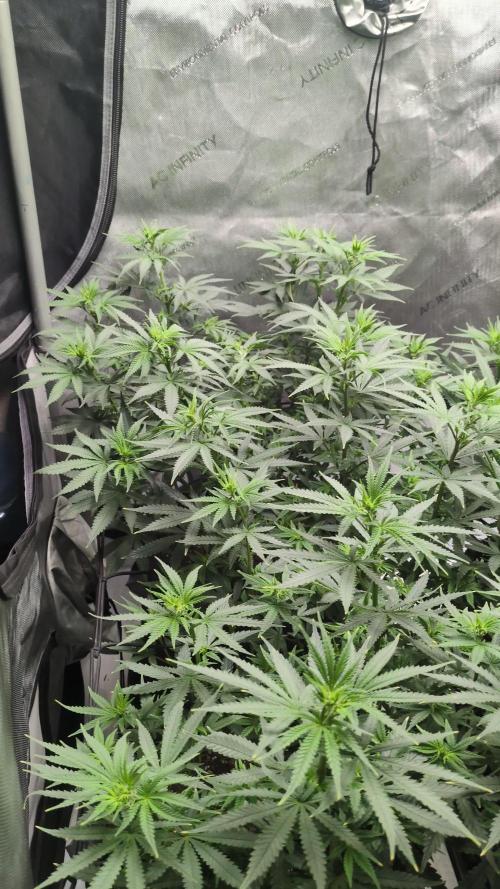
First week of flower has come and gone. Had a slight PH problem in the ladies that with a little help from some growmies we got it fixed just before they started the stretch faze. Now I've done a small defol just to get rid of some bigger fan leafs blocking the lower growth. And cut out anything that was hindered from the dominant branches.. she should get one last defol in two weeks. And will be starting the PK regiment after next week.

Likes
37
Share


@weedgrowlover
Follow
Its a soft smoke, But feels good and relaxed
This strain will be done a next time..
Its a smoke you will not forget
--------------------------------------------------------------------
This is the last one thats still going on.. I have cut 11 and I gave 3 away..
But this lady is a hard to get... Hopefully I can smoke her before 2017
Likes
52
Share


@DogDoctorOfficial
Follow
Week 8 night fro day 1 in to day 2 and all is going as planned 😁 i broth down my lights to a 50% power, this gives me a 500 ppfd, also reduce the shedule to 9h light.
Hoping for great medicine on this run 🙏
5x White Mango WM
5x Alasken Purple AP
4x Blueberry BB
3x SAD S1
2x Badazz Cookies BC
19 in total for a 4x8x6 - 1,2x2,4x2
Light Lumatek Zeus 465W compact pro 2x at 50%
All i Grow is medicine for myself,
Stay safe, stay tuned and B Happy and do it for the love
Peace ✌️
D


Likes
3
Share


@TheGreenGroomer
Follow
We’re kicking off week 3 of veg today, and things are looking up. She seems to be bouncing back nicely from that magnesium deficiency—leaves are perking up, color's evening out, and overall growth is picking up again.
I topped her at the 5th node and gave her some light LST. After about 3–4 days of recovery, I removed a few lower leaves that were sitting in the dirt and getting in the way during watering.
Feeding her 500 PPM at a pH of 5.8

Likes
8
Share


@0ni_wan_kenobi
Follow
This week the plants went through a lot of training. First, at the beginning of the week, the humidifier was taken out, the light was set to 4, and I applied worm castings to reduce the Ph level. Then two older plants got topped, and applied LST on the main branches. I rolled the main branches between my fingers to soften the branches until they are limp. Then tied down the tallest branch. Then, the rest of the plants got topped. By the end of the week, ALL of the plants were topped at the fifth node and trimmed under growth, up to the third node. This prepares them for top bud production and sets the plants into healing mode. Which will increase yield and terpene production.
Note: the baby Lemmosa plants are very healthy and vibrant and young enough to withstand the HST!
Likes
40
Share


@BudBoutique
Follow
Welcome to Bud Boutique Grow Diary - really appreciate all your love and support :)
Don't forget to check out my other current grows!
🗓️ This Week:
- Day 52: the end is near - faded out super strong and could handle her how I would like.
- Day 53: Trichomes check - looking super good almost all cloudy, a few amber and clear. perfect point to chop
- Day 54: this one is finished, let's chop them !! ✂️✂️✂️
- now its time to dry inside the tent at about 60%rh and less than 20°C/68°F trying to get it even lower for the next 10-14 days
Thank you for still staying with me 💚
___________________________________________
--- 🌱 Strain (Sponsor) ---
🏷️ Wedding CheeseCake by Fast Buds
https://2fast4buds.com/seeds/wedding-cheesecake-fast-flowering
--- 🥗 Nutrients and Feeding (sponsored by APTUS: APTUS Ambassador) ---
🍸 APTUS: full nutrient schedule extreme
-- Regulator, N-Boost, P-Boost, CaMg-Boost, K-Boost, Allin1 Liquid, Startbooster, Topbooster, Enzym+ every feeding
-- Fulvic-Blast, NutriSpray as Foliar each once a week
🔗 https://aptus-holland.com/
--- ♻️ Grow Control (Sponsor) ---
TROLMASTER: TENT-X + LM14 Light Adapter to dim/sunrise/sunset lights + Temp & rH Sensor all remote on App
🔗 https://www.trolmaster.eu/
--- 🚿 PetraGrow (Sponsor) ---
CannaFogger Foliar Spray
🔗 https://www.petratools.com/product/petragrow-cannafogger-atomizer-new-mini-fogger
--- 🏭 Grow Setup ---
💡LUMATEK Zeus Pro 600
* 🏠🌿 Indoor: Homebox 120x120x200cm (4x4)
* 📐🌀 PrimaKlima exhausting Fan 1180m3/h (running on 60-80%)
* 🌀 Can Light Filter 800m3/h & 1x Fanbox 1x Dyson fan for Air circulation
🔗 https://lumatek-lighting.com/zeus-600w-pro-29/
🔗 https://primaklima.com/de/shop/ventilatoren-de/ec-ventilatoren/pk160ec-tc/
🔗 https://canfilters.com/products/filters/
All Likes and comments are highly appreciated!!!
👨🌾 don't forget to check out my Instagram for daily educational content: budboutiquee
- Bud Boutique
Likes
38
Share


@Hashy
Follow
📋 Comments
Lemon cherry gelato by MNSL Is a good plant to grow. She has produced some nice flowers and is a very forgiving plant.
📋 Data
Seed to havest=113 days.
Veg time=35 days.
Flower time=78 days.
Wet weight=917g
Dry weight=104g
📋 Smoke report
After 11 days of drying i trimmed half the plant (trim jail) and finished trimming the day after, it. Not the easiest to trim and not as dense buds as the other plant in the grow but damn this lemon cherry gelato is absolutely dripping with trichomes and has a really fruity smell. There is a decent amount of trim to run some bubble hash.
This is an excellent smoke, quiet sweet with citrus/lemon and slight cherry or fruity taste to it. Quiet strong maybe 25%THC.
📋Grow stats for GDG 22
#1 Lemon cherry gelato=104g
#2 Zoap=79g
Total=183g
Lights on.
20hrs×7days=140hrs
18hrs×33days=594hrs
12hrs×78days=936hrs
Total hours=1670hrs
Light power=211.09Kw
Rad power=415.73Kw
Extractor=43.5Kw
4 gang=56.62Kw
Top fan=27.82
Total electricity=754.76KW
Electricity cost @£0.25/Kw=£188.69
Average light power a day=1.78Kw
Average watt per hour=106w
g/watt=(183÷106)=1.72g/w
£/g=£1.03/g
📋Final word.
Considering how cold it's been i have managed to get a decent VPD throughout the grow, I'd go as far to say the extra money spent on electricity was definitely worth it. I didn't run into any major problems and the Plagron nutes were excellent, I'm thinking these are going to be my goto from now on. I combined the trim from both plants to make a hash run and managed 14g of hash. That takes my total to 197g for the grow. Very happy.
Back soon.
Take it easy.
********************************************

Likes
9
Share


@Cestlaweed
Follow
La temperatura sigue elevada debido la zona, pero las plantas no presentan problemas y se cuenta con buen sistema de ventilación.
Día 18 noche se riega con 1ml/L de Top Veg, fertilizante de crecimiento de TopCrop.
Día 19 segundo día de entrenamiento
Likes
51
Share


@nonick123
Follow
Día 64 (23/12) Christmas holidays. Only watering
Día 65 (24/12) Christmas holidays. Only watering
Día 66 (25/12) Christmas holidays. Only watering
Día 67 (26/12) Christmas holidays. Only watering
Día 68 (27/12) CBD Auto 20:1 #1 - Riego con 0,5 litros de PK Booster Compost Tea
OG Kush Auto - Riego con 0,5 litros de PK Booster Compost Tea
Preparación del Té de Compost
Ingredientes
Agua Osmosis o Agua declorada durante 24 horas: 1 Litro (o la cantidad que necesites)
PK Booster Compost Tea: 15 g/L
ORGATREX: 5 ml/L
BACTREX: 1 g/L
Instrucciones:
Airear con una bomba de aire de pecera durante 24 - 36 horas a 20-25 ºC
Añadir BACTREX (1 g/L) 30 minutos ANTES de parar la aireación
Usar el Té inmediatamente al apagar la bomba de aire
Usar 0,5 Litros de Té por Planta
Día 69 (28/12) Christmas holidays. Only watering
Día 70 (29/12) Christmas holidays. Only watering
💦Nutrients by Bio Tabs - www.biotabs.nl/en/
🌱Substrate PRO-MIX HP BACILLUS + MYCORRHIZAE - www.pthorticulture.com/en-us/products/pro-mix-hp-biofungicide-plus-mycorrhizae
"GDBT420" 15% DISCOUNT code for the BIOTABS Webshop https://biotabs.nl/en/shop/
With 2 x Mars Hydro FC1500 EVO Led Grow Light (2024 NEW FC 1500-EVO Samsung LM301H 150W LED) - https://marshydro.eu/products/fc1500-evo-led-grow-lights/ - https://www.amazon.de/dp/B0CSSGN5D8?ref=myi_title_dp
Likes
Comments
Share

@JVKdopegrow
Follow
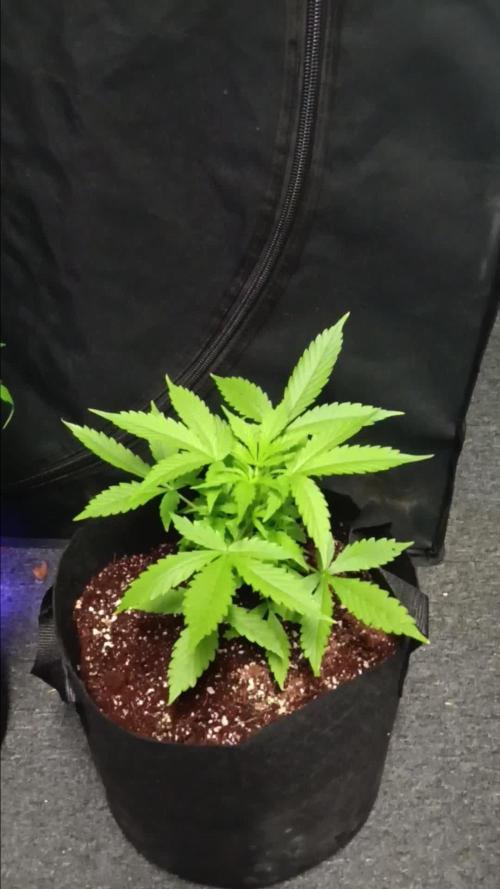
One girl has stretched, the other very much a squatting bush. Both appear healthy, with good stems and leaf growth. Just going to let them do their thing and admire them on occasion!

Processing
Likes
10
Share


@UrbanFog
Follow
Plants continued to mature this week and all the buds are getting fat they will have there last nutrient feed this week in prep for flushing and harvest next week.
The Lemon Zkittles looks and smells amazing looks amazing. Nearly all the plants look and smell the small, good genetics and breading.
The Cxx is again a very stable genetics and flowered and smells exactly as the last grow did. Good genetics.
The Peyote Cookies and Shishkaberry also grew well and similar, good genetics.
Afghan Kush amazing buds and very earthy smell.classic
The gorilla cookies had a rather large variation in pheno types but all look amazing and each will be a pleasure to smoke.


Likes
45
Share


@KrautFabrik
Follow
Day 54: added some nematodes to kill the fungus gnats
Day 56: nutrients like plan
Last feeding
Pictures are taken on day 56
---------------------------------------------
She develops great buds and is getting some nice colour😎👍 she is the Queen of this run 😁
Happy growing 🍌🌱



Likes
109
Share


@buddha61
Follow
Day 127 - Watered/fed today. About 180 oz of water given, with 1/2 tsp Bloom, 1/2 tsp Mag Pro per gallon. It is anticipated that this is the last feed, and will be given water only, the next 2-3 feeds before harvest, to flush/fade the girl (come on autumn colors!). I happened to be searching a couple buds and found my first 3 amber trichs on a calyx. The final countdown has begun!
Day 128 - Nothing to note, I was lucky to be around enough to get the photo.
Day 129 - I feel like there has been some new calyx development over the last few days, but I am still going with my plan to flush 2-3 times before a harvest. I feel like if I was properly set up, and honestly stocked with current flower, I could probably let this thing go another 3 weeks (rookie grower thoughts), but I am still looking to harvest in 10-12 days. Talking to a few different people, ran a few ideas past me, but I think I am going with my plan for this first grow. Someone mentioned one more big bloom feed before a flush, but I think I'm just ready to be done feeding. The idea of 24 hours of darkness before harvest to 'boost trichs' was brought to me by another person, and I am still unsure of my thoughts on that plan.
Day 130 - The 'flush' has begun. Today the plant was given 2 gallons of water, which is almost 50% more than was given with feed, as she had been getting 180oz or so of water. You can really tell the difference in the amount of runoff! Lets see how long she takes to really show a fade.
Day 131 - I got nothing for today. Snapped a pic and bolted out of the house.
Day 132 - Again, sadly, I got nothing for today. A picture and out the door.
Day 133 - 11 weeks of flower are down. She was watered today, with another 2 gallons of water only. I added a small amount of new Mother Earth Coco Peat to the pot, in my mind, just to ensure that she doesn't fade out too quickly. Probably a bit unnecessary and may not help, but I did it anyways :) I originally planned on chopping likely at the end of this weekend, but I might see if she can hold out 2 more water only feeds, and chop next Thurday-Friday, at the end of the 12th week. I keep checking a few buds with the loupe, and still can barely find any amber, but also don't see any clear trichs. Either way, I am going to be anxious for this last week to finish up, then the real test of waiting will come, hanging and curing!
