Likes
Comments
Share
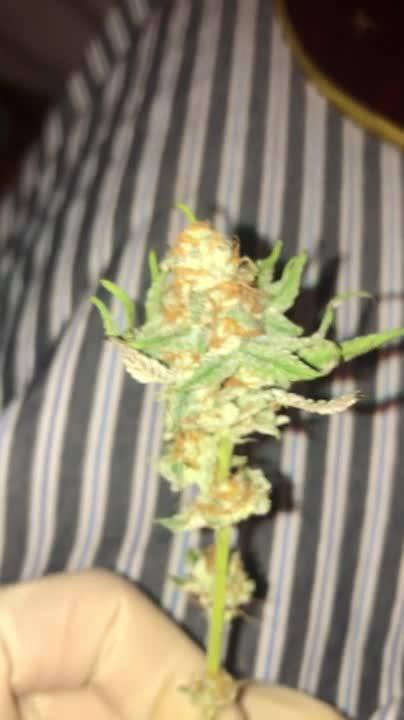
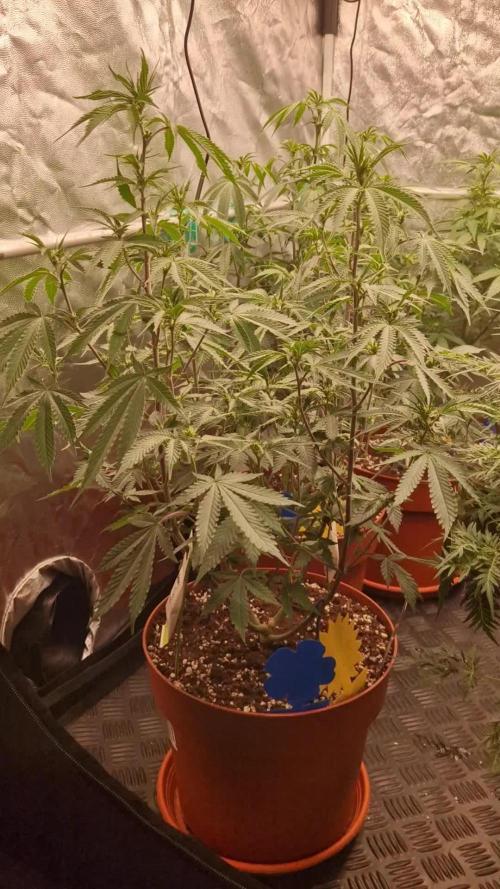
На прошедшей неделе не случилось ничего необычного, продолжаю формировать зеленый экран, и это довольно увлекательное занятие, как-будто собираешь большой живой пазл. Некоторые загнутые под Scrog ветки скручиваются по спирали, уже начинает вырисовываться будущая структура кустов, пока всё в норме. Повторно внёс Delta9, в этот раз под корень. В конце недели(55 день) сделал дефолиацию, признаков цветения пока не обнаружено, но я и не тороплюсь. upd: 56 день, заметил первые стигмы, начался предцвет. Спасибо, что заглянули, и будьте здоровы! 🙏 Продолжение следует ...😶
Likes
6
Share
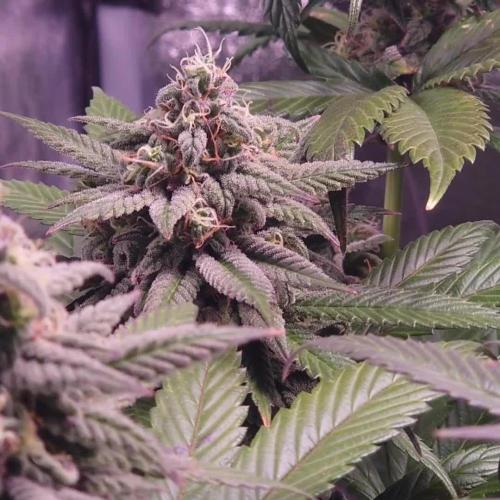
D71/F24 - 11.29 - There's not much to say about these two. They didn't even hiccup after the defoliation, though it does appear their stretch has just about finished. They both have fat greasy prebuds right now, and the Passion Berry has particularly long pistils. A pleasure to watch em grow! <3 D76/F29 - 12.4 - Just like holy fuck these things are monsters. 🙏🙌 Praise be to Swerve 👑, I'm astonished at the pace and vigor of these two plants
Likes
13
Share
@gr3g4l
Follow
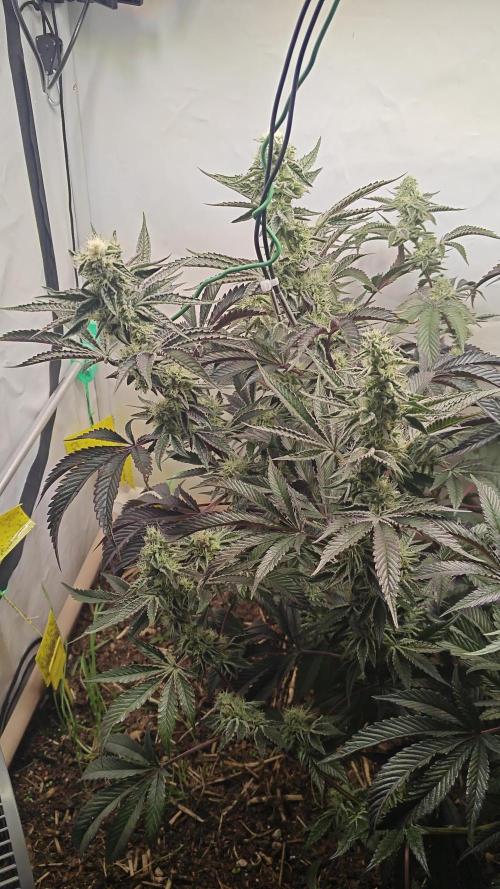
Empezamos la semana cambiando los nutrientes al observar ya unos pequeños pistilos o estigmas , en definitiva, empezaron a mostrar tímidamente el sexo. Empiezo con poco y iré subiendo la dosis hasta 4ml/L hasta que vuelva a cambiar de nutrientes. Creo observar del Lumatek ATSpro que le fataria un punto de luz en el centro del panel. Por lo general con otras luminarias la planta del medio me solia crecer mucho mejor y esta vez está quedando retrasada. Seguiré cultivando y si me sigue pasando lo mismo entonces no tendré ninguna duda, por ahora solo son conjeturas, xd De lo anterior rectifico , tengo que decir que pasados dos dias lo estoy viendo diferente, la del medio parece que sigue por buen camino, ahora apenas notaria la diferencia. La semana anterior, la sexta, se les hizo una segunda pulverización con dosis alta de 3ml/L con spiderbloom ( "fitofortificante de impacto muy rápido") pero de nada sirvió, durante esta semana subió la temperatura a 30ºC un par de dias y las arañas salieron a pegarse el gran festín. Una vez constatada la existencia de araña roja correteando por el envés de las hojas solo toca desinfectar bién el armario, lavarlas a todas una a una con agua corriente para arrastrar el máximo de arañitas y una vez secas darles con algun acaricida químico. De no hacerlo ahora me seria imposible más adelante y no tengo ningunas ganas de dejar perder este cultivo. No soy partidario de lo químico pero menos de dejarlas perder.
Likes
52
Share
Lacewings seemed to have mostly killed themselves by flying into hot light fixtures. I may have left the UV on which was smart of me :) Done very little to combat if anything but make a sea of carcasses, on the bright side its good nutrition for the soil. Made a concoction of ethanol 70%, equal parts water, and cayenne pepper with a couple of squirts of dish soap. Took around an hour of good scrubbing the entire canopy. Worked a lot more effectively and way cheaper. Scorched earth right now, but it seems to have wiped them out almost entirely very pleased. Attempted a "Fudge I Missed" for the topping. So just time to wait and see how it goes. Question? If I attached a plant to two separate pots but it was connected by rootzone, one has a pH of 7.5 ish the other has 4.5. Would the Intelligence of the plant able to dictate each pot separately to uptake the nutrients best suited to pH or would it still try to draw nitrogen from a pot with a pH where nitrogen struggles to uptake? Food for stoner thought experiments! Another was on my mind. What happens when a plant gets too much light? Well, it burns and curls up leaves. That's the heat radiation, let's remove excess heat, now what? I've always read it's just bad, or not good, but when I look for an explanation on a deeper level it's just bad and you shouldn't do it. So I did. How much can a cannabis plant absorb, 40 moles in a day, ok I'll give it 60 moles. 80 nothing bad ever happened. The answer, finally. Oh great........more questions........ Reactive oxygen species (ROS) are molecules capable of independent existence, containing at least one oxygen atom and one or more unpaired electrons. "Sunlight is the essential source of energy for most photosynthetic organisms, yet sunlight in excess of the organism’s photosynthetic capacity can generate reactive oxygen species (ROS) that lead to cellular damage. To avoid damage, plants respond to high light (HL) by activating photophysical pathways that safely convert excess energy to heat, which is known as nonphotochemical quenching (NPQ) (Rochaix, 2014). While NPQ allows for healthy growth, it also limits the overall photosynthetic efficiency under many conditions. If NPQ were optimized for biomass, yields would improve dramatically, potentially by up to 30% (Kromdijk et al., 2016; Zhu et al., 2010). However, critical information to guide optimization is still lacking, including the molecular origin of NPQ and the mechanism of regulation." What I found most interesting was research pointing out that pH is linked to this defense mechanism. The organism can better facilitate "quenching" when oversaturated with light in a low pH. Now I Know during photosynthesis plants naturally produce exudates (chemicals that are secreted through their roots). Do they have the ability to alter pH themselves using these excretions? Or is that done by the beneficial bacteria? If I can prevent reactive oxygen species from causing damage by "too much light". The extra water needed to keep this level of burn cooled though, I must learn to crawl before I can run. Reactive oxygen species (ROS) are key signaling molecules that enable cells to rapidly respond to different stimuli. In plants, ROS plays a crucial role in abiotic and biotic stress sensing, integration of different environmental signals, and activation of stress-response networks, thus contributing to the establishment of defense mechanisms and plant resilience. Recent advances in the study of ROS signaling in plants include the identification of ROS receptors and key regulatory hubs that connect ROS signaling with other important stress-response signal transduction pathways and hormones, as well as new roles for ROS in organelle-to-organelle and cell-to-cell signaling. Our understanding of how ROS are regulated in cells by balancing production, scavenging, and transport has also increased. In this Review, we discuss these promising developments and how they might be used to increase plant resilience to environmental stress. Temperature stress is one of the major abiotic stresses that adversely affect agricultural productivity worldwide. Temperatures beyond a plant's physiological optimum can trigger significant physiological and biochemical perturbations, reducing plant growth and tolerance to stress. Improving a plant's tolerance to these temperature fluctuations requires a deep understanding of its responses to environmental change. To adapt to temperature fluctuations, plants tailor their acclimatory signal transduction events, specifically, cellular redox state, that are governed by plant hormones, reactive oxygen species (ROS) regulatory systems, and other molecular components. The role of ROS in plants as important signaling molecules during stress acclimation has recently been established. Here, hormone-triggered ROS produced by NADPH oxidases, feedback regulation, and integrated signaling events during temperature stress activate stress-response pathways and induce acclimation or defense mechanisms. At the other extreme, excess ROS accumulation, following temperature-induced oxidative stress, can have negative consequences on plant growth and stress acclimation. The excessive ROS is regulated by the ROS scavenging system, which subsequently promotes plant tolerance. All these signaling events, including crosstalk between hormones and ROS, modify the plant's transcriptomic, metabolomic, and biochemical states and promote plant acclimation, tolerance, and survival. Here, we provide a comprehensive review of the ROS, hormones, and their joint role in shaping a plant's responses to high and low temperatures, and we conclude by outlining hormone/ROS-regulated plant-responsive strategies for developing stress-tolerant crops to combat temperature changes. Onward upward for now. Next! Adenosine triphosphate (ATP) is an energy-carrying molecule known as "the energy currency of life" or "the fuel of life," because it's the universal energy source for all living cells.1 Every living organism consists of cells that rely on ATP for their energy needs. ATP is made by converting the food we eat into energy. It's an essential building block for all life forms. Without ATP, cells wouldn't have the fuel or power to perform functions necessary to stay alive, and they would eventually die. All forms of life rely on ATP to do the things they must do to survive.2 ATP is made of a nitrogen base (adenine) and a sugar molecule (ribose), which create adenosine, plus three phosphate molecules. If adenosine only has one phosphate molecule, it’s called adenosine monophosphate (AMP). If it has two phosphates, it’s called adenosine diphosphate (ADP). Although adenosine is a fundamental part of ATP, when it comes to providing energy to a cell and fueling cellular processes, the phosphate molecules are what really matter. The most energy-loaded composition for adenosine is ATP, which has three phosphates.3 ATP was first discovered in the 1920s. In 1929, Karl Lohmann—a German chemist studying muscle contractions—isolated what we now call adenosine triphosphate in a laboratory. At the time, Lohmann called ATP by a different name. It wasn't until a decade later, in 1939, that Nobel Prize–-winner Fritz Lipmann established that ATP is the universal carrier of energy in all living cells and coined the term "energy-rich phosphate bonds."45 Lipmann focused on phosphate bonds as the key to ATP being the universal energy source for all living cells, because adenosine triphosphate releases energy when one of its three phosphate bonds breaks off to form ADP. ATP is a high-energy molecule with three phosphate bonds; ADP is low-energy with only two phosphate bonds. The Twos and Threes of ATP and ADP Adenosine triphosphate (ATP) becomes adenosine diphosphate (ADP) when one of its three phosphate molecules breaks free and releases energy (“tri” means “three,” while “di” means “two”). Conversely, ADP becomes ATP when a phosphate molecule is added. As part of an ongoing energy cycle, ADP is constantly recycled back into ATP.3 Much like a rechargeable battery with a fluctuating state of charge, ATP represents a fully charged battery, and ADP represents a "low-power mode." Every time a fully charged ATP molecule loses a phosphate bond, it becomes ADP; energy is released via the process of ATP becoming ADP. On the flip side, when a phosphate bond is added, ADP becomes ATP. When ADP becomes ATP, what was previously a low-charged energy adenosine molecule (ADP) becomes fully charged ATP. This energy-creation and energy-depletion cycle happens time and time again, much like your smartphone battery can be recharged countless times during its lifespan. The human body uses molecules held in the fats, proteins, and carbohydrates we eat or drink as sources of energy to make ATP. This happens through a process called hydrolysis . After food is digested, it's synthesized into glucose, which is a form of sugar. Glucose is the main source of fuel that our cells' mitochondria use to convert caloric energy from food into ATP, which is an energy form that can be used by cells. ATP is made via a process called cellular respiration that occurs in the mitochondria of a cell. Mitochondria are tiny subunits within a cell that specialize in extracting energy from the foods we eat and converting it into ATP. Mitochondria can convert glucose into ATP via two different types of cellular respiration: Aerobic (with oxygen) Anaerobic (without oxygen) Aerobic cellular respiration transforms glucose into ATP in a three-step process, as follows: Step 1: Glycolysis Step 2: The Krebs cycle (also called the citric acid cycle) Step 3: Electron transport chain During glycolysis, glucose (i.e., sugar) from food sources is broken down into pyruvate molecules. This is followed by the Krebs cycle, which is an aerobic process that uses oxygen to finish breaking down sugar and harnesses energy into electron carriers that fuel the synthesis of ATP. Lastly, the electron transport chain (ETC) pumps positively charged protons that drive ATP production throughout the mitochondria’s inner membrane.2 ATP can also be produced without oxygen (i.e., anaerobic), which is something plants, algae, and some bacteria do by converting the energy held in sunlight into energy that can be used by a cell via photosynthesis. Anaerobic exercise means that your body is working out "without oxygen." Anaerobic glycolysis occurs in human cells when there isn't enough oxygen available during an anaerobic workout. If no oxygen is present during cellular respiration, pyruvate can't enter the Krebs cycle and is oxidized into lactic acid. In the absence of oxygen, lactic acid fermentation makes ATP anaerobically. The burning sensation you feel in your muscles when you're huffing and puffing during anaerobic high-intensity interval training (HIIT) that maxes out your aerobic capacity or during a strenuous weight-lifting workout is lactic acid, which is used to make ATP via anaerobic glycolysis. During aerobic exercise, mitochondria have enough oxygen to make ATP aerobically. However, when you're out of breath and your cells don’t have enough oxygen to perform cellular respiration aerobically, the process can still happen anaerobically, but it creates a temporary burning sensation in your skeletal muscles. Why ATP Is So Important? ATP is essential for life and makes it possible for us to do the things we do. Without ATP, cells wouldn't be able to use the energy held in food to fuel cellular processes, and an organism couldn't stay alive. As a real-world example, when a car runs out of gas and is parked on the side of the road, the only thing that will make the car drivable again is putting some gasoline back in the tank. For all living cells, ATP is like the gas in a car's fuel tank. Without ATP, cells wouldn't have a source of usable energy, and the organism would die. Eating a well-balanced diet and staying hydrated should give your body all the resources it needs to produce plenty of ATP. Although some athletes may slightly improve their performance by taking supplements or ergonomic aids designed to increase ATP production, it's debatable that oral adenosine triphosphate supplementation actually increases energy. An average cell in the human body uses about 10 million ATP molecules per second and can recycle all of its ATP in less than a minute. Over 24 hours, the human body turns over its weight in ATP. You can last weeks without food. You can last days without water. You can last minutes without oxygen. You can last 16 seconds at most without ATP. Food amounts to one-third of ATP production within the human body.
Likes
11
Share
@sweetkaya
Follow
Harvested at day 116, had some problems of high inflow pH at week 11 that has a little decreased the final harvest, in my opinion. But I'm proud of my job cause that was the ONLY little problem in the entire grow. Keep Growing and learning everyday 🙏🏻💚🤞🏼🕉️
Likes
9
Share
@WeedOne91
Follow
Empezamos a bajar dosis, seguramente la semana que viene las dejemos ya solo con agua vitasol y kleanse como finalizadores
Likes
14
Share
D85/F41 - 24/06/23 - She's almost ready, I think I'll start the flush soon D86/F42 - 25/06/23 - Temp is still too high, I'm trying to refresh the environment with air conditioning D87/F43 - 26/06/23 - First Thricomes Video. I'm going to start the flush today and I'll arwest next WE D88/F44 - 27/06/23 - Flushing D89/F45 - 28/06/23 - Flushing D90/F46 - 29/06/23 - Flushing D91/F47 - 30/06/23 - She's ready. Tomorrow I'll cut her
Likes
Comments
Share
Week#7 Day#44 Update: shes looking nice and bushy from the ponytailing. I gave her a half a gallon of water and she drank it right up . I gave it to her day 42 I believe I noticed her leaves droopy. I still have not topped her yet there’s atleast 13 main arms needing to be pinched out currently. I’m still riding the fence with whether I’ll top dress feed her and keep her in this pot for one more month or will I transplant her up and boost the feed proportionately with the increased pot size . Week#7 Day#45 update since I can’t seem to stop riding the fence on the methods I want to use to grow this plant I decided I atleast needed to do a heavy defoliation to expose those growth sites to encourage more branching . I could continue with ponytailing & defoliation for a while I just keep kicking the can around on whether topping will make this healthy vigorous growing plant better . It’s already doing everything I could ever want in terms of lateral growth . Could it stand to be a bit more vigorous on the upwards growth ? Sure , however I’ve still got 3 ladies maturing up in this tent that I need to move out so I’m sort of happy shes not requiring a lot of leg room know what I mean ? I think as the fan leaves grow out I’ll pony tail up each top again . Week#7 Day#46 No changes Week#7 Day#47: started pony tailing her tops as the fan leaves get large enough to pin up I’ll cover as many as possible to let those lower growths get growing . Week#7 Day#48: still pony tailing tops 😁 we’ll make her into a Week#7 Day#49: those new fan leaves neeed to be pony tailed but are also incredibly yellow . I wanted to try putting the dry amendment at the bottom of my planter but for the sake of time I won’t experiment & have wasted a 2 weeks considering I knew last week she “ should be getting hungry “ & it’ll take 1 week of top watering before these dry amendments are available to the plant so she may stay e looking deficient. I gave her 2 heaping tablespoons & watered her in with 1/2 gallon of ph’d water with (organic)cal mag .
Likes
8
Share
@CalGonJim
Follow
2/23 4 AM all the photos are in one grow. They’re doing OK Ricky‘s doing surprisingly well I really tortured that plant. I think I’ll keep Ricky for a permanent grow. I’ll flip her back to edge when I’m done. She’s a lot of fun to grow really strong. All of the grim brothers are incredibly strong. Doing great much better now that I have general hydroponics as a nutrient made all the difference all of the Tyson 2.0 seeds are doing great. I have punch pie and gelato 44 going and they’re fine. Montel is doing good in a small container and so is ice.T body count. 👍👍👍👍 2/28 1:58AM https://www.youtube.com/@KittenAcademy KITTEN ACADAMY REAL KITTIES....SO DISTRACTED :)
Likes
17
Share
@NoLimitQ
Follow
16.03.22 25 день цветения. Опрыскиваю талой водой из пульвика. Стадия позднее цветение. 17.03.22 26 день цветения. Опрыскиваю талой водой из пульвика 18.03.22 27 день цветения. Опрыскиваю талой водой из пульвика, завтра полив без удобрений, талой водой со стабильным pH. 19.03.22 28 день цветения. Опрыскиваю талой водой из пульвика 20.03.22 29 день цветения. Полив талой водой, 3 литра, pH=6,5 ppm=10 Опрыскиваю талой водой из пульвика. 21.03.22 30 день цветения. - 22.03.22 31 день цветения. Завершена 9я неделя от всходов. Шишки бухнут, сегодня опробовал нижнюю веточку на водном. Уже берет неплохо=) Растем, цветем и развиваемся=)
Likes
42
Share
@Theia
Follow
Sad news. Due to no fault but my own the sherberts were subjected to some very badly managed environmental factors. I have been busy building our new grow space and was not checking the plants at the back of the space. The 2 sherberts were there at the back and the RH went on a roller coaster over 4 days with temps swinging massively also due to an unmanaged dehumidifier.. the end result was both sherberts stressed out and grew some pollen sacs and I did not see so the burst and pollinated my entire flower room. Gutted. But I will push through the last few weeks of flower with all the current grows and see what we get. I had to chop alot of lower bud. Sacs had burst so I just did a very have clear. Have I mentioned I'm gutted. And this is not a reflection of weedseedsexpress genetics. I have looked at the data logs for last 9 days and it's so up and down with rh and temp it's no wonder they stressed. Next round less plants and I have to stop with the clones.. no room. Thanks for looking. Stay safe😷 Happy grows.🌱🌱
Processing
Likes
24
Share
No complaints... :) I installed a webcam. Now I can learn how the plant responds. It's very interesting. I can recommend a webcam to make timelapse to everyone. I used Booru webcam software to capture pictures. This time lapse video is of week 3 into week 4. (The light never changes, but the webcam auto-adjust messes with the colors) Lots of changes daily... pics are from day 2 of this week
Likes
3
Share
Very well growth and very fast very strong Indica great taste around 11 oz yield four and a half months total good cannabinoids drying was a lot longer than normal
Likes
19
Share
Recovery ,recovery, recovery. Drowned them with nuts @1400 ppm. Hot for a hot soil mix. Soil mix was missing something different that 3 of the strains were needing. I dropped the bomb on them, defoliated the hell out of them and lst . Dark Devil no lst. Let the nutrients set 2 days and flushed with RO testing run off and ph. The plants that weren't showing to much signs of nutrient burn flushed with sledge hammer back to around 1200 ppm 6.5 ph. Plants with burn flushed back to 600 ppm wattered with dechlorinated tap at 7.0 ph. Finally the seeds man white widow and the gg#4 started into flower. The kera white widow and the critcle purp are loving the environment and nutes. May have to flush the Dark Devil a little more or full flush it. Still showing signs of nute burn. Over all happy with the grow. I definitely know what each strain likes and what they dont. I'm keeping a physical journal on each for future grows. Lessons learned: For a first indoor grow and a first auto grow, it would have been easier to select hybrids that were close in their sativa/indica ratio. Sativas are sensitive temperamental little girls. Get a dehumidifier so the room or tent can be contained with less co2 loss for summer. Ventless blue flame wall heaters work great in the winter for heating the room and creating plenty of co2. Running a test grow with 6 plants when your home only 40 hours then gone for 3 days is fun insanity.
Likes
4
Share
Muito bom neste momento a finalizarem a fase de floração gostei de trabalhar com estas duas estripes… sem muito cuidado obtive uma boa colheita
Likes
2
Share
Que pasa familia, vamos con la quinta y última semana de crecimiento de estas GG4 feminizadas de MSNL. Vamos al lío ,se trasplantaron en macetas de 7 litros definitivamente. El ph se controla en 6.0 , la temperatura la tenemos entre 24/20 grados y la humedad ronda el 50%. El ciclo de crecimiento puse 16h de luz, el foco está al 50% de potencia. De momento van creciendo a buen ritmo y tienen un buen color, estaban muy bien enraizadas al realizarle el trasplante se notaba la abundancia radicular, aplique el delta 9 de manera foliar para preparar la floración próximamente. Agradecer a todo el equipo de Agrobeta por el envío del kit gold series para esta temporada, soys unos jefes 🙏. - os dejo por aquí un CÓDIGO: Eldruida Descuento para la tienda de MARS HYDRO. https://www.mars-hydro.com Hasta aquí todo, Buenos humos 💨💨💨
Likes
10
Share
@Sunofa420
Follow
Here we are day 15 from sprout 🌱 the seedling seems to be doing well showing growth every day im eager to see how much growth will happen this week
Likes
15
Share
Hello guys!! Trip is closely going to end and it was the first and by the time the best trip of my life, cannaculture its amazing Next step: chop 19 February; Last weekend i added just the “bloom plantastic” wich is organic and only sugars, this week ladys haven’t seen a drop of water, im gonna pour clean could water on the soil 2/3 hours before harvesting to calm the thirst and make the buds go heavier I have been reducing photoperiod this week, 15 minutes every 2 days, rn 11/13 hours, winter is coming and im just letting her now she has to be quick and use the last single drop of food It seems like the critical its on point, looks like in her peak of THC, haven’t seen orange trichomes, just milky ones but 90% of pistils are orange so i think im gonna chop her tonight, at 4:20 😜 Probably ill let the cookies a few days to mature correctly but im afraid if i wait longer for the critical i could regret it What do you think about? Was this diary a good experience to follow? Personally i enjoyed it to the maximum and thank you everyone that has come with me through this