The Grow Awards 2026 🏆
Likes
Comments
Share
Likes
75
Share
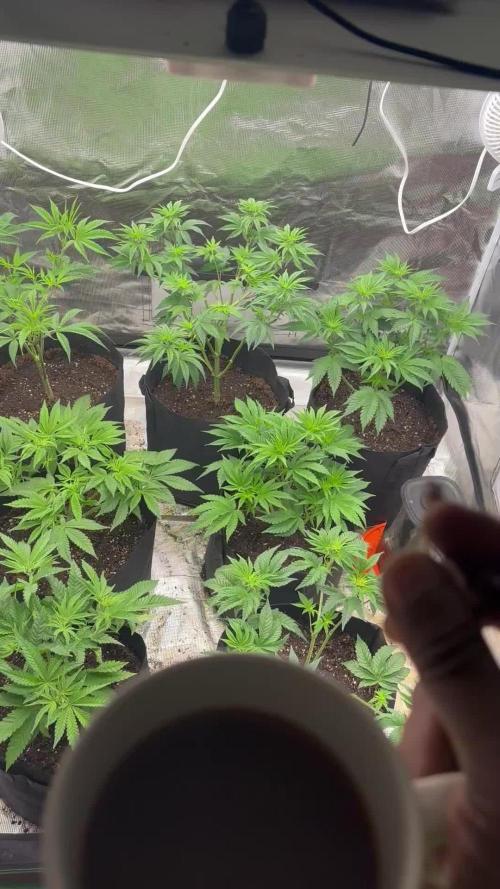
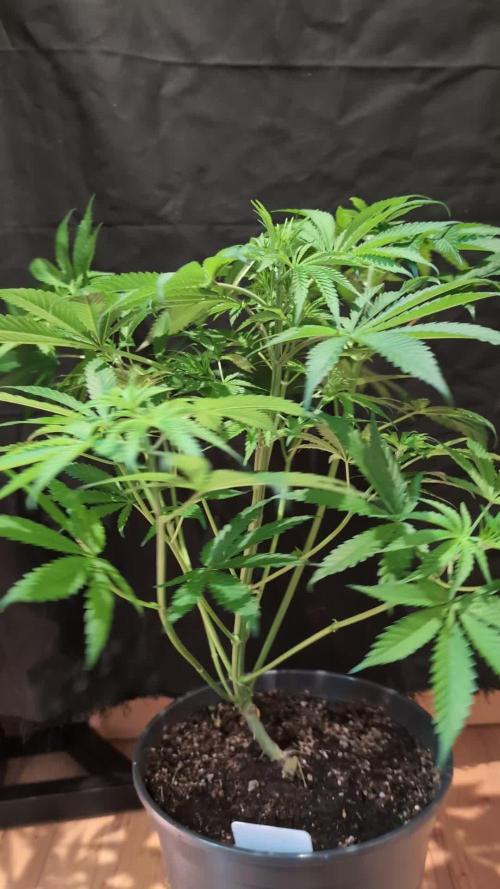
Week 2 Veg Report: Unveiling the Three-Fingered Marvel! The saga of our Panty Punch Auto continues, and what a week it's been! This green beauty has flourished, unfurling her three-fingered leaves like a botanical masterpiece. The journey through the second week of veg has been nothing short of magical. As I marveled at the emergence of those distinctive three fingers, it was clear that the Panty Punch Auto had truly embraced the veg phase with vigor. The sheer growth and resilience displayed during this week were a testament to the robust genetics crafted by the brilliant minds at Seedstockers. Curiosity led me to inspect her roots, but the time for transplanting hasn't quite arrived yet. Back into the tiny pot she went, and feeling that a touch of pampering was in order, I decided to treat her to a foliar application of NutriSpray. Enter NutriSpray, a concoction of natural surfactants, stimulators, and essential microelements. This foliar fertilizer isn't just a treat; it's a botanical feast! Containing organic surfactants, horse chestnut extract, and crucial microelements such as manganese (Mn), sulfur (S), zinc (Zn), and iron (Fe), NutriSpray is a powerhouse of goodness. Horse Chestnut Extract Binding: This extract forms a bond with microelements, making them readily available to our plant for absorption. Protective Shield: NutriSpray creates a natural coating on the leaves, forming a protective shield that not only feeds the plant but also shields it for up to two weeks. Enhanced Nutrient Transportation: By thinning the vascular fluid, NutriSpray accelerates the transport of nutrients, ensuring our Panty Punch Auto receives the care it deserves. Special thanks to Seedstockers for this incredible genetic journey, and to Aptus Holland, my main sponsor, for their unwavering support and top-tier organic mineral nutrients. Grow Diaries, you're my cultivation diary sanctuary, and the green community and followers, your engagement lights up this botanical adventure. Here's to another week of growth, learning, and green wonders! Genetics - Panty Punch Auto - https://seedstockers.com/ Plant nutrition - Aptus Holland - https://aptus-holland.com LED Photons - Lumatek - https://lumatek-lighting.com Controls - Trol Master - https://www.trolmaster.eu/ Watering - myself Love and attention - Me, myself and i As always thank you all for stopping by, for the love and for it all , this journey of mine wold just not be the same without you guys, the love and support is very much appreciated and i fell honored and blessed with you all in my life, With true love comes happiness. Always believe in your self and always do things expecting nothing and with an open heart , be a giver and the universe will give back to you in ways you could not even imagine so More info, the ocasional give-away and exclusive updates from all my adventures can be found - links in the profile description Friendly reminder all you see here is pure research and for educational purposes only Growers Love To you All 💚 💚 💚
Likes
9
Share
Last run of the growing season. Biscotti Mintz by Barney's Farm. I wasn't satisfied with the last crop's yield so i wanted another crack at it. This time I'm armed with a digital Lux meter so i can better dial in the light without the guesswork. Looking to start the clones off with between 5000 and 7000 LUX at the canopy. But i didn't like the brightness at 8000 so i upped it to 15,000 Lux. I think the 5k to 8k Lux recommendations for clones was for clones in the process of rooting. Recommended Lux values for vegging plants is between 15,000 and 50,000 Lux. They were very lanky with long internodal spacing which I thought might be insufficient lighting. Because the other Biscotti Mintz grows and research i've done, shows a very bushy indica trait growth pattern. So either i have a shitty pheno, or my lighting wasn't good enough. I'm guessing it was the light because preliminary testing with the Lux meter showed that my canopy was quite under lit last run. Again using 3 gallon pots, this time i am crossing my fingers with the substrate because it is reused coco that i washed and buffered myself. I've never done this before so i have no idea what's going to happen. For all i know they will all be dead in a few days lol. Anyways, i tested the coco pH last night, and after buffering with 2x strength calmag and soaking the coco in a 6.0 pH for 48 hours, the pH is sitting around 6.8 in the coco. Not where I wanted it, but it's doable. I believe the coco brand new out of the bag measures at 6.8 so... I will be watering in 6.0 pH to try to achieve a balance. Treating the roots before planting with Azos and dusting the planting hole with Mykos. The nutrient solution is very mild to start off. About 450ppm. Hygrozyme will be added to the mix and watered in to help break down the old dead root matter that wasn't able to be sifted out of the coco. The cellulase will break those roots down into usable food for the plant to uptake, and clean up the dead roots at the same time. Hygroben will also be added because i have some left from the last crop. And after seeing the results of using bacteria, i'm pretty sold on using it. Today is March 4th, 2024. I like to start on the first of the month but i like starting on Monday's better for keeping my weed soaked brain organized a little easier. I'm thinking to do half strength doses 2x per week instead of full doses 1x per week. It's twice the mixing, but that's ok. There will be 7 plants in total, and the experiment i am running this time, for anyone that wants to check out, is 1 of the plants i will do a seriously severe defoliation on while leaving the rest untouched. And we'll see how it plays out yield wise. I'm sure of the outcome already, but I'm tired of the babbling dummies all over the place that preach fan leaves fan leaves... So we shall see! I had the pH of the nutrient solution set to 6.0 but after adding the enzyme and liquid bacteria, the pH dropped to 5.78, so beware of that if you use those products, even though they claim not to affect the pH. The light dimmer is set to 6 of 10. The clip fan is set to 2 of 10. Temps set to 74F and humidity set to 70% humidity. The light is 18 inches from the canopy at a dimmer setting of 6, which gives the canopy 15,000 Lux. Each plant was gently watered with about 300ml of nutrient solution, which was carefully and gently dispensed with a 140CC syringe Hope they like what i've done with the place lol. P.S. I realized that the 5000 to 7000 Lux was for clones that are rooting. So I had the lux at 12,000 at 18 inches from the plants at a dimmer value of 5. I've now upped the dimmer to 6. Tomorrow i'll check the lux and see where it's at. The clones have just come out of the dome today so i don't want to push them too aggressively too fast. MARCH 5, 2024 I just tested the Par light reading on BM #1 and the BM right in the center. BM #1 Par reading is 247. Center plant is 270. Light dimmer is at 6 and light is now 13 inches from plant canopy. MARCH 9, 2024 Fed again today. There is some progress in growth. 1/2 inch increase. The clones have been upset getting adjusted to their new environment. I've upped the dimmer to 7 and the PPFD and DLI numbers are good. Humidity remains set at 70% and temperature is set to trigger the fan at 78F Light remains where it was so the plants have grown 1/2 so the light will be 12 inches above the canopy. Mixed up 2 liters of nutrients and the ppm was 555, and the pH was adjusted to 6.15. 2ml Per liter of hygrozyme and hygroben were also added. Clones have curled leaves and a perky/droopy stature. The leaf edges are browning a little bit. I'm not sure whats happening with them other than it's just the effects of transplanting and drastic environmental change. What i'm wondering is how they will/are reacting to the used coco underneath? We press on with fingers crossed! 🙏😁
Likes
36
Share
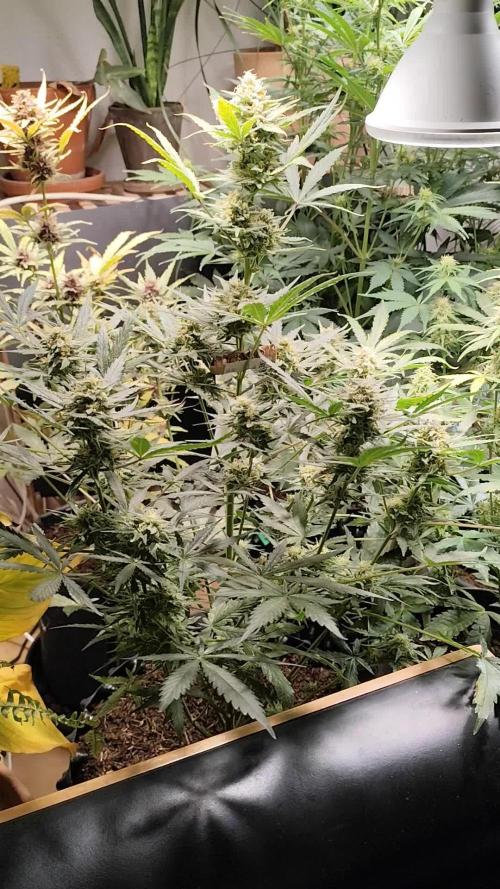
Que dire mise à part que se strain est tous simplement magnifique ? Il porte bien son nom, il commence à être bien Frosty! Et la couleur violet commence à apparaître de plus en plus! Les bud sont beau et dégagent une belle odeur fruité, le plant a une sacré couverture résineuse, je pense qu’elle pourrais être parfaite pour faire des extraction! Cette semaine je lui ai donné un thé de compost oxygéné, on va voir comment elle va réagir. Recette du tco pour 20 litres. (Grammes : gr) 50gr biochar 250gr zéolite 3gr granulé Micro-Organisme IT45 10gr pollen d’abeilles 10gr levure de bière 3gr endomychorize 10gr consoude 20gr vers de farine 10gr cendre coque de ricin 12gr ortie microniser 15gr Kelp 10gr spiruline 10gr de cbd living soil 20ml de miel liquide 30ml de mélasse 20ml d’acide humiques et fluvic Mettre tous les ingrédients (sauf la mélasse ,l’acide h/f et le miel) dans un filtre 400micron, le placer dans un seau avec de l’eau (10litres). Rajoutez le miel et 10ml de mélasse Y mettre un micro bulleur alimenter sur une pompe à air et faire oxygéné le mélange pendant 24h. Rajout de 10ml de mélasse après 12h le début de la mise en route de la pompe. A la fin des 24h rajoutez le restant de mélasse et d’acide h/f, mettez y en plus 10litres d’eau au mélange. Reste plus qu’à arroser! Pour la Frosty j’y ai incorporé 7litre de mélange La veille j’ai préparé le pot à l’arrosage avec 500ml d’eau et 2gr de Bacillus IT35 Amyloliquefaciens X5 Bacillus Amyloliquefaciens : rhyzosphère, probiotiques. Aspersion et arrosage. Utilisable pour toutes cultures. La bactérie Bacillus Amyloliquefaciens se fixe dans la rhizosphère en se nourrissant des exsudats racinaires. En contrepartie, elle stimule la croissance racinaire en sécrétant des métabolites de croissance et solubilise le phosphore en sécrétant des phytases (enzymes). Effet probiotique consistant en l’utilisation de micro-organismes bénéfiques pour la nutrition et la santé des plantes. La spiruline, le plus riche et le plus complet des amendements organiques La Spiruline est une algue aquatique connue comme complément alimentaire, la Spiruline est aussi un amendement organique et écologique très complet. D'une grande qualité nutritive, elle apporte à vos plantes une quantité de nutriments, dont l'azote, phosphore, potassium, minéraux, acides aminés, vitamines, chlorophylle et protéine. Le charbon végétal actif est capable d’absorber jusqu’à cinq fois son poids propre en eau ainsi que les éléments nutritifs qui s’y trouvent. Il joue ainsi le rôle de catalyseur et d'amplificateur pour les fertilisants traditionnels, qu'ils soient d'origine organique ou minérale. Ce pourquoi il est idéal pour activer un sol et pour les thés de compost oxygénés. Le charbon végétal améliore la diffusion et la disponibilité des éléments nutritifs dans le sol et offre des conditions propices au développement des micro-organismes. Le Biochar peut être introduit dans une grande variété de sols. Il est particulièrement efficace dans les sols pauvres, difficiles et acides. Pour faire agir rapidement et efficacement sa capacité d’amendement, le charbon végétal est enrichi et biologiquement activé avec des micro-organismes. Le Biochar se comporte ainsi comme un structurateur et un activateur dans le but de valoriser les sols. Composition : • Charbon végétal actif 31%
• Matière organique 33%
• Matière sèche 75%
• C/N : 17
• PH : 7,2
• Azote (N) : 2,1 % dont 1,2 % azote organique
• Phosphore (P205) : 0,74%
• Potassium (K20) : 1,18%
• Calcium (Ca) : 6,8%
• Magnésium (MgO) : 0,65% Le pollen est l'ingrédient de base de la fabrication du miel par les abeilles. Riche en vitamines et minéraux, il est qualifié « d'aliment parfait », y compris pour les plantes ! Les zéolithes sont des roches cristallines, présentant des capacités d'adsorption particulièrement importantes vis à vis des polluants que l'on rencontre dans l'eau et dans certains liquides, ainsi que dans l'air et les gaz. Elles sont extrêmement poreuses comme les charbons activés et elles peuvent être chargées électriquement pour opérer comme des échangeurs d'ions. La zéolithe est un produit naturel qui respecte notre environnement. Utilisé dans le milieu industriel depuis de longues années déjà, ce minerai aux propriétés filtrantes particulières commence à se vulgariser dans le domaine de la piscine privée, de l'aquariophilie, des bassins d'agrément, de la récupération des eaux de pluie, ou encore de la culture des bonsaïs et autres plantations diverses par exemple... 4 points techniques majeurs : - Grâce à leur propriété hydrophile, les zéolithes peuvent adsorber l'eau jusqu'à 30% de leur poids total et sans aucune variation de volume : pas de gonflement en présence d'eau ni de craquement en cas de déshydratation comme certaines argiles. Les zéolithes sont d'ailleurs de puissants agents anti-mottant (anti-agglomérant). Cette propriété est très appréciée dans le cas des terrains de golf et autres aires de jeux. - Les zéolithes ne captent pas l'eau de façon irréversible, elles se comportent comme une réserve au voisinage des racines. Celles-ci peuvent capter l'eau en fonction de leur besoin. Les zéolithes permettent ainsi de réduire les besoins d'arrosage jusqu'à 35 %. - Une zéolithe se comporte comme une "Zone de Stockage" qui retient l'azote et les éléments minéraux nutritifs au voisinage des racines et les relâche lentement en fonction des besoins de la plante. Cela se traduit par une croissance harmonieuse mais rapide du végétal. - La capacité d'adsorption et l'énorme rapport surface/volume des zéolithes, vont permettre à la fois la rétention de la solution du sol et une bonne oxygénation au voisinage du système racinaire. Les zéolithes favorisent donc l'organisation biologique des sols en contribuant au développement de la micropopulation. L'apport en nutriments (N, P, K) est réduit de 20 à 25 %. Ces derniers, adsorbés par la zéolithe, sont beaucoup moins sensibles au lessivage et à l'évaporation. Composition minéralogique : * Chabasite 70 % * Phillipsite 2 % * Feldspath 5 % * Augite 3 % * Illite - Mica 2% Analyse atomique: * Sio2 52 % * AL2o3 17 % * CaO 5,7 % * K2O 6,1 % * MgO 2 %, * Na2O 0,6 % * Fe2O3 3,6 % Amendement calcaire, dolomie et gypse avec préparation microbienne à base de Bacillus Amyloliquefaciens IT45 et Saccharomyces cerevisiae LYCC6420 Formulation : micro granulés (1 – 1,6 mm) à base de rhizobactéries favorisant la croissance des plantes qui se multiplient et colonisent rapidement la zone des racines, et de levures Saccharomyces cerevisiae souche LYCC ayant un effet probiotique. Les PGPR produisent des enzymes qui solubilisent le phosphore à partir de complexes inorganiques et organiques dans le sol et stimulent la croissance des racines efficaces augmentant ainsi la zone d'interception des éléments nutritifs. Les levures LYCC permettent une occupation de la rhizosphère par une flore bénéfique. Composition :
• Matière sèche : 96,8%
• Matière organique : 91,5%
• N total : 6,6% dont N soluble dans l'eau 0,17%
• P total : 2%
• K total : 1,7% Micro-granulés : 
• Oxyde de calcium (CaO) total : 30%
• Oxyde de magnesium (MgO) total : 7%
• Anhydride sulfurique (SO3) : 13% La levure de bière est une matière vivante qui permet un meilleur fermentation pour les thés de compost oxygénés notamment conseillé pour accompagner les croissances ou apporter un gros coup de pousse pendant la floraisons.  La levure stimule la vie des sols également à l'arrosage direct en apportant tout aussi bien que dans le TCO sa population l'espèce micro-bactérienne positive pour votre sols ainsi que des oligo-éléments et diverse vitamines.   Composition : • 2,8% (N) total dont 1% (Norg), • 2,3% (P205) • 1,6% (K20) • 35% de MO • C/N : 8. PH : 8,4. Sous forme de poudre mouillable. Il contient des spores du champignon mycorhizien Rhizophagus Irregularis MUCL57891 avec des levures inactivées spécifiques. 2000 spores/gramme d’endomycorhize Rhizophagus Irregularis MUCL57891 et Saccharomyces Cerevisiae LYC6420 inactivée. Se connecte efficacement au système racinaire et forme un vaste réseau souterrain de filaments, qui agissent comme des extensions pour atteindre les nutriments et l’eau au-delà de la rhizosphère Composition : • Poudre contenant 2000 spores/g. d’endomycorhizes Rhizophagus irregularis  La Consoude (Symphytum Officinale) est une plante présentant de nombreuses propriétés. Particulièrement riche en Potassium (K) organique, la consoude est une alliée idéale pour les périodes de floraison. La consoude a tout pour plaire : riche en vitamine B12, elle agira également comme stimulateur racinaire, mais aussi comme biostimulant cellulaire, grâce aux alcaloïdes, aux allantoïnes et jusqu'à 30% de protéine ! 100% déjection de vers de ténébrions.
Très riche en microorganismes, le guano de vers de farine est une matière directement composté par les vers. En effet, c'est bien la digestion de matières végétales par des larves, insectes ou autres arthropodes qui valident le processus de compostage, que ce soit en zone de production de cultures d'insectes, pour le compost maison ou la dégradation de litière forestière. Les bactéries et autres champignons obtenus grâce au système digestif de nos vers, permettent la dégradation accélérée des éléments nutritifs dans vos supersoils, et les symbioses permettant l'assimilation des éléments nutritifs. Cette bio-activation intense mettra dans vos sols, à la disposition de vos plantes, un panel tellement varié de nutriments frais qu'il nous est aujourd'hui technologiquement impossible de pouvoir tous les nommer et de les compter.  Le guano de vers de farine fournit une grande polyvalence. Très équilibré, il s'utilise en entretien ou en apport ciblé seul ou en complément de d'autres amendements ou fertilisants organiques. Il agit comme un puissant activateur de sol et/ou de substrat. Cendre coque de ricin NPK 0,1-18,6-16,5. 0,1% (N-Azote), 18,6% (P205-Phosphore), 16,5% (K2O-Potasse), 11,7%(Ca0), 9,1 (Mg0) - Origine : Inde ACTION SOL • rend rapidement accessible au sol Phosphore, Potasse, Magnésium et Calcium. ACTION PLANTE • Apport aux stades agronomiques propices. • Produit riche en éléments fertilisants : combinaison NPK 35%. • Régularité de l’apport, milieu et fin de floraison. . Favorise la sénescence. Analyse chimique : • NPK 0,1-18,6-16,5 • N-Azote 0.1% • P205-Phosphore 18,6% • K2O-Potasse 16,5% • CaO-Calcium 11,7% • MgO-Magnésium 9,1% Ortie bio micronisée Stimule la vie du sol et la végétation. Composition : • 2,8% (N) total dont 1% (Norg), • 2,3% (P205) • 1,6% (K20) • 35% de MO • C/N : 8. PH : 8,4 KELP poudre
ascophyllum nodosum
- amendement sol Croissance et floraison - Meilleure germination - Meilleur développement racinaire Meilleure assimilation - Résistance aux stress osmotiques - Augmente la production de chlorophylle = plantes plus vertes = lumière mieux captée - Lutte contre le stress osmotique - Développement des Micro-Organismes dans le sol – Riche en vitamines, fer, iode, oligo-éléments, hormones de croissance auxines et cytokinines - Idéal en épandage et pour les thés de compost oxygénés. Important : notre Kelp est un goémon noir mais il n'est pas le varech bien moins fertile de la même famille qui est l'algue qui pullule et pollue la Bretagne, notre algue pousse uniquement à plus de 50 mètres de fond dans les grands courants froids au large de la Norvège.
Likes
26
Share
After 2 days the roof is getting of and the plant gets her first 250 ml of Water. The plant grows very vigorously and fast. Unfortunate the last day the plant begun to bend her first 2 leaves up and i dont realy know why. I will try something out and see where it goes.
Processing
Likes
14
Share
@Datiko
Follow
I Topped 3 days ago, she got a little bit stress, she could be stressfull if i top earlyer, so i hadnot other way. I think she will give me 50-60 g dry buds... but i am scaryed with this. she is still not flowering. explain me why. almos every GSC auto starts flowering at 5 week
Likes
20
Share
@Bongman
Follow
She is adjusted to the LED and she is loving the organic nuetrient and tea.
Likes
9
Share
Buds are getting bigger now and the smell is incredible. Looking forward to planting more at start of may full with nutrients this time to see the difference of yield.
Likes
11
Share
@russrahl
Follow
Last Obi-Wan girl was left in dark for 3 days and then chopped on day 66 and is now drying. She was definitely the largest of all 4 plants in the tent. Cant wait to see the dry weight on this girl! Next update will be when all the bud is dry and we have a final weight for all 3 together. The first one we chopped only gave us just over 4oz dried but she was half the size as the other 3 girls and kinda lower in the corner. Pulled 7.4oz off the Wedding Cake in the same tent/setup and these last 2 Obi-Wan’s that are still drying are bigger then she was by a lot I think. Cheers 💨
Likes
2
Share
Now that you are all caught up, we are in week three a flower. I just gave them a top dress feet of Gaia green just blown because I still have just a little bit up all purpose in there but other than that I look at them every morning, give a big smile and turn on their favorite Mosark album
Processing
Likes
10
Share
@TrimQueen
Follow
So, guys.. This is her first month blooming. 4 complete weeks has passed. Here we are for 2 more. Gave Her a super powerful egg shell fert (all powdered - Phosforium Whelthy.) 07/10/20 - We are in the middle of week 5. Thats the way they look like. For me a good number of buds and they are as dense as I thought they would be by this time. I think everything is under control despite some foxtails cuz the heat. Loving the experience.
Likes
4
Share
Day 58 Update: Watered both plants with 3/4gal until runoff. Water was dosed with Terpinator at 15ml/gal. I will start the flush on Plant #1 next watering. Added a stake and a plant yoyo to Plant #2 to support the heavier branches. Day 62 Update: Starting flush on Plant #1. Watered both plants with almost a gallon until runoff. Plant #2's water was dosed with 3/4tsp of Big Bloom, 1/4tsp of Grow Big, and 1/4tsp of Tiger Bloom. Plant #1's water is just plain pH balanced water. I will start watering every 3 days now. I will start the flush on Plant #2 after one more nutrient watering.
Likes
5
Share
@MMorrelo
Follow
sorry for not uploading photos instead of that i post video! plants are doing great seems like on plant number one male flowers dont appear there was only one male flower which i caught on time on week 6
Processing
Likes
20
Share
@Excalibur
Follow
11 Sep Day 78 - Good development. Stems thickening up. Day 79 - Slight spray to leaves. Day 81 - Slight trim of some fan leaves. pH good, sprayed leaves Day 82 - LST Tightened to open grow up to allow more light. 500 ml water added. Fans moved Day 83 - Added Nutrients Day 84 - All good. Red Veins and stems appeared.
Likes
10
Share
@Reaper
Follow
start of week 6. (day 36). i am not sure how far my plant is in flower right now. she looks like week 4 now but shes in flower since march 12 (today is may 4th) i noticed she kept growing the first weeks of 12/12 but here she is now, huge and bushy but looks like a week 4 or 5 of flower here... gues ill have to flower her at least another 3 weeks from now. as u see in the video, the smallest plant doesnt have too much yield, thats because i cut of so many undergrowth (stems and leaves) during the third week of flower) this plant was already in a very bad shape before flower. how she looks now is unbelievable compare here here and watch the pics of week 5 vegetation. i flushed the system this morning untill this evening ( in the 12h dark period they run straight rainwater) and when the lights turned back on tonnight i added the nutrients at 820ppm (0.5 convertion) i hope she will now get more explosive as i had 250 grams dried but last time i grew this on soil (2 plants, this diary is on here too “critical”) these were grown under the same light in soil, finished quicker and had more yield (as of now) anyway lets see what happens the next weeks. may 8 (day 39) defoliation, not too much just big fanleaves from the top of the cannopy and underneath the net, more light reaches budsites now
Likes
12
Share
Nachdem ich zwei Verluste verkraften musste, hab ich mich dafür entschieden 2x "Dark Devil Auto" von Sweet Seeds und 1x "Lemon Cherry Gelato Auto" von Zamnesia nachzuschieben, die sich alle drei mittlerweile als Keimlinge im finalen Topf wiederfinden. Eine "Dark Devil" hat es nicht geschafft, aber dafür geht's dem anderen Keimling umso besser. Bis zum Ende der Woche zeigen sich die unterschiedlichen Genetiken der Strains deutlich .. Am weitesten ausgebildet hat sich .. Überraschung: "Titan F1 Auto" ... 😎 ...
Likes
78
Share
~_~_~_~_~_~_~_~_~_~_~_~_~_~_~_~_~_~_~_~_~_~_~_~_~_~_~_~_~_~_~_~_~_~_~_~_~_~_~_~_~_~_~_~_~_~_~_~_~_~_~_~_~_~_~_~_~_~_~_~_~_~_~_~_~_~_~_~_~_~_~_~_~_~_~_~_~_~_~_~_~_~_ ❤️💡🌱😽💨 2nd week of flower!! Everything is going great..a couple are showing signs of overfeeding but not too bad, no clawing yet but close. We'll be doing water only w/ a little calmag for these until they lighten a few shades.. its been an easy week in this tent, no drama 🐱👍🌱 ~_~_~_~_~_~_~_~_~_~_~_~_~_~_~_~_~_~_~_~_~_~_~_~_~_~_~_~_~_~_~_~_~_~_~_~_~_~_~_~_~_~_~_~_~_~_~_~_~_~_~_~_~_~_~_~_~_~_~_~_~_~_~_~_~_~_~_~_~_~_~_~_~_~_~_~_~_~_~_~_~_~_
Likes
6
Share
I Topped Dressed 5 Tbs of 2-8-4 & 2.5 Tbs of 4-4-4 & Feed 1 Tbs of Molasses in 1 Gallon water Feed