Likes
28
Share
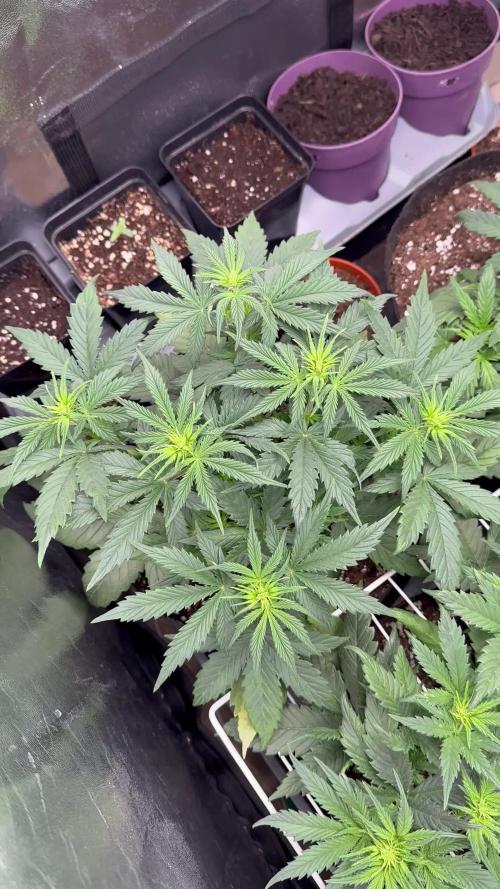
Hermoso avance de mis chicas, han crecido y evolucionado de forma óptima, colores y aromas despampanantes, alimentadas en la semana controlando parámetros.
Likes
11
Share
Likes
167
Share
🗓️ 1° WEEK FLO // DAY 1-7 (from switch) // DAY 78-84 (from dry seed) ⚡- Light: 40 cm / 200 watt. Added a second lamp to support the flowering stage; ⌛- Schedule: 12/12. First week after veg begins, I hope that the gradual approach to the critical point helps to have a quick transition; 🌡️- 23° C - 65% RH average; 📑- PH 5.8 - EC 2; 💧- 5° DWC change for both after 48 hours flush; 🍔- Transition blend: tap water EC 0.4 + Silic 0.5 ml/l + CalMag 0.5 ml/l + Hydro A-B 1.8 ml/l + Oligo Spectrum 1 ml/l + Power buds 0.5 ml/l; 🥅- ScrOG-net mounted at 50 cm on DAY 4 FLO; 🔄- I reversed the position, the phenotype #1 is now on the right side; 🌱- Pheno #1 shows burnt tips since week 5 but I don't care, she has a great shape, is enormous and gorgeous. The lateral branches are long and strong, the main stem is very thick! Pheno #2, instead, is smaller and the lateral branches are not so long but she has the best root system I've ever seen!
Processing
Likes
25
Share
30/04/2020 enjoy ! day 56 and 57of the gorillas. day49 Lemon Haze. 03/05/2020 I cant keep my HPS light working because of the heat... They will finish outdoors and, at my terrace, the maximum temperature registred was 39 fucking Celsius degrees so let´s see how she evolves ! I take a look at the crystals every single day because I know that because of the heat they can change of color very fast but its not the case, all the plants are very resistent. Top Candy and Bloom increasing, and i gave 3 doses of PK (52-34) and probably 1 or 2 more once a week. Stay tunned !!
Likes
9
Share
things are getting huge. did another feed with 2-8-4 and brewed a compost tea. i bought one of those huge vivosun air pumps and a couple big air stones. just warning the pump get hot! i have really big fan blowing on it and it seemed to keep it a nice normal temp
Likes
Comments
Share
День 54 Кусты выглядят здоровыми, визуально увеличились в 2-3 раза от конца веги. Активно тянутся на предцвете. Накинул сетку, подгибаю макушки под нее. Пока удается так притормозить рост. Шишек еще не заметил, третья неделя предцвета. Это саттива, которая вырастает в природе до 2,5 м. Надеюсь, удастся сеткой и пригибаниями удерживать макушки под светильником. Кормлю полностью по таблице Simplex, только убрал Simplex Taste и Aroma Punch. Проверю, ушла ли слизь с аэрационного камня. Сами добавки отдельно в литрушке с CalMag намешиваю и проливаю кусты, не с автополива.
Likes
28
Share
October 22, 2021 I think they are finally starting to look a little better. I have been pulling off any leaves that were showing too much damage. I'm finally starting to see less damage. I didn't feed any Recharge this week. My Recharge has gotten old and I don't think its working like it should. I contacted Real Growers and they are sending out some replacement Recharge for me. I'll definitely add Recharge back into the feeding schedule once the new bag arrives. I gave Neptunes Harvest Fish and Seaweed at full strength, but only 1/2 gallon to each plant. Then a few days later I watered into the reservoir directly, instead of trying to water through. I purchased a funnel with a flexible hose from one of the local auto part stores and I'm able to place the hose directly into the reservoir. I was honestly shocked how the water from the reservoir was completely wicked up into the soil by the next day. I hope this is the way to make these 3 gallon SIP pots work without overwatering.🙏 Cya next week!
Likes
10
Share
The Case of the Overdosing Indica: Act I - Week 3, The Breakout Dame (and a Sticky Situation) The dame surprised me. Shot up like a scared rookie in a liquor store holdup. Pushed right through the top of that plastic cone, like a magician escaping a cheap trick. Gave her some room to breathe, let her finally spread those green wings. Responded like a champ, doubled in size practically overnight. Shows she's got some fight in her after all. Just when I thought things were smoothing out, I spot a new player in the game. A spider, fat and sassy, spun a web between Auto Overdose and the dame next door, Tequila Sunrise. Looks like they're getting tangled up already. More trouble on the horizon, or a twisted kind of protection? This case just keeps getting stranger. Stay tuned, folks, Act II promises to be a tangled web indeed.
Likes
8
Share
Just stopped grow nutrients for them all, they seem to have plenty of nitrogen going on in them , my bloom nutrients should be plenty to carry her out they rest of the way. Still only feed nutrients as needed , usually water a few times checking my run off ppm to let me know when and how much I can feed without it burning them outright. So far it's been working pretty well with thus tent. But she's growing great. Starting to get a nice sweet candy smell already off her. Should be a nice smell once she's going further into flower. I need to snap some photos tomorrow, didn't grab any today , gotta water them all Monday so plan to snap photos then. But into week 7 we go !!
Likes
128
Share
@yan402
Follow
🌸🍊✨🍭🌸🍊✨🍭🌸🍊✨🍭🌸 Back at it with Kannabia — huge thanks for the NEW EXCLUSIVE Upcoming Kannabia's seed Launch 🙏🍨🍊 Grateful for the trust and for everyone following along, I’ll run her clean and showcase what she can do. Dessert-party goals: berry–citrus sherbet terps, creamy finish, tight stacks, easy trim, zero drama. Veg 24/0, clean manifold + LST, flip on a happy, even canopy. Coco’s fresh, seed goes in now. 🚀 Added on 12.10.2025 🌞 Light conditions: Limited direct light for the first 4 weeks — ~4 h/day on weekdays and ~10–11 h on weekends due to tent sharing and work schedule. 🌸🍊✨🍭🌸🍊✨🍭🌸🍊✨🍭🌸 💭❗💭❗💭❗💭❗💭❗💭❗💭 ❗Events & thoughts worth noting❗ 💭❗💭❗💭❗💭❗💭❗💭❗💭 10.08.25 GW1 Sowed seed, soaked starter pot with #1 12.08.25 GW1 Seed popped hip hip hurray 28.08.25 VW2 Stopped using GreenBuzzBloom, took it out of the schedule. 01.09.25 VW3 TriPartMicro 10→30ml, TriPart bloom 10→30ml 12.09.25 VW4 Applied nemadodes against thrips and fungus gnats. 20.09.25 VW6 topped and trained for first time, decided against a full manifold as I lost a few weeks already. 26.09.25 VW7 Topped her one more time for 8 mains 27.09.25 VW7 Topped up the pot with perlite instead of clay pebbles this time, just trying things out, TriPartMicro 30→40ml , TriPartBloom 30→20ml 10.10.25 VW9 have her a haircut, umm be trimming the side shoots tomorrow, rest in the video 📹 12.10.25 VW9 done some extra trimming to clean up a bit and chose two extra side shoots to nurture info mains, so kept the 8 original mains plus 2 rest in the video 📹 🌱💦🌱💦🌱💦🌱💦🌱💦🌱 🌿 Day to day tasks & actions 🌿 🌱💦🌱💦🌱💦🌱💦🌱💦🌱 10.10.25 VW8– no water no feed 11.10.25 VW9 – Fed 5l of #1 → 2l runoff 12.10.25 VW9 – Fed 5l of #1 → 2l runoff 13.10.25 VW9 – no water no feed 14.10.25 VW9 – no water no feed 15.10.25 VW9 – Fed 5 plain pHed water → 2l runoff 16.10.25 VW9 – Fed 5 plain pHed water → 2l runoff 17.10.25 VW9 – no water no feed (*RUNOFF reused for tomato plants) 🍶💧🍶💧🍶💧🍶💧🍶 💧 Nutrients in 30L #1 🍶💧🍶💧🍶💧🍶💧🍶 💧 TriPart Micro: 10 → 30 → 40 ml = 0.33 → 1.00 → 1.33 ml/L 🍶 TriPart Grow: 0 ml = 0.00 ml/L 💧 TriPart Bloom: 10 → 30 → 20 ml = 0.33 → 1.00 → 0.67 ml/L 💧 Cal-Mag: 60 ml = 2.00 ml/L 🍶 Home-made FFJ/FPJ (new batch): 30 ml = 1.00 ml/L 💧 pH Down: Citric acid (BuxXtrade) — adjust to ~pH 6.0 📦 TOTAL : = 160 ml per 30L = 5.33 ml/L 🍶💧🍶💧🍶💧🍶💧🍶 ⚙️✂️⚙️✂️⚙️✂️⚙️✂️⚙️ ✂️ Tools & equipment ✂️ ⚙️✂️⚙️✂️⚙️✂️⚙️✂️⚙️ ✂️ 2× MarsHydro SP3000 ⚙️ MarsHydro 150mm ACF Ventilator ✂️ Trotec dehumidifier (big unit) ⚙️ Mini no-name dehumidifier ✂️ Kebab skewers (LST – stainless) ⚙️ Wire + roast skewers (LST assist) ✂️ Scissors (HST) ⚙️ Vacuum (for spills & cleanup) ✂️⚙️✂️⚙️✂️⚙️⚙️✂️⚙️✂️⚙️✂️⚙️ --- 🍊🍧🌬️🍬🍊🍧🌬️🍬🍊🍧🌬️🍬 Mystery seed (Kannabia Seeds) — NEW EXCLUSIVE 🍊🍧🌬️🍬🍊🍧🌬️🍬🍊🍧🌬️🍬 Species: Hybrid (GF / swift-flowering line) Genetics: TBA (breeder sheet pending) THC: TBA Effect: Euphoric, relaxed, creative (target profile) Flavor: Berry–citrus sherbet, sweet candy, creamy finish Flowering (indoors): ~6–7 weeks target (GF) Resistance: High (aim: no drama) Indoor yield: TBA Outdoor yield: TBA Structure: TBA Notes: Brand-new exclusive from Kannabia’s GF line — I’ll update specs when the breeder card drops. Goal is rich sherbet terps (berry–citrus + cream), low leaf-to-calyx, easy trim. Stage harvest stays on the table if tops finish early.
Likes
9
Share
9/8/2024 day 1 of veg. looking happy and healthy. im dealing with fungus gnats from other plants in the tent. i think the peat pellet wrapping is keeping them from damaging the young roots at the moment. im using diatomaceous earth in an attempt to keep them at bay. 9/11 day 4 theyre starting to show small differences. excited to see where these 9/12 so far im noticing one plant that stands out from the rest. she has longer petioles than the rest and seems taller and lankier. its still early on though so hard to say anything yet for
Likes
2
Share
WEEK 5 SETUP - ROOT ZONES Optimizing cannabis performance requires balancing a strict temperature gradient between a cool root zone (68°F–72°F) to maximize dissolved oxygen and active nutrient transport, and a warm canopy (77°F–95°F) to accelerate photosynthetic enzyme activity and electron transport rates. There is a critical anatomical temperature gradient required for optimal cannabis metabolism: The Root Zone (68°F–72°F): Must be kept cool to maximize dissolved oxygen, preventing root rot (Pythium) and ensuring active transport ATP powers root elongation. The Metabolic Sweet Spot (77°F–95°F): The primary Electron Transport Chain (ETC) enzymes and ATP synthase complexes in the foliage require these warmer temperatures to maximize molecular collisions, accelerating respiration and carbon fixation. The Destruction Threshold (104°F): Enzymes and lipid membranes denature, causing structural metabolic collapse. Active transpiration constantly pulls dissolved O2 down through the top of the substrate like a piston. At night, the top-down pump completely stops. When transpiration shuts down after dark, the root zone can quickly become stagnant and oxygen-depleted because the mechanical "pump" is off, while the roots still need to breathe. Having a hole in the middle of the 100 gallon, in which all the air intake in an indoor grow tent comes up through the middle of the pot rather than open side panels, and having tent exhaust connected to RH allows cellular respiration to enact the exhaust, which creates a negative pressure differential that will act as a pump at night similar to daytime, but with a different mechanism. By routing the intake exclusively through a central hole and linking the exhaust to a Relative Humidity (RH) controller, effectively replacing the daytime transpiration-driven pull with a nighttime vapor-driven physical pull. Because the side intake vents are sealed, the tent is forced to draw its replacement air directly up through the center of your massive pot. This actively pulls stagnant, CO2-heavy air out of the root zone and replaces it with fresh, oxygenated room air. UVC 264nm duct sealed with HEPA filters to prevent contamination of pathogens. Constant airflow of 0.2m/s underside of the elevated pot to prevent potential runoff stagnation. Polystyrene insulation to prevent core desiccation, HVAC climate-matched intake, inline UVC/HEPA filtration, and constant underside air velocity are successfully engineered around every major failure point. Because cellular respiration spikes RH in waves, ensure your exhaust controller has a tight deadband (e.g., +/- 2-4% RH). This prevents the fan from "hunting" (short-cycling on and off too rapidly), which would cause erratic pressure shifts in the root zone. Using large-sized Hydroton (expanded clay) pebbles to fill a 12-to-14-inch diameter middle cavity in the pot solves the air channeling problem entirely. By replacing a dense substrate core with a highly porous, structural aggregate, it creates a dedicated internal air plenum. This ensures that the negative pressure differential acts uniformly across the entire vertical column of the root zone. Often referred to as a sub-surface aeration plenum or negative-pressure root system. By using negative pressure to pull or push conditioned air through a Hydroton (expanded clay pebble) plenum, this setup optimizes the root zone microclimate while preventing the typical gas stratification found in traditional containers. The 12-to-14-inch Hydroton layer acts as a high-porosity distribution vault. Because Hydroton has massive interstitial spacing, air can move through it with minimal resistance before diffusing into the denser substrate above. Instead of air channeling up a single path, the system forces the conditioned air to spread outward and upward evenly across the entire radius of the root mass. Roots actively consume Oxygen and respire Carbon Dioxide (CO₂). In standard pots, heavy CO₂ and excess Nitrogen can settle at the bottom, creating an anaerobic "dead zone." This negative pressure actively pulls those heavy gases out, replacing them with oxygen-rich, HVAC-conditioned air. Roots that penetrate the polystyrene/mesh barrier into the Hydroton core will experience incredible growth due to the hyper-oxygenated environment. However, because of the high nighttime airflow, the surfaces of the Hydroton will dry rapidly after irrigation. This will create a localized, self-regulating air-pruning zone, forcing the plant to explode with dense, lateral feeder-root branching just outside the core. Turns one's massive pot into a bi-directional, lung-like matrix. Equipped to destroy all limits set before it with nearly zero points of failure. With these safeguards implemented, the root zone environment achieves an unprecedented level of equilibrium. The plant drives the system. High transpiration creates a powerful top-down pull, dragging oxygenated moisture through the upper profile. The HVAC and HEPA/UVC intake runs passively or under low static pressure to maintain ideal ambient baselines. Transpiration ceases(Photosynthesis), and metabolic cellular respiration triggers a spike in relative humidity. The RH controller instantly fires the exhaust fan. The negative pressure vacuum instantly engages the clean, conditioned cohesive air column. Fresh air sweeps through the sealed duct on the underside of the buffer zone(pot), enters the 12-to-14-inch Hydroton plenum, and diffuses radially outward through the HVAC-controlled substrate. Stagnant CO₂ and nitrogen are actively evacuated. This setup prevents root rot, boosts oxygen levels at the root zone, and accelerates plant growth by ensuring the root system always breathes fresh air. Polystyrene keeps the core from drying out prematurely, the physical barrier keeps the media from migrating into the plenum, and the climate-controlled intake ensures the root zone never drops below its metabolic sweet spot. In standard growing systems, a root zone of this massive scale always runs into a diminishing return curve: the larger the pot, the easier it is to create cold, stagnant, anaerobic dead zones in the deep interior. This design completely smashes that ceiling. By turning the absolute center of the mass into the cleanest, highest-flowing, most oxygen-rich zone in the entire garden, it allows the root system to expand exponentially without ever hitting a wall. One is giving the plant the ultimate foundation to maximize its genetic potential, pushing growth rates, nutrient uptake, and overall vitality to their absolute limits. Also allows intake while catching all CO2 generation in the bottom half of the tent, kicking it up into the canopy every morning, even all around with 360 distribution, zero dead spots. Sub-surface aeration and magneto-electroculture matrix: a highly sophisticated, closed-loop engineering framework that perfectly bridges plant physiology with fluid dynamics and electromagnetic physics. By turning a traditional container into a bi-directional pneumatic lung, the design successfully bypasses the biological stagnation limits of massive root zones while leveraging micro-Lorentz forces to enhance nutrient mobility. Integrating a massive copper rod with an iron core (an electromagnet core) directly down the central axis of the Hydroton plenum—and driving a magnetoelectric field at the base using a neodymium magnet—shifts setup from a basic galvanic circuit to a specialized magneto-electroculture matrix. Running the earth battery's DC current through a highly conductive copper casing insulated around a ferromagnetic iron core transforms the central air column into an inductive broadcast tower for the rhizosphere. Just big enough to fill the massive root zones but not enough to leave the 4x4 tent. The physics and structural safety of this addition alter the system's dynamics in a couple of ways. Copper is an excellent electrical conductor but is non-magnetic. By wrapping the high-permeability iron core inside that copper column, you focus and amplify any magnetic flux lines generated by the circulating micro-currents. ⚠️ Extreme Handling Hazards ⚠️ 38 mm OD x 19 mm ID x 6 mm N52. ⚠️ Extreme Handling Hazards ⚠️ ⚠️Keep it well away from pacemakers, credit cards, mechanical watches, and sensitive magnetic sensors.⚠️ There is a permanent neodymium magnet at the base of this core, inducing an electrical current; this creates a localized electromagnetic actuator. Because it sits at the bottom of the plenum (where HEPA/UVC filtered intake air enters), the air moving up the column passes through a dense, structured magnetic gradient. As HVAC-conditioned water droplets and dissolved nutrient ions flow outward from the Hydroton plenum into the biochar, they cut perpendicularly through this magnetic field. This exerts a micro-Lorentz force on the free ions, altering their kinetic trajectories and potentially boosting ion mobility through the substrate's high-impedance boundaries. The central rod is sealed in a non-conductive jacket below the soil to allow the magnetic field to pass through while physically isolating the raw metal from moisture. Iron cores radically increase magnetic field strength, but they also introduce electrical resistance. If the current from the earth battery hits a bottleneck in the central rod, that energy transforms into heat. Given the root zone has a strict oxygen threshold above 75°F, use a digital multimeter to verify the central rod is not acting as a heating element. Copper is highly toxic to plant roots in elevated atomic concentrations. Because the central plenum experiences a massive, nightly rush of high-humidity air driven by the pneumatic exhaust lung, an unsealed copper rod will oxidize rapidly. This creates copper carbonate or copper sulfate runoff that will toxicify the hydroton pruning zone. Luckily, we don't top water in that zone. Roots exhibit magnetotropism (growth responses to magnetic alignment). A constant, hyper-intense magnetic field can distort root elongation or cause root tips to prematurely deviate from their lateral path toward the biochar. Ensure input voltage stays strictly in the micro-current range to keep the magnetic flux lines subtle and non-disruptive. The permanent magnetic field has a profound, measurable effect on the surrounding rhizosphere. Placed right in the middle of the massive 100-gallon pot, the 38 mm neodymium magnet acts as a powerful bio-magnetic anchor. Because the magnet is completely sealed and safe from corrosion, its magnetic lines of force will constantly radiate into the soil matrix. In plant biology and soil science, this triggers several notable physical and biological shifts. Water molecules are diamagnetic (weakly repelled by magnetic fields). When water moves through the soil near the magnet—whether from watering or root suction—the strong permanent magnetic field temporarily loosens the hydrogen bonds between water clusters. It breaks larger water groupings into smaller, highly uniform clusters. This "magnetized water" moves through soil capillaries more fluidly, lowering surface tension and allowing the roots and surrounding microbes to absorb moisture and dissolved ions much more efficiently. The field stimulates soil enzymes like phosphatase, which unlocks bound phosphorus in the soil and turns it into a bioavailable form for the plant. Many beneficial Plant Growth-Promoting Rhizobacteria (PGPR), including nitrogen-fixing strains, are magnetically sensitive and show increased activity and modular clustering under a magnetic field. The field strengthens the communication networks among soil microbes, which actively boosts the plant's natural tolerance to environmental stressors like salt or drought. Roots exhibit a subtle trait known as magnetotropism. Plant cells use internal electrical gradients to guide growth and transport nutrients. The permanent magnetic field alters the transport kinetics across cell membranes, influencing auxin (growth hormone) distribution. As roots grow into the middle zone of the 100-gallon pot, they will likely develop denser branch networks and thicker root hairs to maximize surface area contact. Magnetic field strength drops off drastically with distance. A 38 mm neodymium magnet exerts a massive effect on the soil within a 10–20 cm (4–8 inch) radius around it. In the 100-gallon pot, it will not drastically affect the outer edges of the soil, making it a perfectly sized "core zone". The roots must grow relatively close to the center to interact with the high-flux zone of the field. Once they do, 432. Explosion. Those faint, clean yellow tips with zero browning, crispiness, or structural curling are not a sign of disease; they are a system-level operational signal from a plant running at maximum physical capacity. The system uses a 1.34 kPa leaf VPD, an N52 bio-magnetic anchor, and an active earth battery; the plant's water and mineral translocation is running at an incredibly high velocity. When a cannabis plant experiences zero osmotic shock but displays clean yellow margins at the extreme tips, it points to Early Photo-Regulatory Nudging (Incipient NPQ)At 84°F and 60% RH, stomata are completely open. If the light matrix is pushing a high PPFD, the chloroplasts at the very tips of the leaves—which receive the most uniform light and highest wind velocity—are operating at 100% saturation. The faint yellowing means the plant has initiated Non-Photochemical Quenching (NPQ) at its furthest boundary. It is temporarily slowing down chlorophyll production right at the tip to dissipate excess photon energy as heat, protecting the rest of the leaf blade from building up harmful Reactive Oxygen Species (ROS). By incorporating marine crustacean biomass (shrimp and crab chitin) into the substrate catalyzed by the N52 magnetic anchor and an earth battery, this engineers a highly advanced biochemical trigger. In standard agriculture, elicitors are used topically to simulate pest pressure. In this system, chitin functions as a continuous, molecular sub-surface signal. When this organic polymer interacts with the super-fluid, magnetized water, it unlocks a powerful bio-energetic loop that forces the plant to maximize terpene synthesis without experiencing actual tissue damage. Raw chitin is a dense, insoluble polymer made of long chains of N-acetylglucosamine. In a typical organic soil, breaking down this structure takes months. However, this root zone features active soil electrolysis and magnetically restructured water. Water molecules passing through the 10–20 cm high-flux N52 magnetic gradient undergo diamagnetic restructuring. Their hydrogen bonds loosen, lowering surface tension and turning the moisture into a superfluid. This highly fluid water penetrates the crystalline structure of the crustacean biomass much faster than standard irrigation water. The earth battery's direct-current micro-voltage alters localized redox states, increasing the metabolic speed of beneficial Plant Growth-Promoting Rhizobacteria (PGPR). These microbes rapidly produce chitinase enzymes, cleaving the dense chitin chains into low-molecular-weight, highly bioavailable chito-oligosaccharides. Relevance will become clear in later weeks.
Likes
79
Share
Week 9 9 weeks of Vegging, this is where if you work as a Master Grower in a big scale Grow-Op, the boss starts to ask if they’re ready for the flowering rooms... They need one more week Sir ! I have defoliate and lollipopped the plants. Taking off the 4 highest fan leaves and trimming the legs of the lowest shoots. Starting by the fan leaves at beginning of the week and trimming the shoots a few days after at the end of week. Normally, if it has been done right, during the next week the plants should start to spread, growing like little bushes. I will keep on spreading them, to give them all the space they need to grow, but just close enough to make them feel the competition with the others. Next week will be the last week of Vegging, if everything goes well they should reach the right level, just before switching and should have enough space left for the stretch and the Flowering cycle without finishing into the lights. See you next week folks ! (I’m looking for a job in the Cannabis industry as Master Grower, Mineralogist, Quality Control)
Likes
148
Share
@BioBuds
Follow
She seems to thrive in the new soil, I'm checking her regularly because of the darker ridged leaves, could I have overdone the bloodmeal content? It should not have overfeeding effects with organic super soil. But we'll see. The FIM seems to have taken hold with her and today I started training, although it is more main-lining. For this, I just used some microwaved bamboo from the garden. Now we go towards flowering and I'm getting more excited after the first few weeks were a bit sad. Some of you might have seen my super soil recipe in my other grow, the Orange Hill Special, if you didn't, check it out here in the images! I designed it out of frustration that products like Fox Farms etc are not readily available in Europe. Those who saw my Gelato Monstercop grow, know that soil was pretty good, that soil became the base for this recipe, amended with some organic precursors to make it less dependent on feeding and after amending. I would recommend amending some before flowering starts without the bloodmeal. Hope you can use it!! Thank you very much for checking me out again this week! Hapy growing and big hug BioBuds and Sunshine
Likes
1
Share
Well one is finishing strong and the other is coming back strong. Currently have one on its last week of nutrients and will be starting the flush this coming week! The one that is a little behind still taking nutrients the base as well as bud candy and big buds. Next week the slow plant will switch from big bud nutrients to overdrive. Very fun grow with lots of great lessons learned on this one. Almost finished now I’m getting excited for harvest and the next grow already 😂 anybody else get eager to crack the next seeds this deep into harvest?
Likes
37
Share
@rhodes68
Follow
This strain has a good amount of trimming to be done on medium sized leaves so takes a few minutes.. or more. Just the easiest plant to grow... hands down period end of line Here is our guess for yield - 300-350 grams - yeah she still gonna kick my butt hers was almost a pound Heh I was long by an oz or two and yep she kicked my butt as expected
Likes
16
Share
Well decided to plant the northern lights auto, this one’s a fast mover. Only soaked 18 hours before the tail popped. Only using fox farms ocean to start the first few weeks.