Likes
Comments
Share
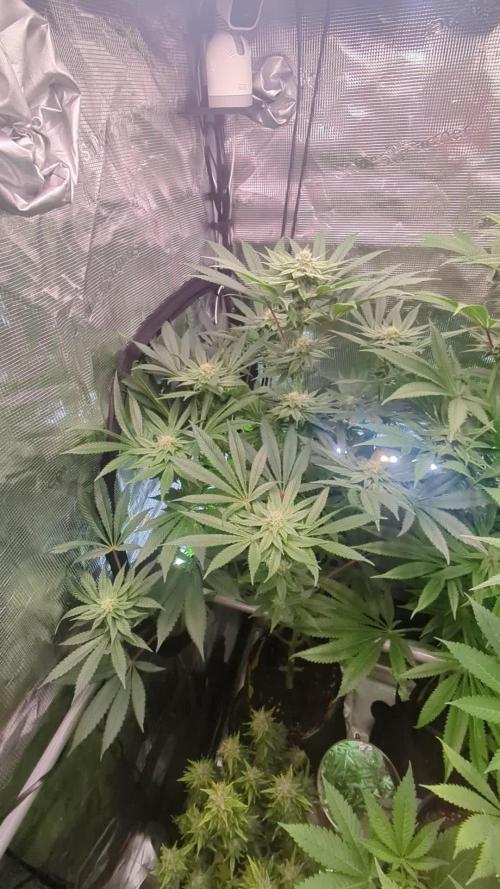
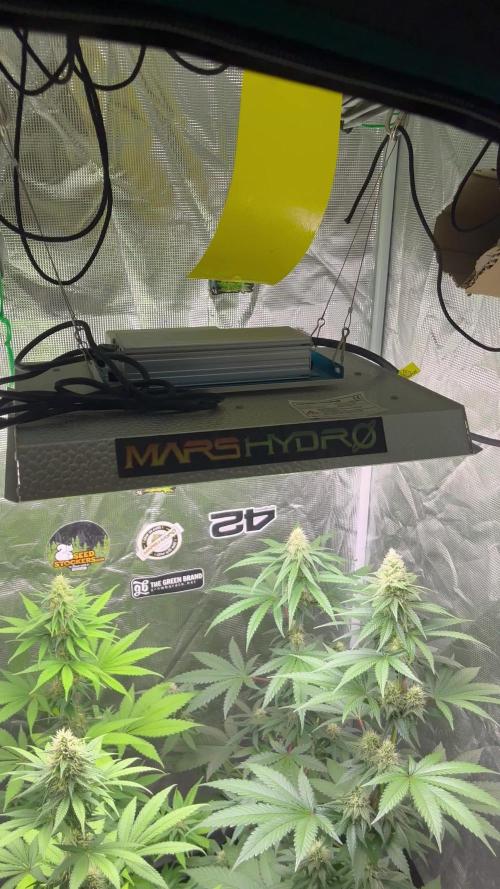
Well guys! home stretch! as you can see in the photo, harvest day is not far away)) Both plants look amazing! the structure of the Buds, trichomes, smell, stickiness and oiliness, all this is in excess!)) Buds are very solid and elastic .. very happy ..
Likes
15
Share
So time flew by these last couple weeks and the girlies finished nicely. I harvested last night and they doin their thing under the cover of darkness. They all had some amazing color when trimming. I can’t wait to see how colorful they become. The 🦍 Glue pistils started with almost an orange sherbet like color and were almost like a strawberry milkshake color when I trimmed. Once again the only disappointment was me 😔, for many reasons. They outperformed my expectations yet again. I’m amazed still, that even if you find your girls face down in the dirt, you still gonna bag something……which is always better than nothing 💯 #ResilientDNA #HellaResistant #StickyIcky #Pungent #Fruity #Gas #FastBuds #AdvancedSeeds Will update with photos, weights etc. most likely Sunday night/Monday. Usually takes 4-5 days in my environment however I’m having a Little issue at the moment. I’ma little warm and a little extra moisture in the air than I like. Stay tuned 😮‍💨
Likes
71
Share
@Roberts
Follow
I just switched to water on Quebec Blast. Starting the purging of nutrition from the plant to harvest. Next update will be a harvest. Trichromes are frosty so should be prime ripeness when ready. She grew under the Spider Farmer SE5000 light in New Level Hydro buckets the whole grow. Thank you New Level Hydro, Spider Farmer, and Quebec Seeds. 🤜🤛🌱🌱🌱 Thank you grow diaries community for the 👇likes👇, follows, comments, and subscriptions on my YouTube channel👇. ❄️🌱🍻 Happy Growing 🌱🌱🌱 https://youtube.com/channel/UCAhN7yRzWLpcaRHhMIQ7X4g SE5000 https://amzn.to/3qFpAML Spider Farmer Official Website Links: US&Worldwide: https://www.spider-farmer.com UK: https://spiderfarmer.co.uk CA: https://spiderfarmer.ca EU: https://spiderfarmer.eu AU: https://spiderfarmer.com.au Coupon Code: saveurcash (is stackable in most cases) Www.newlevelhydro.com Www.hygrozyme.com
Likes
12
Share
June 29: should start growing quickly here soon. July 1: last 30 days has been 1.5 C cooler than historic average, and is more than 3 C cooler than last year. Big heat wave in eastern Canada, but not here this year (so far). July 4: some growth going on above ground but she should pick up speed here now with nice weather and Week 4.
Likes
13
Share
@russrahl
Follow
This girl is growing on her own almost...lol very easy plant so far, takes a ph swing like a champ and really seems to like anything I throw at her. Been trying to keep nutes on the lower side as well and that seems to be working out so far too. She stretched up a bit more then the other Obiwan Kush’s around her, but I’ll just even them out with the next screen, no biggy. Got some good bud development so far I think and having my light mover setup properly now with the light running at 1000w seems to be working nicely. So far so good. Cheers 💨
Likes
8
Share
Wir sind in Woche 4 ! Konnte die vierte nicht auswählen ! Man sieht so sehr gut den Unterschied von 3 Woche auf 4 Woche. Im Video 2 sieht man sogar schon wie es langsam harzig wird an den zuckerblättern
Processing
Likes
9
Share
Likes
7
Share
@Nw4117
Follow
I reduced nutrients. Powdery mildew is continuing and getting slightly worse. I sprayed it with an apple cider vinegar mix. Hopefully that helps. The smell on the flower is really incredible. Smells berry like, and clean. I opened all vents in tent and have been leaving the window slightly open as well. Heater is keeping up ok. Even in the cold nights it’s keeping it at 66F with everything open. The leaves went crazy refilling the canopy. I’ve been pinching off some of the longer leaves and some that had mildew. The buds look good. Trichomes are cloudy enough yet, but it’s getting close. I’m gonna err on an earlier harvest, if the powdery mildew continues. I’m making some LAB from KNF, along with other natural fertilizers. If the vinegar solution doesn’t help, I’ll try that when it’s ready. Excited to try KNF on my outdoor garden and lawn. Planning on growing a couple canna plants outside this year. Gonna keep my outdoor as organic and natural as I can. The clone is doing well. The areas that I knuckled are strong now. Looks like biceps. Powdery mildew seemed to get this plant worse than the other. I’ve been wiping it off with my fingers as I see it, and finally treated with the vinegar solution too. I increased its feed to week two of medium gh feed chart. Expecting a lot of growth this week even with little light. Getting my dry closet ready as well. Got another humidity controller and an upgraded temp controller with Wi-Fi. Gonna dry one more time inside my house. It’s dry enough inside that I should only need a humidifier to keep it right. Need to get another one before I harvest and then should have everything. I used grove bags last time to cure and will never use anything else. Ordered another cheap TDS meter. The one I had got dropped in the solution. Update: 2/11 The apple cider vinegar definitely cleared the powdery mildew up, but I found a few spots I think I missed directly in the middle of the large plant. I don’t see anything on the clone. I’ll reapply in a few days and pay closer attention to the middle of the plant.
Likes
29
Share
Likes
167
Share
⭐ TrolMaster tracking ⭐ I started to track my crop during week 15, when I got the Tent-X TCS-1 by TrolMaster. First impression was: this is too professional for me, I can't handle setting it up and using it well. Then I started reading some posts on Instagram, I visited their site and in 5 minutes my cultivation experience took a huge step forward with disarming simplicity, I couldn't believe it. I have uploaded tracking videos from the TrolMaster app for each week from the 15th to the 19th, as well as the two weeks of drying stage. ⭐ Controller Chronicles ⭐ Day after day I appreciated the clarity and precision for data, access to all settings and instant readings by connecting a WIFI router to the controller's LAN port. I loved the possibility to dim my lamps remotely, or even automatically based on the temperature in the box! 🌱 GERMINATION (2 days) Seeds in a glass of EC 0.4 tap water for 10 hours, then in root riots and under the lamp. They sprouted after 48 hours from dry seed. 🌿 GROWING STAGE (10 weeks and half) I decided to give these plants a long vegetative growth and this allowed me to do a lot of training on both. Starting from the 4th veg week I started with defoliation sessions every two weeks, for a total of four during the entire vegetative phase. The last defoliation was done a couple of days before the switch, in order to allow the lower parts of the plant to get as much light as possible. Furthermore I did Topping on week 6, cutting the apical branch, then on week 8 I did Topping again on several sites, as well as SuperCropping on the highest branches to make the canopy uniform. The light cycle I used is 18/6 and the last two veg weeks I lowered the light hours to 16/8 first and 14/10 then. During the veg stage I made 4 DWC change, PH was always between 5.5 and 6, about EC I started with 0.6 and was 1.4 on the last veg week. 🌸 FLOWERING STAGE (9 weeks) I started this phase after 36 hours of darkness, I then changed the DWCs solution (adding a flowering stimulator). Then I mounted the ScrOG-net about 50 cm from the base of the plants and I wove the phenotype #1 through the net occupying at least 60% of the available space; the phenotype #2 stretched shortly after the switch and I used the net only to widen the central branches. They showed the pre-flowers two weeks after the switch, then I made two defoliations on week 3 and 5 flo. During the last four weeks of flowering (weeks 6-9) I simply paid attention to the PH-EC levels to provide the roots with optimal conditions. I then kept the TEMP-RH-VPD-PPFD values ​​under control and this also thanks to the Tent-X controller by TrolMaster which allows me to provide optimal conditions also above. I chopped them when trichomes were about 85% milky and 15% amber. During the flowering stage PH was always between 5.8 and 6.2, about EC I started with 2 and was 2.3 on the last week before flush. ✅ HARVEST - From dry seed to harvest: 140 days (2 days germination + 75 days veg + 63 days flo). - Chopped after 4 days flush and 48 hours in dark; - Wet trim, removed fan leaves. ✅ DRYING STAGE - Time: 14 days; - Average: 20° C - 50% RH. - After that I made a dry trim, removed branches and sugar leaves. ⚖️ DRY WEIGHT - Phenotype #1: 230 gr buds + 25 gr larf; - Phenotype #2: 105 gr buds + 50 gr larf. So, the overall dry weight is: 335 gr buds + 75 gr larf. ✅ CURING STAGE - Curing is done after 30 days with Boveda 62%.
Likes
1
Share
@Organic_G
Follow
Einfach wachsen lassen bisher, haben wohl gut gewurzelt und jetzt mal schauen was wird. Bin einfach auf die blütenqualität gespannt ob DS was gutes ist.
Likes
134
Share
@BigDaddyK
Follow
Well she has definitely recovered, the frost is starting to appear.... Day 64 - Tuesday 18/12/18 - Added 3 litres of water, 6ml A+B - ph is stable. Day 65 - Wednesday - changed reservoir for fresh solution Day 66 - Thursday - added 1 litre of water , smells lovely Day 67 - Friday - added 2 litres of water and 6 ml A+B Day 68 - Saturday- added 2 litres of water and 6 ml A+B Day 69 - Sunday - added 2 litres of water and 6 ml A+B Day 70 - Monday - added 2.5 litres of water and 2 ml A+B Looks very frosty ,smell s very strong lemon
Likes
2
Share
Wakíŋyaŋ, I am who I am, the salt of the earth. Thunderbird is an allegory; his conflicts with other forces in nature are then an attempt to allegorize relationships observed in the natural order, such as the changing of the weather. He is essentially an attempt to represent the patterns of activity of a powerful, mysterious force in a way that can be understood simply and easily – sort of the way in which a weather map functions today. Moving from18x60x60 = 64,800 seconds in 18 hours. 64800x860(ppfd) = 55,728,000 umol per daylight. Into Flower 12x60x60 = 43,200 seconds in 12 hours. 43200x1145(ppfd) = 49,464,000 umol per daylight. It's asking a lot of Rubisco regeneration to maintain 50 DLI in the 12 instead of 18. Raised the ambient CO2 to 1200 to 1500 ppm to achieve efficient gas exchange. I don't recommend. Adding sugar to an indoor growing medium is a highly effective way to stimulate microbial activity, which rapidly breaks down the sugars and releases CO2 through cellular respiration. You can safely capture this CO2 to fertilize indoor crops and boost photosynthesis. While this process works, the setup requires precise management to avoid common indoor growing hazards. The plant Carbon to Nitrogen C:N ratio defines the balance between structural carbon (sugars/cellulose) and nitrogen (proteins/enzymes). It acts as a master regulator of plant health, growth, and metabolism. Rubisco (Ribulose-1,5-bisphosphate carboxylase/oxygenase) is the engine of photosynthesis responsible for fixing atmospheric CO2 into sugars. It is intimately tied to the C:N ratio for three primary reasons. It is the Plant’s Biggest Nitrogen Sink, Drives the Carbon Side, and it is the Nitrogen Control Knob. Understanding this relationship allows you to predict how plants respond to environmental stress or fertilizer. Rubisco acts as the primary storage sink for leaf nitrogen, accounting for up to 30% to 50% of a C3 plant's soluble protein. Deep Green Leaves signal a rich abundance of both chlorophyll and Rubisco proteins. The plant possesses the heavy enzymatic machinery required to handle 1145 PPFD. Pale or yellowing leaves indicate a nitrogen deficiency. The plant is actively breaking down its own Rubisco to salvage nitrogen for newer growth, drastically reducing its light-tolerance threshold. Subtle difference, but understanding is important in order to be able to judge when to dial light intensity up and light intensity down, when to push, and when to back off. An extra dose of magnesium is vital if a plant is going to push through the growing pains of high-intensity lighting. Foliar application of magnesium is an excellent and rapid way to assist with Rubisco regeneration within a plant, so long as it is applied correctly. Spray strictly in the early morning or late evening, mixing your magnesium with a little fulvic acid or chelator, but only when she gets a little limey on top. This, for me, is the experience of growing, akin to "riding the surf" maintaining efficient Rubisco regeneration through visual identification of the shade of green. Surf a razor-thin wave when balancing light intensity, nutrient availability, and transpiration to maximize Rubisco enzyme efficiency. Keeping the Calvin cycle fully charged without tipping into nutrient toxicity, light stress, or the dreaded chlorosis requires paying close attention to the visual cues the plant provides. By monitoring these subtle shifts in color, turgor pressure, and leaf posture, you adjust your environmental controls and surf that exact razor-thin wave. Nute recycling acts as the vital execution mechanism for autophagy, which defines senescence. Natural senescence is a genetically programmed developmental stage aimed at nutrient recycling, whereas triggered autophagy is a rapid survival response activated by environmental stress. While both processes utilize the vacuole to break down cellular material, their triggers, selectivity, and overall goals are entirely different. Cannabis plant senescence is not separate from nutrient recycling protocols; rather, nutrient recycling is the primary physiological purpose of senescence, and autophagy serves as the core switch mechanism executing both processes. Takes about 24 to 48 hours to notice visible changes once the signals have initiated the autophagic response. Not too late at all. A little bit of fade from senescence 2 weeks from harvest is normal and genetically expected. Send the C:N 32:1 signal 1 week from harvest for the best effect in your organic grow. Understanding what makes leaves fade is not always senescence, but also strongly linked to Rubisco regeneration. That's a whole other subject. Vital to understand the differences if you want a correct diagnosis and to transition from hobby grower to master stoner, differentiating between a true genetic fade and a decline in photosynthetic proteins. Nitrate is nitrate, whether it oxidizes or not is not up for debate. If it's not sunk by the plant you are smoking some if not all of, it's regardless of what your feelings are on the matter. Senescence is highly critical. It is the natural end-of-life stage where the plant redirects energy to ripen flowers. Properly managed, it breaks down harsh chlorophyll, allowing the terpenes (which provide taste and aroma) to peak. Harvesting outside this window leads to an "unripe" or degraded flavor comparable to going without. To initiate the response you seek, you can trigger it multiple ways, when growing synthetically its triggered by nutrient starvation, generally when the entire medium is flushed. This is more to do with N starvation than being entirely empty. Nonetheless. PK boosters are N starvation through maximizing P and K. (Generally only works for synthetic grows) Because you are using organic nutes and you want to maintain the rhizosphere, what you want to do is add carbon in the form of sugars (powdered molasses). It's almost impossible to empty a medium enough when microorganisms are constantly releasing nutrients into the direct EC. Very difficult to initiate starvation responses with ammoniacal nitrogen. Manipulating the C:N ratio is the key to triggering an autophagic response and resulting nutrient recycling in the last days using organic nutes and without having to flush. Generally not recommended for new growers. So do what you want. But if you don't trigger the plant to dump its nitrates into root zones, you will smoke nitrates as NO3- does not oxidize during the dry and cure no matter what you do or how long you dry or cure. Doesn't matter what anyone "feels" about it, how many grows they had with no fade. "Clover steals valuable nutrients." Crop and drop the clover come flipping to flower, its benefit comes from creating an airy and porous rootzone. I don't need to crop and drop once the plant fills the canopy, she blotches out the light, and the clovers die. This is the nitrogen the microorganisms use to convert carbon for respiration throughout the flowering stage.
Likes
4
Share
@Lazuli
Follow
She flowered very fast. The smaller ones smell different and have more shiny flowers very nice, it smelled very strong at the end, while trimming the buds a smell of fruit and gas spread trough the whole house
Processing
Likes
14
Share
Jetzt sind wir offiziell in Blüte. Die 2. und letzte Düngung mit BioTabs sind gemacht. Sehen gut aus bisher. Bin sehr gespannt. 😊 Edit: Das letzte Bild und das Video sind 2 Tage nach dem Netz und Zeitumstellung entstanden.
Likes
6
Share
Starting Week 10, which marks the beginning of the 7th week of flowering. The buds are stacking nicely and the trichome production is ramping up. Tomorrow, I’m planning a defoliation to improve airflow and light penetration. I’ll also be tucking and organizing the canopy to keep everything tucked neatly within the 70x70 space.
Likes
1
Share
@Chucky324
Follow
Hello This is the end of week 6 and the beginning of week 7 of flowering. These plants will go for Meds as well as smoking. Showed some pictures of the Rick Simpson Oil I've made and I made a gallon of tincture too. Pics are for the extract contest. I take the tincture when I forget to take my oil or I need a break from the oil. I try not to eat much acidic food and drink... That helps too.... try to eat alkaline as much as possible. But all the good tasting food is acidic. I try to avoid sugar too. Cancer likes sugar. One of the Pink Kush plants leaves are going a yellow a little early.... Wonder what's wrong.... got to look into that... 3 More weeks to go before harvest.... Lots of Fun... OK. Be Great. Chuck.
Likes
8
Share
Definitely glad I picked this one to KO first since it’s an easier strain since I’m still trying to learn the whole organics thing but a few more and I should be able to produce something a little better I hope lol
Likes
Comments
Share
En pleno proceso de engorde los 16 clones en macetas de 7 litros,con un leve problema de araña roja ya solucionado orgánicamente. Ya todo funcionando mejor
Likes
9
Share
Nous somme à la 6ème semaines de floraison tout se passe comme prévu les bourgeons continuent de gonflés les paramètres sont excellents 24 degrés en température 55% en hydrometrie. - L'ajout de RQS guano a redonner un coup pouce à la plante les bourgeons ont sacrément gonfler aimer et regarder par vous même. Cet semaine sera aussi la dernière irrigation avec nutes. Ce run est l'une de mes préférée. Léger carences en azote post-stretch cela es dû a un faible apport de celui-ci mais rien de grave cela indique les derniers semaine de vie de cette dame le rinçage sera simple et éfficace. L'odeur quelle dégage es fortement fruité cela sent le 🍬 🍬. A plus pour d'avantge d'informations.👍🏼