


Likes
Comments
Share


@GarciasGarden
Follow
WEEK 2 DAY 14
Since last week the babies have taken off! They didn’t have much light until yesterday when I added another 100w led and since then I’ve seen a huge difference ! They are looking super healthy the roots said fuck the pot and grew right through it I’m actually super interested in seeing how these grow up..
The 3 clones that were separate last week are now moved into one single pot to further develop the experiment.
They are on the same feed as the mother with flora grow/micro/bloom and cal-mag .
And In the last picture you can see my ghettos man way of cloning .. going to see which 2 out of 4 are better rooted and I will move those to a pot in about a week or so.
If you guys have any questions or want to know where I got these exotic seeds message me!! Or comment below !

Likes
27
Share


@Roberts
Follow
Pineapple Express is flowering and lsd looks to be right behind it. Starting to really take off now. Like and follow I will do the same. Thanks everyone. Can check out my you tube channel as well.

Likes
10
Share


@FantasticAttempt
Follow
This is where we are at .. I don't know if I should cut the bigger leaves to help with energy 🤔

Likes
38
Share


@Cariboo_OG
Follow
Utopia Haze is a rare heavily sativa dominant hybrid (90% sativa/10% indica) strain created through back crossing Brazilian Sativa strains. This tasty little bud took home 1st Place for Best Sativa in the 2008 High Times’ Cannabis Cup and for good reason – with its potent 18-22% average THC level and long lasting cerebral effects, Utopia Haze is one powerhouse smoke. The Utopia Haze high comes on soon after you finish your first toke, hitting you with a strong cerebral lift that infuses you with a sense of hazy relaxation.
Type: Feminised/Photoperiod
Cultivation: Indoor/Outdoor
Flowering Time (days): 70-75
Indoor Yield (g): Up to 650
Feminised Outdoor Harvest Month: October
Feminised Outdoor Harvest Month Week: 3rd-4th week
Aroma: Citrus, Woody, Pungent, Mint
Effect: Cerebral Lift, Hazy Relaxation, Sleepy
Welcome Everyone to the Final Entry of my Utopia Haze Grow !
There is so much to discuss ! I have been extremely busy as of late trying to get this Harvest together, but i am happy to have it here for you now !
I Seriously under estimated the amount of time, help from others, and my own necessary skills to pull this off.. and i still kind of screwed it up lol !
But its worth noting i have never actually done this before and trying to document it during....was extremely hard.
It is next to impossible to work an iPhone with rubber gloves on !
First I want to discuss everything step by step so before you jump straight into the comments on how the end product is so small in "quantity"
Rest assured i am happy with its"quality"...and thats all that matters to me because Life is a journey not a destination! and i have learned so much from this grow that I couldn't be any happy even if i messed some things up :)
But at the very least I hope you read through this entry in its entirety with an open mind and focus more on the process, rather than just the outcome!
I ran out of Ice & i was only able to wash three times..(normally I've heard you should go sometimes 5-6 washes)
Preparation is Key & things will be much better next round :)
Photos 1-22
These are pretty self explanatory but for those of you just tuning in now.. this is what happens to a very happy plant when you don't have the necessary tools to monitor key components of growing cannabis.. Ph, as well as EC levels play a very key role in the outcome of your grow lol that being said I was just able to save this plant by purchasing both tools but that doesn't mean the plant didn't suffer because of the prior events.. This was a Huge reason behind me choosing to turn this harvest into what i would consider
"Solventless Hash Rosin" from "Ice water extracted Bubble hash".
Pictures 23
The idea here is the process of using "fresh Frozen Cannabis" this has been discussed many a time online on such sites as instagram and here on grow diaries as well.. I personally have Never tried the process so i decided to try it out and make a judgement for myself..
Video 24
The Cannabis has now been in the freezer for 72 hours making it very well frozen.. as you can tell i struggled getting it all into the 25u Screen Wash Bag. One thing of note i would do differently is i will de-stem my next batch as i also believe this played a part in the amount of plant matter that escaped through the sieves.
Photo/Video's 25-28
The idea here is "ice water Seiving" & especially with the bags that I am using here that are only have screen material on the bottom portion of the bag it is very important to have spaces in-between the screens to allow the water to pass directly through the screens into the bottom bucket with the least amount of resistance.. because the hash is so extremely temperature dependant if it gets warm on the side of the bag.. it will stick there and not make it to the bottom to become use able product..
29
You do not need to use as much Ice as i used here lol... the idea is to keep everything very cold..i certainly achieved that but at the sacrifice of using so much that i ended up grinding product and producing "contaminants" but in the end they are just plant matter that i would be smoking when i rolled up my joint either way so.. I'm not super disappointed..
But it should be noted that what you want to achieve here is a Layering effect where you have the wash bag between two small layers of ice while the "water current" washes the Trichomes away allowing them to be separated by the screens setup below :)
Before Starting the machine you should allow some time (i.e.;10-12minutes pre soak to allow the product to become saturated) before the first cycle.
By video 32 I have just ran out of ice lol..
Video 33-34
Here I have a tip for you.. to separate the screens that you sieve through.. cut 5 gallon buckets to stretch them across nice and tight.. it'll make scooping your Bubble that much easier ! i learned this from the many "Frenchy" videos I have watched :)
Picture 35
Here in lays the problem for most people.. drying your hash without loosing vast amounts of "Terpenes" whilst also stay ever vigilant against mold !
Thanks to all those videos I've watched on youtube.. id like to think this was one of my most successful parts of this process..
Things to Note; Terpenes start to seriously evaporate at temperatures 68F or 20C
you need to stay as cold as possible whilst bringing the Relative Humidity in the space down into the 40-30% to stay away from that nasty mold !
I used my cold storage room in the basement.. with a dehumidifier running to keep the space at 45% RH & staying at a constant 15c.
All while spreading the hash as thin as possible across parchment paper, on top of the white screens with a fan moving air across both sides of the paper.
Pictures 36-38
These are some macros i took in the middle of my drying session I fell in love with the colour.
Yes i know the black spots are plant material but they will get caught when i bag the hash & squish the oil out.
Thing to Note; at this stage it is important to ensure you 'micro plane" the hash down as fine as you can whilst staying weary of the temperature... any "chunks" will hold pockets of moisture.. that lead to potential problems..ie; mold ...
Picture/Video 39-41
Successfully planed bubble hash ready to be bagged and Squished !
Picture 42
Ive decided to follow Pedro.. from Pedros Grow Room and double bag to be on the safe side so i don't have any blow outs.
So thats One 25u bag inside one 160u bag ! :)
Pictures 43
This is almost 3 grams of the bubble hash from above, already melting in the bag.. this is where i ran into trouble again lol things started getting to warm in the house and i was only able to get one of the three squish's i did on video :( things started getting sticky.
Picture 44
This is basically just a photo of the equipment I'm using; 3x5 LowTemp Cage in the frame I built myself, with a 20Ton bottle jack.
Something to note here is this is an older Lowtemp model with only a single heating zone which is which i have it closed here heating Both sides of the press :)
As well as the importance of having adequate pressure on your plates.. my rig is very overkill for the size of hash bags..lol
Video 45
Here is the lovely press video.. its didn't quite work the way i wanted either lol my directional folding wasn't quite tight enough for a big "drip" :)
&the Press was set to 65°c
Photo's 46-50 are pretty self explanatory :) I had a blow out.. but still managed to pull an 80% return from the hash once squished...& yes it tasted amazing :)
Was it worth it in the end... that could be debated.. for some..i understand..its not your thing, but for those of us that are interested in making our own concentrates.. free from Solvents...
I wouldn't make it any other way :)
If even ONE of you reading this diary finds it helpful to reference for ANYTHING.....even if its "what not to do" ill consider it a success !
Thanks again for tagging along on this garden adventure.. its been one heck of a journey !
Much Love from B.C. Canada,
Until Next time,
Cariboo
Likes
4
Share

@jdean88
Follow
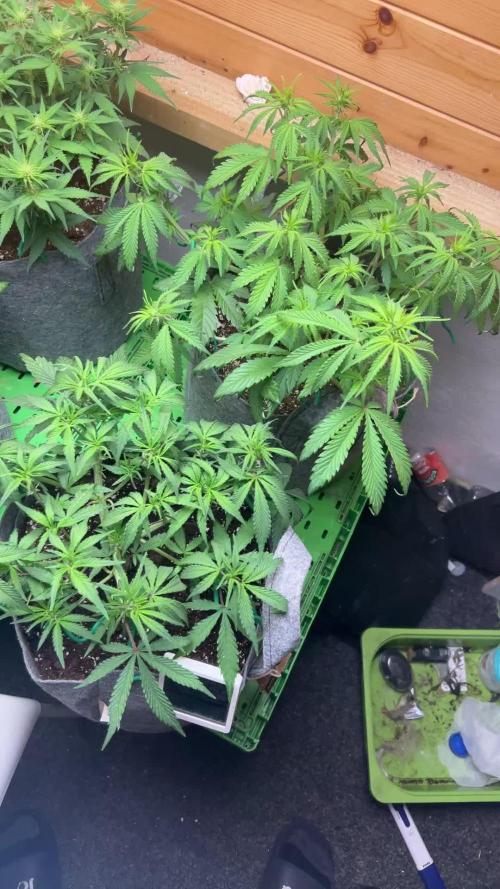
All flowering now starting to really take off the blue dream is flying they all have stayed short bit hoplyy the stetch will give a bit the gorilla melon is in its own tent now to continue veg to fill a 3x3


Likes
14
Share


@NewbieGrowmie
Follow
Just been flushing her these past 12 days, and she is starting to fade, so I'm harvesting her this weekend. Gonna try bud washing her as well, I'm excited to see if it has any effect on the quality of the smoke.

Likes
24
Share


@JONNY_APPLE_WEEDS
Follow
More to come!... don't even ask how I keep this tent in the 70s in the garage when it is already getting to 96 degrees outside..... short answer... "oh, this works, well it did work, maybe if I do this, that seems to help, well shit, that didn't work, uh oh, its getting hot, I got it!... and done. - temps start to climb into the 90s - " oh shit, oh shit!, Its not working anymore, I guess 90 degrees inside the tent is better than being in the 100s.... think, think, think, 😲 I got it!... annnd done👌! Its working. The temp at the time of writing this is... 73 degrees (last night it is was in the upper 80s lower 90s).
So yeah, my wife is upset at the time I've been spending on it..... if only she would have let me do this inside the house like I wanted to. Meh, whatareya gonna do? 😕
There is something living in my attic... I hear it now.😒....
Likes
10
Share


Likes
10
Share


@JiminyCricket
Follow
I've been having a tough time with shipping getting things I need to properly control my environment and running into issues.
I have invested in a new; 4x5 Vivosun tent to give the bigger plants more room, a Spider Farmer 1000 ( MrCanucks, a guy I learned a lot from on YouTube did a paid trial of this product with pretty great results, thought I'd try compared to my current crappy LED.), Sizing down to 1 and 3gal fabric pots for a softer transplant transition next go around, the hygrometer/thermometers, some more appropriate sized fans for the tent ( Genesis clip on and treveda circulating fan) to help with general airflow.
Overall I'm actually very happy with all my first set plants (the bigger ones), most seem to be producing multiple sites and growing bigger every day. Noticed the seedlings having trouble about two to three days ago at most. Honestly did not give them the attention they needed. First though it was nutrient deficiency or lockout, maybe, overwatering. Finally checked the soil good and seen how clay like and thick it had become, then took a few out their cups and seen the roots we're choking. I have a grow question up wondering whether I should try to save the seedlings or scrap them in favor of more light for the bigger plants that are obviously growing well?
Until next week!
Happy growing and much love to all! ✌️🌱
-UPDATE-
So I ended up receiving my new Spider Farmer SF-1000 LED grow light and my two fans a bit ahead of schedule today! ☺️ Got the Treveda circulating fan and Genesis clip on fan. Reset all the plants to better benefit from the new gear and a couple other things. Need video I uploaded shows the most current setup.
I moved all my bigger 1st set seed to the left side and hung the SF LED to about 20.5-21in from the tallest of the 4 of those plants. Most all are at least 9 inches. I moved the ring of the 1st set and seedlings to the right side under the Vivosun 600W at about 24in. Still haven't received much feedback on my grow question regarding my seedlings. Since I wasn't quite what to do, I ended up leaving them out of the cups and putting them in my germination tray. My hope is I can keep the plants surviving long enough off of regular sprayings and using the tray as a make shift nutrient reservoir until the soil and pots finally arrive. Scheduled to be here Wednesday, hopefully earlier like the light and fans 👍
Would love to hear all your feedback and opinions! Hope everyone is having good grows and good vibes!


Processing
Likes
23
Share


@eldruida_lamota
Follow
-En primer lugar dar las gracias a zambeza por creer en mi en todo momento,y por darme a conocer esta gran pagina y familia, espero que sea para largo esta colaboración.
•Hemos germinado 9 semillas, 3 de cada raza, lemon , power plant xl, northern light xl, y que pasadas 48h fueron colocadas en maceteros pequeños, los cuales iluminaremos con un bajo consumo las primeras semanas.
•Esperemos que este seguimiento sea más completo y más extenso que el anterior , (que lo edite todo en una noche,aún que me llevase casi 4 meses el jodido proyecto).

Likes
13
Share


@BigNoob
Follow
I was forced to chop a small branch off of the Fire OG because of PM. Tropicana Cookies was lightly affected as well. I finally grabbed a larger 70 pint dehumidifier, I’m hoping that high humidity issues are now a thing of the past.
On my next run, i will definitely run a longer veg with more LST training. I feel like my buds are pretty small in comparison to others I’ve been seeing at the same stage as mine. The trichomes are coming in nice and heavy tho!

Likes
8
Share

@BobbersDown
Follow
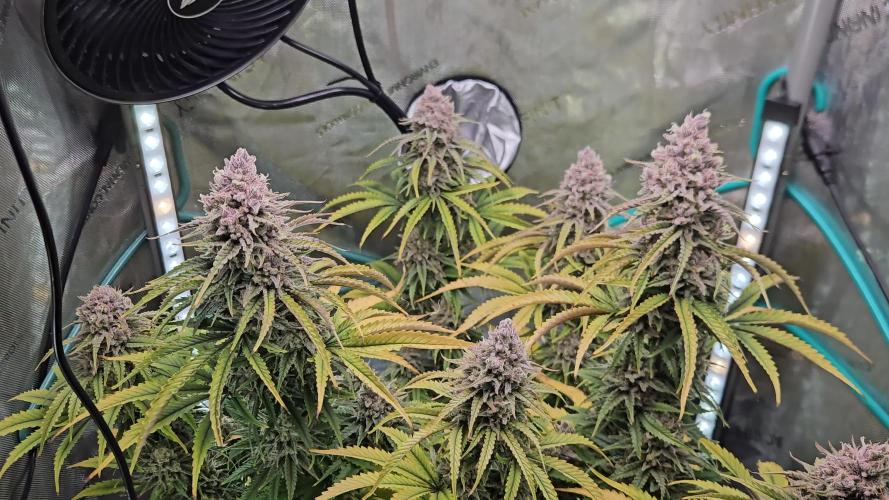
I'll report back with weight post dry and trim. Extremely high hopes for this strain, grew basically perfect start to finish. The one additional comment I have is on the wicking self watering base from AC Infinity I used. It did really well at keeping the soil damp, but not wet. Not sure if there will ever be issues with root rot, but I was careful to let the reservoir empty between waterings. The one downside to it is once it's set, you can't really move the pot at all without messing up the wicking ropes. Pros vastly outweigh the con though as you can leave it several days with a full reservoir.

Likes
Comments
Share


@Bombmom420den
Follow
This week was so mixed with the ladies and the heat issue we had this week. Cherry Bomb seemed to be the only one who didn't care that it got hot the rest have burned leaves from the heat. But they all are bouncing back and should be looking better over the next week.
Likes
14
Share


@CampaCavallo
Follow
Buongiorno amici della CampaCavallo 💚💅🏻🔥😍 ... In questo week (8.3.23),il team di disinfestazione CampaCavallo si è dato da fare per salvare il salvabile dai maledetti spider mites 🕸️...
Ringrazio molto @MiyaguyOKPolilla per i consigli BIO che mi ha dato, ma purtroppo non avendo a disposizione ne chiodi di garofano, ne bastoncini di cannella, mi sono dovuto arrangiare con la canna dell'acqua💦💦💦
Abbiamo preso ogni pianta, portata all esterno della grow box, e con un bel getto d acqua abbiamo letteralmente spruzzato energicamente le piccole... Tutto perché il merda di spider mites odia l acqua👍🏽 abbiamo anche rimosso le grandi foglie compromesse o troppo infestate.... Speriamo di non averle stressate troppo.... Ma é stato fatto tutto per il loro/nostro bene💚🙏🏼👍🏽
... Abbiamo anche trattato la grow box con una miscela di acqua e candeggina per disinfettare come si deve🚑
Le foto mostrano il risultato.
Ci piacerebbe molto sapere cosa ne pensate... Consigli, critiche... State sintonizzati 👍🏽💚💯👌
BUONA SPANNABIS 2023 A TUTTI I GROWER 👏🏽💚💅🏻🔥😍💯👯♀️

Likes
28
Share


@OGgrows
Follow
slight increase in flowering feeds and introduction of new biobizz nutes. good filling of buds this week. very homogeneous strains. good week everyone 🌴🌱💚🙌

Likes
26
Share


@GoodVibeGarden
Follow
Things are moving right along. She is loving life and starting to frost up. Stacking is nice, And she smells like pungent cheese.


Likes
12
Share


@603grower
Follow
She came out amazing. Super frosty. I got exactly 2 ounce off of her I wish I vegged her out a few more weeks and got a few more branches. Every still branch was stacked! I love useing this site really helps me keep track of my grow and what I’ve done!
Likes
27
Share


@adam_pawloski87
Follow
Today is day 72 from seed!! This week went real well , 2 of the Forbiddin Runtz have been getting flushed an the rest will also start flush through this next week, I can’t believe the smell of this combo strain,, super fruity smelling an all are super sticky!! Stay tuned for next week yall !
Likes
11
Share


@Jays_Not_Here_Man
Follow
Another good week for this lady. Temps were high, but she handled it like a champ. Because she is so beastly and only in a 4 gallon pot, I’m watering about 1 gallon of water every 3 1/2 days. The dry back seems to be better if I don’t wait till the 4 th day.
Buds are developing nicely, and stacking really well. I’m going to have some decent sized colas. Frost is coming along nicely too. She has a Kush smell with some sandalwood at the moment…
Temps were floating around 82 degrees this week, with RH around 55-58%. Plucked a few more fan leaves, but otherwise just a slight turn each time I check on the tent. Happy Gardening
