Likes
Comments
Share


@Ganjaman19
Follow
Overall its been a decent grow had some high temps but all the plants have turned out good in there own way this is the 1st time I have not lollipopped and I got alot of small buds for making extracts and hash etc the next grow will all be lollipopped and we will see some bigger nugs


Likes
9
Share


@Kayotic
Follow
Couldn't log in for a few weeks!!
End of week 10 today, supposed to be the final day to finish.
#5 has some leaf issues, but smells great. Like sour berries.
#1 looks the best and smells of straight banana
Fox Farms Cha Ching
Just waiting
Likes
6
Share

@julianflores
Follow
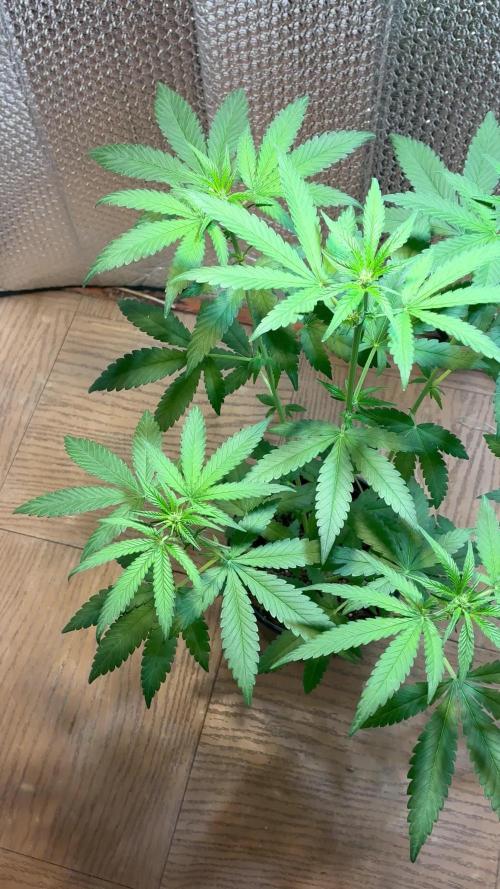
There’s no doubt that she’s in flower on day 31, mid week 4 from seed. I’m going to cut the nitrogen supplementation back to half and start introducing More Phosphorus and Potassium….They’re starting to focus on bud growth on day 35

Likes
24
Share


@Grnhead
Follow
This was a great grow and only my second one so far. I am starting to figure out more about my setup and just keep learning things. My final harvest weights were more than I expected and I couldn't be happier!


Likes
26
Share


@SmokeableHobby
Follow
12/28 - Day 43 / Day 15 Flower - Feed Day
Pots were mostly dry on this day. It has been about a week since I last fed them. I've only had two small waterings since last feed, about a half gallon of water for each of my 5 gallons and about 8oz of water for my bonsais. My plants are drying out within about 48 hours of each small watering.
For today's feeding I decided to pull Grow Big out of the solution and focus exclusively on bloom nutes. My solution consisted of:
- 1 gallon distilled water
- 4ml CalMag
- 2 tsp of FF Big Bloom (2/3 dose)
- 1 tsp of FF Tiger Bloom (1/2 dose)
- pH: 6.7
- TDS: 582
- EC: 1.2
The pH of my solution was down around 5.3 when first mixed so I pH'd up with baking soda to get to a final pH of 6.7. I gave each of my 5 gallons about a half gallon of the fertigated water each which wasn't enough to produce runoff. I gave them each about another 1/4 gallon distilled water to generate enough runoff to test. I tested the runoff of my Z52 which gave me readings of:
- pH: 6.4
-TDS: 1620
-EC: 3.3
I gave about 12oz of fertigated water to each of my bonsais. My ZB2 runoff posted readings of:
- pH: 6.8
- TDS: 718
- EC: 1.5
****************************************************
12/30 - Day 45 / Day 17 Flower
Pots were close to dry so gave each of the girls a light watering. Gave about 1/4 gallon of de-chlorinated, pH'd water to each of the 5 gallons and 6oz to the bonsais. Everything looking good aside from the fact that my girls are getting too tall for my tent. I've ratcheted my lights up as far as they'll go but the tops are now starting to get within 12". May need to take action to lower the canopy.
****************************************************
1/1 - Day 47 / Day 19 Flower
Happy New Year!
Pots were getting pretty dry again so provided another light watering with no nutes.
****************************************************
1/2 - Day 48 / Day 20 Flower
I am officially concerned with the the distance between the tops and my lights. After reading a few forums to see what other growers have done in my situation, the consensus feedback is to do some supercropping. I ended up supercropping both of the main stems on my 5 gallon pots. I counted three nodes from the top, massaged the stem a little bit where I planned to bend and and then bent each branch to almost 90 degrees. Luckily, the stems didn't snap or show any signs of breakage.
Had to remove the shelf in what should be a second compartment of my tent and attempted to do a little LST to widen my plants and lower their canopy.

Likes
5
Share

@GoodTimesOrganics
Follow
Hi liebe Community and Welcome back! 💚
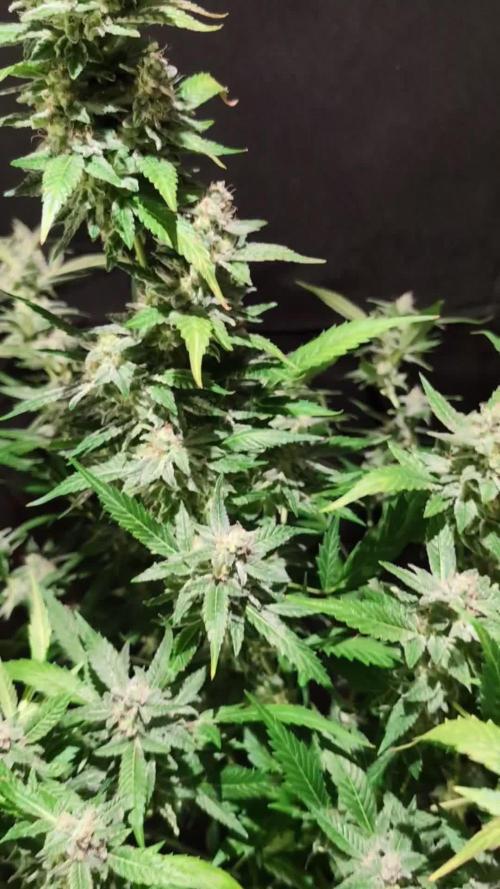
Jetzt war es Zeit für den Trichomcheck und ja, es sieht genau so aus, als wäre die Pflanze exakt in der 8 Wochen Blüte Range.
Nächste Woche ist es dann endlich soweit und die DMO Grapefruit kommt unter die Schere ✂️.
Ich habe die Pflanze nochmal Stark ausgedünnt und es zeigt sicher eine sehr stark ausgeprägte Blütenstruktur. Absolut im XL Bereich.
Es lässt sich beobachten, dass die Blütenbildung im mittleren Bereich der Colas stark ausgebreitet hat und die Pflanze Richtung Spitze eher etwas dünner wird.
Sie bildet die Blüten sehr vielseitig aus, von dünner kompakt bis hin zur breiten dichteren stellen.
Ihr Geruch ist nun sehr stark ausgeprägt und eine Grapefruit Note zeichnet sich als markante Hauptnote ab.
Abgerundet wird dass ganze durch etwas skungige, Säure und etwas Zwiebel/Pfefferigel Noten. Auch eine leichte Süße Komponente kommt etwas hindurch.
Die Wachstumsbedingungen im Growzelt sind aktuell wieder super!
———————
🌞 Temp: 23°C
🌚 Temp: 20 °C
💨 RH: 53%
VPD: 1,00 kPa
😎PPFD: 830 mqm
———————
Stay Tuned! 💚
Likes
18
Share

@MedicaL
Follow
Den 62 od přepnutí.
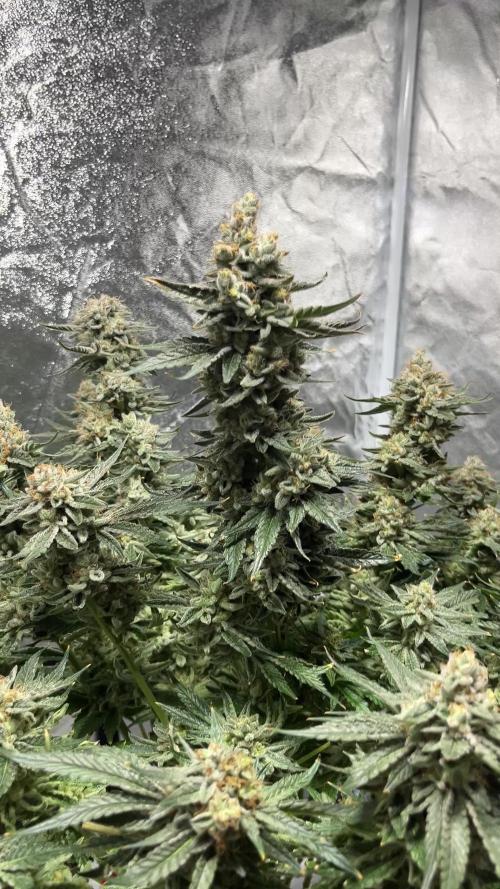
Hell yeah, třetí kolo za námi 🌴 posledních 10 dní pouze čistá voda.Trim proběhl za mokra, sušení probíhá mimo box, v sušící síti HerbDryer s podmínkami 15-17stupňů a 30-50rh 👌 Voní to moooc pěkně.
Shrnutí grow:
🗑️ Pot- 15l
💦 Voda- reverzní osmóza
🥥 médium- koko-perlit 70:30
💩hnojivo- Advance Nutrients Cultivator
Na tak slabé světo..Spokojenost 🙂 👍🏻

Likes
8
Share


@Rabidreject
Follow
My oh my, what a difference a week and a dimmed down light can make! I expected to have to have it covered for longer period than I actually did as well.
I don’t know what there is to say really, you can see I have repotted into the Autopot XL so it is probably the smallest Autopot XL grow there is!
I was super careful to actually cut the paper pot it was in away as I didn’t want the auto to think that was the bottom of the pot and start flowering.
I simply prepped what it was going into and wetted it and ripped it off then buried it - it was a little leggy from the windowsill action so I sorted that.
Somehow the dimmer that was broken is no longer broken so that’s cool - its on about a third of the total of what’s it can put out atm.
Honestly, I thought this plant was going to die before! It still might but it looks a fuck load better now than it did!
I am going to have to start mixing up some hydrocrop notes as it’s what I have on hand. I’ve always had great results with it before so why not.
I am back in touch with FastBuds and they have sent me some more seeds so hopefully next run I’ll be doing something a bit newer as they seem to always be pushing that THC value! So far, so good - now to have a look at other smoothie auto diaries too see what stresses she can handle in terms of training.
Edit: it’s been a couple of days since my last update but I needed to add a small reservoir for the Autopot XL to run from so I nominated a 5l plastic jug. Only after drilling the hole for the Autopot filter and plug I realised I needed to get to the inside of it so I cut away the section that was the lid so I can still use the handle and it has structural integrity.
Everything seems to have gone swimmingly but the jury is still out on whether a 5l bottle will be enough for 1 plant - I can’t remember how thirsty the smoothie one was from before.
It’s a resilient plant though - it recovered so quickly from germing on the windowsill. The tent is pretty sketchy because i had to cut down the poles to make it fit the space and so the skin is a bit saggy.
Still, she seems to be thriving - the light is on about 50% (75w) and before I connected up the ‘res’ today I was just spraying a very small amount of water that had mammoth p added to it after it had been PH’d to 5.5 ish.
I did intend to go with grow dots but unfortunately they have taken too long to come now - its in its final pot and im not messing around with slow release now we are coming into veg, they would surely be behind schedule.
I have been using the trusty Hydrosol by Hydrocrop - its cheap as chips and has a cannabis specific feed chart that has never let me down. I was using GHE before and this is like 10x cheaper and i get the same results. Once you have worked out your concentration and diluted the powder into bottles it is very similar to any other rip off, cannabis specific bottle feeds, only you get enough powder to make 5 bottles worth of each so it works out super cheap, you dont need to mess around with silica, it literally has everything the plant needs so no PK boost either, you simply adjust the ratio of bottle A to bottle B and it boosts the PK and lowers the N. It also has enough calcium and magnesium - although they do sell a cal mag but they specify it is specifically for buffering coco - fair enough. I’ve never had any luck doing that and my plants always die using that bricked coco that I have buffered myself but that’s just me - my mushrooms love it though and I dont have to do shit to it either!
Likes
7
Share


@Sabac
Follow
Fin de mis plantitas.
Recomiendo el banco greenhouseseeds primera Vez que cultivo ese banco y salieron excelentes...


Likes
8
Share


@ManilaGrowOp
Follow
She took off like a rocket. This week she’s definitely growing day by day. I bought a cctv to monitor my plants while I’m not at home.
She loves the nutrients I’m giving her. I’ll probably grow her for about 1.5 feet in height and flip her until she can cover the entire 2x2 tent. We’ll see in the next weeks
Likes
20
Share


@Ghostknife78
Follow
Adding SLF 100 and Calmag to feeding. Although everything seems good, I'm going from tap to RO to have maximum control over my PPMs or TDS. Buds are really developing nice and she is still stretching. I appreciate any suggestions. ( Running CalMag, Photosynthesis Plus, and SLF 100)

Likes
105
Share


@BioBuds
Follow
This is the final week, they are going to be chopped coming week. Already had some darkness and they are very very smelly. I am amazed at this strain's resilience. It had to deal with my noobishness with autos, heat, very hot soil and less PH buffering with my own super soil recipe (see the yellow image in the germination page) in the smaller bags. Still, they became huge and full of bud.
Forbidden Runtz is an amazing strain. Very strong growth but also with most auto's I've grown: once the grow derails, it seldom recovers. But these do.
I'm sure next grows I'm going to get even more out of them. Can't wait to try them again with what I've learned now.
And you should all consider the SP-3000 as a growlight, look at my results!
I will update when I've harvested, thanks for visiting!!
Don't forget to check out the special spring discounts on www.mars-hydro.com
Big hug
Bud
Likes
7
Share


@TJHeadley
Follow
Tempature was getting to 60° at night and 67° during lights on. Bought foam board to put under the tents and an oil space heater to combat cold temps. Defoliated on 11-6-23. Top Dressed with BuildaSoil Craft blend ¼ Cup
Likes
14
Share


@danwho
Follow
10/13/2024
Reduced light to 85%, which has dropped tent temperatures a few degrees. Daytime air temp high is around 82 again with leaf/bud temperatures around 78. Seasonal changes have dropped outdoor temperatures and therefore indoor temperatures as well. Night temperatures are getting down around 69F. Lung room humidity is bouncing between 45-50%.
The plant is looking strong with some definite signs of fade setting in around the canopy. Trichome development is great, a lot of white showing up and starting to look frosty! For the last few days I have not pruned many leaves to allow the plant to pull nutrients if needed. Mainly because I still have not done a full water change in the system. I have continued to water with a reduced strength nutrient solution with the same ratio to maintain the 600 - 650 PPM window.
10/18/2024
It has been a pretty stress-free week. Humidity has dropped a bit lower than I would like so I have had to use the humidifier to keep VPD in check with daytime temperatures in the low 80s. I have spotted a few seeds developing around the plant (maybe a handful). From what I can tell it does not look pollinated and I cannot see any nanners. Either pollen from the second plant was mature enough and stuck around after culling, it pollinated itself, or parthenogenesis is at play here. Regardless, going to finish the plant as planned.
Trichomes are about 95% white at this point, by inspection with 30x loupe.
10/19/2024
Started the water change to reduce reservoir PPM to about 450 by pumping some off and replacing the water with pH-adjusted water. About 5 gallons cycled. Reduced lights to 80%. The fade is really taking hold and looking quite nice. Plant is still very healthy and the smells are amazing!
Trichomes are about 98% white by 30x loupe.
Likes
51
Share


@nonick123
Follow
Día 57 (16/12) CBD Auto 20:1 #1 ha empezado a bajar el consumo de agua... pero sigue creciendo! ¿Tendrá fin el stretch de esta planta?
CBD Auto 20:1 #2 empieza a perder hojas por senescencia. Está a punto de cosecha!?!?!?!
LSD-25 Auto está increiblemente dura y brillante. Un color morado oscuro casi negro
OG Kush Auto ha bajado un poco el consumo de agua, pero empieza a formar unos cogollos monstruosos, completamente cubiertos de resina+
Día 58 (17/12) CBD Auto 20:1 #1 empieza a tocar la lampara! Vuelvo a subir la lampara....
Además presenta una ligera coloración morada en las puntas de las hojas... ¿Coloración natural o deficiencia de P?
CBD Auto 20:1 #2 tiene un montón de hojas con senescencia acelerada de un dia para otro! Ha llegado el día de la cosecha! 😍💥
LSD-25 Auto sigue acercandose al final... todos los cogollos son duros como pelotas de golf 💥
OG Kush Auto estaba practicamente seca! Vuelvo a darle 1250 ml de H2O RO. Va a hacer unos cogollos brutales
Día 59 (18/12) CBD Auto 20:1 #1 - empieza a mostrar coloración morada en las puntas de las hojas ¿Genetica o deficiencia? Aprovecho el riego con BIO PK 5-8 10 ml/L y darle un booster!
LSD-25 Auto - se acerca la cosecha! 😍💥 Cogollos duros como piedras en todas partes y bajando el consumo de agua...
OG Kush Auto - muestra más avanzada a deficiencia de hace unos dias, de modo riego con BIO PK 5-8 10 ml/L. A ver como le sienta!
Día 60 (19/12) CBD Auto 20:1 #1 - sigue mostrando más deficiencia de P con alguna mancha en las hojas superiores. Menos mal que ayer la regué con el BIO PK 5-8!
LSD-25 Auto - Le miro los tricomas y aún no está lista. 50% trasparentes + 50% nublados. Pero solo faltan días!
OG Kush Auto - Está empezando a apilar cogollos de forma brutal, y el olor es una maravilla! Además se muestra sedienta! Eso es buena señal
Día 61 (20/12) Busy time
Día 62 (21/12) LSD-25 Auto - muy cerca de la cosecha. Apenas consume agua....
Día 63 (22/12) LSD-25 Auto - harvest day! Tricomas mayoría nublado y alguno ambar. Perfecta!
💦Nutrients by Bio Tabs - www.biotabs.nl/en/
🌱Substrate PRO-MIX HP BACILLUS + MYCORRHIZAE - www.pthorticulture.com/en-us/products/pro-mix-hp-biofungicide-plus-mycorrhizae
"GDBT420" 15% DISCOUNT code for the BIOTABS Webshop https://biotabs.nl/en/shop/
Likes
62
Share


@OwlGang_Uk
Follow
Time Is Winding Down On The Girls Scout Cookies In The 3 Gal Pot It’s Starting To Show A Nice Purple Color On The Buds. All The Girls Are Highly Scented And Frosty. The Lemon OG Looks Like It’s Going To Be The Frostiest Of Them All. . .The Purple Power Is Still Drying But It Shrink Up Pretty Bad I’ll have An Update For You Next Grow.
Height Chart:
Girls Scout Cookies: 31 inches (3gal)
Stardawg: 35 inches
Girls Scout Cookies: 40 1/4 inches (5gal)
Gorilla Glue: 33 1/4
Lemon OG: 42 inches


Likes
9
Share


@alejandrogo_chile
Follow
Cada vez crecen más las Big Devil F1 y la "luz" que emite este LED de Mars-Hydro les encanta ❤️, gracias a Emmie de Marshydro por enviármelo.
Le hago amarres para disminuir la altura, ya que se han espigado por un viaje desde otra ciudad.
Aunque sigo sin saber cual es la distancia ideal, por ahora tengo al TS1000 a unas 18'' pulgadas de las plantitas 💡📏🌱.
Likes
64
Share


@Targona
Follow
Targona, 43 days since my little girl sprouted from the seed 🌱
Sixth week of growth for my Red Pure Auto CBD 💚❤️💚❤️
Nutrients:
As I mentioned last time, I switched to mostly organic nutrients from Plagron and Biobizz💓 -
Plagron Alga Bloom - is a complete fertilizer designed exclusively for the flowering phase. It contains all the important substances that the plant easily absorbs 🌸🌾
----------------------------------------------------------------------------------------------------------------
Plagron Sugar Royal - is a supporting enzymatic fertilizer designed exclusively for the flowering phase. It contains hormones, enzymes, vitamins and trace elements necessary for proper flower development 🍭🍭🍭
----------------------------------------------------------------------------------------------------------------
Plagron Green Sensation - Green Sensation is a professional flower stimulator and activator. It contains all the necessary ingredients that support flowering and also the formation of sugars, and thus the overall yield 🌊🌿
-------------------------------------------------------------------- ---------------------------------------------
JUNGLE X Environ is a highly effective complex preparation for stimulating the formation of flowers 🌸🏵️
----------------------------------------------------------------------------------- ---------------------------------
BioBizz Bio pH - is an organic pH regulator. An aqueous solution of citric acid, which is naturally found in citrus fruits 🍋🍋
----------------------------------------------------------------------------------- ---------------------------------
I am no longer fertilizing Plagron Power Roots this week, it should be fertilized no later than the fifth week of plant growth.
Anyway, this is the last watering that I mix like this. I will gently switch to mainly organic nutrients, with the addition of very gentle flower stimulants, which are only slightly or partially mineral.
In general:
Red Pure Auto CBD 💚❤️💚❤️ - It is a beautiful plant. It still has deep green leaves, those that are close to the flowers are dark purple. It is clear that the flowers will be dark red, even purple. The plant responds well to everything from temperature, humidity, to excellent nutrient response, especially during the transition to flowering. It also responded well to the nutrient change in general. The truth is that I was very careful. Anyway, it looks really healthy and is enjoying life💚🌺🌱
Training:
I did LST only on two small branches, which were blocked from the light by older strong branches and also a slight defoliation. It was really a few leaves that cast a shadow on the buds 💚🌞🌿🌞
Light: Mars Hydro TS1000 The plants respond effectively and the light is technically very well managed - I try to have 50 cm between the light and the plants, so I move it up regularly 💡💡💡
Thanks for the likes
See you soon 😍😍