


Likes
Comments
Share


@AutoCrazy
Follow
I ran into a few problems with this grow as it was my first indoor organics grow but I know where I messed up so I shouldn’t repeat those mistakes. With that being said the quality of the cannabis is still there and I am excited about starting again using DWC next time.
I love Humboldt genetics and I will be growing more of their lineup in the future for sure.

Likes
12
Share


@Scottydarkmoon75
Follow
Had an awesome visit from Sebastian and Chubbs from 420fastbuds! They really seemed to like the smell of these ladies right here. It was an absolute pleasure.

Likes
12
Share


@Fccfarms
Follow
Start of week 8, day 50.
So it's the final week and it's just water for the girls.i don't think they need more than 8 weeks as they are showing amber trichomes on both plants.
This strain has taken the summer heat here with no obvious signs of issues. I usually encounter heat stress that normally effects final yield, in my summer grows. But that doesn't seem to be the case here. Thanks LIT for this great grow.

Likes
21
Share

@DogDoctorOfficial
Follow
Before starting this harvest chapter, I want to apologize once again for not uploading everything directly into the official harvest and smoke review tabs.
GrowDiaries has been struggling a little with very large uploads lately, and with the amount of photos, videos and information involved in this Ghost Train Haze harvest, I decided to split everything into multiple parts to make sure nothing gets lost or broken during upload.
And honestly… this plant deserves the full story.
So welcome to Part 1 of the Ghost Train Haze harvest. 🌱✨
Before talking about harvest itself, let’s do a quick recap of how we even arrived here.
This was another 12/12-from-seed run.
No traditional vegging.
Very little manipulation.
Minimal training.
Mostly just letting the plants naturally express themselves while guiding environment, airflow, watering and light intensity carefully around them.
Instead of forcing the plants into a shape, the goal here was to let them grow naturally into the PPFD and into the environment themselves.
And wow…
Ghost Train Haze really showed personality during this run.
Most of the attention naturally went toward the massive main plant everybody keeps seeing in the photos — the giant colorful spear covered in fading reds, dark purples and swollen flowers — but there were multiple plants in this room, and in this harvest report we’ll finally start talking about all of them and the different directions they took after harvest.
By Week 14, the room looked absolutely incredible.
The fading on these plants became something special.
Deep reds.
Dark purples.
Almost black tones in some areas.
Golden fading leaves.
Heavy trichome coverage.
Color spreading through the sugar leaves and surrounding flower tissue.
One of those harvests where the plants almost stop looking real.
And underneath all those colors:
extremely heavy flowers.
Dense.
Massive.
Sharp aromas.
Long spears everywhere.
The branches became so heavy during late flower that support was absolutely necessary. Yo-yos were holding branches constantly, helping prevent collapse under the weight of the flowers.
And the moment the supports came out during harvest…
everything opened and leaned downward immediately under its own weight.
That alone says a lot about the size and density of these flowers.
There are photos in this report where I’m holding entire plants, and honestly, seeing them outside the tent really puts scale into perspective. It’s one of those plants that instantly makes you imagine how unbelievably huge she could become outdoors in native soil with unrestricted root space.
Harvest day finally arrived, and from there the project split into two different paths.
Some plants were harvested whole and hung for traditional drying.
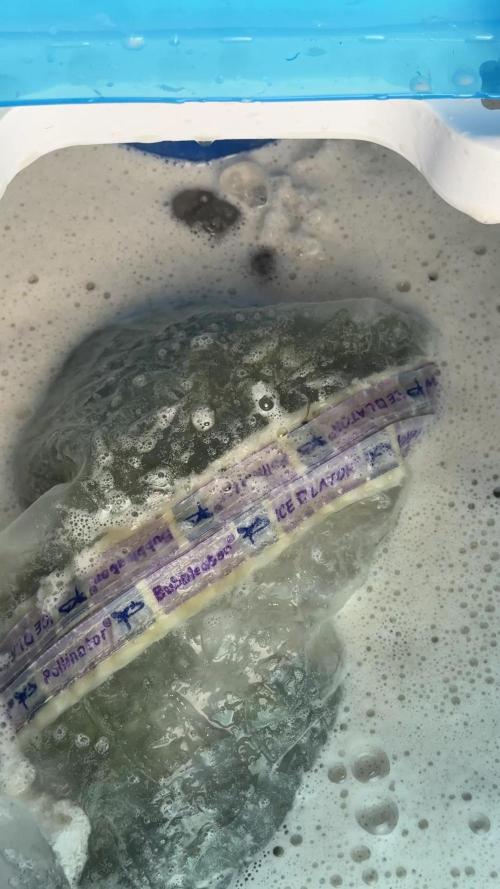
Others were fully broken down, every single flower removed from the branches, vacuum sealed into bags and immediately frozen for ice-water extraction work.
And this is where things start becoming really interesting.
Because this report is not only about harvesting flower.
It’s also about exploring different post-harvest directions and understanding why growers process material differently depending on their goals.
The flowers selected for traditional drying will continue their journey in Part 2, where we’ll focus much more deeply on drying conditions, moisture management, branch snapping, trimming and curing.
But for now…
let’s talk about the frozen material and ice-water extraction. ❄️
After harvesting, the flowers destined for washing were separated carefully and placed into vacuum bags before going into the freezer.
Freezing fresh material helps preserve volatile compounds, terpene expression and trichome integrity while preparing the flowers for ice-water extraction.
And no — this is not simply “throwing weed into ice.”
There’s actual science and technique behind this process.
Before washing, the frozen material is combined with ice and extremely cold water, ideally close to 0°C. The goal is to make the trichome heads brittle enough to detach cleanly while keeping unwanted plant contamination as low as possible.
At the same time, the flowers need time to fully soak and rehydrate slightly before agitation starts. This helps reduce excessive breakage of plant material during washing.
And then comes the wash itself.
The bubble washer machine agitates the mixture gently, allowing trichome heads to separate naturally from the plant material and suspend inside the cold water.
From there, the water passes through a series of filtration bags with different micron sizes.
25 micron.
45 micron.
73 micron.
90 micron.
120 micron.
160 micron.
220 micron.
Each size captures different grades and sizes of resin heads and contaminants.
We are not using every single bag configuration during this run, and we’ll go much deeper into grading, collection quality, drying and final results later in the series. But since this report already includes videos and photos of the process itself, I thought this was the perfect moment to explain what ice-water extraction actually is — and what it is not.
This process is not about adding anything.
It’s about separating what the plant already naturally created.
Water.
Ice.
Agitation.
Filtration.
Patience.
That’s it.
And honestly…
watching these resin-covered flowers moving inside ice water almost feels hypnotic.
The harvest itself may be finished…
but the real post-harvest journey is only beginning now.
This report will continue in the next update very soon because there is simply too much material, too many photos and too much information to fit properly into a single upload without risking GrowDiaries crashing or losing content again.
Part 2 will continue deeper into:
the drying process,
environmental control,
trimming,
flower handling,
and the continuation of both post-harvest paths.
And eventually, Part 3 will close the circle with curing, smoke review, flavors, extraction reflections, effects and final thoughts.
As always, thank you to everybody following this journey.
To Zamnesia for the genetics.
To Plagron for the nutrition.
To all the gear keeping this room alive day after day.
To GrowDiaries itself.
To the community.
To the longtime followers and OGs.
To the new people arriving every day.
To the curious ones.
To the silent supporters.
To the lovers.
To the skeptics.
To the haters.
To everyone who stopped by, even for a moment.
Thank you for being here. 🌱
Part 2 coming very soon. ✨
📡 DELETED @ 1K Please stay tuned.we never quit https://www.youtube.com/@TheDogDoctorOfficial NEW 🙏 Thank you for your patience and continued support.
FOR DISCOUNT CODES AND MORE JUST FOLLOW THE LINK https://website.beacons.ai/dogdoctorofficial
📲 Don’t forget to Subscribe and follow me on Instagram and YouTube @DogDoctorOfficial for exclusive content, real-time updates, and behind-the-scenes magic. We’ve got so much more coming, including transplanting and all the amazing techniques that go along with it. You won’t want to miss it.
GrowDiaries Journal: https://growdiaries.com/grower/dogdoctorofficial
Instagram: https://www.instagram.com/dogdoctorofficial/
YouTube: https://www.youtube.com/@dogdoctorofficial Deleted by Youtube - https://www.youtube.com/@TheDogDoctorOfficial NEW
Vimeo : https://vimeo.com/dogdoctorofficial Under construction stay tuned ⸻
Explore the Gear that Powers My Grow
If you’re curious about the tech I’m using, check out these links:
🔆 Lighting & Environmental Control
• Future of Grow — Advanced LED lighting technology
https://www.futureofgrow.com/
DISCOUNT CODE: DOG20
• Lumiflora — Under-canopy LED lighting
https://lumiflorade.com/
• TrollMaster — Environmental controllers and automation gear (past collaboration)
⸻
Genetics
• Zamnesia Seeds — Genetics used in this project
https://www.zamnesia.com/
⸻
🌱 Soil, Substrates, Boosters & Root Support
• Plagron — Substrates, bio mixes, and supportive products
https://plagron.com/en/
⸻
🎒 Storage, Curing & Preservation
• Grove Bags — Curing and storage solutions
https://grovebags.com/
⸻
📸 Photography Equipment & Tools
(Not sponsors, but part of my creative toolkit)
• Sony A6700
• Sony full-frame macro lens + few more
• Stacking photography workflow - learning
• iPhone (for behind-the-scenes shots)
We’ve got much more coming as we move through the grow cycles. Trust me, you won’t want to miss the next steps, let’s push the boundaries of indoor horticulture together!
As always, this is shared for educational purposes, aiming to spread understanding and appreciation for this plant. Let’s celebrate it responsibly and continue to learn and grow together.
With true love comes happiness. Always believe in yourself, and always do things expecting nothing and with an open heart. Be a giver, and the universe will give back in ways you could never imagine.
💚 Growers love to all 💚
📸 P.S. – The Eye Behind the Lens
All photos in this diary (for now — except for the ones showing the camera, which I took with an iPhone) are taken with a Sony A6700 paired with a Sony full-frame macro lens and a few more.
Photography is part of the story — it’s how we share the fine textures, the glow, and the quiet details that words can’t always capture.
I’ve also started experimenting with photo stacking — a technique where multiple images, each taken at a slightly different focus point, are layered together to create one perfectly sharp image from front to back.
It’s not digital enhancement or AI; it’s pure photography — a way to reveal the plant’s beauty in microscopic depth, from trichome to petal.
You’ll even see a few shots of "ghost me" capturing the shots — camera, lens, setup — because every grow deserves not just to be cultivated, but documented like art.
FOR DISCOUNT CODES AND MORE JUST FOLLOW THE LINK https://website.beacons.ai/dogdoctorofficial
NEW DISCORD - Official Server Invite Link : https://discord.gg/ksjAkA5T74

Likes
13
Share


@RFarm21
Follow
Semana 15 abril - 21 abril
16 abril feeding day (1.5l)
20 abril feeding day


Likes
10
Share


@GanjaFarmer101
Follow
Will update after dry/cure - wet trim - 12 and a half weeks from seed to harvest.

Likes
5
Share

@El-Ecko
Follow
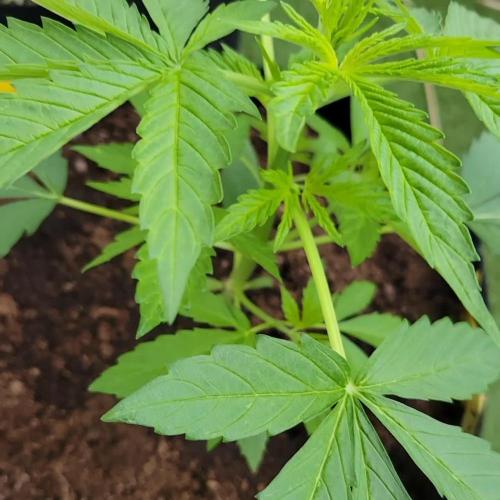
Week 4: Vegetative Growth
Brrrrrr🤧
It’s been a really cold week for this time of year so far—just under 15 degrees during the day and between 6 and 8 degrees at night.
It’s supposed to stay this way for a few more days.
But the Gelato is doing great anyway.💪 The temperatures don’t seem to bother her, even though her growth has slowed down a bit... at least that’s how it seems to me.
Still, I’m very happy... and she’s also starting to give off a little scent.😍
Processing
Likes
14
Share


@Wicked_Stix
Follow
This little orange sherbet was topped on day 10 and is growing well. I ran out of calimagic due to a shipping issue. I was hoping that tap water would give them enough cal mag but the plants started showing rusty spots symptoms of calcium deficiency. The only cal mag that I could find locally is Gringo Rasta from fox farm. I gave her a dose of it but it is too early to tell if it is going to work. I am skeptical about any organics in my system from past experiences but the pH is holding steady after a couple days so hopefully it will work out. Other than that they are still getting 24 hour light and I am starting to think that I might have to figure out a way to spread the plants further apart. A couple of them are getting pretty big.
Likes
11
Share


@VagueReaper
Follow
I attempted some LST and defoliating over the last couple of days. I wasn't overly confident as it was my first time so I decided to take a different approach with each plant so hopefully I don't mess them all up haha
Likes
11
Share

@Lajolend
Follow
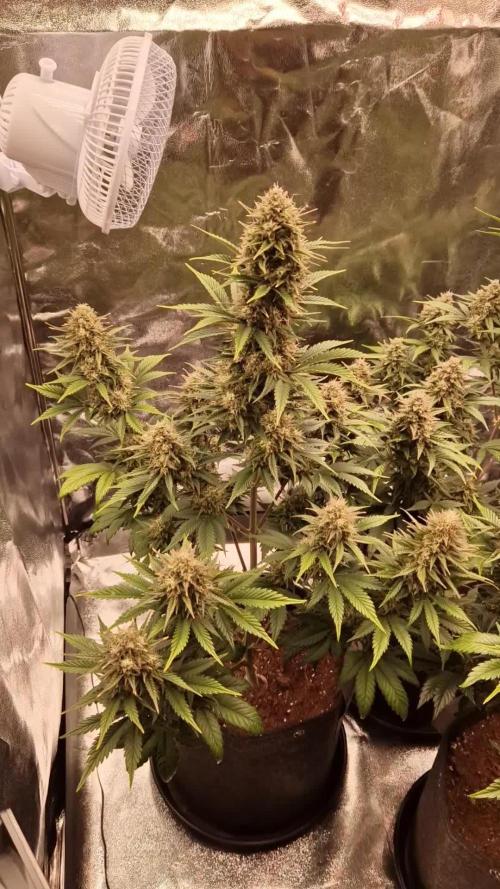
Holky se začaly hezky zabarvovat, velmi silně voní a do výšky už nerostou. Jen koukám, jak krásně nabývají palice :) O něco málo jsem snížil hlavní hnojivo a přidal víc PK na květ. Těším se :)
Likes
44
Share


@Jays_Not_Here_Man
Follow
The girls had a big week! Started off with transplanting to their 2 gallon pots early in the week. They showed no stress, or signs of slowing down. With the extra room to spread, the girls were clearly loving their transplant home.
Temps were steady around 82 degrees, and RH was kept to a reasonable 60% while they were recovering. I also started with a larger nutrient feed, and will be rotating between regular feed, light feed and then plain water now that they can handle more.

Likes
2
Share

@Borberad
Follow
Woche 12
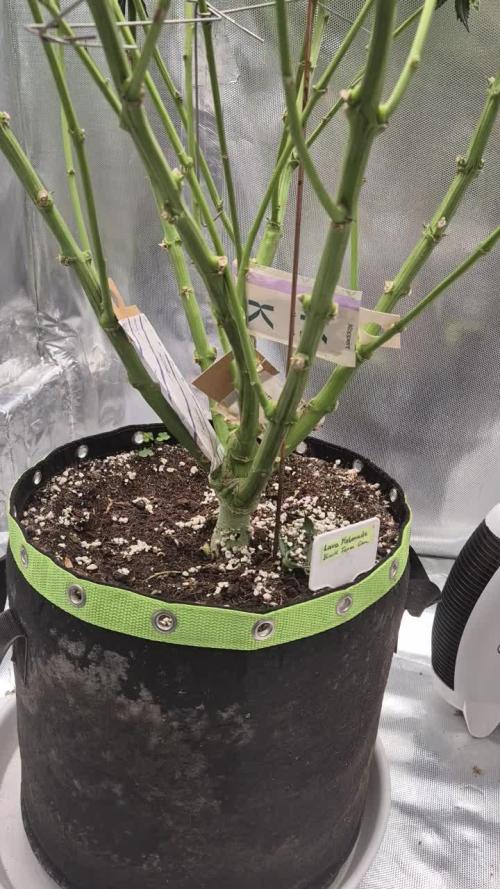
Die Woche beginnt weniger erfreulich. Schimmel in den Buds! Waren aber auch wirklich dicke Monster. Dennoch! Bisher haben wir keine Erklärung dafür. Luftfeuchte unter 60% auch im Dunkeln. Temperatur Tag und Nacht 25°C. Gießen alle zwei Tage. Bleibt nur frühzeitige Headbud Ernte. Trichome glücklicherweise schon fast alle Milchig. Begeben uns auf die Suche nach den falschen Parametern.
Plan: Mehr Hygrometer an verschiedenen Stellen im Zelt. Evt. falsche Messtelle zur Überwachung der Luftfeuchte gewählt??? Die andere Pflanze im Zelt erscheint hingegen vollkommen Schimmelfrei. Pflanze evt. Durch unsaubere Arbeit (Kontakt mit Kleidung / Nase beim
riechen) kontaminiert?
Demnächst kommen alle Nasen ab, bevor wir an die Blumen gehen. 👃🔪😜
Nach genauerer Betrachtung unter dem Mikroskop scheint die Pflanze schon nahezu fertig zu sein, haben uns daher wieder zu einer Teilernte entschieden die Headbuds können schonmal ab. Der Rest darf noch etwas nachreifen. Was uns schon etwas wundert, ist die Tatsache das die Blume mit 56 - 63 Tagen angegeben ist aber schon jetzt fast vollständig ausgereift zu sein scheint!?
Likes
15
Share

@UnitedStrainsGermany
Follow
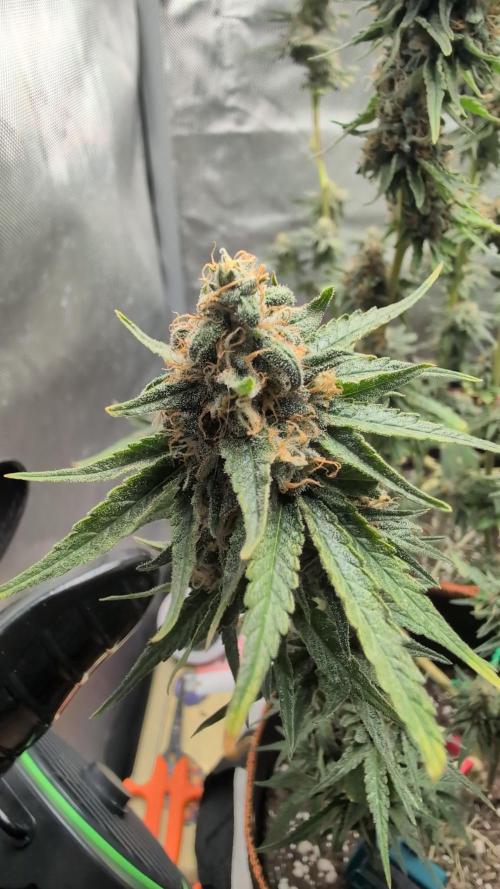
Die letzten 26h bevor die Ernte ist keine tripse mehr kein düngen nur noch flush mit 6.3 Leitungswasser sie werden in dryfembags getrocknet.



Likes
5
Share

@GanjaFarmer101
Follow
9 weeks and 3 days to harvest
Not much to say until 3 are harvested and dried/cured
Will update when the time comes.

Likes
31
Share


@KitaKush
Follow
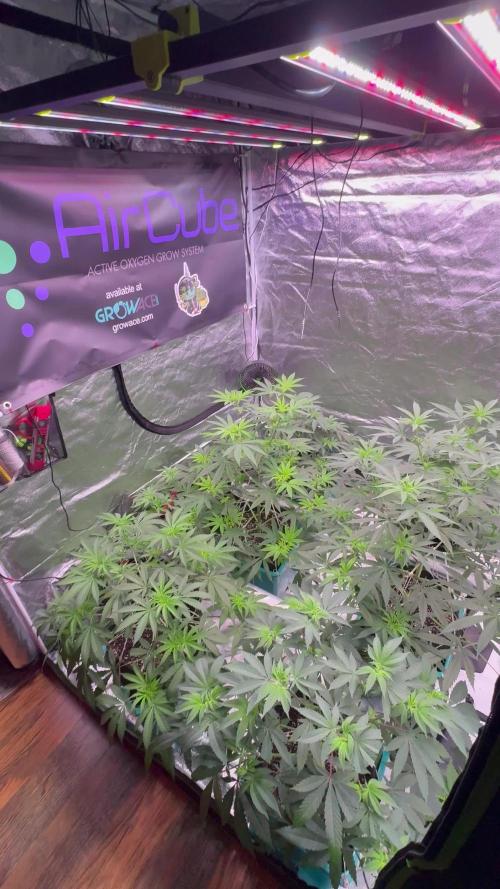
2 weeks left!!! Flushed with water a few days ago..can’t wait to see that leaf fade!
#1 trichomes are popping off..lots of milky and amber..my frostiest plant to date!
#2 trichomes increasing but not nearly close to #1
Likes
2
Share

@Ninjabuds
Follow
Straw electric lemonade has an amazing smell already. It’s growing a lot like some Barney’s plants I grew last year.
Likes
2
Share


@JBurnstein14
Follow
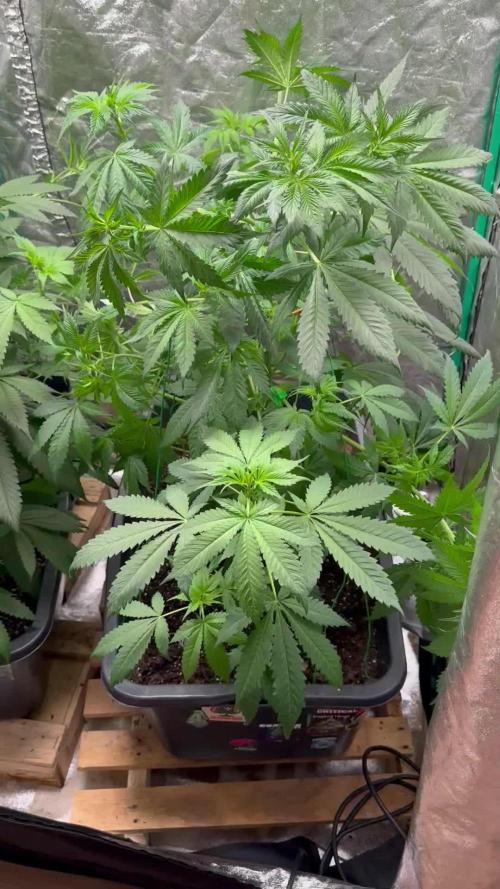
Planted directly into substrate!
I am growing this strain along side other mephisto seeds but I will do them in another diary🔥



Likes
2
Share

@DogDoctorOfficial
Follow
👑 8×8 Adventure – Week 13 🌿
Godfather OG – Pheno A 👑🔥
🌸 The Queen Is LOUD… And She's Looking Better Than Ever
Hello everyone, and welcome back to another chapter of the 8×8 Adventure! 🌱💚
Guess what?
The Queen is still shining.
👑✨🌸
And honestly...
WOW.
This girl continues to surprise me.
Godfather OG Pheno A is looking absolutely remarkable right now. The flowers are developing beautifully, the colours are changing, the plant is moving deeper into maturity, and the overall appearance of this girl is becoming something really special.
And then there's the smell...
😂
OH MY GOD.
This girl is LOUD.
🔥👃💨
I don't know yet if she's going to be the loudest plant in the entire 8×8.
But let's just say...
she's making a very strong argument.
And that's quite something considering what we've already smelled in this room.
She's been one of the more difficult girls throughout the journey. She hasn't always been the happiest-looking plant in the room. She's had her moments. She's had her stresses. She's made us work a little harder to understand what she was trying to tell us.
But now?
Look at her.
Just look at her.
The Queen is looking like a Queen.
👑🌸💚
So let's give her the spotlight she deserves.
────────────────────────
👑 WEEK 13 – THE QUEEN KEEPS SHINING
Week after week, Godfather OG Pheno A has been writing her own story.
And it hasn't necessarily been the easiest story.
She's had stress.
She's had moments where she wasn't exactly the happiest girl in the room.
She's made me question things.
She's made me watch her more closely.
She's made me learn.
But that's exactly what makes this week so satisfying.
Because despite everything...
she's still here.
And she's beautiful.
Really beautiful.
The flowers are looking increasingly mature.
The colours are becoming more pronounced.
The pistils are changing.
The foliage is fading in places.
And the overall plant is giving us that unmistakable feeling that we're moving deeper into the final chapter.
She's not simply growing anymore.
She's finishing.
And she's doing it in her own style.
👑🌸
────────────────────────
🌿 LOOK AT THOSE COLOURS
This is one of the things that really caught my attention this week.
Look at the fading.
Look at the colours appearing throughout the plant.
Look at the transition.
This is one of those moments where the photographs really tell the story.
Earlier in the grow, she was carrying much more uniform green.
Now we're seeing those deeper flowering-stage changes becoming more obvious.
And I absolutely love it.
Not because "fading = better."
That's not the point.
The point is that we're watching the plant change.
We're watching her move through time.
We're watching the transition from active flowering development toward maturity.
And with Godfather OG Pheno A, that transition is becoming beautiful.
She's developing her own palette.
Her own colours.
Her own final expression.
And when you put the photographs from earlier weeks beside these...
you can really see how far she's travelled.
────────────────────────
🌸 THE FLOWERS ARE LOOKING BEAUTIFUL
And then we get to the part that really matters...
the flowers.
🔥🌸
They're developing beautifully.
The buds are becoming more substantial.
The structure is becoming increasingly defined.
The pistils are changing.
The resin continues to catch the light.
And everything is starting to look much more mature.
This is the stage where you can finally start seeing the plant's personality expressed through the flowers themselves.
Not just:
"Here is a flowering plant."
But:
"This is what THIS phenotype produces."
And Godfather OG Pheno A is giving us something beautiful.
She's not trying to be the biggest.
She's not trying to be the most perfect.
She's not trying to behave like the other eleven girls.
She's simply being herself.
And I really like what she's becoming.
────────────────────────
💎 THE RESIN IS STILL GETTING MY ATTENTION
Of course...
I can't talk about this girl without talking about the frost.
😂💎📸
The closer we get...
the more she gives us.
The flowers are becoming increasingly decorated with resin.
The sugar leaves are carrying that beautiful frosty appearance.
And when you combine that with the changing colours?
Oh my.
👑❄️🌸
This is exactly why I love photographing these girls week after week.
The full plant tells one story.
The individual flower tells another.
And the macro tells you something completely different again.
You can see the progression.
You can see the maturity.
You can see the resin.
You can see the colours.
And you can see just how much this girl has changed.
────────────────────────
👃 AND THEN THERE'S THE SMELL...
Okay.
We need to talk about this.
Because this girl is LOUD.
😂😂😂
I mean...
LOUD.
🔥👃💨
Every time I get close to her, she makes her presence known.
And that's saying something in a room with twelve different plants.
I don't know yet if she's officially the loudest.
I'm not giving her that crown just yet.
😂👑
We need to wait.
We need to compare.
We need to get through the harvest.
We need to see what happens during drying and curing.
And then, eventually...
we'll really know what this girl has to say.
Because aroma can evolve dramatically throughout the rest of the journey.
But right now?
Let's just say...
Godfather OG Pheno A has entered the conversation.
And she's shouting.
😂🔥👃
────────────────────────
🔊 IS SHE GOING TO BE THE LOUD ONE?
This is now officially one of the questions I'm carrying into the final part of this diary.
We've got twelve girls.
Twelve different phenotypes.
Different structures.
Different flowers.
Different expressions.
And eventually...
we'll get to compare them.
Who has the most interesting aroma?
Who has the strongest aroma?
Who changes the most during drying?
Who develops the most interesting cured profile?
Who surprises us?
And who...
is simply fucking loud?
😂🔥👃
Godfather OG Pheno A may have just volunteered herself for that last category.
But I'm not declaring the winner yet.
We'll see.
And when we eventually get to the smoke reports and final reviews...
that's where we can really talk about it properly.
For now...
I'm just enjoying the smell.
A LOT.
────────────────────────
🌿 THE QUEEN WASN'T ALWAYS THIS HAPPY
And this is something I really want to acknowledge.
Because looking at her now, it would be easy to forget the journey.
She hasn't exactly been the easiest plant in this room.
She's had stress throughout the grow.
She's had moments where she didn't look like the happiest girl.
She's made me pay attention.
She's made me adapt.
And sometimes...
she simply made me shake my head and say:
"Okay, Queen. What are you doing now?"
😂👑
But that's the beauty of growing individual phenotypes.
You don't get twelve perfect copies.
You get twelve personalities.
Some are easy.
Some are demanding.
Some are fast.
Some are slow.
Some seem to love everything you do.
Some make you work for every little bit of cooperation.
And Godfather OG Pheno A?
She's definitely made me work for her.
But now she's giving something back.
And I think that's pretty damn special.
────────────────────────
❤️ THE REWARD AFTER THE STRESS
This is probably what makes me happiest about this week.
It's not just that she looks beautiful.
It's that she looks beautiful AFTER everything.
After the stress.
After the difficult moments.
After all the times I wondered how she was going to finish.
She's still standing there.
Still flowering.
Still producing resin.
Still developing colour.
Still smelling absolutely ridiculous.
And looking better than ever.
😂👑🌸
That's a reward in itself.
Sometimes the plants that give you the easiest ride aren't necessarily the ones you remember most.
Sometimes...
it's the difficult ones.
The ones that make you learn.
The ones that make you pay attention.
The ones that keep you guessing.
And then, at the end...
they turn around and give you something beautiful.
That's Godfather OG Pheno A for me.
────────────────────────
💡 THE PHOTON EXPERIMENT CONTINUES
The lighting setup remains unchanged.
We're still running the upgraded Future of Grow environment with the two additional Black Series 600W fixtures.
We're controlling their output at approximately:
🔌 59% power from the plug
And the upper canopy remains around:
☀️ ~1,500 PPFD
That's a lot of photons flying around this jungle.
😂☀️🌿
But again, the interesting part isn't simply the number.
It's what the different plants do with those photons.
Godfather OG Pheno A is giving us another answer.
She's developing.
She's maturing.
She's producing flowers.
She's changing colour.
And she's showing us her own expression.
Same artificial sun.
Different genetic response.
That's the 8×8 Adventure.
────────────────────────
☀️ SAME PHOTONS — DIFFERENT QUEEN
This is something I keep coming back to because it becomes more obvious every week.
The environment is shared.
The lighting is shared.
The irrigation is shared.
The nutrition philosophy is shared.
The room is shared.
But the plants don't behave the same.
Godfather OG Pheno A has her own interpretation.
And I love that.
We're not trying to force her to behave like another phenotype.
We're not trying to make her look like somebody else.
We're simply providing the stage...
and watching what she does on it.
And right now?
She's putting on one hell of a show.
👑🔥🌸
────────────────────────
⚗️ NUTRITION – THE FINISH IS APPROACHING
We're also continuing with the gradual nutritional transition as the room moves deeper into the flowering cycle.
Terra Bloom has been reduced from the earlier level toward:
🌱 2.0 ml/L
with the EC now around:
⚡ ~2.05 mS/cm
The philosophy remains the same.
Gradual.
Observational.
No dramatic overnight changes.
We're approaching the final part of the journey, so we're beginning to reduce the mineral base while continuing to watch how the plants respond.
And Godfather OG Pheno A is giving us plenty of information.
The flowers are developing.
The colours are changing.
The plant is moving.
The resin is building.
And now we're watching her approach the final stage.
She's getting there.
But we're not rushing her.
────────────────────────
🌸 THE PLANT GETS THE FINAL VOTE
This is probably one of the biggest lessons from the entire 8×8 Adventure.
We can have calendars.
We can have feeding schedules.
We can have expectations.
We can have numbers.
But ultimately...
the plant gets the final vote.
Godfather OG Pheno A is telling us:
"I'm changing."
"I'm maturing."
"I'm getting closer."
And our job is to listen.
That's what I'm doing.
I'm not trying to force her into a specific timeline.
I'm watching.
I'm photographing.
I'm smelling.
I'm comparing.
And I'm letting her show me where she is.
────────────────────────
📸 THE QUEEN DESERVES HER PORTRAITS
And yes...
the Queen gets her photographs again.
😂📸👑
After her previous photographic privileges were restored, there is absolutely no way we're taking them away again.
She's earned them.
And honestly...
look at her.
These flowers deserve to be photographed.
The colours deserve to be photographed.
The resin deserves to be photographed.
The fading deserves to be photographed.
And the plant herself deserves the spotlight.
This is what these individual diaries are about.
Not just showing the final result.
Showing the journey.
Showing the difficult weeks.
Showing the beautiful weeks.
Showing the changes.
Showing the personality.
And Godfather OG Pheno A has certainly given us a journey.
────────────────────────
🌡️ WEEK 13 – CURRENT ROOM CONDITIONS
The 8×8 continues under the same general environment:
🌸 Flowering — Week 13
💡 Light schedule — 12/12
☀️ Upper-canopy PPFD — ~1,500
🔌 Future of Grow Black Series output — ~59% from the plug
🌡️ Day temperature — ~26.5–27°C
🌙 Night temperature — ~25–26°C
💧 Relative humidity — ~60–61%
🌱 Substrate temperature — ~25–26°C
💦 Nutrient solution temperature — ~25°C
⚗️ pH — approximately 6.0
⚡ EC — ~2.05 mS/cm
💨 CO₂ — ~693 ppm
💧 Irrigation — ~1.4–1.45 L/plant/24h
🌱 Pot size — 15 L
The room remains stable.
The lighting remains strong.
The plants continue moving at their individual speeds.
And the Queen?
She's still doing her thing.
────────────────────────
🔬 SAME ROOM — DIFFERENT JOURNEY
This is becoming more fascinating every week.
Because we're getting close enough to the end that the differences between these plants are becoming extremely obvious.
Some are still very green.
Some are fading.
Some are moving quickly.
Some are taking their time.
Some are developing huge flowers.
Some are developing unusual structures.
Some are incredibly frosty.
Some are incredibly aromatic.
And Godfather OG Pheno A?
She's giving us colour...
resin...
flowers...
and one hell of a smell.
😂👑🔥
That's her expression.
That's her story.
And I wouldn't change it.
────────────────────────
🌿 LET HER FINISH HER STORY
At this point, I'm not interested in trying to turn her into something else.
She's already shown us who she is.
She's been stressed.
She's been difficult.
She's been beautiful.
She's been stubborn.
She's been rewarding.
And now she's approaching the final chapter.
So we're going to let her finish.
We're going to continue observing.
We're going to continue documenting.
We're going to continue watching the flowers.
We're going to continue watching the colour changes.
We're going to continue enjoying that ridiculous aroma.
And eventually...
we'll harvest.
Then we'll dry.
Then we'll cure.
And THEN...
we'll really get to know this girl.
Because that's when the story gets even more interesting.
────────────────────────
🔮 WHAT COMES NEXT?
We're getting closer.
And I have to admit...
I'm curious.
Very curious.
Because the plant is already giving us clues.
Beautiful colour.
Mature-looking flowers.
Increasing resin.
Changing pistils.
And that smell...
😂🔥👃
But we're not going to spoil the ending.
We'll let her take us there.
And when we eventually reach the harvest and curing stages, we'll talk properly about the aroma.
The flower structure.
The final appearance.
The dry weight.
The cure.
The smoke.
The flavour.
The effects.
Everything.
But for now...
we're still in the garden.
Still watching.
Still learning.
Still enjoying the Queen.
────────────────────────
❤️ FINAL THOUGHTS – LOUD, BEAUTIFUL & STILL THE QUEEN
Week 13.
And Godfather OG Pheno A is still shining.
👑🌸💚
Honestly...
I'm really, really happy with how she's looking.
Look at those flowers.
Look at those colours.
Look at that fading.
Look at the resin.
Look at the plant.
She's remarkable.
She's amazing.
And considering how much stress she's had throughout this entire grow...
I'm genuinely impressed.
She hasn't been the happiest plant in the room.
Not by a long shot.
😂
She's made that very clear.
But maybe...
just maybe...
she was saving all that energy for the flowers.
Because now?
She's showing us something beautiful.
And she's smelling absolutely insane.
🔥👃💨
I don't know if she's going to be the loudest girl in the 8×8.
I'm not giving her that crown yet.
But she's certainly making her case.
And when we finally get to the smoke reports...
that's going to be a very interesting chapter.
For now, though...
let's just appreciate what she's becoming.
The Queen has been through a lot.
She's had her moments.
She's tested our patience.
She's made us pay attention.
She's made us learn.
And now she's standing there...
beautiful.
Frosty.
Colourful.
Aromatic.
And completely herself.
That's what I love about phenotype hunting.
You don't always get the easiest plant.
You don't always get the happiest plant.
You don't always get the biggest plant.
But sometimes...
you get a plant that makes you say:
"Wow."
And Godfather OG Pheno A is giving me that feeling right now.
👑🔥🌸
So let's give her the spotlight.
Let's celebrate her.
Let's photograph her.
Let's enjoy her aroma.
And let's see how loud this Queen really is when the time comes.
Until then...
Keep shining, Queen.
You've earned every bit of that crown.
👑🌿💎🌸🔥
────────────────────────
🙏 THANK YOU
A huge thank you to Zamnesia for giving us these Godfather OG genetics and allowing us to explore this individual phenotype throughout the 8×8 Adventure. 💚🌸
Thank you to Plagron for supporting the garden throughout this journey and providing the nutritional foundation behind these flowering girls.
A massive thank you to Future of Grow for supplying the Black Series lighting and especially for providing the two additional Black Series 600W fixtures we're testing in this room. 💡🔥
The extra lighting capability has given us another fascinating variable to observe across these twelve completely different plants.
Thank you to Lumiflora for helping bring additional light deeper into the canopy and allowing us to explore this room as a three-dimensional lighting environment.
Thank you to TrolMaster for helping us monitor and manage the environment behind the scenes.
And, of course...
thank you to everyone following the 8×8 Adventure here on GrowDiaries.
Every week...
another chapter.
Another phenotype.
Another personality.
Another lesson.
And Godfather OG Pheno A has certainly given us a story.
She's been stressed.
She's been difficult.
She's been beautiful.
And now...
she's becoming absolutely remarkable.
👑🌸🔥
And possibly...
very, very loud.
😂👃💨
We'll find out.
The final chapters will tell us.
Until then, we're going to keep doing what we do.
Observe.
Document.
Listen.
Adjust when necessary.
And let the plants show us who they really are.
Godfather OG Pheno A...
the Queen is still shining.
And she's looking damn good doing it.
👑💚🌸💎🔥
Growers Love, happy growing, and take care everyone! 🌱💚
See you next week in the 8×8 jungle.
🌿🔥👑