Likes
Comments
Share
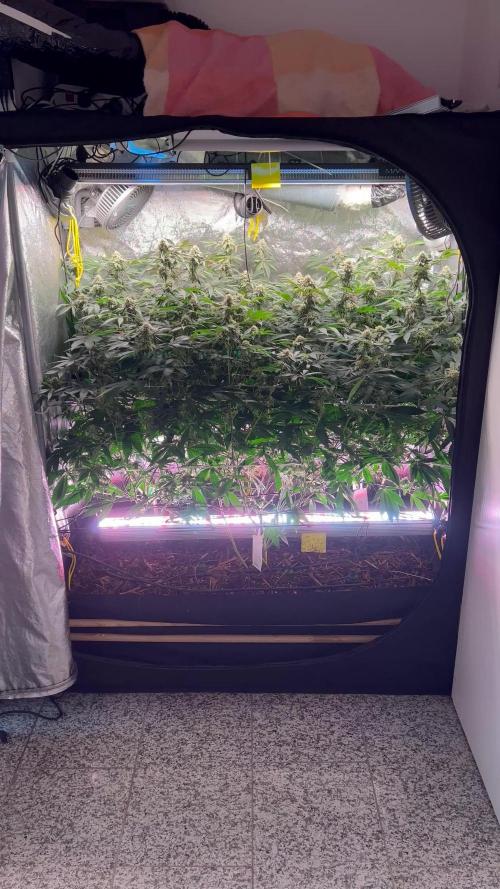
Absolutely over the moon with my first attempt really interesting and fun think I have myself a new hobby and grateful for the help from you guys on here ✌️🏻
Likes
2
Share
@Bobaloo
Follow
I didn’t use these nutrients in last three weeks in flower and stopped watering completely the last week sorry for the old grow I found out about the site after
Likes
31
Share
@THCpapa
Follow
Week 17, and my garden is blowing my mind! It's like a botanical fireworks show out there. The buds are popping up like they're trying to outshine the sun. I'm so happy I'm doing the leafy dance of joy every time I check on them. I can't believe how beautiful everything is – it's like my garden is showing off just for me. I feel like a proud plant parent, watching my green babies grow up so fast. Here's to Week 17 – a week of beauty, happiness, and the joy of watching nature do its thing. Cheers to my amazing garden – may it keep on growing and blowing my mind! 🌿🌺
Likes
16
Share
@DabBod
Follow
Finally finished my last week of veg and sent these girls into flower last night. I tried to continue scrogging the larger pheno and somewhat succeeded, there’s now only a 3-4 inch difference between the 2 plants. There’s some slight discolouration on some of the leaf tips but it isn’t too severe and I’m not seeing any other signs of deficiency or stunted growth.
Likes
3
Share
Girls were welcomed by some shower of blessing... pistils poppin out girls filling out....upcoming week start doing some clean up and pruning
Likes
11
Share
Hello Tokers and Growers! Welcome to another great Indica adventure! Some of you already know I love me some Indica. 😁 My current favorite Indica is Cream Caramel from Sweet Seeds but I decided to try something new this run. Sweet Zenzation (SWS84) also from Sweet Seeds. She's my only Indica dominant cultivar in the tent so I'll be taking extra care of this one. Strain characteristics: Sweet Zenzation derives from a cross between an elite clone of Zkittlez combined with a specially selected Grape Ape clone, which is one of the strains used to develop the original Zkittlez. The result is a predominantly indica genetic hybrid. It produces a large amount of resin-soaked flowers. It is both relaxing and stress-relieving, yet it also stimulates the imagination and conversation, an effect that is normally associated with sativa strains. The flowers have a high terpene content, an exquisite aroma and sweet taste, with hints of fruit flavoured candies, hardwood undertones, shades of lemon, cypress and subtle aromatic peppers. Variety SWS84 Genetics: Zkittlez x Grape Ape Type: Feminized Indica: 70% / Sativa: 30% THC: 16-23% · CBD: 0,2% Indoor Yield: 450-650 g/m2 Outdoor Yield: 400-700 g/plant Indoor Blooming: 9 weeks Outdoor Harvest: late September, early October Expectations & Training method: First time growing this strain but Sweet Seeds have always given me sweet and savory yields so I’m guessing this one won’t be any different. Genetics are promising some tasty terps, I’m the aroma will blow me away. Indica dominant so I’ll be trying to make a bud packed bush out of these. Haven’t quite decided what training technique to go with either LST or TOP and just a bit of LST adjusting the colas. That’ll depend on how I see the growth up until the training day. As for yield I’m aiming for at least 50g each plant. Equipment used in this cycle: Tent: Dutch Masters 120x240x220cm Lights: 1 x Mars Hydro TSW2000 1 x Mars Hydro FC3000 Ventilation: Garden HighPro - ProFan TT Extractor Fan - 150mm Garden Highpro - ProActiv Carbon Filter - 150mm Garden Highpro - ProFan Oscilating Clip Fans - 25cm Blauburg - Inline Fan - 125mm Humidifier: Garden Highpro - Humipro Digital Humidifier - 4 liters Pots: Garden Highpro 11L Fabric pots Medium: Biobizz Light Mix Nutrients: Grotek - Mycrorizo Plagron- Alga grow, Alga Bloom, green sensation and royal sugar. PH down Calmag Measuring instruments: Hygrometer/Thermometer - Govee: EC Meter - HM Digital: COM-80S Hydrotester PH Meter - Vanguard Hydroponics Happy Growing!
Likes
40
Share
@xbrico
Follow
Day 107 - Day late and a dollar short on my Update! :P Haven't added any new nutes...just topping up with water on the current base and then will flush around Thursday. The Cookies Kush all look done...pistils been brown and shrunk for days now. The Purple punch still showing a lot of white pistils though and its the oldest of the 4 plants and should be done the quickest (Per Barneys Flower Time Expectations). Am well over the 8 weeks now and will play the flush by ear, like I say, expecting Thursday for a 4 day flush in Hydro but may stretch the current nutes out the end week to see if the Punch Browns (It is fox-tailing slightly...but this can be expected with Purple strains). Apart from that, nothing else to do but wait til harvest! :) Also, have to note...can't say I have sen an increase in frosting using the 10K bulb from where they were before I introduced it a week ago but could be something that's been that gradual, its really been unnoticeable! What I have noticed with it is Cola Leaves starting to Pray, so they're getting some light intensity without bleaching or burning so it has done something...if its beneficial, I can't really say!
Likes
13
Share
@Chubbs
Follow
420Fastbuds FBT2311/Week8 What up grow fam. I hope all is good with everyone. Week 8 update on these absolutely stunning girls. They're definitely progressing nicely with the flower sites swelling up. Super frosty and beyond sticky when you happen to touch them. Over all Happy Growing
Likes
15
Share
Likes
26
Share
Gracias al equipo de Seedsman y XpertNutrients sin ellos esto no sería posible. 💐🍁 Bubba Cheescake: Bubba Cheesecake es un cruce de Bubba Kush anterior al 98 con Cheese Cake (Wedding Cake x Exodus Cheese). Se trata de un híbrido 70% índica con muy buenos rendimientos, alto en THC y bajo en CBD. Bubba Cheesecake prospera en interiores y exteriores. En interior se aconseja un corto periodo de crecimiento vegetativo debido a la cantidad de estiramiento que presentan las plantas. Las plantas pueden crecer hasta una altura de 250 a 350 cm. cuando se deja crecer naturalmente al aire libre. En interior, la floración dura entre 60 y 65 días, con rendimientos entre buenos y altos, de 400 a 550 gr/m2. Las plantas de exterior son capaces de producir entre 700 - 800 gr. peso seco. En las latitudes norteñas, en exterior, los productores pueden esperar cosechar a principios de octubre. Los cogollos son grandes y duros como piedras. Las plantas maduras muestran atractivos colores púrpuras y azules y brillan con una resina pegajosa que cubrirá las manos del cultivador si no tiene cuidado. El componente Wedding Cake agrega dulzura al sabor del regaliz y el aroma es terroso y musgoso. La producción de THC es muy alta con un nivel bajo de CBD. El efecto es intensamente narcótico, fuerte y duradero. 🌻🚀 Consigue aqui tus semillas: 🍣🍦🌴 Xpert Nutrients es una empresa especializada en la producción y comercialización de fertilizantes líquidos y tierras, que garantizan excelentes cosechas y un crecimiento activo para sus plantas durante todas las fases de cultivo. Consigue aqui tus Nutrientes: https://xpertnutrients.com/es/shop/ 📆 Semana 6: Buena semana, ellas está consumiendo todos los nutrientes perfectamente, espero que pronto agarre tierra profunda y empiece a crecer como bestia 🐅.
Likes
17
Share
@Wizard555
Follow
As the third week draws to a close, our plant continues to thrive, thanks to the nurturing care and high-quality nutrients provided by Xpert Nutrients. Embracing the art of Low Stress Training (LST), our girl has responded with enthusiasm, showcasing new growth and vibrant green foliage. With each passing day, she flourishes under the nourishment of Xpert Nutrients' Master Root and Master Grow series. Their Master Root, at 2ml per liter, and Master Grow A and B, each at 1ml per liter, have become essential components of our feeding regimen. With a balanced pH of 6.2 and a TDS of 250, our plant receives precisely what it needs to thrive. We extend our heartfelt gratitude to Xpert Nutrients for their exceptional products, which play a pivotal role in the success of our grow journey.
Likes
18
Share
Green light is radiation with wavelengths between 520 and 560 nm and it affects photosynthesis, plant height, and flowering. Plants reflect green light and this is why they appear green to our eyes. As a result, some growers think that plants don’t use green wavelengths, but they actually do! In fact, only around 5 – 10% of green light is reflected from leaves and the rest (90 – 95 %) is absorbed or transmitted to lower leaves [1]. Green wavelengths get used in photosynthesis. Chlorophyll pigments absorb small amounts of green wavelengths. Light that doesn’t get absorbed is transmitted to leaves that are shaded out from direct light. This means that leaves at the bottom of the canopy get more green light than leaves at the top. A high proportion of green wavelengths compared to other colors tells lower leaves that they are being shaded out, so they are able to react accordingly. Lower leaves may react by opening or closing their stomata or growing longer stems that help the leaves reach brighter light [1, 2, 3]. When it comes to growing cannabis, many cultivators are interested in the quality of light used for the flowering stage. In many plants, flowering is regulated by two main photoreceptors: cryptochrome and phytochrome. Both photoreceptors primarily respond to blue light but can also respond to green, although to a lesser extent. Green can accelerate the start of flowering in several species (although cannabis has yet to be tested) [1, 4, 5]. However, once flowering has begun, it’s important to provide plants with a “full spectrum” light that has high amounts of blue and red light, and moderate amounts of green, in order for photosynthesis to be optimized. Green light mediates seed germination in some species. Seeds use green wavelengths to decide whether the environment is good for germination. Shade environments are enriched in green relative to red and blue light, so a plant can tell if it is shady or sunny. A seed that senses a shaded environment may stay dormant to avoid poor growing conditions [1]. Some examples of plant species where researchers have documented this response are: ryegrass (a grass that grows in tufts) and Chondrilla (a plant related to dandelion) [1, 6]. Although green wavelengths generally tell plants NOT to germinate, there are some exceptions! Surprisingly, green wavelengths can stimulate seed germination in some species like Aeschynomene, Tephrosia, Solidago, Cyrtopodium, and Atriplex [1, 6, 7]. Of course, light is not the only factor affecting seed germination – it’s a combination of many factors, such as soil moisture, soil type, temperature, photoperiod, and light quality. When combined with red and blue light, green can really enhance plant growth [1, 8]. However, too much green light (more than 50% of the total light) can actually reduce plant growth [8]. Based on the most current research, the ideal ratio of green, red, and blue light is thought to be around 1:2:1 for green:blue:red [9]. When choosing a horticultural light, choose one that has high amounts of blue and red light and moderate amounts of green and other colors of light. Not many studies can be found about the effect of green light on cannabis growth or metabolism. However, if one reads carefully, there are clues and data available even from the very early papers. Mahlberg and Hemphill (1983) used colored filters in their study to alter the sunlight spectrum and study green light among others. They concluded that the green filter, which makes the environment green by cutting other wavelengths out, reduced the THC concentration significantly compared to the daylight control treatment. It has been demonstrated that green color can reduce secondary metabolite activity with other species as well. For example, the addition of green to a light spectrum decreases anthocyanin concentration in lettuce (Zhang and Folta 2012). If green light only reverses the biosynthesis of some secondary metabolites, then why put green light into a growth spectrum at all? Well, there are a couple of good reasons. One is that green penetrates leaf layers effectively. Conversely red and blue light is almost completely absorbed by the first leaf layer. Green travels through the first, second, and even third layers effectively (Figure 2). Lower leaf layers can utilize green light in photosynthesis and therefore produce yields as well. Even though a green light-specific photoreceptor has not yet been found, it is known that green light has effects independent from the cryptochrome but then again, also cryptochrome-dependent ones, just like blue light. It is known that green light in low light intensity conditions can enhance far red stimulating secondary metabolite production in microgreens and then again, counteracts the production of these compounds in high-intensity light conditions (Kim et al. 2004). In many cases, green light promoted physiological changes in plants that are opposite to the actions of blue light. In the study by Kim et al. blue light-induced anthocyanin accumulation was inhibited by green light. In another study it has been found that blue light promotes stomatal opening whereas green light promotes stomatal closure (Frechilla et al. 2000). Blue light inhibits the early stem elongation in the seedling stage whereas green light promotes it (Folta 2004). Also, blue light results in flowering induction, and green light inhibits it (Banerjee et al., 2007). As you can see, green light works very closely with blue light, and therefore not only the amount of these two wavelengths separately is important but also the ratio (Blue: Green) between these two in the designed spectrum. Furthermore, green light has been found to affect the elongation of petioles and upward leaf reorientation with the model plant Arabidopsis thaliana both of which are a sign of shade avoidance symptoms (Zhang et al. 2011) and also gene expression in the same plant (Dhingra et al. 2006). As mentioned before, green light produces shade avoidance symptoms which are quite intuitive if you consider the natural conditions where the plants grow. Not all the green light is reflected from the highest canopy leaves in nature but a lot of it (50-90%) has been estimated to penetrate the upper leaves at the plant level ((Terashima et al., 2009; Nishio, 2000). For the plant growing in the understory of the forest green light is a signal for the plant of being in the shade of a bigger plant. Then again, the plants growing under unobstructed sunlight can take advantage of the green photons that can more easily penetrate the upper leaves than the red and blue photons. From the photosynthetic pigments in higher plants, chlorophyll is crucial for plant growth. Dissolved chlorophyll and absorb maximally in the red (λ600–700 nm) and blue (λ400–500 nm) regions of the spectrum and not as easily in the green (λ500–600 nm) regions. Up to 80% of all green light is thought to be transmitted through the chloroplast (Terashima et al., 2009) and this allows more green photons to pass deeper into the leaf mesophyll layer than red and blue photons. When the green light is scattered in the vertical leaf profile its journey is lengthened and therefore photons have a higher chance of hitting and being absorbed by chloroplasts on their passage through the leaf to the lower leaves of the plant. Photons of PPFD (photosynthetic photon flux density) are captured by chlorophyll causing an excitation of an electron to enter a higher energy state in which the energy is immediately passed on to the neighboring chlorophyll molecule by resonance transfer or released to the electron transport chain (PSII and PSI). Despite the low extinction coefficient of chlorophyll in the green 500–600 nm region it needs to be noted that the absorbance can be significant if the pigment (chlorophyll) concentration in the leaf is high enough. The research available clearly shows that plants use green wavelengths to promote higher biomass and yield (photosynthetic activity), and that it is a crucial signal for long-term developmental and short-term dynamic acclimation (Blue:Green ratio) to the environment. It should not be dismissed but studied more because it brings more opportunities to control plant gene expression and physiology in plant production. REFERENCES Banerjee R., Schleicher E., Meier S. Viana R. M., Pokorny R., Ahmad M., Bittl R., Batschauer. 2007. The signaling state of Arabidopsis cryptochrome 2 contains flavin semiquinone. The Journal of Biological Chemistry 282, 14916–14922. Dhingra, A., Bies, D. H., Lehner, K. R., and Folta, K. M. 2006. Green light adjusts the plastic transcriptome during early photomorphogenic development. Plant Physiol. 142, 1256-1266. Folta, K. M. 2004. Green light stimulates early stem elongation, antagonizing light-mediated growth inhibition. Plant Physiol. 135, 1407-1416. Frechilla, S., Talbott, L. D., Bogomolmi, R. A., and Zeiger, E. 2000. Reversal of blue light -stimulated stomatal opening by green light. Plant Cell Physiol. 41, 171-176. Kim, H.H., Goins, G. D., Wheeler, R. M., and Sager, J. C. 2004.Green-light supplementation for enhanced lettuce growth under red- and blue-light emitting diodes. HortScience 39, 1617-1622. Nishio, J.N. 2000. Why are higher plants green? Evolution of the higher plant photosynthetic pigment complement. Plant Cell and Environment 23, 539–548. Terashima I., Fujita T., Inoue T., Chow W.S., Oguchi R. 2009. Green light drives leaf photosynthesis more efficiently than red light in strong white light: revisiting the enigmatic question of why leaves are green. Plant & Cell Physiology 50, 684–697. Zhang, T., Maruhnich, S. A., and Folta, K. M. 2011. Green light induces shade avoidance symptoms. Plant Physiol. 157, 1528-156. Wang, Y. & Folta, K. M. Contributions of green light to plant growth and development. Am. J. Bot. 100, 70–78 (2013). Zhang, T. & Folta, K. M. Green light signaling and adaptive response. Plant Signal. Behav. 7, 75–78 (2012). Johkan, M. et al. Blue light-emitting diode light irradiation of seedlings improves seedling quality and growth after transplanting in red leaf lettuce. HortScience 45, 1809–1814 (2010). Kasajima, S., et al. Effect of Light Quality on Developmental Rate of Wheat under Continuous Light at a Constant Temperature. Plant Prod. Sci. 10, 286–291 (2007). Banerjee, R. et al. The signaling state of Arabidopsis cryptochrome 2 contains flavin semiquinone. J. Biol. Chem. 282, 14916–14922 (2007). Goggin, D. E. & Steadman, K. J. Blue and green are frequently seen: responses of seeds to short- and mid-wavelength light. Seed Sci. Res. 22, 27–35 (2012). Mandák, B. & Pyšek, P. The effects of light quality, nitrate concentration and presence of bracteoles on germination of different fruit types in the heterocarpous Atriplex sagittata. J. Ecol. 89, 149–158 (2001). Darko, E. et al. Photosynthesis under artificial light: the shift in primary and secondary metabolism. Philos. Trans. R. Soc. B Biol. Sci. 369 (2014). Lu, N. et al. Effects of Supplemental Lighting with Light-Emitting Diodes (LEDs) on Tomato Yield and Quality of Single-Truss Tomato Plants Grown at High Planting Density. Environ. Control Biol. 50, 63–74 (2012).
Likes
38
Share
@Tesla
Follow
Week 8 since switch to 12/12h. The weather stays good, finally. Pistils start to turn brown. Thricoms are 50% clear, 50% cloudy. Going low on nutrients to avoid over fertilization (600-650 ppm) 2 or 3 weeks until harvest, I guess... Suggestions are welcome. 👍
Likes
6
Share
@Spazmagi
Follow
11/3 - Today was the first day of week 5 and also the first day I could see a visibly measurable decrease in her water level between check-ins (~12 hours apart). As a result of her drinking so much water in such a short time, the ppms shot up to almost 800. I used straight tap (7.5 pH, 170ppm) to adjust since her pH was also measuring 5.3. I adjusted her with this method until she registered 5.6pH and 670ppm (1.0ec + tap, 500ppm of nutrients). I would prefer for her pH to be a bit higher (5.8, ideally), but I will settle with this for now since the water is back to just touching the basket. Over the last couple days I've been adjusting her LST to help her bush up as much as possible. I can already see the heavy Sativa influence in her compared to her sister in the tent. I can't wait to see what she will throw at me. 11/4 - I wasn't even planning on doing an update today, but I want to note a few changes. Her root bundle is over a foot long and getting more wound up every day. I removed her LST ties in order to take advantage of the ScrOG screen apparatus (see notes below). After lights came back on, she measured 650ppm and had another notable drop in water level. Currently, I am preparing another nutrient solution that closely matches what she is feeding on now. I will be upgrading her to a 5 gallon bucket. I will be aiming for 1ec of nutrients/additives (500ppm + Tap on my meter, Hanna Primo .5 conversion). Tap measured 180ppm, so target ppm would be 680. Later that same day... So I finished upgrading her to a 5 gallon bucket before I actually got done writing the update. Added one photo showing new 5 gallon setup. Solo ScrOG test mk1 - In an attempt to do a ScrOG, but maintain control over each bucket, while still having relatively easy access to each reservoir, I decided to throw together this little contraption. I removed the lowest complete segment of a tomato cage, leaving a short "tail" beyond the lower ring to act as a peg to insert into corresponding holes in the lid. The lower ring is 10" in diameter and the upper is approximately 12" in diameter. Each ring is 11" apart. I would prefer to have a shorter segment, but I haven't worked out exactly how to do this yet. I would prefer to set the screen height at around 6" above the bucket instead of 11". This will have to suffice for the time being while I let my latent conscious work out a solution or one is provided by the community. Above each cage will sit a coated wire fence with grids measuring ~2"x3", as shown in the above picture. 11/5 - Uploaded short video showing Solo ScrOG Apparatus in place. Screen height currently set to 6". Thanks for stopping by my garden, and, as always, Happy Growing!
Likes
1
Share
@CocoLogic
Follow
Received the clones on Sept 5th and planted them in a 1L Airpot filled with Coco Coir, added Dynomyco Mycorrhizal Inoculant Started to irrigate at 900 EC working my way up 100 EC everyday until I reach 1250 EC
Likes
2
Share
@BDDDDD123
Follow
Tasty bud, and tough plants, when the Gelato's were struggling with mildew and budrot, the mimosa's didn't have any problems, even when they stood in the rain. Had a few nanners because of light leaks, but no seeds. Too green at harvest I know, even after two weeks of flushing. Guess there was still too much left in soil. Still, this is some outdoor that looks and tastes like indoor.
Likes
27
Share
Not much has really changed this week from last week. They are starting to swell up a bit more. Next week I think will be the time to start flushing them.
Likes
15
Share
Weather Continuos Cool And Wet Beautiful Bubs Forming In Black Cream Wedding Cake Gone Full Bloom. Discoverd Source Of The Yellowing.... Red Led From My esp32.... BomBerry Shes a Later Late VegBoom Late Full Bloom If Shes Continuos To Grow I Dont Have More Space For Her Couskush She Isnt So Big as The Other. The Other Are More Evolued I Think. Shes Now Starting To Go Full On Bloom. Chears BrotherHood
Likes
16
Share
Sep 28: Overdose is packing on weight and looking to be quite a big yielder considering I only topped her once and didn’t optimize for it being a photoperiod and not actually an auto. So far so good and flowering is picking up speed. Sunlight gets very weak into October and potentially frost but with UV lights and putting her in the garage on cold nights, this will finish strongly. Sep 29: cool and overcast today so I got the LED light out for supplemental light during midday. Minor hassle really but I know the light is quite weak here in October and this supplemental light will likely make a big difference on a late finisher. Watered with cal-mag and potassium this morning. Went to add N and I have some fish fertilizer still…pH dropped in water and I had to use potassium silicate again to get pH back up to proper range. Oh well, she’ll appreciate it all. Oct 1: gave her another dose of fish fertilizer and potassium silicate this morning. Oct 3: not sure why but I gave her a partial dose of seaweed extract this morning along with the warmed water. With lower temperatures I’m upping the water temperature a bit. Now using about 28 C water in the morning when it’s still only about 5 C. That seems to help and is easy to do with a cheap kettle to boil water. Oct 4: she’s completely purple now but flowers are still blooming and no signs of bud rot. Will try to hold off on harvest for another week.
Likes
199
Share
Love testing out genetics thank you so much , next round incoming ! 🚀 So this grow clearly a very neat grow, kept right on top of things with VPD, always in the optimal ranges even if i had to manually tinker with the mister , the exhaust, the fans, the lights. Speaking of the lights i applied a "pumping technique" meaning moving the lights up a down : down going into flower, then up then down again towards the end of flower to trigger rippening. The smart proteins were used through out the grow meaning the veg went nuts, started smelling loud right out of seedling stage, then at flower stretch i think it does help give it a kick, mid flower though it makes the trichomes rippen quicker than the plant can put on biomass, meaning you get strong , ripe colas that come out a bit thin. Cut and harvested at 30% amber believe it or not, to me that's late but i couldnt believe it when i noticed the plant was ripe at 10 weeks so i let it go on a bit longer. wet trimmed and dried over 10 days, Jarred and cured for 2 months.