


Likes
Comments
Share


@Corwinism
Follow
HARVEST WEEK
-----------------------------------------------------------------------------------------------------------------------
06/20/2021 - Harvested Jelly Bananen
-----------------------------------------------------------------------------------------------------------------------
06/21/2021 - Last watering of final flush.
-----------------------------------------------------------------------------------------------------------------------
06/25/2021 - Harvested Glookies, American Pie #1, and American Pie #2
-----------------------------------------------------------------------------------------------------------------------
Harvest results coming soon!


Likes
12
Share


@TeamQuality420
Follow
First week of flower lots of notes to come stay tuned !!!
So first week of flower notes will have to make up for my lack of content . I was on the covid train so I was pretty sick this week ( no excuse but it is what it is )
Minimal stretching so far this week she did very well with plucking and taking a majority of leaves off with great ease !!!
Big fan leaves strong structure it's gonna make for so massive spudz down the road !! They are now in the Autopot system so I'm excited to see how that works out !!!!

Likes
17
Share


@Leonardo_DaGrower
Follow
Week 10 is probably my last nutrient feeding.
One of these plants looks like she is less than two weeks away.

Likes
6
Share


@LoganatorDude
Follow
So I didn’t know about Grow Diaries when I started this, and do I am jumping in first day of second week. I know for a fact that she has been slowly picking up some vegetative growth over the past week. Before that I would say it was between 1-2 weeks to get her rooted out.
She has been inside the tent still, but will be transplanted outside in a fabric pot with a whopping 100 Gallons of custom made soil.
I am still new and learning. I started mother from seed and will be using her to make more seeds(rev-fem). It is possible I may be obsessed 😍. Either way it is also my very first successful clone, which I literally took ONE cutting at about 10” long off the main trunk towards the bottom, then I took off an additional 4”. I guess I was confident? Even though last year, or year before that when I tried a lot of cuttings from a completely different plant, they all failed miserably. I knew why. I just needed to be way more on top of my game with the cuttings. Anyways, this one here means a lot to me because it’s my first clone!
Let’s hope I don’t love ❤️ (water) it to death ☠️!!! lol


Likes
6
Share

@Naujas
Follow
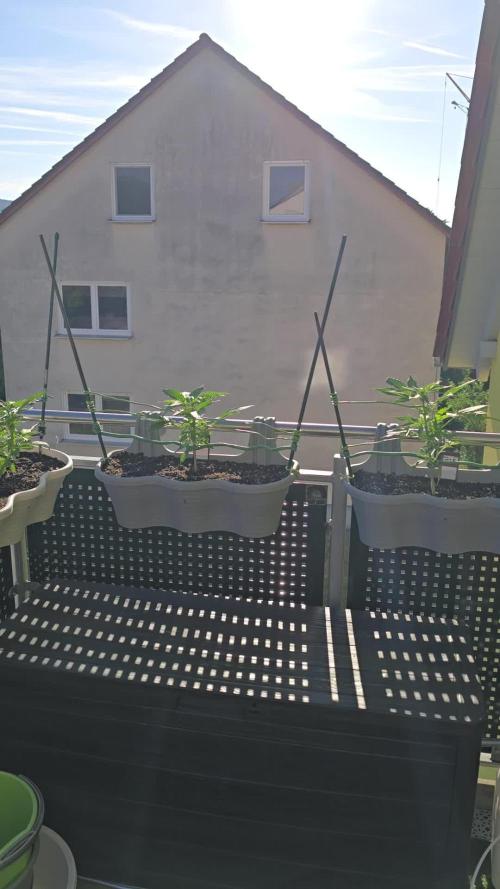
35 dienos!! Mano projektas su @Fastbuds merginomis, šiauriniame namo balkone, tęsiasi:) šią savaitę oras buvo geresnis, kas mergaitei labai patiko, ji pradėjo greitai augti:) nors žydėjimas prasidės netrukus, bet dar turiu kelias savaites jos augimui, tad galiu tik tikėtis geresnio oro ir daug saulės:) sėkmės visiems :).

Likes
121
Share


@Tropicannibis_Todd
Follow
💩Holy Crap Growmies We Are Back💩
Code Name FBT2307
Well growmies we are at 63 days in and everything is going much better , she's bounced back pretty good👍 really good actually 👌
👉 Shes getting frosty now , and i hope she fills out 👌if she does gonna have some buds on a stick 💪
Lights being readjusted and chart updated .........👈 Even with early major issues due to the soil/medium she's come a long way 👈
👉I used NutriNPK for nutrients for my grows and welcome anyone to give them a try .👈
👉 www.nutrinpk.com 👈
NutriNPK Cal MAG 14-0-14
NutriNPK Grow 28-14-14
NutriNPK Bloom 8-20-30
NutriNPK Bloom Booster 0-52-34
I GOT MULTIPLE DIARIES ON THE GO 😱 please check them out 😎
👉THANKS FOR TAKING THE TIME TO GO OVER MY DIARIES 👈
Likes
10
Share


@Waveydavey420
Follow
Plants are responding well with the gold leaf at 4ml per gallon. The reservoir is starting to have a strong bad smell on day 3. May switch back to ph'd water at 6.5, then add gold leaf at 10ml gallon every 3 days. They're drinking water like crazy. Iowered the light to about 20", running on 580 watt.


Likes
12
Share


@Medgrow93
Follow
26 Mar - 2.2L each + calmag + adjust pH
3 Apr - 2.2L each + calmag + yucca + adjust pH
Edit: Having some pH issues but it's too late to fix now, just waiting for them to finish and watering when needed.

Likes
35
Share


@SantaStone
Follow
🎅 So, as for the smoke after 30 days of harvest day. Biscotti Mints have a high concentration of THC, definitely above 25%, you can feel it.
Beginners should exercise caution.
-The taste, I wouldn't exactly call it mint. It's similar to peppermint, but it doesn't taste like mint, it tastes like flowers. Bottom line, the taste is similar to pepper flowers.
-The effect is only evening, not daytime. It will be good for an evening relaxation or in the company of friends.
-The appearance is something beautiful. Everyone who saw him liked him. Dense, stone buds, green-violet color.
Likes
7
Share

@MrLahey
Follow
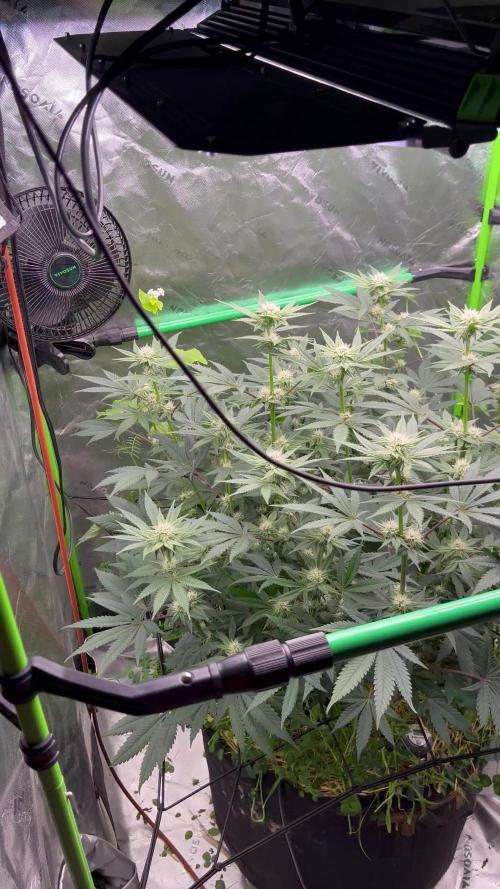
Today is day 23 of flower and she’s still stretching. It seems the one I have is really stretchy which makes me happy I put the lower trellis net where I did. Maybe it’s an act of cannabis defiance for being so stunted at the beginning or perhaps I’m just anthropomorphizing lol.
I did minimal defoliation the first 21 days of flower and since then I’ve done it each day little by little. I’ll probably do one more bigger defoliation tomorrow nightand then I’ll probably step back and let nature take back over.
At day twenty she started to smell rather syrupy. I feel like that’s early for a cultivar to start smelling this noticeably strong considering that it’s estimated to average around 60 days in flower according to HSC. I’m hoping this means she’s gonna have like 4D terpenes and crazy strong cannabinoid profile lol.
The Blumat is keeping her perfectly watered. I think it’s translating to a much heartier and healthier plant than when I was watering by hand. I’m waiting for my typical mid flower nutrient issue to show up any day now and if it doesn’t I’m gonna thank the Blumat for that and assume my previous plants mid flower issues were due to me not meeting the voracious water demands of a plant in early flower.


Likes
3
Share


@PoshGrow
Follow
Welcome to GhostGrow Chapter One by PoshGrow!
🌳 Week #5
2nd week of flowering. Last week LST went as planned, strains recovered fast, so this week I gonna rearange LST and apply home made Scrog net, also I will remove all big fan leaves for better light penetration.
Watering when needed, every other watering I used Fox Farm Big Bloom, Grow Big & Tiger Bloom.
I wont be moving plants around, they will keep their positioning till the end of the grow, so in further pictures I wont put tags with strain names😉✌️

Likes
48
Share


@MG2009
Follow
Day 18 of flowering,fed(top dressed) 1/3 cup bud swell watered in with veganic special sauce,soil soaked up3/4 of a gallon before any runoff.
Update 2/24/ 2018
Defoliation would have better results next Grow.!

Likes
18
Share


@The_Lonely_Farmer
Follow
Nearing the end for these girls, the shorter tropicana will be ready first with the older girl finishing up a week or so later maybe 🤞...
Feel free too comment any advice or comments welcome 👊🌱💚
Likes
10
Share


@DreamIT
Follow
Sponsored by:
🦎THE HIGH CHAMELEON🦎-💡VIPARSPECTRA💡-💐GREEN BUZZ LIQUIDS💐-🛠️WEDRYER🛠️
🏁 10/8 New sponsor at DreamIT. I am delighted to warmly welcome The High Chameleon to my journals and growboxes. The shipping was fast and the package was anonymous. Instead of the usual plastic to keep the seeds in place, I found a nice bag of chopped hemp, a smart and ecological choice. In addition, a very practical grass holder with attached grinder, really practical and comfortable. I will open a diary for each seed that I will try to grow with different types of training techniques, I will decide which ones along the way. let's begin !!
12/8 open seed! it was not necessary to help her. it is a bit crooked because the light is central and it is already looking for it. transfer tomorrow
18/8 everything is going well
__________________________________________
Personal advertising (contains affiliate links)
__________________________________________
🦄 Check out The High Chamaleon website, their first selection criterion is the strong signature of terpenes by taking rare strains while being 100% organic and respecting nature. Safe anonymous shipping!
✅ https://bit.ly/TheHighChameleon
__________________________________________
Did you know that Green Buzz Liquids fertilizers are 100% vegan? A complete line of products ready to give the best to each of your plants! Visit the site and see my journals to see how they work 🦄
🤯 And with the code "dreamit" you will immediately receive a 15% discount on your purchases
✅https: //bit.ly/GreenBuzzLiquidsPro
__________________________________________
👀 Are you looking for a good lamp to start with? 👀
🌞Viparspectra has something more than the others, take a look at their site.
⏩ Use "GDVIP" for an extra discount or "DREAMIT3" for an extra 5 %% discount
👀 Search for it on Amazon
✅Amazon USA: https://amzn.to/30xSTVq
✅Amazon Canada: https://amzn.to/38udUVe
✅Viparspectra UE: bit.ly/ViparspectraUE
✅Viparspectra USA: bit.ly/ViparspectraUS
______________________________________________
🌈 Tired of blowing on your weed hoping it dries quickly? Check out the Wedryer website! You will find a well-made accessory that will help your weed dry in just 8-10 days without the annoying risk of finding mold or other annoyances! (no affiliate links)
✅https: //bit.ly/Wedryer_
______________________________________________
📷🥇Follow the best photos on Instagram 🥇📷
https://www.instagram.com/dreamit420/
Backup
https://www.instagram.com/dreamit4200/
🔻🔻Leave a comment with your opinion if you pass by here🔻🔻
🤟🦄💚 Thank you and good growth 💚🦄🤟

Likes
38
Share


@Chucky324
Follow
Hello This is the end of week 2 and the beginning of week 3 of flowering, for the 6 plants in the greenhouse.
This is the end of week 1 and the beginning of week 2 of flowering, for the 3 plants inside.
Things are going good in here this week. I want to get in here this week and do my last trim/prune before the resin starts flowing.
The Voodoo Plant opened this week. It smells like rotten stuff so the flies pollenate it. It's only a 4 day flower before it goes bad.
I showed some of the sweat shirts and t-shirts I put image's on, with a ink jet printer and some iron on transfer paper.
Are you a pot/cannabis activist too. Make your own shirts with the images "you" want on them.
Ok. Wishing you the Best Wishes. Be Great.
Chuck

Likes
54
Share


@ASCBOOGS
Follow
Day 23 Veg have not topped yet only bit of LST and HST everything seems fine


