Likes
Comments
Share


@my420experiment
Follow
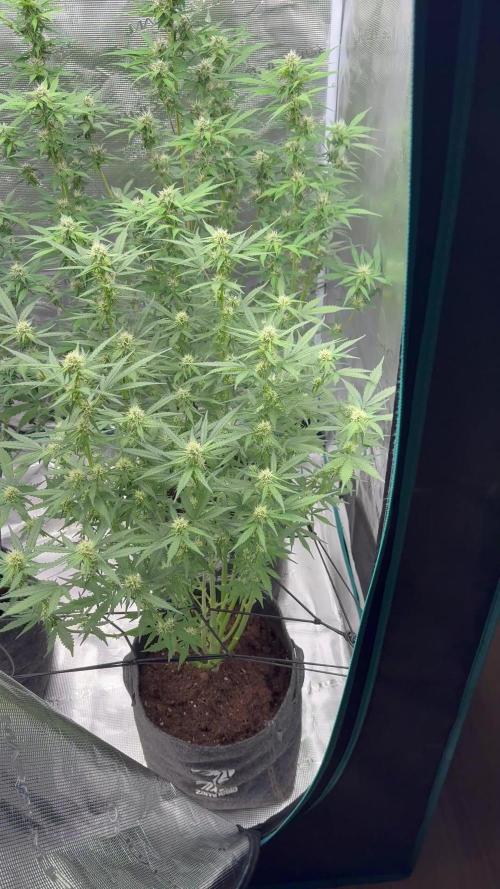
Learning a ton as I go.
Started low stress training using rubberized wire poked down into the soil.
Spent a lot of time just tucking the fan leaves down.
I'm an idiot when it comes to watering.
I dont think I'm getting enough down to the bottom of the pot, but dont want to over water.
I'll just continue with what I'm doing.

Likes
10
Share


@asstonmartian
Follow
Bushing out nicely! I probably should have adjusted the LST to allow them to grow taller but they were responding nicely so I kept them pinned and adjusted every few days. Finally started ph’ing the water to around 6. Water is tap, not measuring TDS or adding liquid nutes at this point.
The soils transplant was done with 50/50 mix of Natures Living Soil and soil, botto 1/3 of pot and remaining 2/3 soil.


Likes
7
Share


@Mr_nugs_lover_David
Follow
First of all sorry for not showing you all the transplant of this beauty, My phone freaking died and couldn't be able to film the process of this plant, I'm very sad about it, but anyways we gotta keep working, so this lady has been Transplanted on day 39 just like her sister and she will be fed with the complete biotabs organic line, I've prepared the 15L pot adding 25G for every 5L of soil of startrex then sprinkled a few mycotrex grams on the planting hole, and once the transplant was done I added 3 biotabs slow release tabs and then just watered with 1g of bactrex and 1ml of orgatrex per liter of water, the plant looks absolutely beautiful, let's see how she develops, one thing is sure, she won't be hungry at all!

Likes
11
Share


@RadDad
Follow
I originally had applied to Green House Seed Co.'s Taste of the USA Contest here on Grow Diaries. Turns out I was ineligible but the good folks at GHS still had the big hearts to send me seeds anyway. So big ups to them for hooking this grower up.
Welcome to the Sea of Fire 🔥
For this grow were using the Dark Phoenix seeds that GHS sent to me to create a Sea of Green. I've got 8 plants in 8 1L pots.
I've decided to use Black Swallow's living soil for this grow so we won't need to add anything but water for the first 3 weeks or so.
Our goal for this grow is to have these girls ready for harvest in about 20 weeks which will bring us to the beginning of November 2021. If all goes according to plan these firey buds should be filling my friends stockings this Christmas.

Likes
10
Share


@Beancultiv8r
Follow
I’m starting to see both the dosi & bride cakes nodes reaching taller everyday, more & more pistils are forming! No signs of deficiencies or pests. I will be keeping these ladies on the Jacks/ Autopot feed but the seedlings shown in the update video are going to be receiving the Athena program via hand watering which I’m very excited about!


Likes
29
Share


@GrowCaCola
Follow
This strain was a little inconsistent for me, but the one that did end up doing well was well worth me trying this one out again. Overall the process was great and she performed very very well. 9/10 would grow again!

Likes
1
Share

@BalconyBoy
Follow
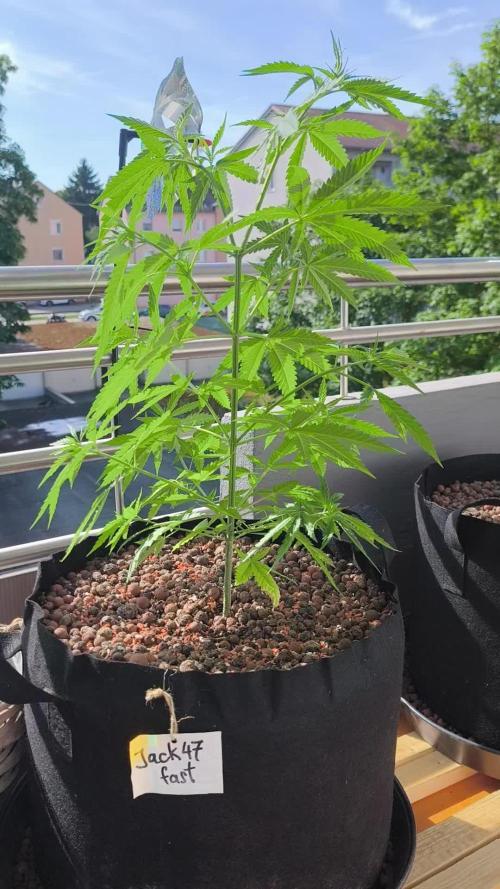
08.06.26 die Pflanzen entwickeln sich weiterhin gut und hatten die vergangene Woche mehr Wind abbekommen, jedoch ohne Schaden. So darf es gerne weiterlaufen!


Likes
13
Share


@Rob691
Follow
Here we go for the first session. Hope it will be as easy as the first one was... finger crossed !
As I love sativas strains, Chocolate Haze seems a perfect choice to me. The grow tent in tall (2m) so the girls can grow till 1.6m more or less. With some training and topping, it should be ok.
Germination day 5 : 2/3. I decided to put a 4th Chocolate seed. If it germinates, it will be just 5 days younger. Nothing I can't deal with ! If it doesn't, never mind. Let's give it a try !
Germination day 9 : 4/4 ! Now it means that I have to deal with 7 pure sativas in 1m2…. I love chalenges 😁😅
Germination day 12 : The litle girls are growing gently. The second pair of leaves is coming, and I thing I'll turn diary into "week 1" on saturday with their first repotting. The 4th Chocolate haze is a bit small for repotting as she's 5 days late compared to the others. But, she grows fast and strong (maybe faster than the 3 others) and I think she'll make it ! We'll see.
Likes
88
Share

@squalino
Follow
🌿 Journal de Culture : Mac 1 Autoflower
– "Bee Happy" 🐝 (Semaine 11)
#Dryrocket
On entre doucement dans la dernière ligne droite. La production de résine atteint son paroxysme et les choix stratégiques pour la récolte commencent à se profiler.
Un Grand Merci
Un merci tout particulier à @mia_biotabs et @Mrs_Larimar pour leur accompagnement tout au long de cette aventure, ainsi qu’à tous les cultivateurs qui suivent ce ce journal depuis le début !
Je tiens également à remercier chaleureusement @Dryrocket de me donner l'opportunité de tester leur appareil. J'espère sincèrement que j'aurai assez de silice pour mener à bien cette session avec, ça s'annonce super intéressant ! ☺️
Paramètres de Culture & Environnement
Taille : Toujours stable à 91 cm.
Le problème de colocation : "Bee Happy" est toujours très impactée et cachée par l'envergure de sa grande sœur Spirit. À cause de ce manque d'espace et de cette ombre imposée, il m'est encore difficile de me prononcer précisément sur la structure globale de la plante et sur l'estimation finale de la quantité. On fait avec, mais le potentiel est clairement là.
Climat & Environnement :
Les constantes restent inchangées. Lampe calée à 40 cm de la canopée, températures fixées à 24°C jour / 21°C nuit, et déshumidificateur en marche pour maintenir l'humidité à 60%.
Nutrition & Gestion de l'Eau
Système :
Le réservoir Autopot gère toujours l'arrosage automatique de fond en eau claire.
Ration du jour :
J'ai donné aujourd'hui une dose légèrement réduite par rapport à la semaine dernière : 4 ml de Liquid PK 5-8 Biotabs. On commence à lever le pied doucement en vue des prochaines étapes.
Étude des Trichomes & Structure des Buds
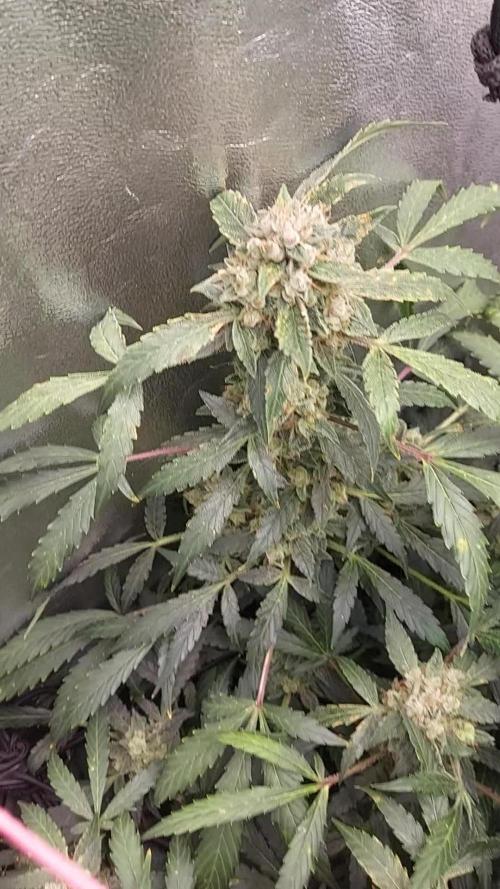
C'est ici que l'on constate une vraie divergence génétique. Les têtes de "Bee Happy" gonflent de façon totalement différente de celles de Spirit :
La structure :
Alors que Spirit développe des fleurs longilignes en forme de "sapin", "Bee Happy" nous sort des têtes ultra-compactes, très denses et groupées, qui ressemblent à des têtes de choux-fleurs.
L'évolution des trichomes :
Le givre est tout simplement impressionnant et très épais. À la loupe, les trichomes sont presque majoritairement laiteux. Il reste encore quelques trichomes transparents isolés et très peu d'ambrés pour le moment.
État général :
L'odeur sucrée est toujours bien présente et très agréable. Excellente surprise du côté de la santé globale : l'absence de sénescence se confirme, toutes les feuilles nourricières disponibles sont encore bien vertes et captent le moindre rayon disponible.
Perspectives pour la suite 🏁
Au vu de l'évolution des trichomes (majoritairement laiteux), le pic de THC est tout proche. Je pense que je vais la mettre au rinçage dans pas très longtemps. L'idée va être de couper le PK pour laisser la plante vider ses réserves et consommer les nutriments restants dans le sol avant la coupe.
Merci à tous d'avoir suivi cette mise à jour !
La fin approche pour "Bee Happy" et le test de l'appareil Dryrocket s'annonce très lourd pour la suite des événements.
À la semaine prochaine !

Likes
24
Share


@m0use
Follow
***Sponsored Grow*** = Medic || https://medicgrow.com || Grow = ***Sponsored Grow***
Ok big update this week, I finally edited the footage of the lights and got their unboxing photos processed, this took way longer then expected and should have been done on germination or week 1 entry but better late then never. You can really see how the lights shine in comparison to my older ones. The brightness of the leds is next level and I can use their V1 spectrum from seed to harvest. Its a great balance of red and blue in a full spectrum light. The medic grow mini sun 2 is a all purpose light that I can see myself getting lots of use out of in the future. Plus they fit in my tent just as snug as my last ones and that's a big thing for me, I don't like dim corners. I am using the lights at 80% dim level. this will be raised to 100% when they enter flower :D First time useing lights I can dim. they also have an onboard timer attached to them, I will be playing aorund with this to see if its something I want to use in the coming weeks, I all ready have all the external timers so I can see how this is a useful tool for anyone starting off without them.
On top of all this I also transplanted my plants into their final pots. they went from a .7-.8L to a 2gal or 7.5L, all the root balls on the plants where perfect, nice white roots, maybe a bit compacted for the size and might explain why I am having some issues with them but healthy none the less. I think they will not start to grow a bit better and I will see less issues moving forward. I still have yet to get a new PH pen but I am blindly guessing the PH by adding 2 drops of phosphoric acid ph down per 1gal of feed solution. it seems to be working out just fine.
Till next week.
***Sponsored Grow***
Official Website:
https://medicgrow.com/
+
https://www.emeraldtriangleseeds.co.uk/
Facebook:
https://www.facebook.com/medicgrowled
+
https://www.facebook.com/OriginalETS/
Twitter:
https://twitter.com/medicgrow
+
https://twitter.com/emeraldseeds
Instagram:
https://www.instagram.com/medicgrow420/
+
https://www.instagram.com/emeraldtriangleseeds/
YouTube:
https://www.youtube.com/channel/UCNmiY4F9z94u-8eGj7R1CSQ
Growdiaries:
https://growdiaries.com/grower/medicgrowled
https://growdiaries.com/grow-lights/medic-grow
+
https://growdiaries.com/grower/emeraldtriangleseeds
https://growdiaries.com/seedbank/emerald-triangle-seeds

Likes
19
Share


@Naujas
Follow
the girl looks good :) I have already removed the yellow "autumn" leaves:) she received food with 1500ppm, the weather is not very good, I am afraid that it will start to rot :( there will be an update :) in 2-3 weeks ;) good luck growing


Likes
11
Share


@Jayhaze
Follow
Started this week on 15th of March, being day 8. Got to meet Doc (nr1) that day and met Happy (nr2) on day 10.
Unfortunately nr3 wont show up, I dug it up and saw that it's still in its shell. Placed the seed back in a paper towel.
Doc and Happy went quite fast on day 11 and got quite a bit of sun this week. They are now, on day 16, tuesday 23th of March, about 4cm each.
Will plant them in the bigger pots today.


Likes
38
Share


@LittleBigTrees
Follow
Lowered the feed this week to 700 ppm then just plain water with no run off for the last 3 days. Two of the plants could have done with going for another week or two but time constraints mean I had to chop now .
There very frosty and smell like gelato with funky gas hints , I have 6 phenotypes so I'm expecting some variations. There now hanging at 18°c and 60% humidity . Hopefully I can get some nice dry nug shots before the judging , there close but not dry yet ..