


Likes
Comments
Share


Processing
Likes
7
Share


@Kushizlez
Follow
Day 17F-24F
(Day 19) Man it’s such a shame that bbb#1 stunted out. It was so damn vigorous until it’s most recent feeding. I will make sure to cut back on teas next round as they can be a wild card sometimes.
All 5 plants are packing on some serious early frost. But I’m not seeing too much chunk to the buds yet. My other grow that was flipped on the same day has almost no frost yet so that’s a good sign.
(Day 21) Big strip today. I will pull off as many leaves as I need to ensure nearly all bud sites are exposed to adequate light.
I’m still seeing excess N so I’m going to water in 2 gallons each until I get some runoff. The plants seem to be up taking water pretty decently so I’m going to push it a little with a heavier watering.
Wow do the plants look amazing after that strip and flush! Everything is praying up beautifully, including #3 in the back. Let’s hope that gets it back on track now.
(Day 22) I want to give a PK boost but all my bloom nutrients have way too much N and I don’t really want to risk it toxing anymore. I could give it a little bit of 0-18-0 bat guano and some 0-0-15 kelp extract but it could be completely unnecessary. I can’t see any signs of deficiencies but a small surplus couldn’t hurt either.
(Day 23) I like how the ladies responded to the thorough watering. I will up my watering to 1 gallon every 48 hours from now on.
It sucks to see how short bbb#1 is. I was expecting such a huge stretch but it never came because of that fucking tea! I should have leached the medium as soon as I saw stunting. It’s too bad because it definitely had the most potential for yield.
(Day 24) I’m starting to think the main problem with bud size this round is all the topping I did early on. Not to mention they were vegging for nearly 3 months. I will try to pick off most of the larf before it wastes anymore energy.
I think the ideal style of growing for bud size and veg time is a semi sea of green, or 6-8 plants per 25 square feet. I’m not a big fan of these giant plants as it’s a lot of wasted veg time and smaller bud size overall.
The smell is really ramping up!
Likes
2
Share


@DurbanPoison420
Follow
So the older plant finally started flowering after 6 weeks and a couple days of veg. AH#2 looking very healthy, seems to be taking to the nutrients well :)
Likes
28
Share


@BB_UK
Follow
It’s such a good feeling when a plan comes together! Trained these girls all the way through the grow period of the other 6 keeping them down, chopping branches down twice in order to maintain control! They are bursting with flowers! And the aroma already is so lush! They’re technical day of bloom is 22 days as of today! Shows 4 weeks because I transitioned when the WSE purples turned 6 weeks! I’m actually so excited for the end of this one because I upgrade tents through sponsorship and really go to town with the females! Plus I have a few new strains from Zamnesia and also unreleased ones!! That’s autos and photos! So keep a look at! Big things are coming!

Likes
1
Share

@ukojesita
Follow
Zdarec pěstiči, čtvrtý týden za náma a holky vypadají že jim zatím nic nechybí, včera jsem udělal defol spodků a teď už jen čekat na pořádný bambára 😁. Zatím Čus.
Likes
13
Share

@DevelGrow
Follow
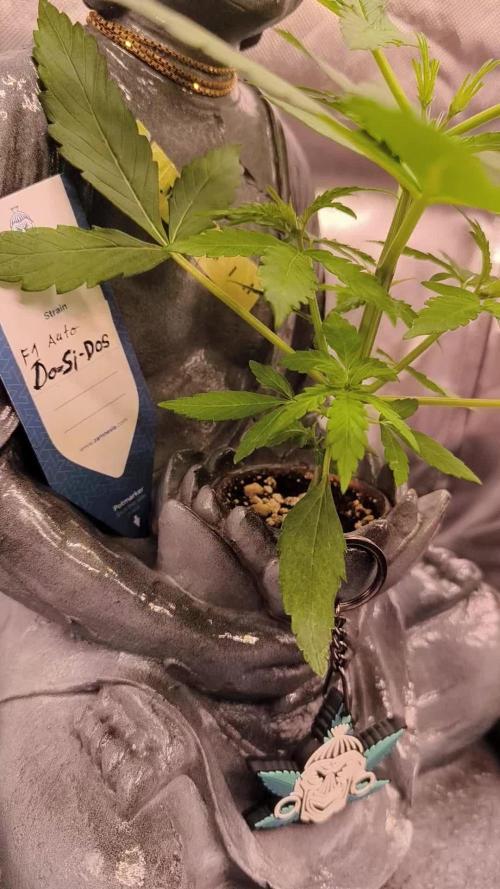
Hallo Freunde 👋 Do-Si-Dos F1 von Zamnesia ist 21 Tage alt! Sie wurde getoppt und wird in den nächsten Tagen in Richtung gebunden (LST) der Strain selbst ist sehr schön in den Händen angewachsen und legt täglich ein wenig zu! Bis nächste Woche,keep Green and Grow High ✌️🍀💙🍀

Likes
1
Share


@Dabcik
Follow
Aumentato distanza lampada e ph dell’acqua di irrigazione. Le piante stanno bene hanno un bello stretch che sto cercando di tenere sotto la rete. Ora i fiori iniziano a formarsi


Likes
56
Share


@Prilyfe13
Follow
April 12, 2024 Day 57
This week we will be focusing on defoliation. The last defoliation until flower to be exact. I don't plan on doing it all at once, but I'll be doing it throughout the week or when it's done. Whichever comes first.
Banana Purple Punch A is about 22" in most spots with a few colas standing an inch or two higher. I believe she has for the most part finished her stretch. Not as tall as I had hoped, but there's tons of bud sites throughout, so it should be a pretty decent yield for her size.
Banana Purple Punch B is slightly shorter at 21" tall with 2 colas being 23". Her buds are huge and fat. I'm expecting a really nice yield from her regardless of her size. I'm pretty sure her stretch has stopped now and this is the final size she will be. She may stretch another half inch or so in the next week, but that's it.
Both ladies got a partial leaf cut today. Just cleaning up some clusters and larger overshadowing leaves. There's a couple more areas to work on, but I'll save those for the next trimming in 2 days. It honestly should only be about 6 days for the whole thing to be good. With Banana Purple Punch A having less to work on, she may be done next trimming session. Let's hope. It's really time to focus on bud production.
The nutrients are going to change with the next watering. Banana Purple Punch A got a full reservoir refill, while Banana Purple Punch B needs another day. I'll top her off tomorrow.
I'll be switching Big Bud with Overdrive and removing Sensizym. Tasty Terpenes will remain as well as B-52. I'll keep the new setup for about 2 weeks. Then I'll cut the dose in half for one watering before the flush. I'll be using Flawless Finish for the flushing cycle.
I decided to increase the light power back up to 90%. It's the best place for the DLI. The center is about 50 mol/m²/d while the surrounding area is 45 mol/m²/d. The very edges are about 42 mol/m²/d. Overall it's a really nice position and I get to keep the 24" distance. I'm really enjoying this footprint. Also, depending on what happens over the next week, I may have to drop the power back down or lift the light up as high as it can go. I may lose an inch, but that's perfectly fine.
The environment was a bit wonky for the last couple days, but now it's back to an acceptable range. Today it's at 76° with a humidity of 55%. The VPD is 1.33 kPa. Again, not the most ideal for this stage. It's fine though. The humidity will drop later this afternoon and the VPD will raise up to about 1.42 kPa. So everything is good there.
April 13, 2024
Absolutely nothing to do today. No clipping of leaves, no watering, no light lifting, nothing. Just took some pictures, checked over the plants and that was it.
I'll look for leaves to trim tomorrow. If I even decide to trim anymore leaves at all. I might just leave Banana Purple Punch A alone. She seems to be done stretching along with Banana Purple Punch B. So I guess from here on out, I should probably just leave them alone. So tomorrow with be the last day.
As I said earlier, the lighting need not be changed. The ladies are praying. I think this is where the light will be for the rest of the grow.
Updated Correction: I ended up cutting some leaves off today. Not a whole lot, but there were clusters I missed and a couple massive leaves that were overshadowing several bud sites. It's all about the angle of view. I only have one way I can look, so it makes trimming a bit of a pain. But that should be it from now on.
Maybe a bit more tomorrow. We shall see.
Grow System Environment:
Temp: 73.5°
RH: 52.0%
VPD: 1.32 kPa
April 14, 2024
As I said yesterday, today is the last day of defoliation. So I dug nice and deep. I didn't take off as much as I thought I would, but I'm sure I'll find more this afternoon. Anyway, I had the intention of doing a full defoliation, so I was looking for anything that could be done away with. Lots of power clusters from the younger foliage growing and spreading. I think I will end up removing the SCroG net today or tomorrow. I may do it this afternoon before I check for more leaves and pull each plant out and finish the defoliation then. I'll also clean up the outsides of each plant to help keep them more compact. Mostly leaves that are sticking out too far. Those that touch the walls and overlap each others bud sites.
It's early afternoon and I have removed the SCroG net and did a nice defoliation. Both plants got a decent amount of leaves taken off. Nothing crazy, maybe 15% came off each plant. With the net off and the ladies trimmed up, there is plenty of deep light penetration and air flow.
Banana Purple Punch A is actually filled in the center now. For the most part. After removing the net, the middle branches came in a bit, offering ample light penetration for the tops that were behind the middles. I've also noticed that the internodal spacing is pretty long on her. Very spread out. But all the buds are big and fat and covered in trichomes. Not quite super frosty yet, but getting there.
Banana Purple Punch B opened up quite nicely with her defoliation. Not much changed in branch placement with the net off, but the defoliation opened up a ton of space for ultimate light penetration and air flow. She is also covered in trichomes. Also not frosty yet, but definitely getting there.
I checked the DLI today. It looks great at 43 mol/m²/d. Not the 45 I was expecting, but the center of the tent still hits 51 mol/m²/d. Not to mention that the two Tropicana Cookies I have sharing the tent several taller tops than these ladies by about 3 inches. That leads me to have a slight issue. I would prefer the light be at 45 mol/m²/d for these ladies, but if I lower it, the intensity will be too much for the other plants and their taller tops.
Lifting the plants up may be the only option. However, it's tops that are taller. The canopy is still just over the net. And that's for all of the plants in the tent. So I'm just trying to figure out what to do. I'll decide this afternoon, after the net is removed and the plants are all trimmed up. I can also get a better idea of what the canopies look like and the amount of tops that are taller.
Honestly, the best canopy is from Banana Purple Punch B. She's the smallest, but has the best structure. The canopy is nearly perfect compared to Banana Purple Punch A who is more spread out with tops in a range of heights. Not so level. My training may have been a bit off for her. Still nice and open though.
She definitely didn't grow as I expected either. Inner branches didn't stretch as much as I would have expected. So this plant would have benefited a wider canopy. To help get those center auxiliary branches could keep up with the outers. Nothing to be done now. But for future reference.
The environment is doing pretty good today with a temp of 77° and the humidity just over 54%. The DLI is looking really good as well at 1.44 kPa. Perfect for this stage. I would prefer to lower both the heat and the humidity. The heat should be around 75° with the humidity under 50%. The DLI would stay the same though. And that's the goal. 1.44 kPa and a temp of 75°. I'll match the humidity to the temp for the DLI.
Grow System Environment:
Temp: 75.5°
RH: 52.2%
VPD: 1.39 kPa
April 15, 2024
Not as wordy as yesterday. It's watering day! Except for Banana Purple Punch B. She is nearly full still. I soaked the bottom of her container to kick start the wick system. This kind of happened with my last run. One plant just wouldn't take water in as much as the rest. It was also the smallest of the plants. It's interesting that for some reason she started slowing down her water intake at the flowering stage. It's still way too early to do that.
Anyway, with the net gone, I finally got to clean the basins out. Well, I cleaned the one for Banana Purple Punch A. It was empty. For Banana Purple Punch B, I mixed the solution and cleaned the wicks. They were definitely clogged.
I changed the nutrients to 8 ml of Overdrive and removed the Big Bud. I was supposed to remove the Sensizym as well, but forgot to. I'll remove it next watering. This will be the final regimen for the rest of the grow. I am a bit concerned with the 8 ml dose of Overdrive. It may be too much to start. I should have started with 4 ml. Oh well, I'll be able to fix it pretty quickly if there are any issues.
All that being said, everything looks great! The plants definitely look much better without the net. As well as being much more even around the canopy.
The lighting was not changed yet again. I'll double check the light tomorrow. I may do it later this afternoon. I'll see how I feel. However, I don't think it will need any movement.
The environment looks really good today. 75° and 50% humidity. Looking great! Pretty stable as well. I will say the night temps are a bit high. It's about 71° to 73°. I'd much rather see the temp at 66° to 68°. Especially during the flowering stage.
Update: I lifted the light an inch and left the power alone. It's a bit all over the place with the canopy definitely not being level. Like it should be, but now it's at least in the 40's and not in the mid 50's.
Grow System Environment:
Temp: 75.3°
RH: 50.2%
VPD: 1.45 kPa
April 16, 2024
Not much going on today. Banana Purple Punch A looks great. She may need watering tomorrow. I'll double check this afternoon. Banana Purple Punch B on the other hand need water today. The dip in the basin worked wonders and kick-started the wick system. She's definitely drinking now. She may slow down a bit once the soil saturation rate levels out.
Neither plant needs any maintenance today. I didn't bother pulling them out. I don't think it's necessary to pull them out daily if I can avoid it. I'd rather leave them to grow those buds as much as possible without any disturbances.
I will pull them out tomorrow though. Just Incase they need anything done. It'll also give me a better idea of what I'm looking at when they are in the tent.
It's a tight fit with 4 plants in there, and it's really hard to tell them apart where they meet up. They are all touching each wall, but definitely not as bad as it could be. Looks like a perfect fit to be honest.
Their buds are huge. And haven't really started swelling quite yet. Lots of trichomes. I'll start posting trichomes pics next week as well as individual plant pics. They are too big to really tell apart in the tent, so I'll do the solo pics instead.
The lighting didn't need to be changed. I believe this is where I'm keeping it for the rest of the grow. At least until the last week. I'll drop it down a bit for the first half of the week and a bit more for the last half before harvest. For now, the light stays at 45 mol/m²/d and 24" canopy distance.
The environment looks great today. I finally got the temp down to 66° last night. It has climbed up to 76° today. The humidity has been stable at 51% for most of the time. It climbed a little bit yesterday, but hasn't showed signs of climbing at all today.
Grow System Environment:
Temp: 73.5°
RH: 52.3%
VPD: 1.32 kPa
April 17, 2024
A little to do today. Both ladies got a reservoir refill and Banana Purple Punch B needed a whole branch pulled out of the way of other tops. Looking good now. I will say this strain has some super strong branches and stalk.
I didn't pull Banana Purple Punch A out today. No need. I can see through and around her. Looking good as well.
I still haven't changed the light. No need at this stage. Another week or 2 before I drop the light power down to 70%. In theory, if I'm right, that should bring the DLI down to about 38 mol/m²/d. The final week will have the light power at 60%. That will be roughly 35 mol/m²/d. And that's the final light schedule.
The environment is back on track with the night temp being around 67° with day temps climbing back up to around 76°. The humidity is still really stable at 51%. I'm not sure I'll be able to drop it below 50%, but I'm going to try my damnedest. 45% is where it should be now. It's just tough to get there.
Grow System Environment:
Temp: 74.0°
RH: 50.0%
VPD: 1.40 kPa
April 18, 2024
Not much going on today. No water needed and no sense in changing the light. Instead, I lifted Banana Purple Punch B up one more riser. Now she is perfectly level with the whole canopy. Should have done that in the first place, but you never know.
I've come to the conclusion that this run isn't the best I could have had. The plants aren't up to where I would have liked them. I've been monitoring container size for a while now and I can tell you 3 gallon containers. Don't generally produce large plants. I prefer large plants to shorter ones. Even though larger is not always better, but I have learned from my mistakes and I find that 5 gallon containers are the best bet for a larger plant. I mean, I could just be doing it wrong and got lucky with a few larger plants, but I feel like I generally get better plants with the 5 gallon containers. I'll do a side by side at some point. For the next run, it's a contest, so I'm keeping all the plants in 3 gallon containers. If I have enough soil, I'll do 5 gallon containers.
Anyway, Banana Purple Punch A has some taller colas, but the internodal spacing is pretty long, so the branches aren't covered in buds, but the buds that are there are getting really fat.
Banana Purple Punch B has more bud development, but is significantly shorter. They have the same amount of branches, but they just grew differently. She also kept up with the wick system, so the bottom of the container is nice and moist with roots showing throughout the bottom. A little too late for that, but still good for strong bud development.
As I said earlier, I didn't mess with the light, but lifted Banana Purple Punch B up to canopy height again. The light is seemingly a bit too bright in some areas, where the super tall tops are. I may decrease the power back down to 80% in a week. Then down to 70% and then 60% and maybe even 50% if need be. The DLI for these two is now finally 45 mol/m²/d.
The environment is a little wonky today. Well, at least for the morning it has been. It should fix itself later today. The temp is around 75° and the humidity is a bit high at 55%. The VPD is low at 1.33 kPa.
Grow System Environment:
Temp: 74.2°
RH: 53.3%
VPD: 1.33 kPa

Likes
12
Share

@JoLatto
Follow
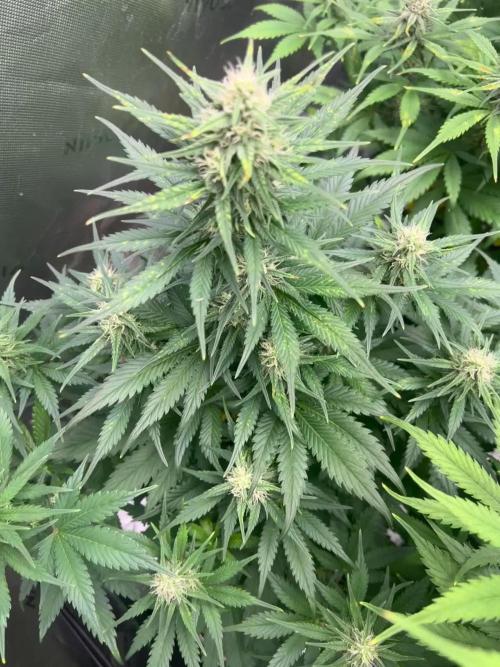
Week 8 - Strawberry Gorilla RF3… 4/5 are still growing. I had to chop the mutated plant it started to herm. I should’ve caught it in time not seeing anything on others but we’ll see. The smell has me shocked you can feel it in your whole body. Terps are Pure Strawberry Pie & Super Fuel. I’ll update next week good luck everyone !
Likes
12
Share


@Virke
Follow
They started blooming early and im very satisfied with their appetite
Next week bigger heads hipefully after some Big Bud additive😉

Likes
23
Share


@burnout
Follow
Trichomes look done, put a fork in it. The smaller plants, pheno 3 and 4, may need a little longer, but I am chopping on day 72 of flower, 112 days since they sprouted.
I will be back in a couple of weeks after they dry for weights on each plant

Likes
7
Share


@Guerillafarm
Follow
D 74 es wurde zu eng also hab ich die pflanze in einen anderen Raum gestellt mit einer anderen Lampe
Lampe : COSMOS 150W mit UV und IR.
Mein Anbau Raum wird bis zu 32•C warm wenn die Tür ganz zu ist, ich lasse aber auf dann komme ich auf 29,5 - 30,5
D 75 gestern habe ich vergessen zu gießen
Also bekommt sie heute 2L bis zu den Topf löchern.
Lampe nur auf 80%
D 77 2L gegossen bis es überlauft.
Processing
Likes
35
Share


@DjDaveAtHome
Follow
Spent the week rinsing and massaging roots, cleaning, filling then re-cleaning and refilling reservoirs. The rot is gone. Replaced with beneficial microbes from Advanced Nutrients Tarantula, that I made into a tea. This tea has cured the rot and also made a huge contribution to the roots and therefore, the whole plant.
Am very impressed with the plants progress, vigour, vitality and strength!
Now that the crisis is over, I'll be using the tea twice weekly to replenish the ranks.
Blueberry Headband (1), Amherst Sour Diesel (1) from Humboldt Seeds.
https://www.humboldtseeds.net/en/blueberry-headband/
https://www.humboldtseeds.net/en/amherst-sour-diesel/
Lighting
https://www.horticulturelightinggroup.ca/products/260w-qb-v2-led-kit
DWC Nutients
https://generalhydroponics.com/floraseries
FloraGro
FloraBloom
FloraMicro
Cal Mag
https://generalhydroponics.com/calimagic
Epsom salts
Brown Slime Root Rot Organic Microbe Tea
5 ml (1 tsp) organic sulphur free molasses
5 ml Alaskan Organic grow fertilizer (or something comparable)
5 ml Alaskan bloom fertilizer (or something comparable)
5 ml Seaweed or kelp fertilizer

Likes
Comments
Share


@MellowVibes_CBD
Follow
Just water some more everything is still going smoothly
Doing a little topping and cleaning up the plants


Likes
6
Share


@MG2009
Follow
06/02/2019
Pics last week were wrong. It was my mother star cookies plant. This week I got IT right transplant This week.

Likes
4
Share

@jdean88
Follow
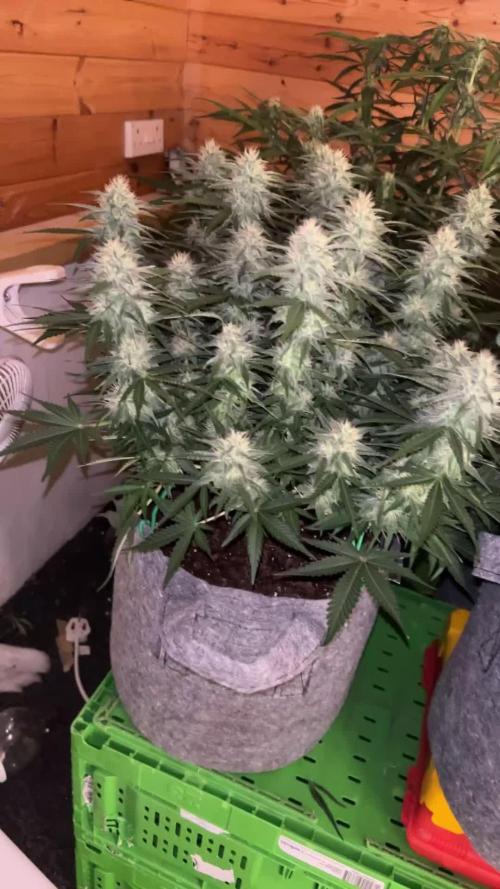
In crisis control now there doing there thing the west coast had a few calmah issues but seems to of responded well they all smell amazing but the blue dream atm smells like sweet candy blueberry’s with a slight citrus if it tastes as good as it smell I can’t wait
Likes
88
Share


@DogDoctorOfficial
Follow
🌾 Harvest Day — The Grand Finale of the Eternity Grow Cup 🌾
Days 72–73 | Trimmed on May 25 | Posted May 27
What a journey this has been — and what a finish. These five incredible Runtz phenos have now completed their cycle, and today, we celebrate the final stage of their flowering life: the Harvest.
We sent the girls into darkness on Day 70, allowing them a full 48+ hours of rest and reset. The dark period was just a bit longer, truth be told, because time… it flows as it must. This extended dark time helps increase resin production, allowing the trichomes to mature just that final bit more.
On Days 72 and 73, we harvested them with care and reverence.
Each plant was hung upside down, whole, in a perfectly controlled 60% humidity environment for 13 full days. Before hanging, we gently removed only the fan leaves, leaving all trichome-rich sugar leaves in place — a natural armor for the delicate resin glands during drying. Why do we do this? Because those sugar leaves help protect the essential oils and terpenes, preserving potency, flavor, and aroma for the smoothest experience later on.
🌿 The Dry Room & The Trichome Guardians
Throughout the drying, we used a moisture meter to monitor the moisture content in the stems. Once it dropped to around 12–13%, we knew it was time. This tool is a simple but game-changing ally in ensuring a perfect dry — not too fast, not too slow.
We then trimmed everything by hand over a 6.5-hour focused session. Armed with trim bins and good energy, we collected an abundance of glistening trichome heads in the process — a golden bonus from these resin-packed beauties. The leaves themselves told a story: deep purples, near-black shades, autumn fades and metallic tones — just stunning.
Each girl was trimmed in order:
#5 → #4 → #3 → #2 → #1,
revealing dense, chunky buds all the way from top to bottom. Not a single pop-corn bud among them — only rock-solid nugs, heavyweight champions in every sense.
📦 Cure Begins – Grove Bags & Glass Jars
Once trimmed, the buds were tucked carefully into Grove Bags and glass jars, each stabilized at around 61% RH. The Grove Bags handle the microclimate beautifully, keeping humidity between 58–61%, perfect for preserving all that hard-earned quality.
We’re now opening the jars daily, monitoring aroma and feel. This part of the process — the cure — is where the soul of the flower truly comes to life.
☀️ UV, Reds & The Perfect Run
Part of what made this run so special was the precision in light spectrum. 40% whites, full reds, UV and IR, and the girls responded like royalty. The UV pushed trichome development to the max. The deep reds gave us thickness, color, and weight. All of it under ThinkGrow Model Ones powered through the Trolmaster ecosystem — everything syncing in harmony.
This run was stable, lush, expressive — a grower’s dream. To my eyes, this was a perfect run.
⚖️ Final Yield: 1,302 Grams (1.3 kg)
In a 4x4 tent — that’s just 1.2m x 1.2m for metric friends — we pulled in 1,302 grams of flower, not even counting the buds that were taken for filming, photos, or “quality control testing” along the way. 😉
Dense. Loud. Sticky. Resinous.
🌿 The Hidden Half: A Tribute to the Roots
In every grow, there’s a part we don’t always see — a part that lives underground, quietly holding everything together. The roots. And this time, I wanted to honor them too.
When we unpotted the plants after harvest, we were met with massive, dense root systems, completely filling the Autopot trays. These roots were vibrant, white and healthy, looking like noodles in a thick herbal soup — a true sign of vitality. The Autopots system, combined with the Aptus Holland Clean Program and Plagron Green Sensation, made sure they had the perfect environment to expand, absorb, and thrive. The PRO-MIX soil was the perfect foundation — light, fluffy, with excellent aeration. It all worked in harmony.
After unpotting, I carefully washed every root system, removing all soil to prepare them for the next chapter of their story. Now, they’re hanging and drying — and will be left to cure for at least one month, possibly more, in a dry, dark, and well-ventilated space.
But why keep the roots?
Because cannabis roots hold ancient value — both medicinal and ritualistic. Though they don’t contain cannabinoids like THC or CBD, they are rich in alkaloids, triterpenoids, sterols, and other therapeutic compounds that can be anti-inflammatory, analgesic, antifungal, and calming.
Medicinal Benefits of Cannabis Roots:
• Friedelin – known for liver protection and anti-inflammatory effects
• Pentacyclic triterpenoids – believed to support immune and anti-tumor functions
• Alkaloids – some studies suggest pain-relief and muscle-soothing properties
• High levels of fiber and tannins – excellent for digestive and skin applications
🍵 Root Medicine — Ways to Use Dried Roots:
Once fully dried (they should snap like twigs, not bend), they can be gently crushed, powdered, or infused:
🌿 Cannabis Root Tea
Soothing & Detoxifying
• 1 tablespoon of dried, ground roots
• 3 cups of filtered water
• Simmer gently (do not boil) for 20–30 minutes
• Add a bit of ginger or lemon for taste
• Sip warm, especially good for menstrual discomfort, inflammation, and general relaxation
🍲 Healing Root Soup Base
Brothy & Nourishing
• Add a handful of dried roots into a veggie broth or bone broth
• Simmer for 2+ hours
• Strain before serving
• This adds a subtle earthy tone and allows the healing properties to infuse your meal
Topical Root Cream or Balm
Great for sore muscles or irritated skin
• Infuse roots in olive oil or coconut oil (low heat, 2–3 hours)
• Strain and mix with beeswax to form a balm
• Add essential oils like lavender or eucalyptus
• Apply to temples, joints, or sore areas
🛁 Root Soak Bath
Perfect for grounding and full-body relief
• Bundle dried roots in muslin or cheesecloth
• Steep in hot bathwater for 15 minutes before entering
• Let the soak draw out toxins and ease tension
⸻
The roots are more than just the anchor of the plant. They are its memory, its foundation, its quiet miracle. By using them, we honor the entire lifecycle — nothing is wasted, and everything has a purpose.
This part of the process is new for many growers, and I truly encourage anyone reading this to try saving and reusing the roots. Dry them, process them gently, and let them offer you one final gift.
Much love to Aptus Holland, Plagron, Autopots, and PRO-MIX — this wouldn’t have been possible without their harmony working underground while the beauty bloomed above.
🌱 The Gift That Keeps Giving: Reusing the Soil
As we say goodbye to one incredible season, we begin quietly preparing for the next. But not everything gets thrown away. In this garden, nothing is wasted. Just like the roots, the soil gets another life.
After each harvest, I carefully remove the remaining roots and break up the soil. I inspect it, rejuvenate it with compost and beneficial microbes when needed, and most importantly, I repurpose it — giving it a second life in my outdoor veggie garden.
Why do I do it?
Because this soil has already done something extraordinary. It has supported life, held moisture, breathed air, balanced nutrients, and fed plants that became medicine. It’s not just dirt — it’s a living ecosystem. And to throw it away would be to ignore its potential.
In my veggie garden, this recycled soil now nurtures cucumbers, tomatoes, courgettes, and so many other little miracles waiting to unfold. It’s a beautiful way of continuing the cycle, taking all the energy and intention that was once used to grow cannabis and transferring it into growing food. 🌞🍅🥒
🌾 The Benefits of Reusing Soil:
• Sustainability — less waste, less environmental impact
• Cost-effective — no need to constantly buy fresh medium
• Soil memory — rich in organic material, microbial life, and structure
• Nutrient potential — amended soil still holds value for many plants
• A deeper connection — a way to honor the entire cycle of growth
When we reuse our soil, we’re not just being resourceful — we’re believing in tomorrow. We’re trusting that what we’ve built can be rebuilt. That what has been used can become useful again. That from what seems like an ending, something new can always emerge.
And maybe that’s the most powerful message of all in this journey:
Planting is believing in tomorrow. 🌍🌱
Every seed in the ground is a little act of faith.
So as this season comes to a close, the first tomatoes have been planted. The cucumbers are reaching for the sun. The courgettes are settling in. And the same soil that once gave us dense, resinous flowers is now feeding the vegetables that will grace the table.
From harvest to hope — the cycle continues. And it’s beautiful.
🎉 The Final Touches
Fun fact:
• Trimmed on May 25
• Photo shoot on May 26
• This report: May 27
• Dry Bud Exclusive Photo Set: Coming soon
Stay tuned — the next upload will be something special, just in time before the Eternity Grow Cup closes on May 31st.
⸻
💚 Thank You
To Zamnesia — your genetics were nothing short of extraordinary.
To GrowDiaries, for hosting such a powerful space for community.
To everyone following this journey, your support, love, and kind words fuel this project and keep the spirit alive.
Let’s keep pushing boundaries, together.
With roots deep in the earth and eyes on the stars — the next chapter begins soon.
Much Growers love always,
🌱 Dog Doctor Official 🌱
Genetics - Runtz https://www.zamnesia.com/6000-zamnesia-seeds-runtz-feminized.html
Nutrients - Plagron https://plagron.com/en/hobby
- Aptus Holland https://aptus-holland.com/
Controls - Trol Master https://www.trolmaster.eu/
LED - https://www.futureofgrow.com/en
LED - https://www.thinkgrowled.com
Soil - https://www.promixgardening.com/en
Germination - Cannakan https://cannakan.com/?srsltid=AfmBOopXr-inLXajXu3QFgKXCXXos4F1oEvScjMKIB5MR5dk8-GJ-F49
DOGDOCTOR 15% off
Smoking Papers - https://ziggioriginal.com/
Terpene saver - https://grovebags.com/
As always thank you all for stopping by, for the love and for it all , this journey of mine wold just not be the same without you guys, the love and support is very much appreciloved and i fell honored with you all in my life
With true love comes happiness Always believe in your self and always do things expecting nothing and with an open heart , be a giver and the universe will give back to you in ways you could not even imagine so
As always, this is shared for educational purposes, aiming to spread understanding and appreciation for this plant. The journey with nature is one of discovery, creativity, and respect. Let’s celebrate it responsibly and continue to learn and grow together!
Growers Love To you All 💚
#EternityGrowCup #RuntzHunt #GrowersLove #CannabisCommunity #AptusHolland #ProMixSoil #TrolMaster #Zamnesia #Plagron #ZiggiPapers #Grovebags
Likes
126
Share


@nonick123
Follow
Día 54 (10/03) Riego 1,25 Litro H20 + Wholly Base 2,5 ml/l + Solid Green 2 ml/l + Early Flower 1,25 ml/l de Gen1:11
TDS 1033 PPMs - pH 6,51
Día 55 (11/03) Defoliation time!
Con la increíble ayuda de @miyaguiokpolilla, @dogdoctorofficial y @growwithflow420 hice la defoliación recomendada exactamente después de 21 días cambiada a 12/12
Consejos de defoliación
- Elimine menos del 20% de las hojas de abanico y solo las hojas de abanico
- Retirar el tercio inferior de la planta, incluidas las ramitas.
- Retirar las hojas en forma de abanico dirigidas hacia el interior de la planta.
- Retire las hojas de abanico que dan sombra a los futuros cogollos.
Día 56 (12/03) Esperando algo de estrés tras la defoliación... Han crecido 2 centímetros en 24 horas 😍🚀
Día 57 (13/03) Riego 1,25 Litro H20 + Wholly Base 2,5 ml/l + Solid Green 2 ml/l + Early Flower 1,25 ml/l de Gen1:11
TDS 1043 PPMs - pH 7,0
Las plantas muestras una ligera deficiencia de CalMag. Voy a subir el pH a 7.0 en este riego para mejorar la biodisponibilidad
Día 58 (14/03) Siguen con su crecimientos, los cogollos formándose y las hojas de azúcar empezando a llenarse de resina
Parece que la corrección de la deficiencia de CalMag ha sido muy efectiva! No hay más manchas y las plantas no paran!
Día 59 (15/03) Como mañana me voy a Spannabis 😍 voy a adelantar 1 día el riego reduciéndolo a 1 litro
Riego 1 Litro H20 + Wholly Base 2,5 ml/l + Solid Green 2 ml/l + Early Flower 1,25 ml/l de Gen1:11
TDS 1080 PPMs - pH 6,57
Día 60 (16/03) Spannabis time! 🚀
Día 61 (17/03) Spannabis time! 🚀
💦Nutrients by Gen1:11 - www.genoneeleven.com
🌱Substrate PRO-MIX HP BACILLUS + MYCORRHIZAE - www.pthorticulture.com/en/products/pro-mix-hp-biostimulant-plus-mycorrhizae
Likes
5
Share


@GarciasGarden
Follow
Had to go another week in veg but damn these plants look good! Transplanted 2 of the snowcandy late and put them in 5 gallon pots instead of 3 gallon and I’m using dry amendments for these 2. The other 4 will be fed liquid nutes. Switching to 12/12 next week!
