


Likes
Comments
Share


@GYOweed
Follow
This was the fastest photoperiod i had and most fruitiest. Not most frost.


Likes
15
Share


Likes
37
Share


@TheIceCreamParlour
Follow
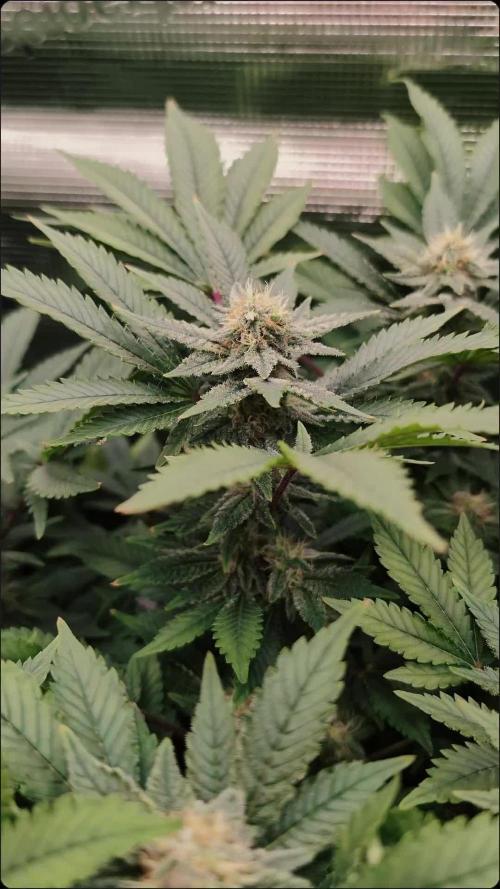
Right then 7 weeks of flower complete. I'll dive right in to the juicy bits as this week has been predominantly about deciding weather to chop or keep one of my girls going. In the end I chose to do both! As the photos and videos show the plant wasn't recovering so I checked the trichomes and it was actually pretty ripe. A few Amber's on the upper buds. Lowers still undeveloped so I decided to take the biggest and leave the smallest for another week or while ever the plant is healthy. I estimate I've taken around 7oz once dry. Depending how they swell up I'm hoping for a further 5oz of solid bag worthy nugs.
Looking nice and frosty, smell is that typical sweet haze with some sour diesel/fruit kick in there. You can see how the photos progress my hands getting covered in resin.
Got to give my other 3 some love as they are getting healthier and fatter. I'm thinking another week on one of them and 2 on the others. I'll more than likely stagger the harvest like tonight if it proves worth while. I will update mid week.
Likes
58
Share

@FatnastyzBudz
Follow
1-10 Day 78 Day 32
- First full dose of Green sensation today
- Per Gallon: 1.5ml Cal Mag, 4ml Green Sensation, 8ml Coco A+B - 714ppm @ 6.0ph
- 2500ml, runoff is 803 @ 6.6ph.
- Still giving an extra liter at midday
1-11 Day 79 Day 33
- Using the same mix I had left over from yesterday, but diluted with plain RO water to bring down all PPMs.
- 589ppm @ 6.2 ph
- 3500ml, runoff is 815@ 6.1ph
- Will start to lower the coco A+B tomorrow
1-12 Day 80 Day 34
- 1.5ml Cal Mag, 4ml Green Sensation, 7ml Coco A+B - 660ppm @ 5.9ph
- 3500ml, runoff is 716 @ 6.0ph
1-13 Day 81 Day 35
- 1.5ml Cal Mag, 4ml Green Sensation, 6ml Coco A+B - 660ppm @ 6.1ph
- 3000ml, runoff is 721 @ 6.1
1-14 Day 82 Day 36
- 1.5ml Cal Mag, 4ml Green Sensation, 5ml Coco A+B - 573ppm @ 6.0
- 3000ml, runoff is 690ppm @ 5.9ph
1-15 Day 83 Day 37
- 1.5ml Cal Mag, 4ml Green Sensation, 4ml Coco A+B - 543ppm @ 6.1 ph
- 3500ml, runoff is 650 @ 6.3
- Turns out that a liter of coco A+B is not enough for 4 plants LOL....so, I'm about out. I'm going to switch up I guess to Advanced Sensi Bloom A+B. So to get ready for this, me and chatgpt came up with a plan. Tomorrow I will flush out everyone with cal mag water, reset them, and then slowly start to introduce Advanced Nutrients.
1-16 Day 84 Day 38
- Resetting for Advanced Nutrients today!
- Per Gallon: 0.5ml Cal Mag, 2ml SLF - 33ppm @ 6.0ph
- 7000ml, runoff is 378 @ 6.3
- Will start low on the new Advance A+B tomorrow per ChatGPT
Fem 9 smells great, sweet like. Her buds are coming in big. I lover her size and she is perfect for a scrog.
Likes
1
Share


@eLeMeNt3de
Follow
This is it for the Blueberry Auto from i49, I am completely Happy with the turn out, came in a a bit hot at the end but the buds are fine and flushed

Likes
3
Share


@Chanardo
Follow
Hola! Apliqué un poco de LST. Voy a seguir haciéndolo cada dos días como otro cultivador me ha dicho aquí.
La planta se ve muy bien. Está comenzando a largar un poco más de olor, super agradable.
Saludos!

Likes
33
Share


@OrangeSunshine
Follow
Today, May 31, harvest day. Very sticky and heavy purple-green buds.

Likes
4
Share


@Willy_Balls
Follow
Everything going great. Cleaned up some of the bottom leaves. 🍃
Increasing irrigation to 9 events.
Light at max intensity. Almost as high as it goes but they still got room to grow.
18.11
Defoliated the bottoms further and removed weak branches.
They really packed on budsites these few days.


Likes
3
Share


@Earthsower
Follow
She has recovered from the under feeding and sprung back with vigour. The scent on her main stem has returned with lime green foil also the peak of her canopy has split open creating an umbrella shape. Her stem is about 5cm wide and she stands approximately 35cm. She is receiving 500 ml of water each week!

Likes
3
Share


@Tzoptzobe
Follow
It was my first grow
They were 1meter80 tall.
The soil was mixed with othe one from market, because they got to be yellow color,
No Nutrients ,watered always before to take photos.
I always preffer to give them the Sunn they know.
It was a pleasure to care of Them,
The next one hope will be Pandora or Sensi Star.

Likes
9
Share


@Ryno1990
Follow
The strain came out amazing very purple an very dense didn't have a very strong smell but deff a nice one got 3 ounces after all said an done

Likes
152
Share


@BioBuds
Follow
So... welcome back! Last week was rather uneventfull. Just the way I like it. They are all getting more substance though. The middle one is more leafy, the two outer ones are more developed and although the biggest buds are maybe only the size of a lighter. Most buds have filled out with calixes and only little leaves. They are dense and compact.
The smell is getting heavier. When close to the buds it reminds of expensive herbal perfumes like Rabane. I distinctly have a 'hug from your poppa' kind of association with it and memories start flowing....
It is citrussy but in the ethereal way, it is spicy in the 'spicetrader' way, a mixture of ginger, cinnamon, black pepper, with a huge funky basetone. This combined, its as if a master perfumer had composed an exquisite fragrance. The funk of an attick full of weed to serve as the musky base undertones upon which, a layer of earthy spices, upon which a floral and citrussy fresh layer. It is bloody amazing and I wished ya'll were with me to smell it and taste it when the time has come. I want to exersize patience but my god this smells better than any weed I recently acquired and we have some excellent dispensaries here.
So I've started giving them up to 4 ltrs ( a gallon) of water each, every two days or so. They seem to need it, no drooping but also bonedry earth till deep in the pot. SInce two days ago with less feed and today only the Biobizz Topmax and PH correction.
Although not really convinced of flushing, Im trying it to see if I get a more pure taste and experience.
So trichomewise I find it hard to see, my magnifier is not strong enough to see the individual trichomes. I do see area's on leafedges etc that seem more amber, trichomes look milky from this distance but have get a better magnifier to get better view. On the images I see that there are many clear ones and not many ambers so we have some weeks to go which is correct according to Advanced Seeds, this Gelato #33 Fast has to flower 45 to 55 days, We are on day 39...
The plant itself seems utterly healthy. Some white points and very little heatstress from checking absolute minimum for these lights. You don't know until you find out. For anyone else looking for reviews on Rubol V3 100 watt QB's in a three in a row setup, with 10 cm spacing between each board, the minimal distance is 28 cm or one foot, when flowering, gradually lowering to this point btw. These lights are excellent, good value for money and with the two years of waranty a good investment. Also great service from Justin at www.rubol.nl. They are helpfull, considerate and very knowledgable.
So far so good, the grand finale is coming in just one or two weeks and I want to thank you for taking time and read all this, everybody who had advice and answered my growquestions, wish you were here for the harvestparty and may your harvest be bountifull!! See you next week!!

Likes
7
Share


@Geili_Seili_fireinfireout
Follow
Tag 26 in flow
Bin bis jetzt echt stark begeistert von den ladys.
Suuuper robust und vital.😋👌
Diese sauberen stecklinge gibts wie immer hier bei ROOTS-FARMS. Getestet und von tumi für sauber befunden🌱

Likes
23
Share


@MadeInGermany
Follow
Hey everyone 😃.
This week is still going perfectly 😃👍.
The trichomes have been checked (70% milky, 20% amber and 10% clear) so there is still some time until harvest :-).
Let's start the week:
Flowering day 56
Today the plant was checked for health.
Flowering day 57
Today it was poured with 1.2 l, only with Clean Fruits so that you can use up your remaining nutrients 👍.
Flowering day 58
The humidifier was refilled and the tent cleaned.
Flowering day 59
Today was only controlled.
Flowering day 60
The humidifier was refilled and the tent cleaned.
Flowering day 61
Today was poured with 1 liter, and the trichomes checked, of course the tent was also cleaned.
Flowering day 62
Today was cleaned, the plant cobtrolized for trichomes, mold and health.
everything looks great 👍.
And fresh osmosis water was filled in tanks for next week.
The way the trichomes look like, is harvested in about 10-14 days 👌👍.
Until the next update, I wish you all the best, stay healthy 🙏🏻 and let it grow 🍀👍
You can buy this Strain at
https://thecaliconnection.com/seeds/girls-scout-cookies-34.html
You can buy the fertilizer at
https://www.greenbuzzliquids.com/
Type:
Girls Scout Cookies
☝️🏼
Genetics:
GSC Tint Mint
👍
Vega lamp:
2 x Todogrow Led
Quantum Board 100 W
💡
Bloom Lamp :
2 x Todogrow Led
Cxb 3590 COB 3500 K 205W
💡💡☝️🏼
Soil :
Canna Coco Professional +
☝️🏼
Fertilizer:
Green Buzz Liquids :
Organic Grow Liquid
Organic Bloom Liquid
Organic more PK
More Roots
Fast Buds
Humic Acid Plus
Growzyme Big Fruits
Clean Fruits
Cal / Mag
Organic Ph - Pulver
☝️🏼🌱
Water:
Osmosis water mixed with normal water (24 hours stale that the chlorine evaporates) to 0.2 - 0.4 EC. Add Cal / Mag 2 ml per l water every 2 waterings . Ph with Organic Ph - Pulver to 5.8 .

Likes
19
Share


@eldruida_lamota
Follow
Bueno, empezamos por el final familia.
Gorilla girl, me parece una cepa BRU-TAL , ya partiendo de esa base, mi error, creo que e cometido , es poner estos ejemplares en macetas de 5L, que tonto... mínimo recomendado 7L y a ser posible 11L
Otro error fue no dejarlas una semana más. pero, escasez. (intentaremos curarla un par de semanas).
Cepa con flores muy compactas, hay bastante separación entre nudos pero compensa las flores de verdad.
Sabor muy dulzón a mi me recuerda a melón , es un pepino recomendado para amantes de la hierba que llevan tiempo en esto, un colocón muy fuerte, ahora mismo estoy bajo los efectos de esta vaina, aseguro que con cada frase, leo varias veces y detenidamente por que válgame.

Likes
209
Share

@BioBuds
Follow
The Orange Hill Special is finishing! She has compact and dense buds that have grown in. The waiting is on the amber trichomes now, which I'm giving her time for!
There are some more faded leaves and she is clearly rounding it up. The smells in the room (and the house are getting very pungent and were happy we don't have many visitors in the coming days! We are beyond camouflage.
She has some more space as I've taken out the Gorrila for darkness. That one was way more done, but this one needs one more week, I gather.
Take care and thank you for following again!!
Likes
31
Share


@Chubbs
Follow
SuperSativaSeedClub
PurplePunchOG Auto
Week7
What up everyone. Weekly update on these three ladies. Today they're a little upset with me as we had a power outage during the lights off cycle that turned the heater off bringing the Temps down to 45'f. But no worries by the time I checked over all the plants on the tent they where perking back up. They've transitioned into flower great and by the looks of it gone into overdrive on flower site production as pistols are everywhere. All in all Happy Growing

Likes
35
Share


@bmvape
Follow
This grow had ups and downs and I really learned a lot, thanks to everyone who shared their wisdom! Considering how very little I fed the plant, I'm surprised she even made it to harvest. The majority of her bud was mainly in the one man cola that made up 95% of plant. I didn't have much trimming to do at all. The buds are more airy than I would like, but probably my fault. She dried in 4 days and have been curing for 9 days.
I took a small sample off of the main bud to get an early taste so I could complete the diary. The smell has a spicy, berry, and pine aroma. There is an earthy smell to it that is fading during the cure. I think they dried a little fast as the humidity has been very low.
The first hit (vaporizer) had a piney taste and was a little heavy. I think it's just still to moist on the inside and hope it thins out over time. The flavor turned to the burnt popcorn taste rather quickly, but there was still some green in the chamber, so assume more curing will help.
Overall, I am happy with my first grow. I was able to yield enough to last me to next harvest!
