




Likes
45
Share


@SherbGrows
Follow
Update time. (1 day early)
During week 8
Watered once with compost tea (Worm castings and unsulfured molasses)
Light defoliation every few days on bottom leaves/popcorn buds
Noticed some of the girls fan leaves are darker than others. These autos are very sensitive to nutes/light/watering.
**Promoted to Apprentice Grower. Thanks!! :D
Plan for week 9
Planning on adding phosphate/potassium with dry amendments one more time during this week. Nitrogen seems to be showing a bit high in a few of the girls and not in the others. Not sure if its early N toxicity or just the genes of the plants. Feeding each one the same.
Watering with regular PH water 6.6-6.8 (checking run off)
More minor defoliation as I see fit.
Overall really happy still with this grow! I am definitely a "Newbie" when it comes to growing Autos so this is a great learning experience. I have noticed these girls really don't need too heavy of nutrients and are very sensitive plants. Thanks for checking in!

Likes
4
Share


@UnUlver
Follow
Растениям от IZI осталось дней 7. Анубису дней 10-14, CloudWalker'у от двух недель, максимум 3, фенотип сативный + поздний зацвет (почти на неделю позже)
Как тут внести новые удобрения? Добавить его в базу.
Хоп-хей спамеры, кто зарабатывает хуй знает сколько в час?
Общий вид не возможен - сломалась камера, только макро.


Likes
60
Share


@SooSan
Follow
12/12 + 144 jours
Vu qu’il y a 16 plantes mais que sur growdiaries on ne peut mettre que 8 variétés j'ai divisé en 2 diaries pour le bas de la tente
1️⃣
🏠 90x60x90
☀️ FC-E 4800 => puissance a 60%
🍁
Black Bomb / Philosopher Seed
Amnesia Lemon / PEV Seeds
Amnesia Lemon /PEV Seeds 35g
Blueberry / PEV Seeds = 17g
Blueberry / 00 Seeds = 17g
Wappa / Paradise Seed = 11g
Dark Phoenix / Green House Seed
Quick Sherbet / Exotic Seeds = 14,5
Mango Cream / Exotic Seeds 19,5g
Banana Frosting / Sensi Seed = 11g
Hindu Kush / Sensi Seed 10,5g
Mix 1 / Sweet Seed = 26,5g
Mix 2 / Sweet Seed = 15g
Mix 3 / Sweet Seed = 22,5g
Mix 4 / Sweet Seed = 14,5g
📎 https://growdiaries.com/diaries/122084-grow-journal-by-soosan
📎https://growdiaries.com/diaries/124052-grow-journal-by-soosan
2️⃣
🏠 30x60x50
☀️TS1000 => 100w = 54g
🍁
Quick Sherbet - Exotic Seed = 12g
Quick Sherbet - Exotic Seed = 12g
Quick Sherbet - Exotic Seed = 17,5g
Quick Sherbet - Exotic Seed = 12,5g
📎 https://growdiaries.com/diaries/122080-grow-journal-by-soosan


Likes
2
Share


@cozzalenco51
Follow
At this point she was drinking more then 4L a day and due to the root mass that was about all i could fit in the res at the time so I had to mock up a external res and convert the system to RDWC
K.I.S.S.


Likes
152
Share


@EBxAH
Follow
Went camping so I couldn't start the week right away. June 16th was the start of week 3...going GREAT so far. I'm definitely leaning towards topping and mainline for these ladies!
EDIT: I goofed up, lol. They were born on June 6th. So yesterday, June 20th was the start of week 3.
EDIT: the ladies went in their final pot today, june 22nd to a 6.25 gallon pot. They look dinky now, lol. That'll change pretty quick 😎
Likes
33
Share


@BudXs
Follow
Ok, so photos are finally in flower, autos will have to do with 12/12 till finish. A batch of 15 more photos is brewing outside the main door, all primo. Plan is to veg em out there for 4 weeks and then in the flower room. Will fill in missing spots with more autos and then a late auto run as batch 2 of photos finishes. Will get my 7 lbs or so
@peakyplanters - slide in my dms
Likes
8
Share

@Growverse420
Follow
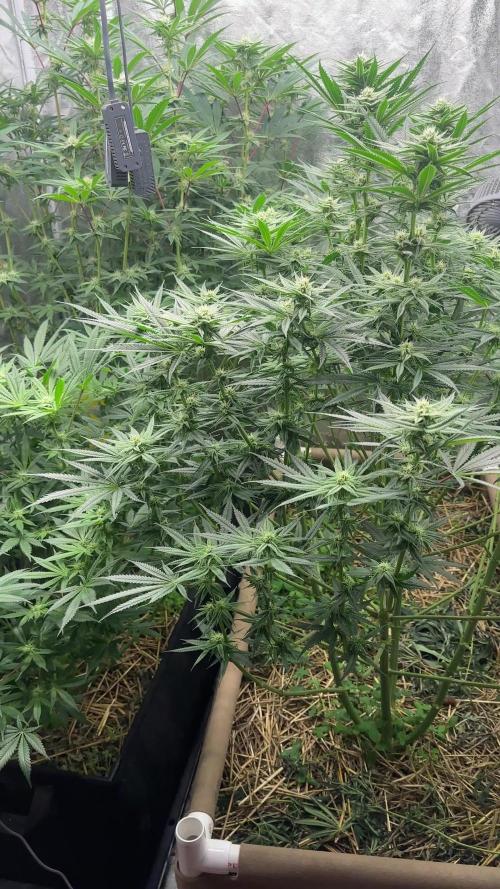
The stretch is starting to slow down (thank goodness because the Vanilla Frosting is about ready to grow through the light lol she STRETCHED). Overall I am very happy with how each is developing. The front right Hella Jelly is starting to give off a great candy nose. I’ve been defoliating like a madman to keep airflow high. This week brought a lot of rain and high humidity to my area. I have a new dehumidifier coming for my lung room, which should be getting here Tuesday. It should be strong enough to keep the humidity low enough to finish flower strong and avoid any bud rot or powdery mildew…Until then, the inline fans are cranked, the wind is blowing and I’m plucking leaves like crazy 🤪 Happy Growing!

Likes
3
Share


@BruWeed
Follow
Se secó bastante rápido. En 5 dias. Y metí todo en un frasco grande para que empiecen a curarse. Todo perfecto.




Likes
38
Share


@MadeInGermany
Follow
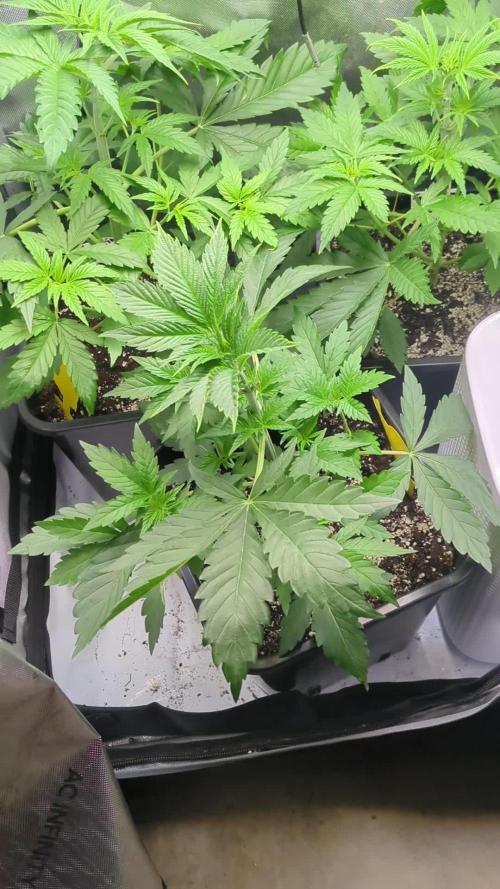
Flowering day 30
since time change
to 12 / 12 h
Hey guys :-)
Every day when I look into the tent, the sight and the smell are a dream 💚.
They are all developing very well.
There is no tip of the leaf that looks funny at the bottom or at the top 😃.
They were watered every 2 days with 1.3 l each (nutrients see table above).
They were all checked and checked for their health.
Stay healthy 💚🙏🏻
👇🏼👇🏼👇🏼👇🏼👇🏼👇🏼👇🏼👇🏼👇🏼👇🏼👇🏼👇🏼
You can buy this Nutrients at :
https://greenbuzzliquids.com/en/shop/
With the discount code: Made_in_Germany you get a discount of 15% on all products from an order value of 100 euros.
👇🏼👇🏼👇🏼👇🏼👇🏼👇🏼👇🏼👇🏼👇🏼👇🏼👇🏼👇🏼
You can buy this strain at :
https://www.exoticseed.eu/de/hanfsamen/hippie-therapy-cbd
Water 💧 💧💧
Osmosis water mixed with normal water (24 hours stale that the chlorine evaporates) to 0.2 EC. Add Cal / Mag to 0.4 Ec Ph with Organic Ph - to 5.8 - 6.5
MadeInGermany
Likes
16
Share


@Mrg7667
Follow
Another eventful week! Transplanted into 5 gallong pots. Its interesting to see that there hasnt been much vertical growth but allot of branchung out compared to how it was with the other lights

Likes
14
Share


@Bread_n_Buds
Follow
Going into flowering is always a special moment and we prepare to do it at our best to make the plant understand that it is time to become a woman and speed up the start of the formation of buds.
We start with 24 hours of darkness this to give a strong break and sign of change to the plant that understands the change of time and prepares to go into flowering.
Our Black Runtz was worked with a topping x16 buds but unfortunately I got stupid one day and after having vaporized something strong while doing a defoliation, I also cut a branch, our x16 buds became like this x14, story of a bullshit done. I hate doing bullshit and I expose them to public shame to remind myself not to do it again any normal human being would have hidden the fact. But we are not here to comb the dolls so we always tell the truth. It happens and the plant will be super beautiful anyway.
Another thing that gives the plant the signal to start flowering are flowering stimulators, we friends at Plagron use Power Buds.
The start of the flowering program includes the same additives as the vegetative phase Power Roots, Sugar Royal, Pure Zym and adds the flowering stimulant Power Buds. Now the basic fertilizer is Alga Bloom specific for flowering.
Green Sensation will arrive as the hero of the end of flowering and at the same time it will be time to remove Power Roots and a week later the Pure Zym enzymes. It is recommended from the 4th week, if the plants flower quickly I start at the 3rd, it depends on the size of the bud.
---- Decide on the right soil and calculate your fertilizer card based on the soil on the official website. -- www.plagron.com
Try a seed of this strain that drives us crazy..
-------- https://www.zamnesia.io/en/11159-zamnesia-seeds-black-runtz.html
Zamnesia Description // Black Runtz comes from a truly legendary gene pool. Our breeders used three modern classics from the US to create this strain: Zkittlez, Gelato, and Runtz. With 20% THC and flavors of grapes and berries, Zkittlez brought her delicious flavors and relaxing effects. Gelato contributed to Black Runtz's immense flavor profile by bringing high concentrations of the terpenes limonene and humulene. Finally, Black Runtz inherited the high potency of the original Runtz, a strain with a respectable 21% THC. The end result of this 3-way cross is a strain with 55% indica genetics and 45% sativa. Black Runtz boasts fast flowering times, high potency, and contrasting yet balanced terpenes that support her delicious flavor profile.
All the best that mother nature has to offer is at ---- www.zamnesia.com

Likes
2
Share


@Munchiesfrommars
Follow
I DIDNT EXPECT THIS WILL GROW SO FAST
AMAZING OPORTUNITY
ERROR UPLOADS PHOTOS
ALL THE TIME
PLEASE
HELP
8 DAYS ALREADY ERROR PHOTOS
Likes
3
Share


@123Grow
Follow
This is for the RQS autumn cup.
I also use SST’s: Corn and Lentils
LABS ( lactic acid bacteria serum)
Looks like I have 137 days to harvest these 4. So that means 2 full months of veg and 65 day of flower.
Happy growing to everyone

Likes
51
Share


@Chumpkilla
Follow
1/21/24 - Day 76 - Everything is looking good still. Today is water change day! This time i was out at the box during the change. Everything went well. I did install a new temperature sensor to replace the old one. Also I installed a new C, and PH- bottle.
1/23/24 - Day 78 - I noticed the buds are starting to fatten up. They kind of grow in little nodules sticking out from the main bud site. Its really cool to see. I added some pictures up top! Ill update on some more pictures in the next couple of days.
1/25/24 - Day 80 - The buds are getting fatter and the smell is getting super pungent. Everything is going as planned. I need to start scoping it to check for color. We are still a long ways from starting the flush but it time to start looking!
Likes
2
Share


@Hannax
Follow
Last week of flo >> harvest the 29th october
This strain is highly resistant of mistakes.