Likes
Comments
Share
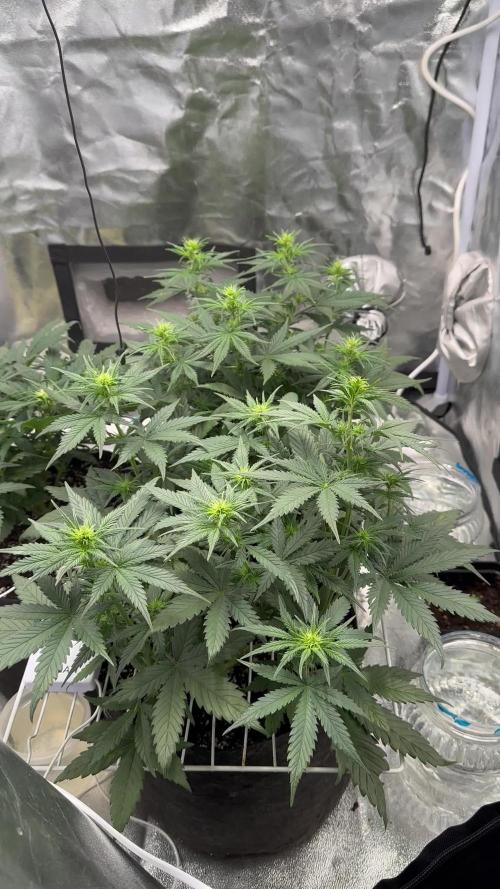
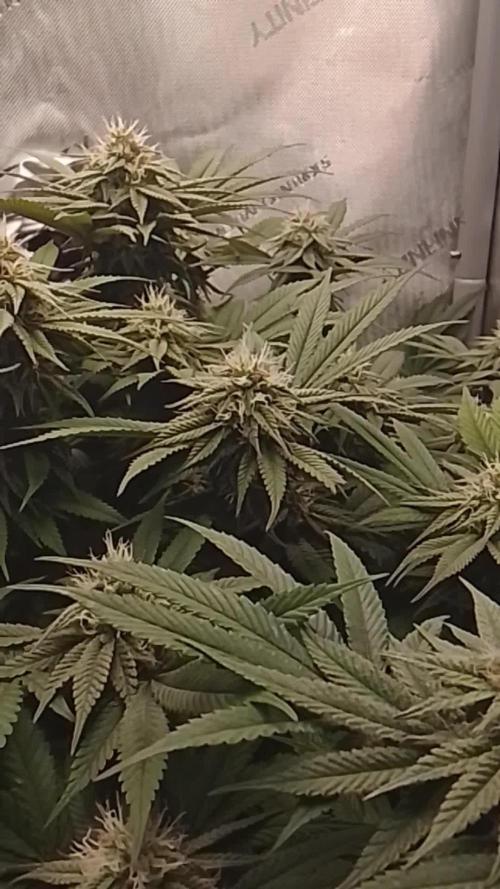
01-10-2021: Put the ladies on 12/12 scheme 2 days ago. Growing really fast now and the difference between the TSL compared against the SP3000 is starting to show. TSL Much better spread, canopy more even. SP3000, plants right below them very big, plants on the last row significant smaller. 03-10-2021: Just doing great, nothing special to say about it now 05-10-2021: Nothing special to say about it. Just growing great. Should mention I turned on my CO2 controller at 900PPM and raised the EC to 1.5 for next week. 06-10-2021: Had to bind a lot below the net. Growing extremely fast right now. I think the VPD of 1.7 is just great for the ladies. Last day of first week 12/12 today
Likes
13
Share
@Rob691
Follow
D-29 : I made a mistake. I think the second top I did today was too soon. Only 4 days after the first one. What is done, is done. Now, let see what happend but, I'll wait more for the last top. I think I'll wait untill the new mains have at least 3 new real nodes. On top of that, 2/4 of the plants have brocken branches because of too tough HST. D-30 : Every thing is ok except that the new mains are really really really small.... It should be better in a couple of days. D-33 : The one that have been broken during topping, still alive and looks pretty good, but she grow slower than the others. And more, the branch that have broken grows slower than the other one. That means that she's not symetrical anymore, and then, it's not good for the main-lining... I let her grow anyway. We'll decide later what we'll do with her. The others are getting back to a normal pace.
Likes
11
Share
Week 2 Flower 09/04 Bllimburn Apple Fritter - Seedsman Critical +2.0 39 - 40inches - Increased Raw NPK feed ( Phosphorus - Potassium ) 2 teaspoons per gallon on each with Cal Mag, Flower Fuel and Floranova Bloom. Flowering processing accordingly. *End of week update 09/09* Both Apple Fritter and Critical are flowering accordingly. 3-4 Inch height increase Budsites looking healthy - No signs of deficiencies from nute feeds Main Colas were aggressively LST's to avoid light burn.
Likes
29
Share
@Hasard
Follow
Starting week 6 Tent is being slowly full A little bit too hot for the next days as the weather outside will climb to 36-38°C, I thnk I will bring them some CO2. I will check with the growshop. Any idea is welcome. The stretch is really impressive, 1 of them get 20cm in 7 days Waiting for the buds 😁 Day 39 I have now added CO2 with an organic boost, it is linked it to the fan. Should be a little bit better with that temperature
Likes
15
Share
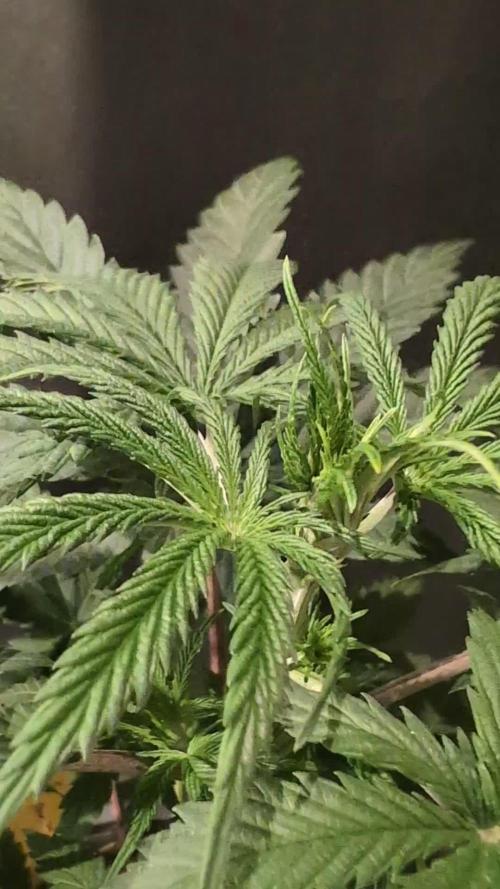
Veg Week 4. Excellent week. 6th node appears. Looked at the leaves, and my guess, we are good to top. Topped plant on the 16th. As of 5 days later, the plant appears to have recovered and has started growing nicely again. We should be completing the 2nd topping within 10 days at most if I am correct.
Likes
17
Share
@Neo86
Follow
Quick little video tour today. I'll sort a proper detailed update a little later this evening ☺️ 🌱✌️😉🤘🌱 Front row, left to right: Phantom OG, Wedding Cake Auto, G13 x Blueberry Headband. Back row, left to right: Glookies, Ayahuasca Purple, Peyote Cookies. The only girls receiving the Force nutrient are the Glookies and the Wedding Cake Auto but from now on, I'll only be feeding them plain water to cleanse them as much as possible before harvest. The rest of them still have a couple more weeks of feed before changing anything else 😎
Likes
81
Share
@m0use
Follow
SPONSORED DIARY===SPONSORED DIARY===SPONSORED DIARY This is my diary entry into the Dynomyco Show Us What You Got Contest! #DynomycoShowUsWhatYouGot! @DynomycoShowUsWhatYouGot! Big Shoutout to @Dynomyco for picking me in their contest. Happy to be involved and as a user of Dynomyco I am curious to see this side by side with my own eyes. I will be honest I am a little skeptical it will show any major differences. but we will see what happens. Some disclaimers, I am still using LABS serum I made as well as MIIM Miicrobial Mass. These are also beneficial to the root mass however they are bacteria based and not fungal or mycorrhizae like Dynomyco. https://growdiaries.com/giveaways/DYNOMYCO_Show_Us_What_You_Got I was going to use my own clones I made from the g13 labs grows I just finished but released I had used a Dynomyco in the medium when I was rooting them for a extra strong start. So to fix this little error I went out and purchased two Cherry Pie clones from a local grey market dispensary. I joked Dynomyco will cover the cost and yet to hear back from them lol. I have inoculated one clones rootball and the transplant medium with Dynomyco, the other clone and its medium got no Dynomyco. The Dynomyco Clone is on the left in photos, it's also the only pot with a mini glass thermometer. I did this exact thing in my Dr Seeds Granddaddy Purple Diary vs 60day wonder. I don't expect it to count as an entry but more of a 2nd side by side on two different strains. GDP vs 60DW. Hopefully I will get some stickers in my package and can label the pots as such. I used my own personal stash of Dynomyco as I have not been shipped the contest materials yet but the clones where good to go an I wanted to get this beast on the way. The plants will be grown outdoors and transplanted at min 2 times max 3 times. Nursery pot to 1Gal, "this weekly entry" 1Gal to 2Gal, "3-4 weeks away" and finally 2Gal to 3Gal maybe. "6-8 weeks away" This week 1 entry is the first transplant from nursery pot to 1Gal, I have sheltered them inside for the first few days as we got heavy rainfalls and I did not what that to be to much of a shock for them, they are in my Spider Farmer tent under 24/0 lighting with the SF1000 @60%, they should be good to make their way outside tomorrow if the weathers good. I have noticed I have a lot of outside light interference on my balcony with all the safety lights in the surrounding areas buildings. I am going to try and LST these plants to keep them low and below my balconies wall to avoid excess light pollution. about 3 feet high.
Likes
13
Share
Que pasa familia, vamos con la cosecha de estas Tropicanna Poison F1 de Sweetseeds. Esta variedad me resultó bastante sencilla de cultivar, y si no la maltratas crece sana a mi parecer, la flor se ve increíble, tiene una cantidad de resina considerable y unos tonos rojos muy peculiares, se ven muy apetecibles. El olor que desprende es muy peculiar es muy dulce con toques terrosos, a mi parecer, no pinta nada mal, las flores están prietas. También os comento que la variedad es muy fácil de cultivar y no da mayores problemas, el ciclo no es largo, cuiden con la altura ya que se desmadran un poco. IMPORTANTE destacar: En las fotos comprobaréis que ya no hay botes de cristal con sobres de bóveda, ahora hay Grovebags. Que son una especie de sobres o bolsas que retienen el peso, previene la aparición de moho y mantiene intacto el terpeno, para que el curado sea más óptimo. Hasta aquí todo, Buenos humos 💨💨💨
Likes
17
Share
Vamos familia actualizamos la cosecha de las Purple OG KUSH de Dutchfem . La verdad que el secado muy bien 7 días en Malla y a los botes, 40% humedad y 24 grados es la temperatura ambiental que han tenido en el secado. Por lo demás de miedo os la recomiendo. Gracias a DutchFem, Agrobeta y Mars hydro , sin ellos este proyecto no sería igual 🙏. Agrobeta: https://www.agrobeta.com/agrobetatiendaonline/36-abonos-canamo Mars hydro: Code discount: EL420 https://www.mars-hydro.com/ Buenos humos.
Likes
23
Share
(Update: 4/20/19) Please stand by while they dry. (Update Everything is going great though! The smell is very strong now; no more cut grass smell. From looking at all three today, I believe that some of the smaller branches will be done drying and ready for trimming and weighing in a day or two. I have one guess for dry weight of Big Lemon, any other guesses?? Remember, the picture of Big Lemon hang drying looks like its two plants, but its all Big Lemon; I had to cut it off to be able to hang it. The amputated branch left of the main plant is bigger than my other two plants alone! (Update 5/2/19) Woah...Okay. So after drying the whole for about nine days, and trimming for four days, Big Lemon's dry weight SO FAR is about 430ish grams of super dense and sticky nugs. Its amazing that I got more big bud than I got popcorn nugs from such a big plant. I have one more 1/2 gal Mason Jar of untrimmed tops to finish, then I'll post pics or a vid of the weigh up and glamour shots etc.. Oh, almost forgot, Little Lemon produced about 40 grams of very nice bud. This surpassed expectations because, although it was planted on the same day as Big Lemon, it was the runt of the bunch because it got pushed out of the main tent that had all the lights and Co2 environment and everything. It spent much of late veg under a very weak light. I remember how limp it was when I gambled on it and chose to switch her over to 12/12. But it was totally worth it in the end! Alight back to work for me. Check back later today for pics, vids! (Final Update: 5219 @11:09pm PT) Its done. Its finally done! I had to trim both plants with my own two hands! So Exhausting, yet so rewarding. So above are several videos of the weighing. Grand total for Big Lemon is 14oz of prime top shelf nugs, and about 3oz of nice popcorn/LARF (they are separated as shown above in a video. Forgive me for not throwing it all together to weigh it, I spent a long, long, very long time trimming and sorting and canning the buds according to their respective grade/quality. I may add one more update to show their respective weights. Oh and little lemon produced about an 1 1/2 oz of prime nuggets and quite a bit of popcorn/LARF, which I haven't gotten around to weighing yet. So, Grand Grand total of Both Lemon OG Candy (amazing job with this beast of a strain, Philosopher seeds) is about 18.5oz, or 1lb 2.5oz for two plants; 15.6oz of which is entirely made up of top-shelf buds 😎 Damn I love SoCal, I didnt even need to run carbon filters because no one be trippin about a lil stink weed. Thanks to those for following this grow! Tell me what yall think! Cant wait to see some comments from all you growers out there. (Update: smoke review after a week or two of cure) This Lemon OG Candy had an extended veg period, about 4 months maybe a little longer, and I harvested her on day 56 of flower (recommended harvest 60-70 days) because of the size/distance to light and her root-bound problems. The results so far, a very uplifting and stimulating quality.
Processing
Likes
8
Share
@sweetkaya
Follow
Day 45 - Found the GC's main branch broken this morning. My error was tying it down too much. Never had plants so big so I'm still learning the best way to LST them in order to fit them in my closet. Takin the broke with philosophy: I never topped a plant, so I'm curious to see how she will develop from now and how much she will yield. Keep growing and learning every day 🙏🏼💪🏼🌱 Day 48 - Ladies are stretching much more every day, going to be two big girls 😋😋😋
Likes
2
Share
Likes
55
Share
2nd net is up. Early bud formations are promising. holding up to the extremes pretty well, some leaves taking minor damage, but overall, she is holding up, gave her 1 night at 50F see how she would react, stressful. Not advised as it messes with her metabolism, but I want to see if it triggers any anthocyanin response. Love to see her purp up but no signs yet. Remember, For every molecule of glucose produced during photosynthesis, a plant needs to split six molecules of water. This process provides the hydrogen needed for synthesizing glucose and other organic compounds, while oxygen is released as a byproduct. Homework. If Rubisco activity is impaired and it cannot properly function or regenerate its substrate, the plant's leaves are likely to turn a pale green or lime green, a condition known as chlorosis. Essentially, Rubisco activity is highly regulated and susceptible to various environmental and metabolic factors that can cause it to become inhibited, leading to an apparent failure in RuBP regeneration due to a lack of consumption. Rubisco regeneration is intrinsically linked to nitrogen supply because Rubisco is a major sink for nitrogen in plants, typically accounting for 15% to over 25% of total leaf nitrogen. The regeneration phase itself consumes nitrogen through the synthesis of the Rubisco enzyme and associated proteins (like Rubisco activase), and overall nitrogen status heavily influences the efficiency of RuBP regeneration. RuBisCO is a very large enzyme that constitutes a significant proportion (up to 50%) of leaf soluble protein and requires large investments in nitrogen. Insufficient nitrogen supply limits the plant's ability to produce adequate amounts of RuBisCO, thereby limiting the overall capacity for photosynthesis and carbon fixation. Maintaining the optimal, slightly alkaline pH is crucial for the proper function and regeneration of Rubisco. Deviations in either direction (too high or too low) disrupt the enzyme's structure, activation state, and interaction with its substrates, leading to decreased activity and impaired RuBP regeneration. (Lime/yellowing) Structural Component: Nitrogen is an essential building block for all proteins, and the sheer abundance of the Rubisco protein makes it the single largest storage of nitrogen in the leaf. Synthesis and Activity: Adequate nitrogen supply is crucial for the synthesis and maintenance of sufficient Rubisco enzyme and Rubisco activase (Rca), the regulatory protein responsible for maintaining Rubisco's active state. Nitrogen deficiency leads to a decrease in the content and activity of both Rubisco and Rca, which in turn limits the maximum carboxylation rate, Vmax, and the rate of RuBP regeneration Jmax, thus reducing overall photosynthetic capacity. Nitrogen Storage and Remobilization: Rubisco can act as a temporary nitrogen storage protein, which is degraded to remobilize nitrogen to other growing parts of the plant, especially under conditions of nitrogen deficiency or senescence. Nitrogen Use Efficiency (NUE): The allocation of nitrogen to Rubisco is a key determinant of a plant's photosynthetic nitrogen use efficiency (PNUE). In high-nitrogen conditions, plants may accumulate a surplus of Rubisco, which may not be fully activated, leading to a lower PNUE. Optimizing the amount and activity of Rubisco relative to nitrogen availability is a target for improving crop NUE. Photorespiration and Nitrogen Metabolism: Nitrogen metabolism is also linked to the photorespiration pathway (which competes with carboxylation at the Rubisco active site), particularly in the reassimilation of ammonia released during the process. To increase RuBisCO regeneration, which refers to the process of forming the CO2 acceptor molecule Ribulose-1,5-bisphosphate (RuBP) during photosynthesis, the primary methods involve optimizing the levels and activity of Rubisco activase (Rca) and enhancing the performance of other Calvin-Benson-Bassham (CBB) cycle enzymes. Biochemical and Environmental Approaches: Optimize Rubisco Activase (Rca) activity: Rca is a crucial chaperone protein that removes inhibitory sugar phosphates, such as CA1P (2-carboxy-D-arabinitol 1-phosphate), from the Rubisco active site, thus maintaining its catalytic competence. •Ensure optimal light conditions: Rca is light-activated via the chloroplast's redox status. Adequate light intensity ensures Rca can effectively maintain Rubisco in its active, carbamylated state. •Maintain optimal temperature: Rca is highly temperature-sensitive and can become unstable at moderately high temperatures (e.g., above 35°C/95F° in many C3 plants), which decreases its ability to activate Rubisco. Maintaining temperatures within the optimal range for a specific plant species is important. •Optimize Mg2+ concentration: Mg2+ is a key cofactor for both Rubisco carbamylation and Rca activity. In the light, Mg2+ concentration in the chloroplast stroma increases, promoting activation. •Manage ATP/ADP ratio: Rca activity depends on ATP hydrolysis and is inhibited by ADP. Conditions that maintain a high ATP/ADP ratio in the chloroplast stroma favor Rca activity. Enhance Calvin-Benson-Bassham (CBB) cycle enzyme activity: The overall rate of RuBP regeneration can be limited by other enzymes in the cycle. •Increase SBPase activity: Sedoheptulose-1,7-bisphosphatase (SBPase) is a key regulatory enzyme in the regeneration pathway, and increasing its activity can enhance RuBP regeneration and overall photosynthesis. •Optimize other enzymes: Overexpression of other CBB cycle enzymes such as fructose-1,6-bisphosphate aldolase (FBA) and triose phosphate isomerase (TPI) can also help to balance the metabolic flux and improve RuBP regeneration capacity. Magnesium ions, Mg2+, are specifically required for Rubisco activation because the cation plays a critical structural and chemical role in forming the active site: A specific lysine residue in the active site must be carbamylated by a CO2 molecule to activate the enzyme. The resulting negatively charged carbamyl group then facilitates the binding of the positively charged Mg2+ion. While other divalent metal ions like Mn2+ can bind to Rubisco, they alter the enzyme's substrate specificity and lead to dramatically lower activity or a higher rate of the non-productive oxygenation reaction compared to Mg2+, making them biologically unfavorable in the context of efficient carbon fixation. The concentration of Mg2+ in the chloroplast stroma naturally increases in the light due to ion potential balancing during ATP synthesis, providing a physiological mechanism to ensure the enzyme is activated when photosynthesis is possible. At the center of the porphyrin ring, nestled within its nitrogen atoms, is a Magnesium ion (Mg2+). This magnesium ion is crucial for the function of chlorophyll, and without it, the pigment cannot effectively capture and transfer light energy. Mg acts as a cofactor: Mg2+ binds to Rubisco after an activator CO2 molecule, forming a catalytically competent complex (Enzyme-CO2-Mg2+). High light + CO2) increases demand: Under high light (60 DLI is a very high intensity, potentially saturating) and high CO2, the plant's capacity for photosynthesis is high, and thus the demand for activated Rubisco and the necessary Mg2+ cofactor increases. Mg deficiency becomes limiting: If Mg2+ is deficient under these conditions, the higher levels of Rubisco and Rubisco activase produced cannot be fully activated, leading to lower photosynthetic rates and potential photo-oxidative damage. Optimal range: Studies show that adequate Mg2+ application can enhance Rubisco activation and stabilize net photosynthetic rates under stress conditions, but the required concentration is specific to the experimental setup. Monitoring is key: The most effective approach in a controlled environment is to monitor the plant's physiological responses e.g., leaf Mg2+ concentration, photosynthetic rate, Rubisco activation state, and adjust the nutrient solution/fertilizer to maintain adequate levels, rather than supplementing a fixed "extra" amount. In practice, this means ensuring that Mg2+ is not a limiting factor in the plant's standard nutrient solution when pushing the limits with high light and CO2. Applying Mg2+ through foliar spray is beneficial to Rubisco regeneration, particularly in alleviating the negative effects of magnesium (Mg) deficiency and high-temperature stress (HTS). While Mg can be leached from soil, within the plant it is considered a mobile nutrient, particularly in the phloem. Foliar-applied Mg is quickly absorbed by the leaves and can be translocate to other plant parts, including new growth and sink organs. Foliar application of: NATURES VERY OWN MgSO4 @ 15.0g L-1 in a spray bottle. For those high-intensity workouts when 1 meal a day is just not enough! Foliar sprays are often recommended as a rapid rescue measure for existing deficiencies or as a supplement during critical growth stages, when demand for Mg is high. Application in the early morning or late evening can improve absorption and prevent leaf burn. The plant was getting a little limey yellow in the centre. Shortly thereafter, she was back in business, green mostly regenerated. The starting point [of creativity] is curiosity: pondering why the default exists in the first place. We’re driven to question defaults when we experience vuja de, the opposite of déjà vu. Déjà vu occurs when we encounter something new, but it feels as if we’ve seen it before. Vuja de is the reverse—we face something familiar, but we see it with a fresh perspective that enables us to gain new insights into old problems. Confidence is evidence... nothing more. You are confident because you have driven 10,000 times, you are confident because you have spoken 10,000 times. People think confidence is a feeling, but it's not. If you want more confidence, then you need to create evidence, take more shots, collect more data, build more experiences, take more risks; fail, confidence doesn't come first; it is the reward you get for doing the work. no one else wants to do.
Likes
8
Share
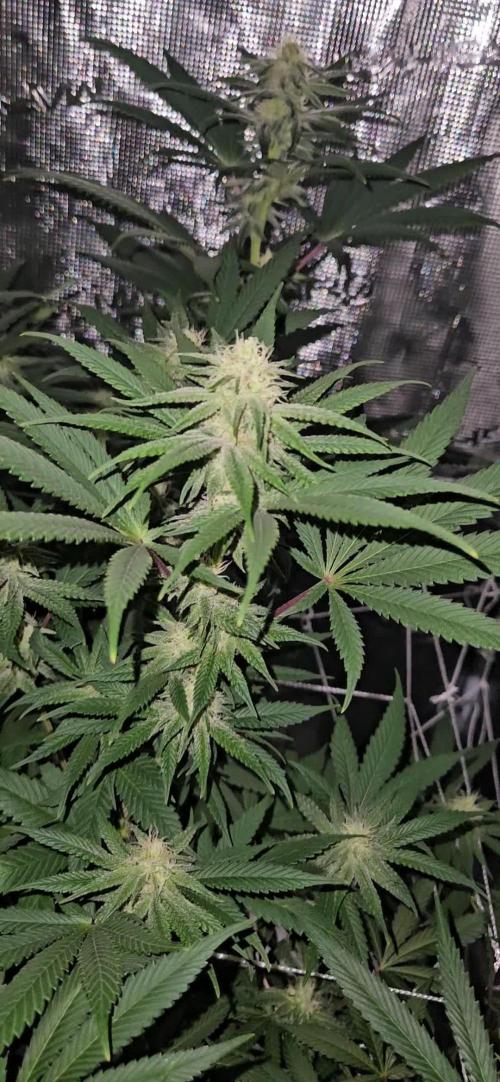
Well this week I’ve tried lollipop on my main plants also removed a lot of fan leaves that we’re stopping air circulation also light reaching down to growing flowers beneath! Introduced canna flores and more cal mag to my feed! Also introduced another led light and turned up ballast light upto 400w keeping temperature at 26 when lights go out also it’s hitting temperatures of 28! When lights are on! Is this is an issue as I’ve removed my humidifiers! As been getting good readings without using a humidifier in a good few weeks now! They seem to be looking good! But still having to do research as would love to create some big colas!!! Second week into flowering now!
Likes
33
Share
@LouShott
Follow
Day 13 - Actual start of the Grow Diary today. Day 14 - She is looking good but developed a weird yellow spot on one new leaf. Gonna keep a close eye on it! Tip - For anyone who is still taking pink/purple pictures, pick yourselves up a pair of growroom green glasses they work perfectly for taking pictures under LED Lighting.
Likes
18
Share
@Mastr
Follow
I chop her down day 70 and let her dry in temperature 17° and humidity 60 I already test her bud and its so nice for daytime stoner test like diesel and fruit i love to smoke her bud cant wait to they get dry and I guess she produce 3or 4 ounces let see next week thanks to everyone all grower happy growing friends 💚
Likes
5
Share
@GhostByte
Follow
Ambers came in quickly overnight. So i decided to chop her. She looks good and smells great. A fresh sweet lemony scent. Overal happy with how she turned out. Cant wait to smoke her. 4/4: all trimmed and in grove bags.
Likes
3
Share
One week more. The two ladies have developed quite well in the last week and I have now defoliated them again. I think the yellow leaf tips are due to low humidity. The morello cherries auto in the soil also had a bit of bad news for me. There was a small bag of bananas, which I have removed for now and will continue to observe whether new ones appear. With a new cultivar, I can well imagine that it will be even more stable. Otherwise, the morello Cherrie flowers very fast and l'm a little surprised at the low stretch.
Likes
8
Share
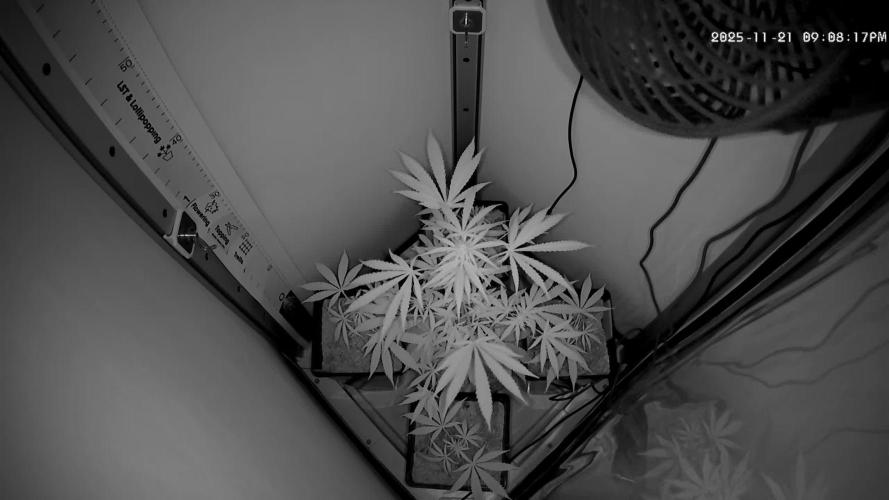
This week I added a scrog net and started guiding some of the branches through it. A few branches were already long enough to be bent and positioned under the net, while others still need a bit more growth before reaching it. From now on, the goal is to let the plant grow freely and focus on filling the net evenly before flipping to flower 🌿💪
Likes
7
Share
This is towards the end of last week. The BB crosses are doing excellent. They have all gone through some extreme temps with intense temp and RH fluctuations. I’ve concluded that the plants 1 week behind experienced too much heat on this one day when some things came up and I wasn’t around to get them out of the hot sun in time, and they were stunted by excessive heat over 90F. The others didn’t show much signs of stress at all. I’m not giving up on the little ones, but I am giving them a large amount of grace and understanding. They can just continue to grow and do their best. Maybe they will come back into full speed in a week or so. Maybe not. At least I will grow them out to learn what happens. From now on I will be extra careful with all stimuli my seedlings are receiving. Showing sone other plants of same age, some of which are photoperiods that began flowering about a month and a half early, with 15 hours of daylight! Why? My first guess is some form of extreme rodelization. I did notice on both A-Trains that they each had a node with two pollen sacks developing as well as the burst of female bracts. So I nicked off the pollen sacks right away, and I’ve been putting them under a light for the nights to hopefully reveg them. Either way, a fun anecdote for some new knowledge and experience! I’m sure they would bud out Fat! Seeing how much they did in 2-3 days! But maybe there’s other elements at play.