


Which device for ppfd?

Splintstarted grow question 23d ago
Not directly a grow question, but:
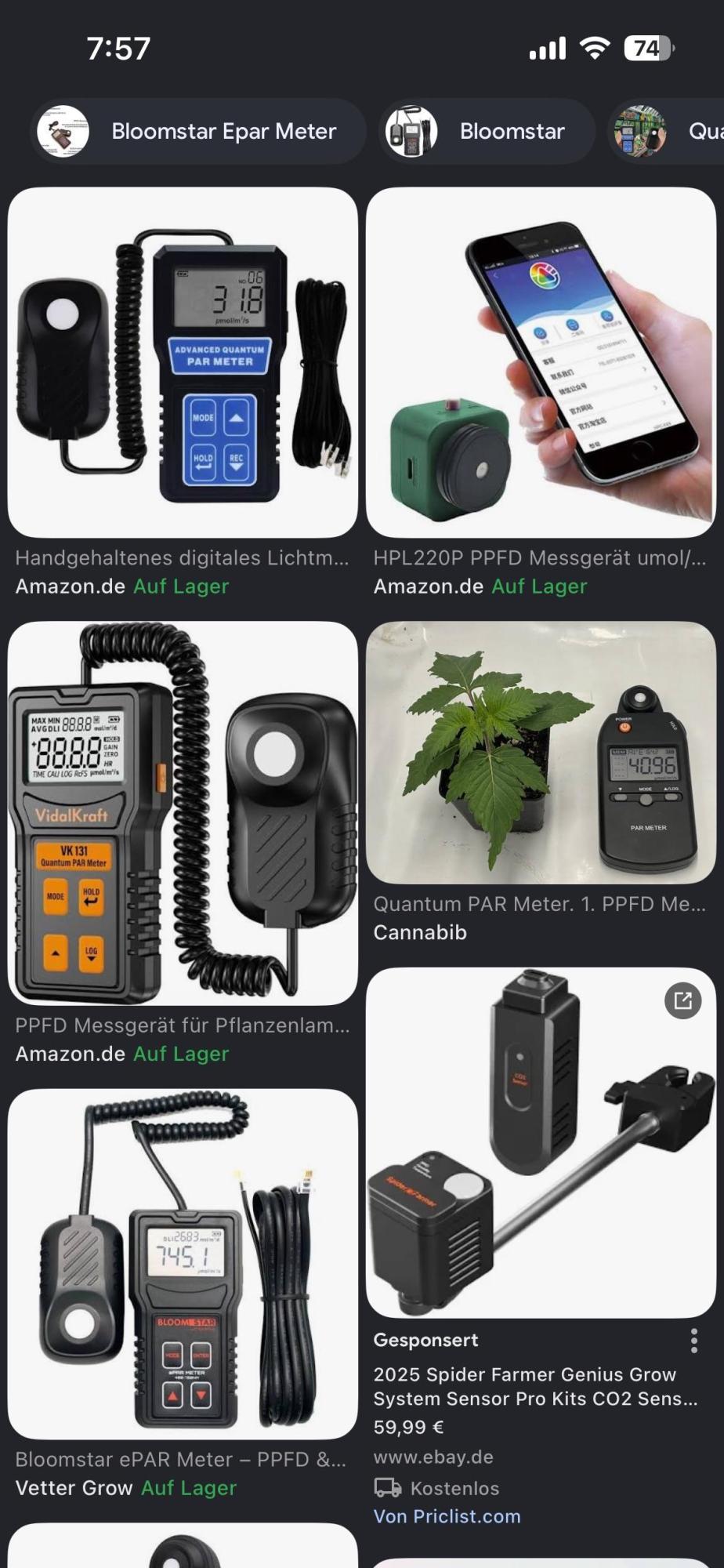
Which device are you guys using and/or recommending for measuring ppfd? I’m on a TIGHT budget and it needs to be shippable to Germany or at least Europe. I don’t really know anything about ppfd.
Pic is just for visibility.
Solved
Other. General questions
Other. Other
Setup. Sensors
likes

Still_Smoqanswered grow question 23d ago
There is an app called Photone that uses your mobile phone to read ppfd. It cost just a few $. But very simple and definitely puts you in the ballpark with lighting. I’d personally be more concerned with DLI than ppfd, it’s just a different measurement of the light but easier to deal with. This along with observing your plants growth and reaction is as good as anything else you buy out there.
Crusty_Juggleranswered grow question 23d ago
If you're on a tight budget, a quantum sensor is definitely not on your list of priorities.
Measuring PPFD is not necessary at all and a reliable quantum sensor is pretty much the same price as a complete budget home grow setup - Spend the money on more light, better climate control, and better genetics.
1 like
Complain

MindFlowers68answered grow question 23d ago
that last one that is 250 usd is spec-ed more for outdoor use for indoors and led would need full spectrum meter witch is much pricier at 500 usd https://www.apogeeinstruments.com/sq-520-full-spectrum-smart-quantum-sensor-usb/ Thats a lot of cal mag =]
1 like
Complain
MindFlowers68answered grow question 23d ago
i guesss im mostly repeating what other said at this point but i agree. If you are on a tight budget theirs no other choice than the photone. those other things are just a waste of money imo. i had one when i first started and quickly returned. they can give some interesting insights though once you are nearly dialed in. Half the time i get away with not even checking the ppfd entirely. Lights are designed to work within a range so its usually easy for me to figure out a power and distance that works for the plant. https://www.apogeeinstruments.com/sq-420x-smart-quantum-sensor-usb-output/ Never used and apogee meter, and could just be overpriced hype, but they look nice. this one is half the price of older version that had a dedicated readout module. this one looks like it plugs into the computer. pretty overkill for a home grower though, especially on a tight budget. the cost wouldn't be justifiable. would be really sick to have though.
1 like
Complain

Hashyanswered grow question 23d ago
I use photone app which uses front camera. I know someone with an expensive proper light meter and I was amazed at how close the photone app was to it when we did a test in his setup.
2 likes
Complain

Johnnytokeranswered grow question 23d ago
There's an app on play store called ppfd meter. You have to buy a Bluetooth compatible hand held meter and the app converts to ppfd. You have to find out specs off your light mine is LED 2700k,
UNI-T UT383BT Mini Light Meter LCD Display with Bluetooth iENV UT383-BT ⊕IK
Got to be the Bluetooth version
1 like
Complain
00110001001001111Oanswered grow question 24d ago
You measure PPF/PPE, then multiple points across a plane could be averaged to estimate PPFD. PPFD is rate of photons per 1m^2. It's not a single point measurement. Tje wiki on Daily Light Integral is very clear and easy to understand. Get the gist of it... it's really easy math to take tent or garden area and match sufficient light production to pick out a well-sized light.
If it's a real quantum meter, it'll be expensive. Cheap ones are likely a 10-dollar lux meter converting it with a slightly arbitrarily choosen converson facro - hopefully related to a typical grow light's characteristics. Any good meter should have the "error" listed in the specifications. that would be the best way to pick out the better quality options. If they don't include such relevant information, it's a bit sketchy. Like a scale giving resolution and error "Resolution to hudredths and +/- .03g" is standard for a cheap 'hundredths' scale. Any meter worth it's price tag will give resolution and error. The pictures here don't give that info, and you are capable of looking this stuff up as you browse the goods - nobody else has to do that for you.
---- however...
You don't need a 300-500 piece of equipment to accurately set your light. First, the "max" light you can give is relative, so it is different for every garden to some extent. So, even wiht a quantum meter, you will still have to observe and adjust your light - albeit a little less and a little more easily than without a quantum meter - but you get to the same point with minimal effort either way.
You could just buy a cheap lux meter or use a free app on your phone like photone -- which measures lux and uses a conversion factor, so it's maybe +/- 10%. but the consistency of a meter is the beneficial factor...
no matter what, you'll have to adjust your light based on the growth pattern you see. Too much light causes easily observable odd growth (too tight) just as too little light causes stretched out branches. Once you get it growing healthy and not too tight with the node spacing, you measure light and that's your target in the future --- doesn't matter if it's lux or converted PPF or a real quantum meter.
Since everyone's local envrionment varies, you can't just target a pre-ordained level of light. You always have to read the plant and adjust to fine-tune the light. You may even have differences based on seasonal changes in your area. Temperature, RH and ambient CO2 in atmosphere will dictate how much light you can give, and the plant observable grow in specific patterns relative to that.
3 likes
Complain
Similar Grow Questions
Solved

Splint
Which device for ppfd?Not directly a grow question, but:
Which device are you guys using and/or recommending for measuring ppfd? I’m on a TIGHT budget and it needs to be shippable to Germany or at least Europe. I don’t really know anything about ppfd.
Pic is just for visibility.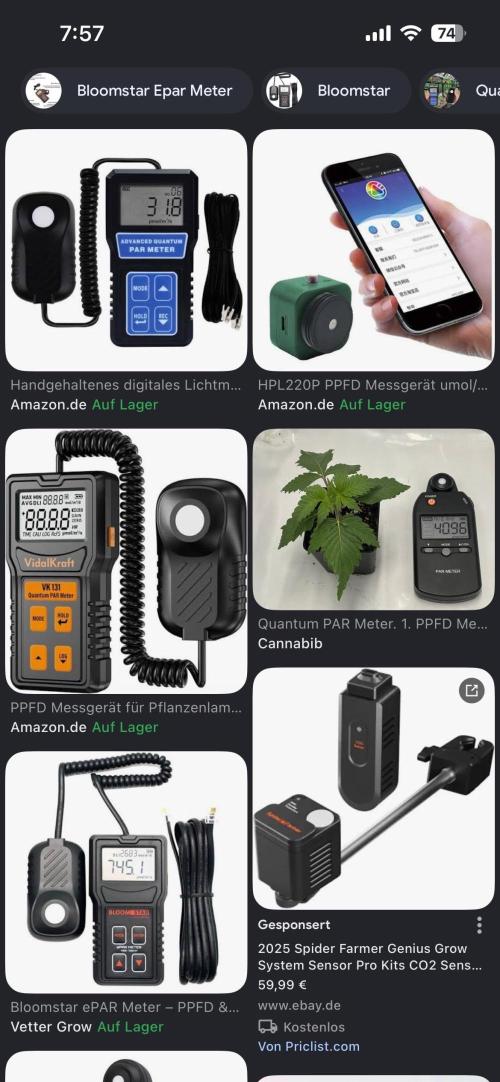
Other. General questions
Other. Other
Setup. Sensors
23d ago
1
7