










Likes
19
Share


@emeraldlabs
Follow
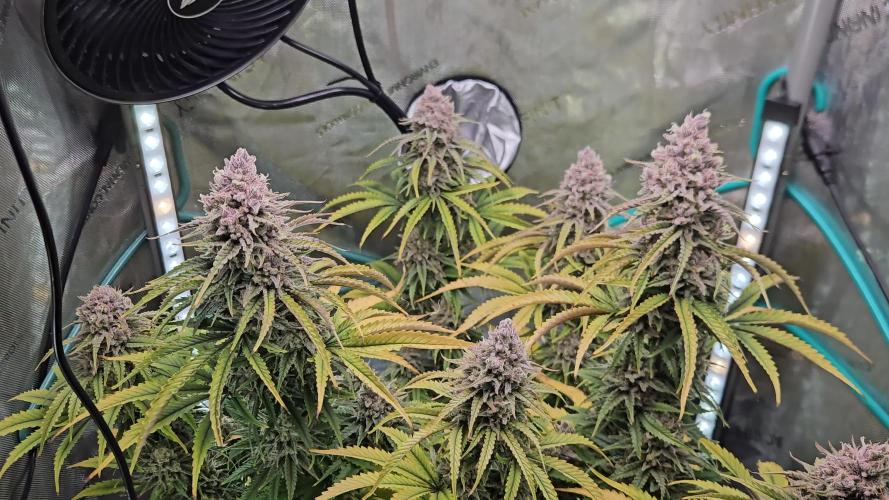
Don’t judge. A few days away from chop!
Again... looking forward to see how the “stress” improves quality...?
Photos/video taken 133 days after breaking soil, day 56 of flower.
UPDATE: Plant harvested on 1/7; day 136 after breaking soil, day 59 of flower.

Likes
12
Share


@cookingwithninja
Follow
day 14 added 1/2tbsp magnesium sulfate in 5gal water along with regular flower water amendments. 1gal of water per day average, bridal and thunder can take more water. Ph 6.8 today
day 15 I will defoliate in a few days :) day 15 video, you see some stem action
day 16 video
day 17 I added (4x20w daisy-chained)80w of poop purple ancient leds Keep adding soluble PK, organic booster etc. I see the stacks relax on defoliation for a few days, maybe tomorrow morning (skip day21) I feel like I will be able to chop week 6-7 as my last grow, push hard fast-continue everything is great, soon bridal and thunder will require 1gal water per day. I would like to see even more mass. I'm extremely happy, starting to see frost
day18. BIG UPDATE many short vids of final defoliation(ahead of "day 21"). Wild amendments appeared! Any recommendations for a lawnmower? Bridalparty stretched over an inch overnight, led touch diode burn on 1 spot. Raised lights slightly, Added new amendments into water. Bridal wants to drink more than 1gal per day, So I will be using almost 5gal-ish water per day not denying the plant needs-watering. I am very happy! defoliation took about 4h today.

Processing
Likes
10
Share


@Jvelez2093
Follow
Easy week of just watering every 2 days. Buds are really starting to swell and become frosty. I picked up a digital microscope to look at trichomes and they are beautiful. Not 100% confident at determining where the trichomes are but most of them still look clear so I still have a couple weeks. Feel free to let me know or correct me I put a photo of the trichomes up. Until next week happy growing.


Likes
3
Share


@CalGonJim
Follow
6/9 12am MONDAY. They look great, went to 4mL per L of Con Grow looking great
6/10 9am. 1130pm loo
GC 🚨🚨 TOP REDSIGN. NODE 5 & 6 HAVE 2 EXTRA BUD SITES.... I USUALLY TOP AT 3 OR 4 AND THEN TRIM OFF NODE 1 DEPENDING ON MAIN STALK HEIGHT, EASIER TO WATER AND MAINTIAN. BUT I CUT OFF NODE 1 THRU 4 AND LEFT MAIN COLA. INVERTED TOP??? SHE IS GIVING ME IDAS.... I WILL TOP GOAT AND GROW AT NODE 5 & 6 GOAT 2 WILL BE TOPPED AT NODE 3 & 4.....🚨🚨⚡️⚡️
6/11 330am new air assist exit fan design prot

Likes
3
Share


@FrostyB
Follow
Again this strain was a pleasure to grow and very resistant to any changes or nutrients. I just wish I had more at the time but it was a feee seed and I only had one. Would be a decent harvest of some juicy tasty pineapple goodness 🍍💚


Likes
2
Share


@DrBud420
Follow
21.06.
OG KUSH# Day 56#
On the OG, thrips appeared in a couple of places, but nothing serious, I regulated it right away, and if it does, it can't do anything to the plant outside, except to slow it down a bit, but come on.
With a little delay because I'm a lazy stoned person, and in addition the responsibilities regarding the plants are already starting to grow, and I also have a lot of work around the garden and then I don't always arrive in time to release the update.
The plants are progressing well, but now they are already hungry, so the next watering is for food.
Two days ago they were topped for the third time, I also topped the two highest side branches.
Yesterday was the end of their eighth week, the pictures are also from yesterday.
Last night I sprayed them with SMC for prevention, but none of those pests can harm the plant outside as well as inside..first of all, the plants are much bigger, and therefore have much more leaf mass, and secondly, it is nature, there are many of them in nature, the only thing that can destroy them all are caterpillars during flowering and mold when the humidity is too high or when there are frequent rains, everything else does not worry me at all.
Tomorrow I will move them somewhere where there is a lot less grass because now they have already filled this space and they can't expand any further, so in order for them not to get too long and to go wider I have to move them where the grass and other plants won't bother them.
Stay High and Keep Growing!!!
Likes
47
Share


@Ultraviolet
Follow
All content on this diary is for inspirational and educational purposes only. The ideas shared are not a substitute for professional advice. This diary/account is not officially affiliated with Alan Watts or his estate. All materials are used under the principles of fair use. I honor the legacy of Alan Watts by sharing his wisdom respectfully and with the intention of inspiring awareness and self-understanding.
2nd net is up. Early bud formations are promising. holding up to the extremes pretty well, some leaves taking minor damage, but overall, she is holding up, gave her 1 night at 50F see how she would react, stressful. Not advised as it messes with her metabolism, but I want to see if it triggers any anthocyanin response. Love to see her purp up but no signs yet. Remember, For every molecule of glucose produced during photosynthesis, a plant needs to split six molecules of water. This process provides the hydrogen needed for synthesizing glucose and other organic compounds, while oxygen is released as a byproduct.
Homework.
If Rubisco activity is impaired and it cannot properly function or regenerate its substrate, the plant's leaves are likely to turn a pale green or lime green, a condition known as chlorosis. Essentially, Rubisco activity is highly regulated and susceptible to various environmental and metabolic factors that can cause it to become inhibited, leading to an apparent failure in RuBP regeneration due to a lack of consumption.
Rubisco regeneration is intrinsically linked to nitrogen supply because Rubisco is a major sink for nitrogen in plants, typically accounting for 15% to over 25% of total leaf nitrogen. The regeneration phase itself consumes nitrogen through the synthesis of the Rubisco enzyme and associated proteins (like Rubisco activase), and overall nitrogen status heavily influences the efficiency of RuBP regeneration. RuBisCO is a very large enzyme that constitutes a significant proportion (up to 50%) of leaf soluble protein and requires large investments in nitrogen. Insufficient nitrogen supply limits the plant's ability to produce adequate amounts of RuBisCO, thereby limiting the overall capacity for photosynthesis and carbon fixation. Maintaining the optimal, slightly alkaline pH is crucial for the proper function and regeneration of Rubisco. Deviations in either direction (too high or too low) disrupt the enzyme's structure, activation state, and interaction with its substrates, leading to decreased activity and impaired RuBP regeneration. (Lime/yellowing)
Structural Component: Nitrogen is an essential building block for all proteins, and the sheer abundance of the Rubisco protein makes it the single largest storage of nitrogen in the leaf.
Synthesis and Activity: Adequate nitrogen supply is crucial for the synthesis and maintenance of sufficient Rubisco enzyme and Rubisco activase (Rca), the regulatory protein responsible for maintaining Rubisco's active state. Nitrogen deficiency leads to a decrease in the content and activity of both Rubisco and Rca, which in turn limits the maximum carboxylation rate, Vmax, and the rate of RuBP regeneration Jmax, thus reducing overall photosynthetic capacity.
Nitrogen Storage and Remobilization: Rubisco can act as a temporary nitrogen storage protein, which is degraded to remobilize nitrogen to other growing parts of the plant, especially under conditions of nitrogen deficiency or senescence.
Nitrogen Use Efficiency (NUE): The allocation of nitrogen to Rubisco is a key determinant of a plant's photosynthetic nitrogen use efficiency (PNUE). In high-nitrogen conditions, plants may accumulate a surplus of Rubisco, which may not be fully activated, leading to a lower PNUE. Optimizing the amount and activity of Rubisco relative to nitrogen availability is a target for improving crop NUE.
Photorespiration and Nitrogen Metabolism: Nitrogen metabolism is also linked to the photorespiration pathway (which competes with carboxylation at the Rubisco active site), particularly in the reassimilation of ammonia released during the process.
To increase RuBisCO regeneration, which refers to the process of forming the CO2 acceptor molecule Ribulose-1,5-bisphosphate (RuBP) during photosynthesis, the primary methods involve optimizing the levels and activity of Rubisco activase (Rca) and enhancing the performance of other Calvin-Benson-Bassham (CBB) cycle enzymes.
Biochemical and Environmental Approaches:
Optimize Rubisco Activase (Rca) activity: Rca is a crucial chaperone protein that removes inhibitory sugar phosphates, such as CA1P (2-carboxy-D-arabinitol 1-phosphate), from the Rubisco active site, thus maintaining its catalytic competence.
•Ensure optimal light conditions: Rca is light-activated via the chloroplast's redox status. Adequate light intensity ensures Rca can effectively maintain Rubisco in its active, carbamylated state.
•Maintain optimal temperature: Rca is highly temperature-sensitive and can become unstable at moderately high temperatures (e.g., above 35°C/95F° in many C3 plants), which decreases its ability to activate Rubisco. Maintaining temperatures within the optimal range for a specific plant species is important.
•Optimize Mg2+ concentration: Mg2+ is a key cofactor for both Rubisco carbamylation and Rca activity. In the light, Mg2+ concentration in the chloroplast stroma increases, promoting activation.
•Manage ATP/ADP ratio: Rca activity depends on ATP hydrolysis and is inhibited by ADP. Conditions that maintain a high ATP/ADP ratio in the chloroplast stroma favor Rca activity.
Enhance Calvin-Benson-Bassham (CBB) cycle enzyme activity: The overall rate of RuBP regeneration can be limited by other enzymes in the cycle.
•Increase SBPase activity: Sedoheptulose-1,7-bisphosphatase (SBPase) is a key regulatory enzyme in the regeneration pathway, and increasing its activity can enhance RuBP regeneration and overall photosynthesis.
•Optimize other enzymes: Overexpression of other CBB cycle enzymes such as fructose-1,6-bisphosphate aldolase (FBA) and triose phosphate isomerase (TPI) can also help to balance the metabolic flux and improve RuBP regeneration capacity.
Magnesium ions, Mg2+, are specifically required for Rubisco activation because the cation plays a critical structural and chemical role in forming the active site: A specific lysine residue in the active site must be carbamylated by a CO2 molecule to activate the enzyme. The resulting negatively charged carbamyl group then facilitates the binding of the positively charged Mg2+ion. While other divalent metal ions like Mn2+ can bind to Rubisco, they alter the enzyme's substrate specificity and lead to dramatically lower activity or a higher rate of the non-productive oxygenation reaction compared to Mg2+, making them biologically unfavorable in the context of efficient carbon fixation. The concentration of Mg2+ in the chloroplast stroma naturally increases in the light due to ion potential balancing during ATP synthesis, providing a physiological mechanism to ensure the enzyme is activated when photosynthesis is possible. At the center of the porphyrin ring, nestled within its nitrogen atoms, is a Magnesium ion (Mg2+). This magnesium ion is crucial for the function of chlorophyll, and without it, the pigment cannot effectively capture and transfer light energy.
Mg acts as a cofactor: Mg2+ binds to Rubisco after an activator CO2 molecule, forming a catalytically competent complex (Enzyme-CO2-Mg2+). High light + CO2) increases demand: Under high light (60 DLI is a very high intensity, potentially saturating) and high CO2, the plant's capacity for photosynthesis is high, and thus the demand for activated Rubisco and the necessary Mg2+ cofactor increases. Mg deficiency becomes limiting: If Mg2+ is deficient under these conditions, the higher levels of Rubisco and Rubisco activase produced cannot be fully activated, leading to lower photosynthetic rates and potential photo-oxidative damage.
Optimal range: Studies show that adequate Mg2+ application can enhance Rubisco activation and stabilize net photosynthetic rates under stress conditions, but the required concentration is specific to the experimental setup.
Monitoring is key: The most effective approach in a controlled environment is to monitor the plant's physiological responses e.g., leaf Mg2+ concentration, photosynthetic rate, Rubisco activation state, and adjust the nutrient solution/fertilizer to maintain adequate levels, rather than supplementing a fixed "extra" amount.
In practice, this means ensuring that Mg2+ is not a limiting factor in the plant's standard nutrient solution when pushing the limits with high light and CO2.
Applying Mg2+ through foliar spray is beneficial to Rubisco regeneration, particularly in alleviating the negative effects of magnesium (Mg) deficiency and high-temperature stress (HTS). While Mg can be leached from soil, within the plant it is considered a mobile nutrient, particularly in the phloem. Foliar-applied Mg is quickly absorbed by the leaves and can be translocate to other plant parts, including new growth and sink organs.
Foliar application of: NATURES VERY OWN MgSO4 @ 15.0g L-1 in a spray bottle. For those high-intensity workouts when 1 meal a day is just not enough!
Foliar sprays are often recommended as a rapid rescue measure for existing deficiencies or as a supplement during critical growth stages, when demand for Mg is high. Application in the early morning or late evening can improve absorption and prevent leaf burn. The plant was getting a little limey yellow in the centre. Shortly thereafter, she was back in business, green mostly regenerated. The starting point [of creativity] is curiosity: pondering why the default exists in the first place. We’re driven to question defaults when we experience vuja de, the opposite of déjà vu. Déjà vu occurs when we encounter something new, but it feels as if we’ve seen it before. Vuja de is the reverse—we face something familiar, but we see it with a fresh perspective that enables us to gain new insights into old problems.
Confidence is evidence... nothing more. You are confident because you have driven 10,000 times, you are confident because you have spoken 10,000 times. People think confidence is a feeling, but it's not. If you want more confidence, then you need to create evidence, take more shots, collect more data, build more experiences, take more risks; fail, confidence doesn't come first; it is the reward you get for doing the work. no one else wants to do.


Processing
Likes
34
Share


@Organijuana
Follow
Feeding nutes based on chart, water in (sameday) ..... clean compost brewer and brew new batch (sameday) ..... use compost tea once wk (nextday, water in lil) and discard and clean for next week.... defoliation a lil daily..... HENCE ... becoming more of a chore or should I say we have a great relationship right now. A coexistence, a sudden need for one another. They are my sheep and I am there shephard! Now lets harvest some cotton!


Processing
Likes
3
Share


@Patillac31
Follow
Ended week three with a flush. I haven't flushed her since purchase. Switched over from FF Open Sesame to FF Beastie Bloomz. Going to add molasses to the next feeding cycle. Any comments or suggestions ste always welcome. ✌️ Happy Holidaze and Happy Growing

Likes
8
Share

@BobbersDown
Follow
I'll report back with weight post dry and trim. Extremely high hopes for this strain, grew basically perfect start to finish. The one additional comment I have is on the wicking self watering base from AC Infinity I used. It did really well at keeping the soil damp, but not wet. Not sure if there will ever be issues with root rot, but I was careful to let the reservoir empty between waterings. The one downside to it is once it's set, you can't really move the pot at all without messing up the wicking ropes. Pros vastly outweigh the con though as you can leave it several days with a full reservoir.

Likes
26
Share


@Buddyman75
Follow
This week I saw rapid growth
The plays seem to be taking the high ec very well.
They don't really have any smell yet.
Some of the branches grow horizontally into the other plants at the same time the plants that grow like this aren't stretching up.
I guess those are bushier pheno.
Looks like they're going to be heavy.
So far so good 😊

Likes
Comments
Share


@Maxximillia420
Follow
Hallo everybody due the holidays I was t home at all and a friend jumped in for me to look after her !!
She got feedet 2ise not to sure witch days , just plain water ph6.5 ec 0.35
Day 21. - 05.01.2020
Came home yesterday and transplanted the nicely growing plant in a 12 l pod with light mix soil
In the next days i gona start training her again have to prepare the pod for that tho !!
Iam gonna give a good feed to her in the neExt couple of days to strengthen the grow a bit and I think in a week or two she’s gona be ready to get in the bloom box !!
Day 24
- 08.01.2020
Plant is growing nicely after getting trained for a few days and gave her a bit of a feed nothing to heavy tho !!

Likes
21
Share


@CanadianFillmore
Follow
Welcome growfessors to another episode of growfessor theatre! 👽🌳💚
Tonight from the 4x4 the ladies move into week 7 and they get a change in nutrients. Out with Big Bud coco & sensizym, in with Overdrive.
Removed dead & dying leaves from each lady, added a support stake in Mandarin dreams & LSD, they was leaning hard!
Thanks for stopping by growfessors 👽🌳💚

Likes
118
Share


@Grow3rPT
Follow
👉 ( Floração ) 👈
📅 Total de Dias 57 (F 27) - 28/09/2021 / Crescimento normal... 😀
📅 Total de Dias 58 (F 28) - 29/09/2021 / 💦 Rega apenas com agua
📅 Total de Dias 59 (F 29) - 30/09/2021
📅 Total de Dias 60 (F 30) - 01/10/2021 / 💦 Rega com nutrientes ( Grow + Micro + Bloom )
📅 Total de Dias 61 (F 31) - 02/10/2021
📅 Total de Dias 62 (F 32) - 03/10/2021 / 💦 Rega apenas com agua.
📅 Total de Dias 63 (F 33) - 04/10/2021
👉 MARSHYDRO
👉 CODIGO PORMOCIONAL : Grow3rPT
👉 Em marshydro.eu 3% de desconto em qualquer produto


