


Likes
Comments
Share


@KingSalomonsWeed
Follow
23.10. Day 53 of flower. The buds become flesh. Still wonderful sticky.
She really likes it moist.
Lifted the lamp and switched the white Light off. Just for a while. Because, i think she began to be grilled.
Just a little relax for her.
Switched to 16_8h light nightschedule.
And agaun with white light, FULL POWER.
With greetings from the unexpected colorful Trans Syberia..😛 💪

Processing
Likes
21
Share


@LittleBigTrees
Follow
I've turned the light up to 35000 lux.
Up'd the bloom to 1.5ml/l.
There still stretching and could do with more room but there doing well 😎
Likes
22
Share


@RaS_Audio
Follow
Starting week 3 with a plain watering at 6.31.
All plants recovered well from topping and are starting to grow much faster. Looking healthy and strong!
Planning on some light lower defoliation early this week to get the bottom leaves off the soil.
Still very short and bushy.
08/05/2020 - Watered at 6.31 all conditions remaining stable. (Pics)
08/06/2020 - Defoliated the bottom 3 sets of fan leaves.
08/06/2020 - Used green twist ties to begin LST the main branches (Pics)
08/06/2020 - Watered at 6.51 with added nutrients 7 ml between 2L.
08/08/2020 - Took a few more leaves from 3 of the 4 and adjusted tie downs, left 1 alone as she seemed unimpressed with the first defoliation.
08/10/2020 - Watered at 6.49 with added nutrients. 5 ml per 2L.
08/11/2020 - Final transplant into 7 gallon pots, All 4 had solid root growth and were starting to be root bound. I'm glad I did not wait any longer.
08/11/2020 - Watered post transplant with Plain water at 6.43 Used 4L between 4 plants.

Likes
18
Share


@KurbinTurbin
Follow
This strain was easy to grow, short and very bushy. The smell when drying has an incredibly strong earthy/chocolate aroma which is very pleasant🤤.

Likes
18
Share


@Ultraviolet
Follow
Green light is radiation with wavelengths between 520 and 560 nm and it affects photosynthesis, plant height, and flowering. Plants reflect green light and this is why they appear green to our eyes. As a result, some growers think that plants don’t use green wavelengths, but they actually do!
In fact, only around 5 – 10% of green light is reflected from leaves and the rest (90 – 95 %) is absorbed or transmitted to lower leaves [1].
Green wavelengths get used in photosynthesis. Chlorophyll pigments absorb small amounts of green wavelengths. Light that doesn’t get absorbed is transmitted to leaves that are shaded out from direct light. This means that leaves at the bottom of the canopy get more green light than leaves at the top. A high proportion of green wavelengths compared to other colors tells lower leaves that they are being shaded out, so they are able to react accordingly. Lower leaves may react by opening or closing their stomata or growing longer stems that help the leaves reach brighter light [1, 2, 3].
When it comes to growing cannabis, many cultivators are interested in the quality of light used for the flowering stage. In many plants, flowering is regulated by two main photoreceptors: cryptochrome and phytochrome. Both photoreceptors primarily respond to blue light but can also respond to green, although to a lesser extent. Green can accelerate the start of flowering in several species (although cannabis has yet to be tested) [1, 4, 5]. However, once flowering has begun, it’s important to provide plants with a “full spectrum” light that has high amounts of blue and red light, and moderate amounts of green, in order for photosynthesis to be optimized.
Green light mediates seed germination in some species. Seeds use green wavelengths to decide whether the environment is good for germination. Shade environments are enriched in green relative to red and blue light, so a plant can tell if it is shady or sunny. A seed that senses a shaded environment may stay dormant to avoid poor growing conditions [1]. Some examples of plant species where researchers have documented this response are: ryegrass (a grass that grows in tufts) and Chondrilla (a plant related to dandelion) [1, 6].
Although green wavelengths generally tell plants NOT to germinate, there are some exceptions! Surprisingly, green wavelengths can stimulate seed germination in some species like Aeschynomene, Tephrosia, Solidago, Cyrtopodium, and Atriplex [1, 6, 7].
Of course, light is not the only factor affecting seed germination – it’s a combination of many factors, such as soil moisture, soil type, temperature, photoperiod, and light quality.
When combined with red and blue light, green can really enhance plant growth [1, 8]. However, too much green light (more than 50% of the total light) can actually reduce plant growth [8]. Based on the most current research, the ideal ratio of green, red, and blue light is thought to be around 1:2:1 for green:blue:red [9]. When choosing a horticultural light, choose one that has high amounts of blue and red light and moderate amounts of green and other colors of light.
Not many studies can be found about the effect of green light on cannabis growth or metabolism. However, if one reads carefully, there are clues and data available even from the very early papers.
Mahlberg and Hemphill (1983) used colored filters in their study to alter the sunlight spectrum and study green light among others. They concluded that the green filter, which makes the environment green by cutting other wavelengths out, reduced the THC concentration significantly compared to the daylight control treatment. It has been demonstrated that green color can reduce secondary metabolite activity with other species as well. For example, the addition of green to a light spectrum decreases anthocyanin concentration in lettuce (Zhang and Folta 2012).
If green light only reverses the biosynthesis of some secondary metabolites, then why put green light into a growth spectrum at all? Well, there are a couple of good reasons. One is that green penetrates leaf layers effectively. Conversely red and blue light is almost completely absorbed by the first leaf layer.
Green travels through the first, second, and even third layers effectively (Figure 2). Lower leaf layers can utilize green light in photosynthesis and therefore produce yields as well.
Even though a green light-specific photoreceptor has not yet been found, it is known that green light has effects independent from the cryptochrome but then again, also cryptochrome-dependent ones, just like blue light. It is known that green light in low light intensity conditions can enhance far red stimulating secondary metabolite production in microgreens and then again, counteracts the production of these compounds in high-intensity light conditions (Kim et al. 2004). In many cases, green light promoted physiological changes in plants that are opposite to the actions of blue light. In the study by Kim et al. blue light-induced anthocyanin accumulation was inhibited by green light. In another study it has been found that blue light promotes stomatal opening whereas green light promotes stomatal closure (Frechilla et al. 2000). Blue light inhibits the early stem elongation in the seedling stage whereas green light promotes it (Folta 2004). Also, blue light results in flowering induction, and green light inhibits it (Banerjee et al., 2007). As you can see, green light works very closely with blue light, and therefore not only the amount of these two wavelengths separately is important but also the ratio (Blue: Green) between these two in the designed spectrum. Furthermore, green light has been found to affect the elongation of petioles and upward leaf reorientation with the model plant Arabidopsis thaliana both of which are a sign of shade avoidance symptoms (Zhang et al. 2011) and also gene expression in the same plant (Dhingra et al. 2006).
As mentioned before, green light produces shade avoidance symptoms which are quite intuitive if you consider the natural conditions where the plants grow. Not all the green light is reflected from the highest canopy leaves in nature but a lot of it (50-90%) has been estimated to penetrate the upper leaves at the plant level ((Terashima et al., 2009; Nishio, 2000). For the plant growing in the understory of the forest green light is a signal for the plant of being in the shade of a bigger plant. Then again, the plants growing under unobstructed sunlight can take advantage of the green photons that can more easily penetrate the upper leaves than the red and blue photons. From the photosynthetic pigments in higher plants, chlorophyll is crucial for plant growth. Dissolved chlorophyll and absorb maximally in the red (λ600–700 nm) and blue (λ400–500 nm) regions of the spectrum and not as easily in the green (λ500–600 nm) regions. Up to 80% of all green light is thought to be transmitted through the chloroplast (Terashima et al., 2009) and this allows more green photons to pass deeper into the leaf mesophyll layer than red and blue photons. When the green light is scattered in the vertical leaf profile its journey is lengthened and therefore photons have a higher chance of hitting and being absorbed by chloroplasts on their passage through the leaf to the lower leaves of the plant.
Photons of PPFD (photosynthetic photon flux density) are captured by chlorophyll causing an excitation of an electron to enter a higher energy state in which the energy is immediately passed on to the neighboring chlorophyll molecule by resonance transfer or released to the electron transport chain (PSII and PSI). Despite the low extinction coefficient of chlorophyll in the green 500–600 nm region it needs to be noted that the absorbance can be significant if the pigment (chlorophyll) concentration in the leaf is high enough.
The research available clearly shows that plants use green wavelengths to promote higher biomass and yield (photosynthetic activity), and that it is a crucial signal for long-term developmental and short-term dynamic acclimation (Blue:Green ratio) to the environment. It should not be dismissed but studied more because it brings more opportunities to control plant gene expression and physiology in plant production.
REFERENCES
Banerjee R., Schleicher E., Meier S. Viana R. M., Pokorny R., Ahmad M., Bittl R., Batschauer. 2007. The signaling state of Arabidopsis cryptochrome 2 contains flavin semiquinone. The Journal of Biological Chemistry 282, 14916–14922.
Dhingra, A., Bies, D. H., Lehner, K. R., and Folta, K. M. 2006. Green light adjusts the plastic transcriptome during early photomorphogenic development. Plant Physiol. 142, 1256-1266.
Folta, K. M. 2004. Green light stimulates early stem elongation, antagonizing light-mediated growth inhibition. Plant Physiol. 135, 1407-1416.
Frechilla, S., Talbott, L. D., Bogomolmi, R. A., and Zeiger, E. 2000. Reversal of blue light -stimulated stomatal opening by green light. Plant Cell Physiol. 41, 171-176.
Kim, H.H., Goins, G. D., Wheeler, R. M., and Sager, J. C. 2004.Green-light supplementation for enhanced lettuce growth under red- and blue-light emitting diodes. HortScience 39, 1617-1622.
Nishio, J.N. 2000. Why are higher plants green? Evolution of the higher plant photosynthetic pigment complement. Plant Cell and Environment 23, 539–548.
Terashima I., Fujita T., Inoue T., Chow W.S., Oguchi R. 2009. Green light drives leaf photosynthesis more efficiently than red light in strong white light: revisiting the enigmatic question of why leaves are green. Plant & Cell Physiology 50, 684–697.
Zhang, T., Maruhnich, S. A., and Folta, K. M. 2011. Green light induces shade avoidance symptoms. Plant Physiol. 157, 1528-156.
Wang, Y. & Folta, K. M. Contributions of green light to plant growth and development. Am. J. Bot. 100, 70–78 (2013).
Zhang, T. & Folta, K. M. Green light signaling and adaptive response. Plant Signal. Behav. 7, 75–78 (2012).
Johkan, M. et al. Blue light-emitting diode light irradiation of seedlings improves seedling quality and growth after transplanting in red leaf lettuce. HortScience 45, 1809–1814 (2010).
Kasajima, S., et al. Effect of Light Quality on Developmental Rate of Wheat under Continuous Light at a Constant Temperature. Plant Prod. Sci. 10, 286–291 (2007).
Banerjee, R. et al. The signaling state of Arabidopsis cryptochrome 2 contains flavin semiquinone. J. Biol. Chem. 282, 14916–14922 (2007).
Goggin, D. E. & Steadman, K. J. Blue and green are frequently seen: responses of seeds to short- and mid-wavelength light. Seed Sci. Res. 22, 27–35 (2012).
Mandák, B. & Pyšek, P. The effects of light quality, nitrate concentration and presence of bracteoles on germination of different fruit types in the heterocarpous Atriplex sagittata. J. Ecol. 89, 149–158 (2001).
Darko, E. et al. Photosynthesis under artificial light: the shift in primary and secondary metabolism. Philos. Trans. R. Soc. B Biol. Sci. 369 (2014).
Lu, N. et al. Effects of Supplemental Lighting with Light-Emitting Diodes (LEDs) on Tomato Yield and Quality of Single-Truss Tomato Plants Grown at High Planting Density. Environ. Control Biol. 50, 63–74 (2012).

Likes
3
Share


@Blunoser
Follow
Week 5 Flower. This is the start of Week 5 Flower. Grow is cruising along. Adding Epsom salts on the last 2 feeds of the week. Tip burn from using it too often.
Likes
36
Share


@Roberts
Follow
Now 14 days into light schedule change. She has been growing good under the Spider Farmer G3000 light. I am running at 65 percent on the light for the moment. Everything is looking good. She should have some pistils by next update. Thank you Spider Farmer, and Amsterdam Marijuana Seeds. 🤜🏻🤛🏻🌱🌱🌱
Www.amsterdammarijuanaseeds.com
Thank you grow diaries community for the 👇likes👇, follows, comments, and subscriptions on my YouTube channel👇. ❄️🌱🍻
Happy Growing 🌱🌱🌱
https://youtube.com/channel/UCAhN7yRzWLpcaRHhMIQ7X4g
Spider Farmer G300w: https://amzn.to/3S2zvsd
Spider Farmer 10X20 Heat Mat Kit - https://amz.fun/lsa0J
Spider Farmer Amazon Store: https://www.amazon.com/spiderfarmer
Spider Farmer Official Site: https://spider-farmer.com
Discount code: saveurcash

Likes
Comments
Share


@GrowDiaries
Follow
We are bringing Adam iLL to Spannabis! Want to meet him? Watch this!
Big News, Growers!
We’re beyond excited to announce that the legendary Adam iLL will be hosting the GrowDiaries Awards at Spannabis! But while those awards shine a spotlight on producers and breeders, we haven’t forgotten about the heart of it all—YOU, our amazing community!
We’ve got a special surprise just for you! Let’s come together, connect, and make unforgettable memories. Watch this video and you won’t want to miss this!
See you there!
Yours,
The GrowDiaries T
Likes
7
Share

@Grow4meds20
Follow
No noticeable comment for this week all growing and forming very well we are into the bulking faze well and truly. Did a slight defoliation today just to open up some more sites and get rid of sites that wouldn’t produce anything. They are all progressing well and looking forward to the next 3/4 weeks to show where they end up and how swollen they get !


Processing
Likes
13
Share


@Green_Blood
Follow
On the final few days of a 10 day flush.
Will be chopping down this week to harvest and hang dry.
Really excited to try this one. The smells in the room are unreal.

Likes
111
Share


@DevilsBud
Follow
Week 2 of veg Hyper glue
Start of new week everything going as planned i will be bumping up the nutrients and by end of the week will be transplanting to 8 L fabric pots.
Posting pic of progress Tru the week see you next week
23/9/21 transplant complete mix some Easy Boost Organic Nutrition with my Plagron batmix work great last time also made video
Happy growings Growmies thanks for popping by 🤘🏻
visit www.marshydro.eu
for your best gear and use the PROMO CODE: DEVILSBUD
Fully marshydro supported Setup:
Marshydro GT100X100X180
Marshydro Ts 1000 LED lamp
Some handy info about the
marshydro TS-1000
Increase Yield&Crop Quality in Led Grow
Newest SMD Led technology provides the highest Par/Lumen output, makes you get 30% higher yield compare old led lights, can get up to 2.5g/watt yied.
High Efficiency Energy Saving Plant Light
Only 150 watts true output with so you don't have to check your light bill every month 😎 342 pcs LEDs, more scientifically and energy-efficient! Perfect for 3'x3' (100x100cm) veg stage and 2'x2' (60x60cm) bloom stage, higher intensity in a Mars Hydro grow tent.
Sunlike Full Spectrum Led Indoor Growing
Infinite close to natural sunlight, suit for all plants whole satge indoor growing, rapid plant response from seed to flower, achieve maximum quality and quantity, much better than traditional HPS grow systems.
High Reflective&Noise Free Fanless Led Grow System
Quickly heat dispersing material aluminum reducing light lost to aisles and walls, increase the light intensity up to 20%, allowing your plants to receive more energy and without burning your plants for maximum headroom


Likes
42
Share


@Jackweed77
Follow
day 32🌱 things are going very well 👊the girls are in shape I made a change of solution👽 and I am very happy👨🌾 with what I see. I'm perfectly in the middle of the flowering🌻 period if things go this way I expect a great harvest💚🔝💪
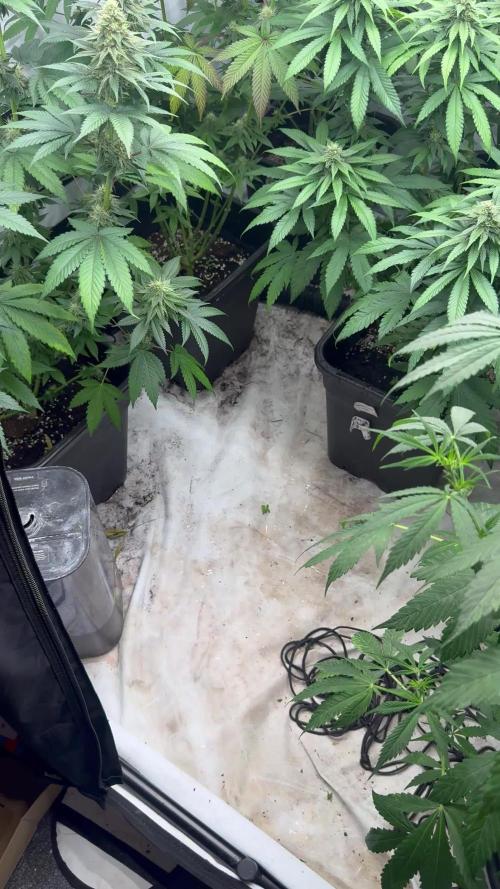
Day 33 I had to open the tent for a check during the hours of darkness (suspicious noise) I took the opportunity to take some photos that without HPS and much better .... 🌻😍💚


Likes
5
Share


@Easygrower
Follow
Hello growers day 82 and the bud is in the jar well it was an interesting grow from germination she played right up growing slow and deformed she had white leafs all over her but I let her go and she grow some nice little purple buds I gave her water for the first ten days then gave bio grow/bloom until I see first pistols then I gave grow/bloom/top max/bio heaven until day 61 then flushed until day 75 I clearly had a doggy pheno I will try again hopefully get a better one I had her on a 20/4 hour light cycle through out the grow well that’s all folks until next time be safe and happy growing 😡
Likes
18
Share


@Rinna
Follow
As said before, I'm incredibly happy that I got to harvest a little bit. Never expected her to make it, but she kind off did! The smell was pungent and sweet like an amnesia haze should be, hoping that will be even better after drying and curing!

Likes
37
Share


@GrownwithLED
Follow
This is my first round with my BRAND NEW LED-Lights from SANlight in Austria. I got myself TWO EVO4-120 fixtures for my HOMEBOX Ambient Q120 growtent, which has an area of 120 x 120 cm. The new EVO4-120 looks AMAZING, reminds me a little bit of a spaceship. I also got myself two magnetic dimmers for the LED-fixtures, so I can control the amount of light my plants get.
Then I went into my 'treasure-chest', where I keep my genetic gems I collected over the years and selected the strains I want to grow this cycle.
My good friends from CNNBS.nl recommended their SNEEZE (=Amnesia x White Widow) to me, which is produced by seedstockers.nl. Since the parents are two classic strains with copious amounts of trichomes, I am curious how 'white' this variety will come out.
My FAVORITE STRAIN OF ALL TIMES is THE PURPS from BC-BUD-DEPOT. It is a purple variety, which has the aroma and taste of grape jolly-ranchers and is simply DELICIOUS! I won the third place in the Sativa category of the HIGH TIMES CANNABIS CUP 2009 in Amsterdam with it and have grown this strain A LOT...therefore i know it well and it is ideal to see how well the NEW SANlight LEDs work.
SERIOUS SEEDS has a NEW PROMO STRAIN, which is called WHITE DELIGHT (=Mimosa x OG-Kush) and which I am very curious about, therefore i will try two of those seeds next to their classic SERIOUS HAPPINESS (= AK-47 x Warlock). The Happiness is an easy to grow strain, which ALWAYS delivers GREAT results, therefore I had to have it in my tent.
My treasure chest revealed some CHEESE seeds from BIG BUDDHA SEEDS, which are the ORIGINAL seeds from the HIGH TIMES CANNABIS CUP 2006, at which the Cheese won the Indica category and started its now famous legacy! Milo, the breeder from Big Buddha Seeds, gifted those seeds to me directly at the fair of the Cannabis Cup that year and I cant wait to smoke some ORIGINAL CHEESE again.
The BADAZZ-CHEESE (=CHEESE x BADAZZ-KUSH) is a collaboration of Ripper Seeds and Big Buddha and entails the BADAZZ-KUSH from Ripper crossed with the CHEESE from Big Buddha. This variety grows hard compact buds with an insane amount of trichomes, I cant wait to see her in flowering.
The STRAWBERRY SOUR-DIESEL from DEVILHARVESTORIGINAL SEEDS (NOT TO BE MISTAKEN FOR Devils Harvest Seeds, because its a split-off!) and the BIG CANDY from Mr. Hide Seeds have been recommended to me by a good friend, therefore I will give them a try as well.
All seeds are germinated in the 'Serious' Way' promoted by Serious Seeds. It is basically the wet paper-towel method, but instead of leaving the seeds laying on a plate, they are hung inside a plastic baggie, so the roots can grow out STRAIGHT of the seed. I use this methods since years and always have GREAT success with it, therefore I put a little video tutorial together of the germinating method, I hope it can help others.


Likes
134
Share


@BigDaddyK
Follow
Day 43 - Tuesday 27/11/18 - changed the reservoir with fresh solution , getting a few mottled under leaves that suggest cal mag issue , or possibly ph , but I have double checked both of these so fingers crossed , I measured her today with my metre ruler and she is 73 cm tall , looks very bushy , I took a light on pic with my iPhone , and made you a little video 😜
I should just add , there are 3 plants in this picture , look back to week 5 and you will see , the lemon is very bushy , gorilla is tallest , Tangie seems to be fastest 👁️
I have also changed the temperature and humidity slightly.
Day 44 - Wednesday - I have included the ruler for scale today, i see so many good pictures on here but the size can be questionable, so also proof i own a 1m ruler...lol , topped up with about 1.5 litres of water, EC was ok and ph perfect. If there are any pictures you would like to see please comment , with a little description.
Day 45 - Thursday - I dont know what happened yesterday but she had drunk so much water ( added 3 litres + ) and needed 10 ml of A+B ,
Day 46 - Friday - Added 12 ml A+B and about 3 litres of water, she is in her super feeding stage, this week she has been devouring everything, some of the leaves I think are showing signs of under feeding but I really think its the strain on the plant as she tries to buildit is really tempting to up the nutrients but once you burn it, its never the same.I made you a video, enjoy.
Day 47 - Saturday - Added 3 litres of water , 12 ml A+B ( I mix it 6 at a time in 20 ml of water syringe )
Day ( insert generic day here ) - JOKE , Day 48 Sunday - still eating and drinking like a monster, i measured her at 89 cm today, added 3 litres of water ,12 ml of A+B
DRAMA ALERT - DRAMA ALERT
Day 49 - Monday - added 10 ml Of A+B and 3 litres of water, came home later an found the electric had tripped, usually this is just a case of flipping the switch, but this time it kept on tripping, so i went through the painstaking unplugging of everything, and had literally unplugged every fucking thing , when i finally ( at my wits en after 2 hrs ) found the fucking culprit,excuse my language but i find that cursing really does help, i think its a middle age thing,and it was.............. A SIX INCH FAN , you know the little clip on one. anyway i added a couple of tAnGiEmAtIc PICS TODAY TO MAKE ME FEEL BETTER ...
A WORD OF ADVICE IN DWC SYSTEMS, DO NOT HAVE MULTI PLUG EXTENSIONS ON THE FLOOR, CABLE TIE THEM TO THE SIDES OR THE TOP, THIS WILL PREVENT ACCIDENTAL WATER SPLASH!!