Likes
Comments
Share
@CG420
Follow
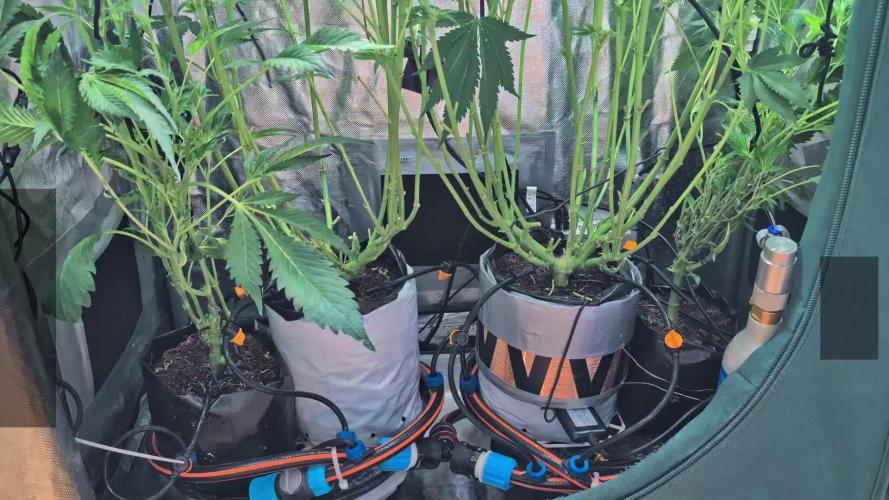
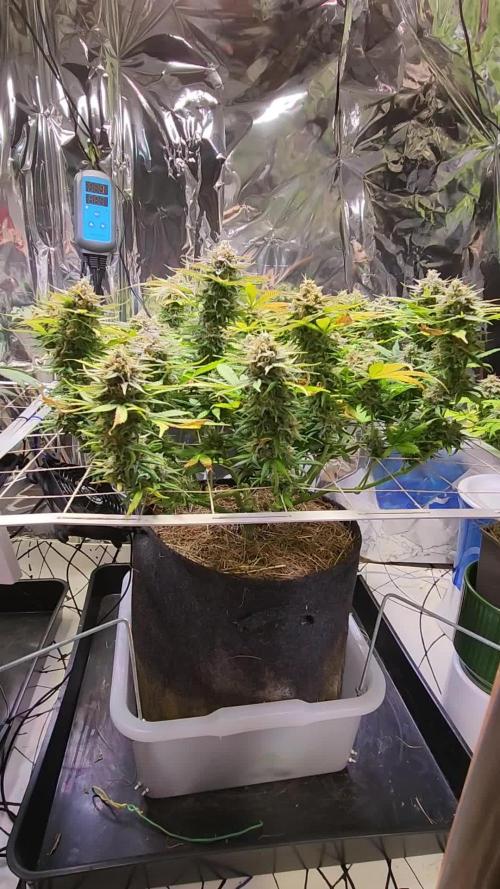
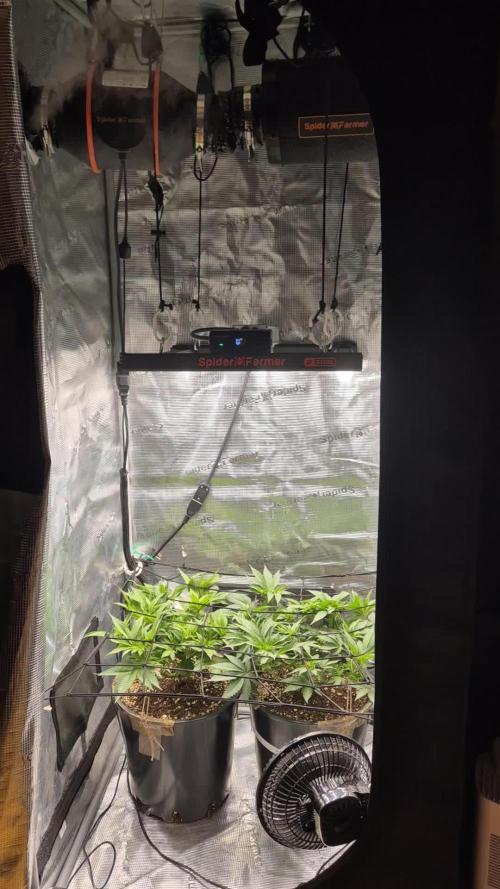
Empieza una nueva semana de floración, seguimos abonando de forma controlada y regulando pH. Los cogollos ya empiezan a formar bolitas en todos los ápices de las plantas . Crecen con los pistilos muy blancos y en gran cantidad . Seguimos en ello 💚.
Likes
Comments
Share
07.07.25 The Auto Amnesia ist taking up shape nicely. Some yellowing leafes but not many, no pests taking a hold so far on this strain, few thrips bites only. The Lemon Kix has some leafes with powdery mildew which I'll keep watching and spraying with H2O2 solution every now and then. Maybe 4 weeks left for this one. The cream cookies I replaced in a mini pot is about 10-14 days from finishing. Half of the trichomes appear cloudy but very few amber still. Sadly this one's has quite some pests for its size, which means it will end up in the rosin press if the ladybugs don't clean it up before harvest.
Likes
25
Share
Day 10 Of 12-12, defoliated 75% of canopy will leave untouched until day 21 Flower. Running 1250 ppms of cropsalts, light dimmed to 75% @15-18” of canopy.
Likes
7
Share
Buenos dias a todos. Es la primera vez que cultivo, en este caso es una Sour Compassion CBD. Esta planta fue un esqueje que me regaló un amigo. Cuando me lo dio estaba espigado en un vaso de plástico con 1 mes de vida. La pase a una maceta "Mad Rocket" de 16L. La hice vegetar 2 meses y luego la pase a florar el 8 de Marzo. Tuvo 111 días de vida y 71 días de floración. Con respecto a la fertilización que aparece, hace referencia a toda la vida de la planta. Saludos cannabicos
Processing
Likes
13
Share
Day one of this week entailed me going to the hydro shop, grabbing so blue sky organics super soil, some 1 gal fabric pots and off I went. I always pot my soil then water the pots down and wait 24 hours for everything to acclimate so as to not shock my seeds. I germinate straight into the soil. I will post more pics to beef up this week! I will be planting 2 fastbuds orange sherbet beans, 1 in a 1gal fabric pot and 1 in a 3gal from the bucket company.
Processing
Likes
14
Share
@GRow_M8s
Follow
We took a closely look at our 18 plants, 18 days before the end (harvest) of the 66 days experiment... * Extreme defoliation for maximum lighting. * Low humidity (45-50%). * 24/24 lights all the 7 weeks from seedlings.
Likes
60
Share
Buds getting big. Very good sweet smell. Remembers a little bit the Radical Juice smell.
Likes
13
Share
After the 3rd week and noticed about 15 plants weren't growing so I got rid of them. There are still a few that aren't nearly as big as the majority so I'll give them another week or 2 and if no improvement I'll get rid of them and only the strongest will survive!
Likes
56
Share
What's in the soil? What's not in the soil would be an easier question to answer. 16-18 DLI @ the minute. +++ as she grows. Probably not recommended, but to get to where it needs to be, I need to start now. Vegetative @1400ppm 0.8–1.2 kPa 80–86°F (26.7–30°C) 65–75%, LST Day 10, Fim'd Day 11 CEC (Cation Exchange Capacity): This is a measure of a soil's ability to hold and exchange positively charged nutrients, like calcium, magnesium, and potassium. Soils with high CEC (more clay and organic matter) have more negative charges that attract and hold these essential nutrients, preventing them from leaching away. Biochar is highly efficient at increasing cation exchange capacity (CEC) compared to many other amendments. Biochar's high CEC potential stems from its negatively charged functional groups, and studies show it can increase CEC by over 90%. Amendments like compost also increase CEC but are often more prone to rapid biodegradation, which can make biochar's effect more long-lasting. biochar acts as a long-lasting Cation Exchange Capacity (CEC) enhancer because its porous, carbon-rich structure provides sites for nutrients to bind to, effectively improving nutrient retention in soil without relying on the short-term benefits of fresh organic matter like compost or manure. Biochar's stability means these benefits last much longer than those from traditional organic amendments, making it a sustainable way to improve soil fertility, water retention, and structure over time. Needs to be charged first, similar to Coco, or it will immobilize cations, but at a much higher ratio. a high cation exchange capacity (CEC) results in a high buffer protection, meaning the soil can better resist changes in pH and nutrient availability. This is because a high CEC soil has more negatively charged sites to hold onto essential positively charged nutrients, like calcium and magnesium, and to buffer against acid ions, such as hydrogen. EC (Electrical Conductivity): This measures the amount of soluble salts in the soil. High EC levels indicate a high concentration of dissolved salts and can be a sign of potential salinity issues that can harm plants. The stored cations associated with a medium's cation exchange capacity (CEC) do not directly contribute to a real-time electrical conductivity (EC) reading. A real-time EC measurement reflects only the concentration of free, dissolved salt ions in the water solution within the medium. 98% of a plants nutrients comes directly from the water solution. 2% come directly from soil particles. CEC is a mediums storage capacity for cations. These stored cations do not contribute to a mediums EC directly. Electrical Conductivity (EC) does not measure salt ions adsorbed (stored) onto a Cation Exchange Capacity (CEC) site, as EC measures the conductivity of ions in solution within a soil or water sample, not those held on soil particles. A medium releases stored cations to water by ion exchange, where a new, more desirable ion from the water solution temporarily displaces the stored cation from the medium's surface, a process also seen in plants absorbing nutrients via mass flow. For example, in water softeners, sodium ions are released from resin beads to bond with the medium's surface, displacing calcium and magnesium ions which then enter the water. This same principle applies when plants take up nutrients from the soil solution: the cations are released from the soil particles into the water in response to a concentration equilibrium, and then moved to the root surface via mass flow. An example of ion exchange within the context of Cation Exchange Capacity (CEC) is a soil particle with a negative charge attracting and holding positively charged nutrient ions, like potassium (K+) or calcium (Ca2+), and then exchanging them for other positive ions present in the soil solution. For instance, a negatively charged clay particle in soil can hold a K+ ion and later release it to a plant's roots when a different cation, such as calcium (Ca2+), is abundant and replaces the potassium. This process of holding and swapping positively charged ions is fundamental to soil fertility, as it provides plants with essential nutrients. Negative charges on soil particles: Soil particles, particularly clay and organic matter, have negatively charged surfaces due to their chemical structure. Attraction of cations: These negative charges attract and hold positively charged ions, or cations, such as: Potassium (K+) Calcium (Ca2+) Magnesium (Mg2+) Sodium (Na+) Ammonium (NH4+) Plant roots excrete hydrogen ions (H+) through the action of proton pumps embedded in the root cell membranes, which use ATP (energy) to actively transport H+ ions from inside the root cell into the surrounding soil. This process lowers the pH of the soil, which helps to make certain mineral nutrients, such as iron, more available for uptake by the plant. Mechanism of H+ Excretion Proton Pumps: Root cells contain specialized proteins called proton pumps (H+-ATPases) in their cell membranes. Active Transport: These proton pumps use energy from ATP to actively move H+ ions from the cytoplasm of the root cell into the soil, against their concentration gradient. Role in pH Regulation: This active excretion of H+ is a major way plants regulate their internal cytoplasmic pH. Nutrient Availability: The resulting decrease in soil pH makes certain essential mineral nutrients, like iron, more soluble and available for the root cells to absorb. Ion Exchange: The H+ ions also displace positively charged mineral cations from the soil particles, making them available for uptake. Iron Uptake: In response to iron deficiency stress, plants enhance H+ excretion and reductant release to lower the pH and convert Fe3+ to the more available form Fe2+. The altered pH can influence the activity and composition of beneficial microbes in the soil. The H+ gradient created by the proton pumps can also be used for other vital cell functions, such as ATP synthesis and the transport of other solutes. The hydrogen ions (H+) excreted during photosynthesis come from the splitting of water molecules. This splitting, called photolysis, occurs in Photosystem II to replace the electrons used in the light-dependent reactions. The released hydrogen ions are then pumped into the thylakoid lumen, creating a proton gradient that drives ATP synthesis. Plants release hydrogen ions (H+) from their roots into the soil, a process that occurs in conjunction with nutrient uptake and photosynthesis. These H+ ions compete with mineral cations for the negatively charged sites on soil particles, a phenomenon known as cation exchange. By displacing beneficial mineral cations, the excreted H+ ions make these nutrients available for the plant to absorb, which can also lower the soil pH and indirectly affect its Cation Exchange Capacity (CEC) by altering the pool of exchangeable cations in the soil solution. Plants use proton (H+) exudation, driven by the H+-ATPase enzyme, to release H+ ions into the soil, creating a more acidic rhizosphere, which enhances nutrient availability and influences nutrient cycling processes. This acidification mobilizes insoluble nutrients like iron (Fe) by breaking them down, while also facilitating the activity of beneficial microbes involved in the nutrient cycle. Therefore, H+ exudation is a critical plant strategy for nutrient acquisition and management, allowing plants to improve their access to essential elements from the soil. A lack of water splitting during photosynthesis can affect iron uptake because the resulting energy imbalance disrupts the plant's ability to produce ATP and NADPH, which are crucial for overall photosynthetic energy conversion and can trigger a deficiency in iron homeostasis pathways. While photosynthesis uses hydrogen ions produced from water splitting for the Calvin cycle, not to create a hydrogen gas deficiency, the overall process is sensitive to nutrient availability, and iron is essential for chloroplast function. In photosynthesis, water is split to provide electrons to replace those lost in Photosystem II, which is triggered by light absorption. These electrons then travel along a transport chain to generate ATP (energy currency) and NADPH (reducing power). Carbon Fixation: The generated ATP and NADPH are then used to convert carbon dioxide into carbohydrates in the Calvin cycle. Impaired water splitting (via water in or out) breaks the chain reaction of photosynthesis. This leads to an imbalance in ATP and NADPH levels, which disrupts the Calvin cycle and overall energy production in the plant. Plants require a sufficient supply of essential mineral elements like iron for photosynthesis. Iron is vital for chlorophyll formation and plays a crucial role in electron transport within the chloroplasts. The complex relationship between nutrient status and photosynthesis is evident when iron deficiency can be reverted by depleting other micronutrients like manganese. This highlights how nutrient homeostasis influences photosynthetic function. A lack of adequate energy and reducing power from photosynthesis, which is directly linked to water splitting, can trigger complex adaptive responses in the plant's iron uptake and distribution systems. Plants possess receptors called transceptors that can directly detect specific nutrient concentrations in the soil or within the plant's tissues. These receptors trigger signaling pathways, sometimes involving calcium influx or changes in protein complex activity, that then influence nutrient uptake by the roots. Plants use this information to make long-term adjustments, such as Increasing root biomass to explore more soil for nutrients. Modifying metabolic pathways to make better use of available resources. Adjusting the rate of nutrient transport into the roots. That's why I keep a high EC. Abundance resonates Abundance.
Likes
6
Share
Bewässerung: 500 ml jeden 3 Tag in der dritten Woche pH-Wert: 5,8 EC-Wert: 0,7 mS/cm Temperatur: 22ºC Luftfeuchtigkeit: 50% Schädlingsbekämpfung: im Moment haben wir keine Anzeichen das es was zu bekämpfen gibt, sobald die ersten Anzeichen da sind werden wir handeln :) PPFD: 200 µmol/m²/s DLI: 15 mol/m²/Tag Düngemittel: COMPO GROW ORGANIC WACHSTUM DÜNGER, Sie bekommen auch ab jetzt immer etwas CalMag von BioBizz zu Prävention. Ab Tag 19 haben wir angefangen sie mit einem Minerlischen NPK Dünger (NPK 7-3-5) zu Gießen . Besonderheiten: Die Linsen wurden entfernt und wir haben mir dem LST begonnen, wir haben ihnen noch ein paar Nützlinge in die erde gesetzt -Tag 16 Heute haben wir mit dem LST Begonnen und sie hat sich sehr gut vom Toppen erholt. - Tag 18 heute wurde sie Entlaubt damit die Triebe mehr kraft bekommen und schön im Licht stehen. - Tag 19 heute wurden wieder die LST Sticks angepasst damit sie in form bleibt.
Likes
41
Share
@Mastr
Follow
Honestly guys she is amazing but bit slow flowering like northern light Shame I have to cut 3 main cola top coz to close to light and she couldn't photosensitive and that's cause slow flowering so I decide to cut 20cm from 3 main cola 😢😢hope that work Well I figure out why she won't flowering coz she too big for 6L pot thats why so I transplant bigger plant into 25L fabric pot and next day she start developing bud so happy 😊 Day 56 and finally preflowering is finish 🙌
Likes
6
Share
5/11 I DID NOT WATER. A COUPLE LOOKED DRY BUT STILL HAD HEFT AND I COULD FEEL MOUSTURE IN THE SOIL. I should've taken more pictures. I forgot it's a new week. Oh well. I'll be back over and I'm planning to bring the girls outside for the first time if it warms up a little more. It's windy as fuck but I can put them in the garage with the doors open. As long as that's not the direction of the wind. I raised the L.E.D light and lowered the hps. I also TRIED to FIM a 10th planet and an mk ultra. I may have just topped them. We'll see how it turns out before I do anything to the others. Pink kush grows slow and compact. Very similar to my experience with purple punch. I have two plants that have slightly twisted leaves. Nothing else is wrong with anything. Looking at the stippling on the leaf I think it might just be either low humidity or slight wind burn or a combination of the two. Now that I've looked again I think it might just be the first 5 finger leaf on those pink kush that I mat have mistaken. I'll keep an eye out. I feel better having done some research. I'll put some more pictures up and I'll update what it is that I get done. EDIT: WENT BACK OVER AROUND THREE. EVERUTHING LOOKED GREAT AND THE LEAVES WETE PRAYING ON SOME. I MAY NEED TO WATER SELECT PLANTS TOMORROW. I'LL PLAY IT BY EAR. LOWER THE HPS AND RAISING THE LED WAS A WISE CHOICE I THINK. OH AND THE "TWISTED" LEAF I WAS WORRIED ABOUT IS NOTHING. JUST THE FAN TO CLOSE AND A FOMBINATION OF LOW HUMIDITY AND MINOR HEAT STRESS. ITS BEEN TAKEN CARE OF. I WANTED TO BRING THE GIRLS OUT TODAY. ITS SUNNY AND 60° BUT THE WIND IS WHIPPING! WE'VE GOT GOOD WEATHER COMING UP THOUGH WITH TEMPS IN THE 70'S. I THINK TOMORROW ILL CLEAN/SANITIZE THE CAGE AND WASH/SANITIZE THE GROW BAGS. 5/12 Looking and lifting some of the pots I found some that were pretty much totally dry. I watered the majority of all the plants. If soil was moist I left it alone. If it looked a little dry I gave it a little water. I didn't measure the water but it wasnt even ALL of what I had left from LAST WATERING (which was like a qtr gallon If that). I just don't want to over water. The ones that I went light on last time were the ones that were dry. Plants seem to explode after watering but this wasn't nearly as much. Everything is looking great. It's easy to tell these are all indicas due to the structure and leaf shape. Much different than even the Chem Dog #4 which doesn't LOOK as "indicay" as some of the others. I wanted to bring them outside today but it's only 50 out. I'm not going to make the same mistake as years past and stress the plants. When we get a nice warm day I'll bring them out. Other plants are ready to be topped or fimmed but I haven't done it yet. Also need to clean the cage and wash the bags. 5/13 It's 60° at 9am so I think the girls will be going outside for a little bit. Didn't fully water but I used what was left of the gallon and gave them that. Some are much drier than others. I'll probably give them a full watering tomm. I only gave them a little today because I didn't want them drying out. I FIMMed a Special Kush today. WE'LL see how the hst turns out. EDIT: WENT AND BROUGHT THE GIRLS OUT FOR FOUR HOURS IN INDIRECT SUNLIGHT. THE TENTH PLANETS WERE THE ONLY ONES THAT LOOKED LIKE THEY HAD AN ISSUE. JUST MINOR HEAT OR LIGHT ISSUES WITH A COUPLE FAN LEAVES. EVERYTHING ELSE SEEMED LIKE THEY SHOT UP IN SIZE. THE LARGER CONTAINERS STILL SEEM KINDA MOIST BUT SOME ARE DRY. I NEED TO GET ON A STABLE WATER SCHEDULE. ITS HARD WITH DUFFERENT PLANTS OF VARYING SIZES. STILL HAVE A LOT OF WORK TO DO. 5/14 One plant was super light today and was a little droopy. I WATERED EVERYTHING TODAY USING APPROX A HALF GALLON. I brought them outside for the second day. I left them out for about 3hrs. It's hot today. I'm still floored that chatgtp gave me exact directions for hardening my plants off at my exact location taking the weather into consideration! That is awesome. They're all doing good. Pink kush is the slow starter this year. Kind of like purple punch was. The only plants that had ANY damage on them was the two 10th planet's and its not really damage. It's just a LITTLE mottling on the leaf and the serrations pointing down. It's weird because this strain did great here last time. The Special Kush #1 and the Pink Kush would probably be fine to leave out soon. Hindu Kush parents make those strains extremely resilient. The one chem dog #4 looks out of place with all tjis big fat indica leaves. I'm hoping the topping and fim-ing will take. It looks like it will. 5/15 Everything is looking great! I have some work to do bit then I'll be over to bring the girls out for a few hours. I'll edit this when I do. EDIT: BROUGHT THE GIRLS OUT FOR THREE HOURS TODAY. I THOUGHT THE TENP WENT DOWN TO 73 BUT TUAT WAS INDOORS. OH WELL. THEY STILL DID GREAT! THEY WERE ALL LOOKING OUT OF THE LEAN-TO LIKE SUNFLOWERS! THE STRAIGHTEN OUT AFTER BEING UNDER THE GROW LIGHTS. I'M PLANNING TO CONTINUE TO HARDEN THROUGHOUT THE WEEK. STILL NEED TO CLEAN BAGS AND GROW AREA. I HAVE 'A' CAMERA DOWN. TRIED TO FIX IT TODAY BUT I WOULD GET RO THE LAST PART BUT THE CAMERA WOULDNT READ THE QR CODE ON MY PHONE. I EMAILED THE COMPANY BUT IF I DONT HEAR BACK BY TOMORROW AND I CANT FIX IT ILL JUST BUY ANOTHER CAMERA TO ADD TO THE SYSTEM. ITS THE OLDEST CAMERA I HAVE AND ITS DONE ME 5 GOOD YEARS. MAYBE ITS TIME TO RETIRE IT. 5/16 I watered a few of the girls this morning with a small ring around the pot. I brought them outside and am leaving them for 3.5 hours today in the lean-to. They get indirect light without all the wind this way. I'll slowly increase the hours outside until there is enough daylight for them to go outside without revegging. When I put them out I noticed that a few were light and since it was close to 80° I watered most everything. I used under a half gallon. I'll see how they do from here and then move forward. I fixed my down security camera and secured my cage. Now I just need to finish hardening off, clean/sanitize bags/environment and put them in tjeir final homes. I'm not rushing it though. I've learned my lesson with that. 5/17 Plants did great yesterday and were perky and praying this morning. It was HOT yesterday too. Got into the low 80's. It's 57° degrees at 9am and it's overcast and sprinkling. I haven't decided if I'm going to bring the girls out today. It might be a good day to try some direct sunlight. I'll update whatever I decide to do.
Processing
Likes
37
Share
From previous experience, the next week should really fatten these buds. My last two feedings were PH water because I saw some slight tip burn. There is some trics starting to build up now but at this point I know she will not be crippler. When it is time, I plan to really fade her out and off nutrients. There is still new growth at the tops of each cola and I think these will be the biggest ones I have grown so far. She looks healthy and happy so far but is slowwwwwww.
Likes
Comments
Share
Flowering Week 6 – Fading Leaves, Persistent Flies The sixth week of flowering brought a mix of progress and persistent problems. The whitefly issue unfortunately hasn’t gone away. I replaced both yellow sticky traps at the end of the week, and within minutes, two new whiteflies were already spotted on the fresh left trap. The old one had four additional flies on the back. This pest pressure remains a concern, but I’ve decided to hold off on further neem oil sprays for now, given how far along we are in flowering. I’ll keep monitoring closely. Nutrient-wise, I stayed cautious this week due to ongoing signs of overfeeding. Leaf tips are still showing yellowing and some burn, especially on the lower leaves. Many leaves have pronounced yellow spots and curled tips — a clear sign of excess nutrients earlier on. To reduce stress, I watered with plain pH-adjusted water (5.5–6.0). Total watering volume was approximately 29 liters This week I also did a second round of lollipopping, focusing on removing all small popcorn buds and lower growth under the net that wouldn’t develop well. Despite the nutrient stress and the ongoing whitefly presence, the plants are still developing well. Buds are getting chunkier, trichome production is visibly increasing, and the overall structure is solid. Still, I’ll be keeping a close eye on both leaf health and pest activity in the coming days. ⸻ TL;DR – Week 6: • New whiteflies still showing up – 7 total seen this week. Both sticky traps replaced. • Additional lollipopping done: removed popcorn buds and shaded growth under SCROG. • Leaf symptoms (tip burn, spotting) persist – watered with plain pH water, once with half HESI dose. • Watered 3x this week: 9.5 L (pH only) • Light stayed at intensity level 7
Likes
Comments
Share
Got a good bit of males out of the lot but the females were def worth the wait. Def some og traces in smell and has a floral taste in the test batch with a little gsc baked cookie and sweetness. Something worth pulling out on occasion not every day.
Processing
Likes
3
Share
11/06/19#friends put the two girls in their respective pots, one of 10 liters and one of 15 liters, a few days and will start to grow. peace and love