


Processing
Likes
Comments
Share


@Sctanley007
Follow
9/30/18. She still looks great. No burn and no deficiencies so far. I fed her a liter and a half . The pot is now heavy but not totally soaked. I did not water to runoff but the lower portion of the pot is wet. I don't like soaking the pots because the bottoms take ay too long to totally dry and I have had issues watering schedules.
10/5/18 Still doing perfect with minimal attention. Bumped up the amount of Grow Big last feeding with no ill effect.
Looking ahead and having weeks before the auto is done I didn't know how to face the upcoming issue of vertical space. Shes too big to LST and I did not want to top her because shes doing incredibly well and want to see what she will produce. I rigged up a scrog contained within the bucket. I did a mod years ago to a smoker which gave me the idea in the middle of the night. I might change out the screen itself since it was just what I had on hand but will see how it works.. The openings are 2.5" so it should suit my needs. I have it set at 8 inches above soil but it is fully adjustable up and down by the nuts on the threaded rod.
I plan on keeping the main stem under the screen to induce the plant to keep producing shoots and fill the area. Im pretty excited about trying this and Stay Tuned.


Likes
1
Share


@Sur_cannabico
Follow
Estamos en plena floración ya engordando esos buds resinosos de las Withe Widow de RQS. Subimos la dosis de nutrientes y como se puede apreciar ningún síntoma de estrés o exeso de fertilizantes
Todo muy bien recibido 🙌🏻
Vamos por mas ❗️

Likes
36
Share


@SlowpokeFuegobud
Follow
That was the Melonade Runtz, Ladies and Gents! 😘
https://dutch-passion.com/en/cannabis-seeds/melonade-runtz
Melonade Runtz
Melonade (Lemon Z x Lemon Tree) x Runtz 🍈🍬🍋

Likes
1
Share

@PicoDeGallo
Follow
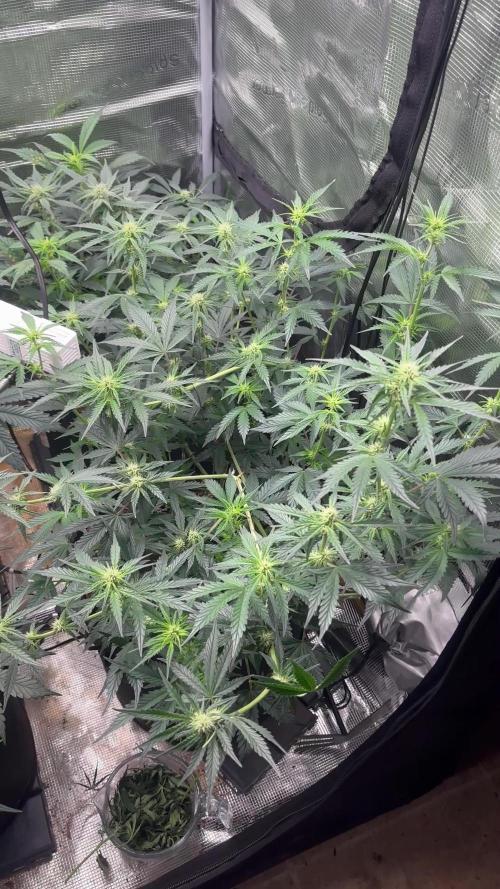
Fast Buds RF3 Auto Mixed pack (4 of 5 seeds)
Everything is coming along fine.
I pinned down most of the branches last week but, the #4 plant is starting to stretch so I added 2 more pins to get the head space more even for the light.
The #1 and #2 plants are starting to get some frost and look like they might be the same variety.

Likes
18
Share

@Pierrougarou21
Follow
Salut les growmies
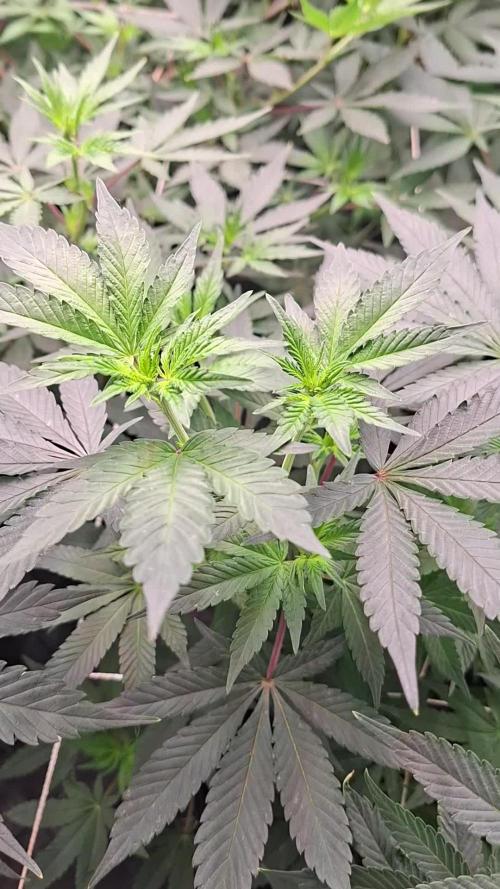
Fin de la semaine de croissance donc la nouvelle sera en mode 12H/12H.
aujourd'hui j'avant de passer mes contrôleurs en mode foraison :
J'ai traité en préventif la totalité de l'espace et des plantes à IPW.
J'ai prélevé des clones de chaque individu et pour finir j'ai installé le filet et j'ai commencé à palisser les filles sur le filets afin de bien remplir l'espace
18/09 5 jours apres le switch
20/09. Video du 7eme jours de la 1er semaine en 12H/12H. Les filles sont justes éblouissantes. Les nutriments BIOTABS sont exceptionnels. Avec, les filles sont en pleine santé et plein de vigueur.

Likes
1
Share


@Green_Peace
Follow
Increased Buddy to 1mm p/l. Will be adding PK14 in the next 2 weeks as they're peak flower and will need the Potassium etc. These plants are at the front and to the right in the timelapses.
Likes
1
Share

@PapaTerps
Follow
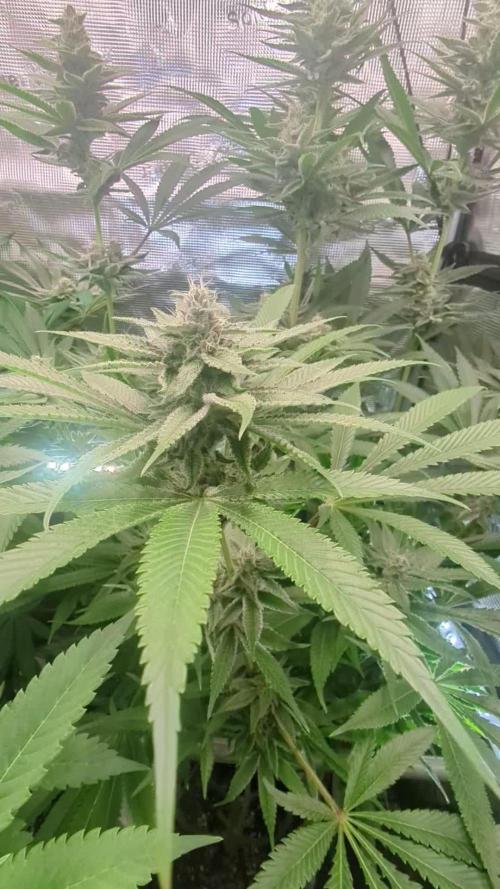
Blue Zushi - Dutch Passion
Day 87 - Watered with 3 litres of RO tap water, with defined nutrients, pH'd to 6.3. She is bulking vigorously at the moment and is drinking 3L every two days at this point, I have also increased her nutrients to ensure she is getting everything she needs 🙏🏻 She is looking so beautiful, her flower is getting so frosty and her aroma fills the tent and the room as soon as I open her up 🤩 very citrusy, possibly one of the best smells I've ever smelled!!
She has been really easy to grow so far, and has only required her first bit of defoliation in weeks today; a couple of fan leaves under the canopy that weren't receiving light or were blocking the side lighting from reaching a bud site.
I'm really impressed with this one, she is a winner!!!🙏🏻

Likes
422
Share


@Crashoverite
Follow
Hi all 🧑🌾
Welcome to my 🍌💜👊 week update.
Hope everyone keeping well and having a good week.
Thank you so much for your support on this bananas journey 💜💚💜💚
I am so happy to see how girls are developing in recent days. It's seems that Athena finally stopped her stretch and hoping that Xena will follow her sister very soon. Buds are gaining weight and size rapidly. Lots of nice colours and tonnes of trichomes on those buds already.
Week 10
Dec 18-24
Dec 18-19
Mainly observation. Xena is still stretching like crazy. both girls are developing beautifully.
Dec 20
First watering for this week. 7.5 ltr beetwen both. Runoffs PH's Athena 6.2 Xena 6.3.
Dec 21
Due to lack of light at lower parts of conopy decided for another selective defoliation, lowered a bit tallest branches with colas dangerously close to light by tieing them to netting. Couple cm will make a huge difference here. Could not clear well at the back wall of the cabinet due to limited access.I'm very happy with final result.
Dec 22-23
Joyful observation of my 🍌💜👊girls development 🧑🌾
Dec 24
All is looking great. It's seems that stretch is finally stopped. Girls looking healthy and happy.
Second watering for this week. 8 ltr beetwen both. Both runoffs PH 6.2.
It's the end of this week.
Happy Xmas everyone 🤶🎄❄️🎁☃️✌️💚🌲🎅🎄
Stay tuned for new week update ✨🍀✨✌️💚


Likes
4
Share


@ogfat
Follow
Very Very nice nugs, lots of aroma. Very relaxating high. Cool for netflix and chill. Easy to grow, proud for a first. But have plan for better quality
Likes
10
Share


@Zeravlab
Follow
1/8/24- Beg of week - hairs are beginning to turn red, trichomes are mostly all clear or white. I think at least one more week. Cleaned the bucket and trimmed some.

Likes
16
Share


@Foggedaboudit
Follow
These are the tallest and densest in the tent but there is little to no smell yet to them. Trichome production is very good for the stage so hopefully they develop a nose in the next couple of weeks. I’d hate to end up with rock hard frosty OG Kush buds with no smell 😀

Likes
3
Share


@SamDo
Follow
Week 6 of growth was another bumpy ride. Temperatures climbed up to 27–30 °C (Celsius), which is definitely on the hot side, and humidity sometimes dropped as low as 40–45%. That combo put some serious stress on the plant.
To fix it, I made a simple but effective move: I turned off the exhaust fan. Right away, humidity went up to about 70%, and the plant clearly started looking more comfortable. She seems to be handling these new conditions much better.
I did make a mistake this week, though. Wanting to push growth a little too fast, I cranked up the light intensity too quickly, jumping from 300 to nearly 600 PPFD. With humidity already so low, that sudden boost dried the plant out. She definitely felt it, but I caught it in time, adjusted back, and now she’s recovering well. A bit of lost time, but nothing dramatic.
The real highlight of the week has to be the Athena nutrients. The pH stayed locked at 6.1 from start to finish, without moving at all. I really appreciate that kind of stability, and I’m excited to see how it will impact the plant’s health and growth over the next few weeks.


Likes
4
Share


@Oyziphar
Follow
18 plants, 5 strains. Each plant has 3 main buds. By means of LST I tried to make them all the same height. Because the plants have now stopped growing, leading is no longer necessary. The plants are still attached to the plant sticks with tie strips to support the buds when they get heavy later on.
Lots and large leaves, and therefore a weekly large defoliation every week. The trichomes begin to appear.
I have 4 Marilla Fruit plants and they are all very different. The scent of each plant is very strong and very special.
MF # 2 - 79cm - has a very compact Indica growth pattern with wide and large leaves. I had to defoliate a lot. Trichomes production is well underway.
MF # 3 - 99cm - is more of the sativa type. Very slender leaves with purple stem. Trichomes production is also well underway at this plant.
MF # 4 - 81cm - Indica plant with thick clusters of leaves that are packed very close together. Lots of defoliation work.
MF # 6 - 96cm - rather sativa type. Open structure, relatively few large leaves, many side branches, buds spread over the entire plant. Less positive are the many small leaves between the flowers.
Processing
Likes
13
Share


@Livinit2019
Follow
Finally split up the plants. The big auto has the 2x2 shower to herself now and the bathtub is plenty big for the smaller auto and the vegging bag seed/"mutant". Add the bath tub to the list of domestic areas in my home that Mary Jane has claimed :P
Removing "grow big" from the nurse mix, despite it being recommended in the nute guide provided by fox farm that came with the trio I've been using, seemed to do wonders for the stunting/Yellowing. Unfortunately the top leaves on the bigger auto wilted seemingly irreparably (except for the middle one, like it's flipping me off for putting it through some rough shit >.<). All the other leaves perked back up and are in the process of uncurling.
Thanks for all the answers, you guys. I'm gonna run a flush on these babies tonight or tomorrow. It's been 48 hours since their last watering of 1gal in a 5gal pot, so they should be good to go.
Wish me luck!
Likes
2
Share

@I_T_C_R_W___GROW
Follow
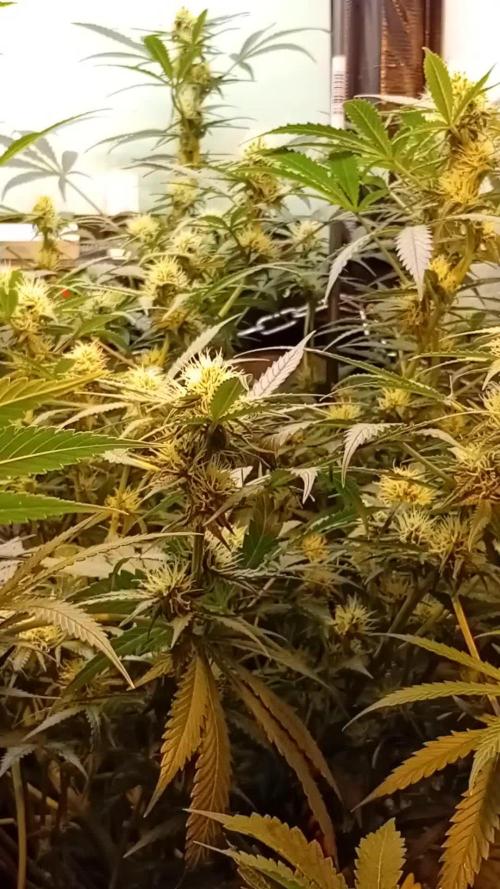
Streatched the main-colas from day to day a bit more while they grow to the outside,
now the inner section gets light and a lot of new buds can develop to a nice size.
But the plant is taking over the space.
Have made a tee from the leaves of teh last weeks and some kitchenherbs,
and then made some leaffeading with 1:5 ratio with the tea in the evening with it.
Also i gave her half Liter of ( extra to her 1L Nutri in the morning).
Repeated the Tea with 1L in higher concentration after a few days.

Likes
80
Share


@Roberts
Follow
AK 2.0 XL Autoflower has some big saggy buds on her. She grew great through the grow. Minor issues with ph here, and there. I have tried growing with low tds, and high tds in DWC. I prefer High TDS to help control ph level better. Plus plant gets much bigger. From my experiments. This plant is a fine example. Heavy yield, and full of frost. Strong aroma of citrus and a earthy fruity smell. She grew really well under the Mars Hydro FC4800. I will upload a harvest video if it let's me. If not it can be found on my YouTube channel. Link will be below. Thank you Mars Hydro, and Ganja Farmer. 🤜🤛🌱🌱🌱
Thank you grow diaries community for the 👇likes👇, follows, comments, and subscriptions on my YouTube channel👇. ❄️🌱🍻
Happy Growing 🌱🌱🌱
https://youtube.com/channel/UCAhN7yRzWLpcaRHhMIQ7X4g

Likes
81
Share


@UnorthadoxDude
Follow
Hey! Welcome to week 8! Karen is mid way through her flowering stretch. Please check back to last week as I update daily so the week is now complete. I count about 20 colas now.
Day 51: Have reconfigured the tent, see video. Karen is now 36cm and still stretching. Karen has more light now. Smell is still there hits you when you open the tent. Fertigated 2l.
Day 52: Height: 39cm. Karen's scent is heavenly. I have reconfigured again and installed some upgrades. Better reflector. Much bigger carbon filter. Increased airflow. Better config. More efficient pot layout. Karen is lovely.
I am grateful to her and for her, so I wrote her a little poem, I hope she liked it.
"Karen! Oh Karen! The phoenix of flowers,
Three lowly weeks she struggled in vain,
Shadowed and starved for five hundred hours,
He slowly wept to witness her pain.
Karen! Oh Karen! I P-H'd your showers,
and in the fourth week you started to gain,
Hallowed and hard you survived as you cowered,
I thought you meek, I was wrong once again.
Karen! Oh Karen! Forgave me my howlers.
She set a pace, a pace she maintained,
Now shes a girl at the peak of her powers,
And so I'm a geek, with buds on the brain."
Day 53: Approx 48h into a simulated dry spell.
Alright I think it is time for Karen to get her first MAJOR defoliation. I will update shortly with photos and info. I will also be doing some gentle LST to separate the colas a bit.
Day 53.5: Defoliation and LST. Finally got chance to photograph that bunda. Enjoy!
Day 53.75: Bit of a fail. Messed up the timer and the lights ended up being off for about 3 or 4 hours. Because I was cooling the room (open window) to keep temperature in the tent down, without any light the temperatures absolutely plummeted as it is sub-zero outside. By the time I realised and turned the lights on, the temp in the main tent had dropped to 14 degrees celsius. Whoops! How is that for mistreating your girl? Defoliated about 80% of her leaves, 4 nodes, significant LST, then stuck her in the cold and dark for 1/6 of a day. Not to mention she is now almost 3 days into a "dry spell". There do not seem to be ill effects, and Karen has already begun to respond to the LST; all the colas that had been changed in angle are now upright again.
The dry spell I keep mentioning, there is a method behind my madness, I have spotted one or two small flies and I think they may be fungus gnats. I am starting to suspect that the 2nd seedling in the Purple OG Punch Auto grow was actually beheaded by fungus gnat larvae. So I am drying out the mediums as much as I dare. I am closely monitoring the plants, so far the only one I have had to break the drought for is Enigma; all the girls in big pots haven't even noticed it's dry yet. How far am I going to push it? Well I will judge it on a plant by plant basis, but quite honestly I am hoping to see physical signs of thirst before I breakdrought. Of all the plants the two I think will respond most strongly to this will be Karen and Bertha, because of where they are. Karen here is actually probably 4 weeks into flowering rather than two, so about now is a good time to give her a little hydration stress. I do not think I will push it past 5 days, as RH is 34%. By now all the plants will be compensating for the lack of moisture and the high temperatures and low humidity. They will be taking more and more moisture out of the coco, and as the coco dries further and further down, those plants that have space will start desperately growing roots to find moisture. Mark my words, 24 hours after I end this drought, every plant in the tent will throw out crazy growth.
Day 54: Ended drought and fertigated 6l, no run off, I will re-fertigate tomorrow. Karen is still stretching her height post LST is now 37cm. The two tallest colas seem to have stopped but the other colas are still stretching.
Day 55: Alright so it has been 5 hours since lights on, and Karen is looking in good shape, all her drooping leaves have perked back up and she has added quite a bit of foliar growth. The colas are all still rising, except perhaps the two tallest. This girl is absolutely loaded with pistils, I'm starting to see trichomes on the sugar leaves, but trich production hasn't started in earnest yet. She has a least 20 colas, and 6 of them are thicker/taller than the primary cola at her tip. Every one of her nodes has reinforced itself with a bulbous growth and these cola branches are swelling rapidly. I am increasingly of the opinion that, all being well, this girl is going to surprise us all with her yield. My first grow, which was just mucking about really, I got 60-70g of the two main plants, and they were just bare sticks with 2 colas. Although her height is less than theirs was, 2/3 of their height was bare stick... whereas every mm of her is befoliaged and living. So in terms of the height of the actual cola I think they were about comparable in usable space on a per cola basis. The main difference being that Karen has 20+ colas whereas they had 2 primary and 2 lower. I know that it is probably unrealistic to expect more than 70g from a single auto grown indoors. Nevertheless my gut tells me this baby could achieve at least 100g, perhaps as much as 150g. The next few weeks will determine that, but given where we were in week 3 I will be grateful for any yield of quality bud. I have dropped the lights down to 18/6 from 'tonight' onwards.
I really have no idea how long we have left for Karen. According the the "brochure" she flowers for 7-8 weeks, with a total crop time of 9 weeks. The problem is I don't know what a total crop time is? Does that mean from seed to finish? If so Karen is clearly not going to be anywhere near that timescale.I am going to go ahead an assume that, for my plant anyway, the first 4 weeks were veg weeks. I think it is fair to count week 5 and 6 as flowering because pistils were popping out very early in week 5 if not before. So that makes this week four of flowering. I am going to assume 8 weeks rather than 7, so I think we have another 4 full weeks give or take a week. On that basis I am expect harvest week to be around week 12 or so. I am not fixed on this though, I am determined not to harvest this girl early.
Day 55: Photos taken 00:00 9/3/23 Strong 24h of veg growth as predicted.
Day 56: Existing leaves continue to swell. Stretch appears to be slowing. I've taken so many media this week that I cannot scroll down far enough to select a recent thumbnail. Probably Karen's biggest week in terms of changes. She is looking like she is going to impress. Height 39cm.
