


Likes
Comments
Share


@GrowinHome
Follow
Day11
Today I did some defoliating.
It took me quite some time laying on my stomach😅
I also like a clean growing space as u can see😁

Likes
14
Share


@Chucky324
Follow
Hello. This is the end of week 9 and the beginning of week 10 of flowering. One week to go.
OK... 1 week to go. I'll post before harvest pics.
Been flushing for a week now and have got some yellowing and dying leaves going on. Part of flushing.
I add 1 oz. of 30% hydrogen peroxide to each 5 gallons of tap water that goes into the reservoir.
Great flushing agent... add oxygen to the water, helps with root rot, and helps to finish the plant before harvest.
OK. Keep Growing Straight.
Chuck.


Likes
66
Share
@Arcadium
Follow
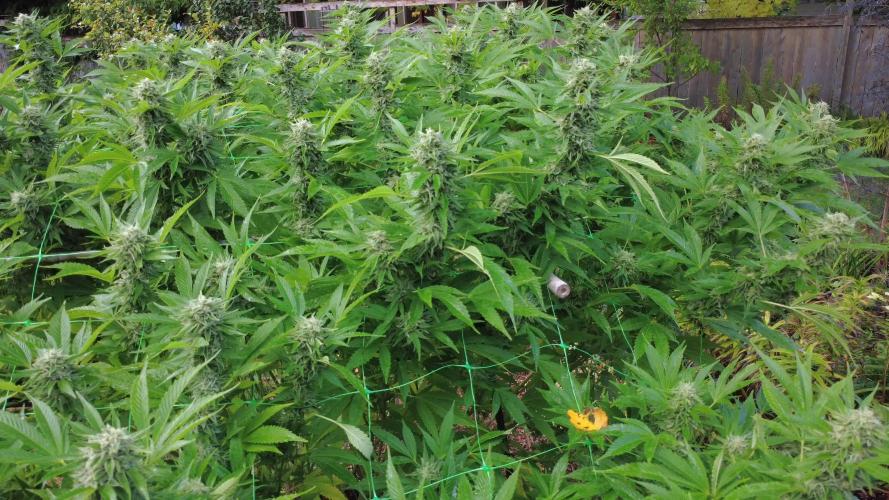
Temperature dropped this week, rain came, next week looks awful, so we're pulling her tomorrow! She's at a full 9 weeks now, 7-9 for this strain, trichomes are looking great. Will be sad to see her go, but I'll update harvest next week, will be pressing some Rosin, and hash runs late Oct that I will update as well.
530am, Snip tops, fan leaves, wash, one bucket baking soda & lemon juice, 2 rinse buckets, drip dry for a few then bring inside to hang dry. After 5 days, will paper bag sweat for a few days, then snip, super light trim and into grove bags. Will press for Rosin next weekend (assuming she's dry) so I'll update then to see how she looks!
Rest will be frozen for hash. She smells amazing, hardly lost any to rot but had some rain yesterday so I'll keep an eye on her while she's drying.
Super sad to see her go, I may leave some lower scraps for a few weeks and see how she does!

Likes
11
Share


@wheedtobeus420
Follow
Day 24 she’s looking beautiful. I’m super happy for her. She’s great had a growth spurt. Excited for her her little pre flowers are showing. I chose not to train her since she was a late bloomer. We shall see what she has to show. candy 🍬

Likes
1
Share


@Akokalypse_Grow
Follow
Den Pflanzen ging es soweit gut. Hatte bemerkt das der wachstum langsam voranging. Ich konntrolierte den EC im Drain. Der war viel zu hoch für die jetzige Vegi Zeit.
Das Substrat wurde dann durchgespült und auf den gewünschten PH&EC Wert gebracht. Es wurde noch Substrat leicht nachgefüllt und leicht gedüngt. Durch das Spülen, hingen die Blätter etwas runter. Die Pflanze hat sich mittlerweile erholt. Substrat ist eindeutig noch zu feucht um neu zu Düngen.
Likes
4
Share


@ApartmentGrower
Follow
It Was amazing. The harvest was so easy, left drying during 8 days, Then did a Cleaning process, the trimming. after doing the trimming I weighed the buds and the scale reported an incredible 103 grams. The taste is sweet, fruity and get me high af.

Likes
34
Share


@Trichome_threshold
Follow
The girls responded again very well to the defoliation. Its now 30. days since i switched to 12/12 and i am very happy with the amount of buds compared to my first grow with Glueberry OG. 😍

Likes
13
Share


@CannaScuzzyB
Follow
Overall, good first time with this breeder strain - cure will tell everything but first impressions are beautiful - berry dank taste that hits you right away and lasts awhile...don't need much to give you couch lock from this bad boy :) 😏😎🙌
Likes
3
Share


@Bdawg
Follow
Grow went well.
Spider farmer produces again the se5000. One day they myt sponsor me beofre someone else does.
Dyno myco somw gd stuff chek out ppl.
Likes
28
Share


@TeamQuality420
Follow
Will be adding a whole lot of notes to the last couple weeks just trying to get all my harvest pictures up :)
This one was a pure treat to grow . I am confident using exotic seeds that they can produce some if the world's best cannabis , hands down .
They all were bushes , not too much stretch in flower at all .
Usually in the first run with a strain I'm just figuring it all out.


Processing
Likes
Comments
Share


@Hampoop35
Follow
This week it seems like they are starting to flower or getting ready to. Day 42 and they are smelling great. I’m super excited to see the difference in plant A and plant B. The runt seems to be bouncing back. After I did some LST it really started to take off.
Likes
45
Share


@Ultraviolet
Follow
2nd net is up. Early bud formations are promising. holding up to the extremes pretty well, some leaves taking minor damage, but overall, she is holding up, gave her 1 night at 50F see how she would react, stressful. Not advised as it messes with her metabolism, but I want to see if it triggers any anthocyanin response. Love to see her purp up but no signs yet.
Homework.
If Rubisco activity is impaired and it cannot properly function or regenerate its substrate, the plant's leaves are likely to turn a pale green or
lime green, a condition known as chlorosis. Essentially, Rubisco activity is highly regulated and susceptible to various environmental and metabolic factors that can cause it to become inhibited, leading to an apparent failure in RuBP regeneration due to a lack of consumption.
Rubisco regeneration is intrinsically linked to nitrogen supply because Rubisco is a major sink for nitrogen in plants, typically accounting for 15% to over 25% of total leaf nitrogen. The regeneration phase itself consumes nitrogen through the synthesis of the Rubisco enzyme and associated proteins (like Rubisco activase), and overall nitrogen status heavily influences the efficiency of RuBP regeneration. RuBisCO is a very large enzyme that constitutes a significant proportion (up to 50%) of leaf soluble protein and requires large investments in nitrogen. Insufficient nitrogen supply limits the plant's ability to produce adequate amounts of RuBisCO, thereby limiting the overall capacity for photosynthesis and carbon fixation. Maintaining the optimal, slightly alkaline pH is crucial for the proper function and regeneration of Rubisco. Deviations in either direction (too high or too low) disrupt the enzyme's structure, activation state, and interaction with its substrates, leading to decreased activity and impaired RuBP regeneration. (LIME GREEN CHLOROSIS)
Structural Component: Nitrogen is an essential building block for all proteins, and the sheer abundance of the Rubisco protein makes it the single largest storage of nitrogen in the leaf.
Synthesis and Activity: Adequate nitrogen supply is crucial for the synthesis and maintenance of sufficient Rubisco enzyme and Rubisco activase (Rca), the regulatory protein responsible for maintaining Rubisco's active state. Nitrogen deficiency leads to a decrease in the content and activity of both Rubisco and Rca, which in turn limits the maximum carboxylation rate, Vmax, and the rate of RuBP regeneration Jmax, thus reducing overall photosynthetic capacity.
Nitrogen Storage and Remobilization: Rubisco can act as a temporary nitrogen storage protein, which is degraded to remobilize nitrogen to other growing parts of the plant, especially under conditions of nitrogen deficiency or senescence.
Nitrogen Use Efficiency (NUE): The allocation of nitrogen to Rubisco is a key determinant of a plant's photosynthetic nitrogen use efficiency (PNUE). In high-nitrogen conditions, plants may accumulate a surplus of Rubisco, which may not be fully activated, leading to a lower PNUE. Optimizing the amount and activity of Rubisco relative to nitrogen availability is a target for improving crop NUE.
Photorespiration and Nitrogen Metabolism: Nitrogen metabolism is also linked to the photorespiration pathway (which competes with carboxylation at the Rubisco active site), particularly in the reassimilation of ammonia released during the process.
To increase RuBisCO regeneration, which refers to the process of forming the CO2 acceptor molecule Ribulose-1,5-bisphosphate (RuBP) during photosynthesis, the primary methods involve optimizing the levels and activity of Rubisco activase (Rca) and enhancing the performance of other Calvin-Benson-Bassham (CBB) cycle enzymes.
Biochemical and Environmental Approaches:
Optimize Rubisco Activase (Rca) activity: Rca is a crucial chaperone protein that removes inhibitory sugar phosphates, such as CA1P (2-carboxy-D-arabinitol 1-phosphate), from the Rubisco active site, thus maintaining its catalytic competence.
•Ensure optimal light conditions: Rca is light-activated via the chloroplast's redox status. Adequate light intensity ensures Rca can effectively maintain Rubisco in its active, carbamylated state.
•Maintain optimal temperature: Rca is highly temperature-sensitive and can become unstable at moderately high temperatures (e.g., above 35°C/95F° in many C3 plants), which decreases its ability to activate Rubisco. Maintaining temperatures within the optimal range for a specific plant species is important.
•Optimize Mg2+ concentration: Mg2+ is a key cofactor for both Rubisco carbamylation and Rca activity. In the light, Mg2+ concentration in the chloroplast stroma increases, promoting activation.
•Manage ATP/ADP ratio: Rca activity depends on ATP hydrolysis and is inhibited by ADP. Conditions that maintain a high ATP/ADP ratio in the chloroplast stroma favor Rca activity.
Enhance Calvin-Benson-Bassham (CBB) cycle enzyme activity: The overall rate of RuBP regeneration can be limited by other enzymes in the cycle.
•Increase SBPase activity: Sedoheptulose-1,7-bisphosphatase (SBPase) is a key regulatory enzyme in the regeneration pathway, and increasing its activity can enhance RuBP regeneration and overall photosynthesis.
•Optimize other enzymes: Overexpression of other CBB cycle enzymes such as fructose-1,6-bisphosphate aldolase (FBA) and triose phosphate isomerase (TPI) can also help to balance the metabolic flux and improve RuBP regeneration capacity.
Magnesium ions, Mg2+, are specifically required for Rubisco activation because the cation plays a critical structural and chemical role in forming the active site: A specific lysine residue in the active site must be carbamylated by a CO2 molecule to activate the enzyme. The resulting negatively charged carbamyl group then facilitates the binding of the positively charged Mg2+ion. While other divalent metal ions like Mn2+ can bind to Rubisco, they alter the enzyme's substrate specificity and lead to dramatically lower activity or a higher rate of the non-productive oxygenation reaction compared to Mg2+, making them biologically unfavorable in the context of efficient carbon fixation. The concentration of Mg2+ in the chloroplast stroma naturally increases in the light due to ion potential balancing during ATP synthesis, providing a physiological mechanism to ensure the enzyme is activated when photosynthesis is possible. At the center of the porphyrin ring, nestled within its nitrogen atoms, is a Magnesium ion (Mg2+). This magnesium ion is crucial for the function of chlorophyll, and without it, the pigment cannot effectively capture and transfer light energy.
Mg acts as a cofactor: Mg2+ binds to Rubisco after an activator CO2 molecule, forming a catalytically competent complex (Enzyme-CO2-Mg2+). High light + CO2) increases demand: Under high light (60 DLI is a very high intensity, potentially saturating) and high CO2, the plant's capacity for photosynthesis is high, and thus the demand for activated Rubisco and the necessary Mg2+ cofactor increases. Mg deficiency becomes limiting: If Mg2+ is deficient under these conditions, the higher levels of Rubisco and Rubisco activase produced cannot be fully activated, leading to lower photosynthetic rates and potential photo-oxidative damage.
Optimal range: Studies show that adequate Mg2+ application can enhance Rubisco activation and stabilize net photosynthetic rates under stress conditions, but the required concentration is specific to the experimental setup.
Monitoring is key: The most effective approach in a controlled environment is to monitor the plant's physiological responses e.g., leaf Mg2+ concentration, photosynthetic rate, Rubisco activation state, and adjust the nutrient solution/fertilizer to maintain adequate levels, rather than supplementing a fixed "extra" amount.
In practice, this means ensuring that Mg2+ is not a limiting factor in the plant's standard nutrient solution when pushing the limits with high light and CO2.
Applying Mg2+ through foliar spray is beneficial to Rubisco regeneration, particularly in alleviating the negative effects of magnesium (Mg) deficiency and high-temperature stress (HTS). While Mg can be leached from soil, within the plant it is considered a mobile nutrient, particularly in the phloem. Foliar-applied Mg is quickly absorbed by the leaves and can be translocate to other plant parts, including new growth and sink organs.
Foliar application of: NATURES VERY OWN MgSO4 @ 15.0g L-1 in a spray bottle.
Foliar sprays are often recommended as a rapid rescue measure for existing deficiencies or as a supplement during critical growth stages, when demand for Mg is high. Application in the early morning or late evening can improve absorption and prevent leaf burn.
The starting point [of creativity] is curiosity: pondering why the default exists in the first place. We’re driven to question defaults when we experience vuja de, the opposite of déjà vu. Déjà vu occurs when we encounter something new, but it feels as if we’ve seen it before. Vuja de is the reverse—we face something familiar, but we see it with a fresh perspective that enables us to gain new insights into old problems. Come walk in the enchanted forest.
Likes
3
Share


@Bluemels
Follow
Tag 39: Heute habe ich an alle Seitenarme Holzspieße befestigt. Befestigt habe ich diese mit kleinen Stücken Softdraht die Arme werden zusätzlich noch durch den Softdraht unten bzw. Vorerst in der Waagerechten gehalten(gezogen). Ich muss noch schauen wie ich die noch tiefer ziehe um eine optimale Lichtausbeute zu erreichen. Es ist also noch einiges an Geduld und Grübeln angesagt.
Tag 41: Der Triple G geht es sehr gut, sie hat das LST gut überstanden, und wächst einfach weiter 😃
Tag 43: wieder etwas entlaubt um den Triebspitzen Licht zu geben.


Processing
Likes
1
Share


@sirdankalot
Follow
Nearing the end for the CBD crack. very few heads, rock solid buds and smell. Just what I like. The BDM has gone crazy with lots of little buds even though I did EXACTLY the same training on her. Crazy, huh? Given them each a HEAVY dose of PK and Bio/PK and anticipating 10-14 days left in CBD C and about 2-3 weeks left in the BDM. She hasn't started hardening up yet, whereas the CBD C has.
Likes
25
Share


@herewegrow
Follow
Ordered a scale the other day so should have some more numbers tomorrow! Not going to sample anything until I get the scale, then I'll update with some more details.

Likes
7
Share


@HomeToGrow
Follow
Moin,
Die Tiger Style dominiert mit ihrem Terpenen den Geruch im Zelt und ich muss jetzt schon sagen, dass ich soetwas noch nie gerochen haben und trotzdem trifft es meinen Geschmack perfekt. Das Profil wird von einem starken Lavendelgeruch dominiert, der von einem tropisch anmutigenden Profil begleitet wird, dabei würde ich nicht direkt sagen das es Tangie. Zur Zeit ist das der erste Strain bei dem ich am liebsten Stecklinge genommen hätte um diese Sorte zu bewahren, nur am Platz dafür würde es dann doch mangeln...
Mittlerweile hat die Trichombildung auch Fahr aufgenommen, auch wenn sie nicht an das Ausmaß der Lemon Z herankommt ist das Terpenprofil deutlich stärker ausgeprägt. Bisher hat der Strain sich als äußerst entspannt und widerstandsfähig gezeigt. Einzig durch den starken Stretch ist die Tiger Style etwas zu nah an die LED gekommen und eine Bud zeigt leichtes Photobleaching, dich habe nun versucht noch ein paar extra cm an Platz herauszuholen ohne den Akf oder Lüfter auszubauen, da das mit laufendes Grow mit viel Pain verbunden ist. Man kann bereits sehen, dass die Buds zu großen Colas heran wachsen (kommt auf den Bilder wenig so rüber), dabei ist das Blatt zu Blüte Verhältnis nicht optimal, aber ich muss es nochmal erwähnen das Terpenprofil ist wirklich einzigartig und gefällt mir extrem gut!


Processing
Likes
7
Share


@gablmo
Follow
It was a busy week full of events. I got them a 600 watts HPS light and microbes to help them grow faster. I finally started the trellis netting to even the canopy and get more from the lights and I also spray the plants again for bugs. I found out that I've been using powder nutrients on my reservoir and that's probably why I've been getting floods two or tree times a week and now the valve is open only when I'm there, because I'm sick of cleaning and I took that little sick plant out. My cats have her now.


