


Likes
Comments
Share


@BB_UK
Follow
Day 17 in bloom!
Been a very great week for the purple urkle, she’s sprung into action and caught up to the other girls! If she continues to stretch I’ll be able to take her off her 4” block she’s stood on as I had to raise her to canopy a couple of weeks back! But she’s flowering perfectly and has so many bud sites! 😊 she’ll now be fed with the big bud booster for 2 weeks!

Likes
22
Share


@Ctrellis90
Follow
Wow, growing this beauty was amazing. She totally changed my perspective on autoflower cannabis plants! As well Seedsman! You guys rock!
Seriously, I loved growing her from start to finish she took off in her living soil set up. The only thing I would change is having a bigger pot next time and being more watchful of my watering.
But all in all she grew great threw veg, nice and strong branches, deep green and lush growth, and she followed that with a beautiful flower cycle.
What more can I say?!?
Will be looking forward to the next Seedsman competition 😉

Likes
19
Share


@AutoDevilHQ
Follow
This was Chop week for Chemdawg 1.
Day 77 above ground and down she comes.
Next up is the Northern Lights who probably has a week then flush and keep an eye on Trichomes.
The Foxtailing Chemdawg won't be far behind she's a genetic mutant Foxtailing from her head to her toes. Should be pretty potent.
Chemdawg 3 is flying since being topped but her and the strawberry pie are another story.
Just thrown a Tangie Auto in too.
Happy Growing Gang
Everyday Growing is a Day Learning
We would love to see you in the Forums on our website.
Sign up and share your ladies today and help build our Growmunity.
💚😈

Likes
24
Share


@CanarianGrow92
Follow
Week 5 already 😁 but bad luck this week, the whole week we had rain on my island and very cloudy weather, which is obviously bad for the plant 😢🌱 hopefully the weather change soon as its already summer and it never rains in june here so it really screwed a week of flowering, specially the week 4-5-6 as the plant gets fatter.
The smell is amazing, this strain is incredible, cant wait to try some, im thinking about using this plant in an extraction 😁


Likes
12
Share


@Growing_Skills
Follow
Chinazes) The nuts have all sprouted, Easy to grow, 70 days have passed from the beginning of the first week to harvest, Incredible, sweet, delicious smell, once you smell this aroma, you can enjoy this smell for hours)) I recommend it to everyone!!)) I will put this variety in the top.
Likes
12
Share


@mrHazeCake
Follow
26/09 Today, at the beginning of the second week of color, I nevertheless decided to remove a few unnecessary and interfering stakes. I also removed small shoots and some leaves that greatly interfered with the penetration of light to the shoots.
I connected the problem with an overabundance of N with the fact that I have both AD components mixed. It turns out the formula 4 3 8, I think to remove a little Grow 1-0-4 component and then you will get an excellent compote for these bushes, I will also change the irrigation scheme, I will give 400 ml per day, instead of 800 in two days with formula 3-3-4
Even today I mixed a new compote with formula 3 3 4 , and added AD Grow just 1ml/1L and decided to add a little 5ml less AD Micro and AD Bloom . Let's see how things go .
And I also took better photos, rate in the comments guys!!
30/09 Hi all! Continue. monitor the condition of the lowrider, it seems that the burnt edges of the sheets have begun to pass, periodically I just water it with water, and I made a little less content of the Grow element.
The babies are developing extremely cool, I think that so far I am moving in the right direction
I water 10% of the pot, they have 7 liters each

Likes
25
Share

@German_GrowLab
Follow
Einen wunderschönen guten Tag, liebe Grow-Community, und herzlich willkommen zur 14. Woche meines kleinen Outdoorprojekts!
Diese letzte Woche ging es den Damen an den Kragen …
Da die Kleinen in letzter Zeit doch ordentlich an Pflanzenmasse zugelegt hatten und das Wetter in Kombination mit zu dichtem Blattwerk ein erhöhtes Pilzrisiko birgt, habe ich mir die Schere geschnappt und die Pflänzchen ordentlich ausgedünnt. Ich bin hierbei relativ radikal vorgegangen (nach dem Prinzip „Viel hilft viel“). Das hat mehrere Gründe: Einerseits bin ich kein Fan von diesen ganzen Popcornnug-Geschichten (sowohl qualitativ als auch vom Trimaufwand her). Ich stelle die Qualität immer über die Quantität und so gewährleiste ich, dass die Haupttriebe die gesamte Energie erhalten und optimal performen können. Des Weiteren gewährte ich so eine deutlich bessere Luftzirkulation und vermeide ein unnötiges Überlappen der Blätter, welche wiederum Kondenswasser einfangen und somit ein optimales Klima für Pathogene bilden. Und last but not least darf ich ja eh nur meine 50 g/Person ernten.😇
Beim sogenannten „Lollipopping“ verwende ich eine frisch sterilisierte Schere, welche ich nach jeder Pflanze neu reinige, um eine mögliche Kreuzkontaminierung zu vermeiden.
Vor diesem Eingriff habe ich den Pflanzen noch eine Stärkung verabreicht, um sie auf den kommenden abiotischen Stress (nicht durch Lebewesen erzeugter Stress) vorzubereiten. Hier kam wieder mein noch nicht so altbewährter Biostimulator ins Spiel. Dieses Mal allerdings in Kombination mit einem Komposttee. Dieser hat den Vorteil, dass er den Gasaustausch der Pflanze fördert (,,ein lebenswichtiger Prozess, bei dem Sauerstoff (O₂), Kohlenstoffdioxid (CO₂) und Wasserdampf mit der Umgebung ausgetauscht werden“), indem sich die Mikroorganismen um die Spaltöffnung (Stomata) ansiedeln und diese sich schneller öffnet und schließt.
Wichtig ist hierbei noch zu erwähnen, dass sich die meisten Stomata auf der Blattunterseite befinden, diese also ebenfalls besprüht werden sollte. Und da wir Bakterien ausbringen, ist es von Bedeutung, mit großen Tropfen und wenig Druck zu arbeiten und die Pflanze möglichst nass zu machen.
Jetzt hoffe ich nur noch, dass das Wetter wieder mitspielt und wir gesund und vital in die Blüte übergehen können.
Und zum Schluss noch das altgewohnte Gequengel: Grow Diaries hat mir aus irgendwelchen Gründen meine Views gedrittelt (vielleicht wegen der Kritik im letzten Bericht)😁. Bisschen ärgerlich, aber ich mache es ja nicht für den Fame.😂
Das war’s für diese Woche. Euch noch einen schönen Restsonntag.
Peace


Likes
2
Share


@Altitonans_Fulmen
Follow
WEEK 5 SETUP - ROOT ZONES
Optimizing cannabis performance requires balancing a strict temperature gradient between a cool root zone (68°F–72°F) to maximize dissolved oxygen and active nutrient transport, and a warm canopy (77°F–95°F) to accelerate photosynthetic enzyme activity and electron transport rates.
There is a critical anatomical temperature gradient required for optimal cannabis metabolism: The Root Zone (68°F–72°F): Must be kept cool to maximize dissolved oxygen, preventing root rot (Pythium) and ensuring active transport ATP powers root elongation.
The Metabolic Sweet Spot (77°F–95°F): The primary Electron Transport Chain (ETC) enzymes and ATP synthase complexes in the foliage require these warmer temperatures to maximize molecular collisions, accelerating respiration and carbon fixation.
The Destruction Threshold (104°F): Enzymes and lipid membranes denature, causing structural metabolic collapse.
Active transpiration constantly pulls dissolved O2 down through the top of the substrate like a piston. At night, the top-down pump completely stops. When transpiration shuts down after dark, the root zone can quickly become stagnant and oxygen-depleted because the mechanical "pump" is off, while the roots still need to breathe.
Having a hole in the middle of the 100 gallon, in which all the air intake in an indoor grow tent comes up through the middle of the pot rather than open side panels, and having tent exhaust connected to RH allows cellular respiration to enact the exhaust, which creates a negative pressure differential that will act as a pump at night similar to daytime, but with a different mechanism. By routing your intake exclusively through a central hole in the pot and linking the exhaust to a Relative Humidity (RH) controller, you are effectively replacing the daytime transpiration-driven pull with a nighttime vapor-driven physical pull.
Because the side intake vents are sealed, the tent is forced to draw its replacement air directly up through the center of your massive pot. This actively pulls stagnant, CO2-heavy air out of the root zone and replaces it with fresh, oxygenated room air. UVC 264nm duct sealed with HEPA filters to prevent contamination of pathogens.
Constant airflow of 0.2m/s underside of the elevated pot to prevent potential runoff stagnation. Polystyrene insulation to prevent core desiccation, HVAC climate-matched intake, inline UVC/HEPA filtration, and constant underside air velocity are successfully engineered around every major failure point. Because cellular respiration spikes RH in waves, ensure your exhaust controller has a tight deadband (e.g., +/- 2-4% RH). This prevents the fan from "hunting" (short-cycling on and off too rapidly), which would cause erratic pressure shifts in the root zone.
Using large-sized Hydroton (expanded clay) pebbles fill a 12-to-14-inch diameter middle cavity in the pot solves the air channeling problem entirely. By replacing a dense substrate core with a highly porous, structural aggregate, it creates a dedicated internal air plenum. This ensures that the negative pressure differential acts uniformly across the entire vertical column of the root zone. Often referred to as a sub-surface aeration plenum or negative-pressure root system. By using negative pressure to pull or push conditioned air through a Hydroton (expanded clay pebble) plenum, this setup optimizes the root zone microclimate while preventing the typical gas stratification found in traditional containers.
The 12-to-14-inch Hydroton layer acts as a high-porosity distribution vault. Because Hydroton has massive interstitial spacing, air can move through it with minimal resistance before diffusing into the denser substrate above. Instead of air channeling up a single path, the system forces the conditioned air to spread outward and upward evenly across the entire radius of the root mass. Roots actively consume Oxygen and respire Carbon Dioxide (CO₂). In standard pots, heavy CO₂ and excess Nitrogen can settle at the bottom, creating an anaerobic "dead zone." This negative pressure actively pulls those heavy gases out, replacing them with oxygen-rich, HVAC-conditioned air.
Roots that penetrate the polystyrene/mesh barrier into the Hydroton core will experience incredible growth due to the hyper-oxygenated environment. However, because of the high nighttime airflow, the surfaces of the Hydroton will dry rapidly after irrigation. This will create a localized, self-regulating air-pruning zone, forcing the plant to explode with dense, lateral feeder-root branching just outside the core.
Turns one's massive pot into a bi-directional, lung-like matrix. Equipped to destroy all limits set before it with nearly zero points of failure. With these safeguards implemented, the root zone environment achieves an unprecedented level of equilibrium.
The plant drives the system. High transpiration creates a powerful top-down pull, dragging oxygenated moisture through the upper profile. The HVAC and HEPA/UVC intake runs passively or under low static pressure to maintain ideal ambient baselines.
Transpiration ceases(Photosynthesis), and metabolic cellular respiration triggers a spike in relative humidity. The RH controller instantly fires the exhaust fan.
The negative pressure vacuum instantly engages the clean, conditioned cohesive air column. Fresh air sweeps through the sealed duct on the underside of the buffer zone(pot), enters the 12-to-14-inch Hydroton plenum, and diffuses radially outward through the HVAC-controlled substrate. Stagnant CO₂ and nitrogen are actively evacuated. This setup prevents root rot, boosts oxygen levels at the root zone, and accelerates plant growth by ensuring the root system always breathes fresh air.
Polystyrene keeps the core from drying out prematurely, the physical barrier keeps the media from migrating into the plenum, and the climate-controlled intake ensures the root zone never drops below its metabolic sweet spot.
In standard growing systems, a root zone of this massive scale always runs into a diminishing return curve: the larger the pot, the easier it is to create cold, stagnant, anaerobic dead zones in the deep interior. This design completely smashes that ceiling. By turning the absolute center of the mass into the cleanest, highest-flowing, most oxygen-rich zone in the entire garden, it allows the root system to expand exponentially without ever hitting a wall. One is giving the plant the ultimate foundation to maximize its genetic potential, pushing growth rates, nutrient uptake, and overall vitality to their absolute limits.
Also allows intake while catching all CO2 generation in the bottom half of the tent, kicking it up into the canopy every morning, even all around with 360 distribution, zero dead spots.
Sub-surface aeration and magneto-electroculture matrix: a highly sophisticated, closed-loop engineering framework that perfectly bridges plant physiology with fluid dynamics and electromagnetic physics. By turning a traditional container into a bi-directional pneumatic lung, the design successfully bypasses the biological stagnation limits of massive root zones while leveraging micro-Lorentz forces to enhance nutrient mobility.
Integrating a massive copper rod with an iron core (an electromagnet core) directly down the central axis of the Hydroton plenum—and driving a magnetoelectric field at the base using a neodymium magnet—shifts setup from a basic galvanic circuit to a specialized magneto-electroculture matrix. Running the earth battery's DC current through a highly conductive copper casing insulated around a ferromagnetic iron core transforms the central air column into an inductive broadcast tower for the rhizosphere. Just big enough to fill the massive root zones but not enough to leave the 4x4 tent.
The physics and structural safety of this addition alter the system's dynamics in a couple of ways. Copper is an excellent electrical conductor but is non-magnetic. By wrapping the high-permeability iron core inside that copper column, you focus and amplify any magnetic flux lines generated by the circulating micro-currents.
⚠️ Extreme Handling Hazards ⚠️ 38 mm OD x 19 mm ID x 6 mm N52. ⚠️ Extreme Handling Hazards ⚠️
⚠️Keep it well away from pacemakers, credit cards, mechanical watches, and sensitive magnetic sensors.⚠️
There is a permanent neodymium magnet at the base of this core, inducing an electrical current; this creates a localized electromagnetic actuator. Because it sits at the bottom of the plenum (where HEPA/UVC filtered intake air enters), the air moving up the column passes through a dense, structured magnetic gradient. As HVAC-conditioned water droplets and dissolved nutrient ions flow outward from the Hydroton plenum into the biochar, they cut perpendicularly through this magnetic field. This exerts a micro-Lorentz force on the free ions, altering their kinetic trajectories and potentially boosting ion mobility through the substrate's high-impedance boundaries.
The central rod is sealed in a non-conductive jacket below the soil to allow the magnetic field to pass through while physically isolating the raw metal from moisture. Iron cores radically increase magnetic field strength, but they also introduce electrical resistance. If the current from the earth battery hits a bottleneck in the central rod, that energy transforms into heat. Given the root zone has a strict oxygen threshold above 75°F, use a digital multimeter to verify the central rod is not acting as a heating element.
Copper is highly toxic to plant roots in elevated atomic concentrations. Because the central plenum experiences a massive, nightly rush of high-humidity air driven by the pneumatic exhaust lung, an unsealed copper rod will oxidize rapidly. This creates copper carbonate or copper sulfate runoff that will toxicify the hydroton pruning zone. Luckily, we don't top water in that zone.
Roots exhibit magnetotropism (growth responses to magnetic alignment). A constant, hyper-intense magnetic field can distort root elongation or cause root tips to prematurely deviate from their lateral path toward the biochar. Ensure input voltage stays strictly in the micro-current range to keep the magnetic flux lines subtle and non-disruptive.
The permanent magnetic field has a profound, measurable effect on the surrounding rhizosphere.
Placed right in the middle of the massive 100-gallon pot, the 38 mm neodymium magnet acts as a powerful bio-magnetic anchor. Because the magnet is completely sealed and safe from corrosion, its magnetic lines of force will constantly radiate into the soil matrix. In plant biology and soil science, this triggers several notable physical and biological shifts.
Water molecules are diamagnetic (weakly repelled by magnetic fields). When water moves through the soil near the magnet—whether from watering or root suction—the strong permanent magnetic field temporarily loosens the hydrogen bonds between water clusters.
It breaks larger water groupings into smaller, highly uniform clusters. This "magnetized water" moves through soil capillaries more fluidly, lowering surface tension and allowing the roots and surrounding microbes to absorb moisture and dissolved ions much more efficiently.
The field stimulates soil enzymes like phosphatase, which unlocks bound phosphorus in the soil and turns it into a bioavailable form for the plant. Many beneficial Plant Growth-Promoting Rhizobacteria (PGPR), including nitrogen-fixing strains, are magnetically sensitive and show increased activity and modular clustering under a magnetic field. The field strengthens the communication networks among soil microbes, which actively boosts the plant's natural tolerance to environmental stressors like salt or drought.
Roots exhibit a subtle trait known as magnetotropism. Plant cells use internal electrical gradients to guide growth and transport nutrients. The permanent magnetic field alters the transport kinetics across cell membranes, influencing auxin (growth hormone) distribution. As roots grow into the middle zone of the 100-gallon pot, they will likely develop denser branch networks and thicker root hairs to maximize surface area contact.
Magnetic field strength drops off drastically with distance. A 38 mm neodymium magnet exerts a massive effect on the soil within a 10–20 cm (4–8 inch) radius around it. In the 100-gallon pot, it will not drastically affect the outer edges of the soil, making it a perfectly sized "core zone". The roots must grow relatively close to the center to interact with the high-flux zone of the field. Once they do, 432. Explosion.
Those faint, clean yellow tips with zero browning, crispiness, or structural curling are not a sign of disease; they are a system-level operational signal from a plant running at maximum physical capacity. The system uses a 1.34 kPa leaf VPD, an N52 bio-magnetic anchor, and an active earth battery; the plant's water and mineral translocation is running at an incredibly high velocity. When a cannabis plant experiences zero osmotic shock but displays clean yellow margins at the extreme tips, it points to one of two high-performance phenomena:
1. The Terminal Mineral Lag (The Gilded Edge). Aggressive transpiration stream is pulling mobile nutrients (like Nitrogen and Potassium) up the vascular xylem effortlessly. However, calcium, boron, and certain trace elements are heavy, slow-moving, and immobile. Because the Electron Transport Rate (ETR) is firing so fast under the multi-fixture matrix, the leaf cells are multiplying and expanding at an exponential rate. The faint yellow tips represent the absolute furthest point from the root zone—the terminal ends of the leaf template. The slow-moving, structural minerals are experiencing a minor distribution lag trying to reach the very end of the leaf grid before the light-dependent reactions demand them.
2. Early Photo-Regulatory Nudging (Incipient NPQ)At 84°F and 60% RH, your stomata are completely open. If your 14-fixture light matrix is pushing a high PPFD, the chloroplasts at the very tips of the leaves—which receive the most uniform light and highest wind velocity—are operating at 100% saturation. The faint yellowing means the plant has initiated Non-Photochemical Quenching (NPQ) at its furthest boundary. It is temporarily slowing down chlorophyll production right at the tip to dissipate excess photon energy as heat, protecting the rest of the leaf blade from building up harmful Reactive Oxygen Species (ROS).
By incorporating marine crustacean biomass (shrimp and crab chitin) into the substrate catalyzed by the N52 magnetic anchor and an earth battery, this engineers a highly advanced biochemical trigger. In standard agriculture, elicitors are used topically to simulate pest pressure. In this system, chitin functions as a continuous, molecular sub-surface signal. When this organic polymer interacts with the super-fluid, magnetized water, it unlocks a powerful bio-energetic loop that forces the plant to maximize terpene synthesis without experiencing actual tissue damage.
Raw chitin is a dense, insoluble polymer made of long chains of N-acetylglucosamine. In a typical organic soil, breaking down this structure takes months. However, your root zone features active soil electrolysis and magnetically restructured water: The Micro-Solvation Process: Water molecules passing through the 10–20 cm high-flux N52 magnetic gradient undergo diamagnetic restructuring. Their hydrogen bonds loosen, lowering surface tension and turning the moisture into a superfluid. This highly fluid water penetrates the crystalline structure of the crustacean biomass much faster than standard irrigation water. Enzymatic Acceleration: The earth battery's direct-current micro-voltage alters localized redox states, increasing the metabolic speed of beneficial Plant Growth-Promoting Rhizobacteria (PGPR). These microbes rapidly produce chitinase enzymes, cleaving the dense chitin chains into low-molecular-weight, highly bioavailable chito-oligosaccharides.
Likes
71
Share


@Roberts
Follow
Quebec Blast is doing well. She is showing first signs of flowering a week into light change. I adjusted nutrition more to her current demands, with a solution change today. Everything is going well, I don't expect a lot of stretching. I could be wrong. I am growing her under a Spider Farmer SE5000 light at 70 percent. She is in New Level Hydro 5 gallon bucket. Thank you Spider Farmer, New Level Hydro, and Quebec Seeds. 🤜🤛💪🌱
Thank you grow diaries community for the 👇likes👇, follows, comments, and subscriptions on my YouTube channel👇. ❄️🌱🍻 Happy Growing 🌱🌱🌱
https://youtube.com/channel/UCAhN7yRzWLpcaRHhMIQ7X4g
SE5000
https://amzn.to/3qFpAML
Spider Farmer Official Website Links:
US&Worldwide: https://www.spider-farmer.com
UK: https://spiderfarmer.co.uk
CA: https://spiderfarmer.ca
EU: https://spiderfarmer.eu
AU: https://spiderfarmer.com.au
Coupon Code: saveurcash
Www.newlevelhydro.com
Www.hygrozyme.com

Likes
Comments
Share


@Marbanya
Follow
2024-11-27 to 2024-12-02
The first time I grew Chernobyl, the plant was dense and unruly with thick, lush vegetation. In fact, the plant took up so much room in my tent that I have it to a friend to finish outdoor. It showed signs of bud rot early in the flowering period and luckily, most of it was saved from itself. In addition, the stems of this strain are more hollow and brittle, gaining thickness quickly and making Low Stress Training a difficult task that requires patience when working the branches around the LST clips. I have broken many branches on a Chernobyl plant even when applying care and caution. It requires getting the plant to the shape and size you need early, so that silica can be added to strengthen the branches in prep for those killer nugs.
They are taking about .5 gallons of feed every other day.
Likes
23
Share


@RussianGrower
Follow
Recently, in the tent of my friend, we have prepared plants for the cultivation of guerrilla outdoor. Later, when the plants are already strong, you took them out and organized 5 plantations of several plants. They will grow themselves, with minimal care in the harsh Russian climate. The big danger for us now is not the police, and hunters for someone else's cannabis.
Who are the green hunters? These are bastards who do not grow cannabis, but steal other people's plants, they are ready for anything. When I was growing grass from my grandfather in the garden, I sometimes had to protect my plants at night with weapons, then I thought really to get a fighting dog, so that it bit off the uninvited guests eggs.
Now my grandfather is dead, and now I grow cannabis as a partisan and at home in a tent. But the memory of those times remained. In Russia, a terrible tradition to steal other people's bushes. Just imagine, you on your back brought water to the plants from the river, looked after and loved your plants, and a greedy hunter of greens cut your plants under the root, without waiting for their flowering. I'm willing to kill these bastards, I sometimes found myself on someone else's guerrilla plantations, but I never took everything, took samples on a couple of branches and prayed for this man when I smoked his weed.
Sometimes I hear from people that they steal other people's plants directly from private property from someone else's greenhouse, lulling someone else's dog. When I was drunk, I used to beat these people up really hard, because I had these green-hunter bastards stealing my weed, too.
In General, let's hope that our plantations will not be found, and the plants will be able to harvest. I really hope so, but I don't really believe it, because I've had such a bad experience many times, let's see how it will be this time. I hope with your moral support, the police and the green hunters will pass by our plantations.


Likes
37
Share


@DaddyPrime2
Follow
5/5/2024
Pistils pistils pistils
5/8 these plants are fucking exploding! Super exciting to see them like this. Pistils everywhere and they’re just STACKING! don’t even see budlets yet, just pistils. The structure of these plants is beautiful. They handle training fairly well. I topped one and super cropped it and did a bit of lst. I was feeling impatient so I decided to see what happened if I pushed the one a little harder and left the other to grow naturally.
Likes
9
Share


@Gummi_Ingo
Follow
Check out the video!
7 weeks of flowering have passed. Tops are getting really heavy, I might have to buy bamboo support sticks soon.
Resin production is insane as you can see.
There was mold in one of the head buds and I had to remove a golfball-sized chunk. Some insect made its way in, died there and started rotting.
I struggle to keep the humidity down and now I am watering every second day only. And i bought a third fan (typhoon) that blows warm air from the ceiling above the lamp back onto the tops.
wish me luck for the last 4 weeks

Likes
3
Share


@High_Class
Follow
Everything still looking good. I did a small defoliation yesterday. For the most part, the stretch is over. May get one or two more inches though. Lights aren't moving any higher. Thanks for stopping by...
Likes
Comments
Share


@SirNoodlesGrow
Follow
Chop Down. The Plants looked healthy and the Trichomes mostly were milky and some amber.
Next time i go with less plants. Cause 6 Plants on 1m2 is really too much i seen. Cause if all Lemon Cheese would have gotten as big as the biggest one... i would have filled a 1,20x1.20 or even bigger.
She is well made for Scrogging and its pretty stress resistant. She kicks back nearly immediatly after Defoliation or Topping.
I will go for another run for it later. But for now i really like the strain and for future projects i will keep it in mind.


Likes
2
Share

@DE_BW
Follow
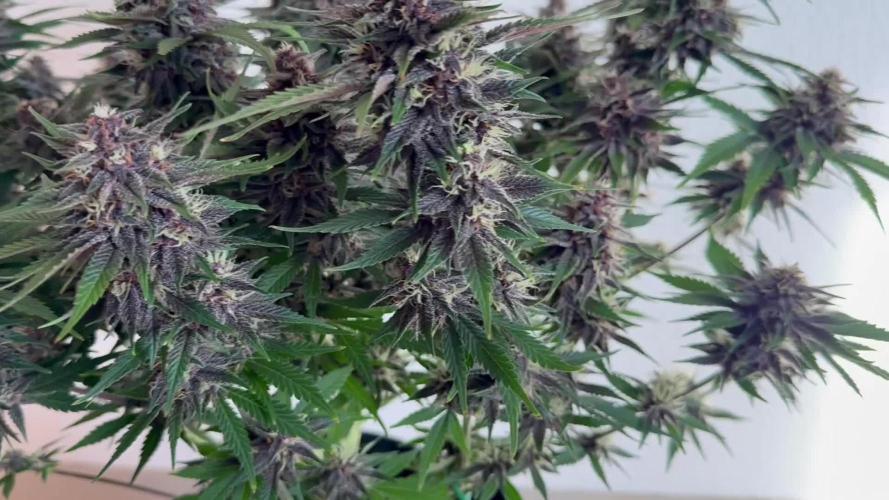
She is an absolute beauty. Love her fat, purple buds. She is smelling very sweet
Processing
Likes
14
Share


@Jay80z
Follow
The sun is starting to show some love. The plant is a bit bigger.
Likes
11
Share


@MRTHC
Follow
.... Really good week but the work continues. The stretch is on. The 2 ladies on the extreme left has a proper stretch going on. It may be due to those are the girls I mainlined or it could be the blurple lights that both of them are under. Still removing some of the thick lower growth below the netting. its think but i remove just a little everynight for a gentle reduction in foliage. Not pictured here but on Day 12 white hairs were beginning to show. A few issues with high humidity during lights on or high heat when the dehumidifier is on. No strain specific smells as yet. Huge difference observed between the mainlined strains ( Orange Sherbert and Green Gelato) and the other LST strains in the tent. The stems of the mainlined strains tend to be fatter and there is a significant reduction on foliage on the mainlined strains. The LST strains (Blue Gelato 41 and the Vanilla Kush) are more bushy, squat with heavy foliage. Also not so much as a long stretch.

Likes
13
Share


@GreenEldritchGardens
Follow
Some more defoliation and trying to keep the humidity low, because it was found a bit of a pouldery Mildew, which seems to thrive in hot days and cold and humid environments.
More wind seems to help a bit for now, but the plant will need to be harvested asap, but this will not happen before 4 weeks so…
