The Grow Awards 2026 🏆
Likes
Comments
Share
@R1pp3r
Follow
Realicé la que yo creo será la última poda, quedó un tercio de la parte inferior completamente sin brotes ni hojas. Próximamente aplicaré guano de ave y hummus para luego regar de forma alterna con agua y melaza
Likes
22
Share
Hey welcome to the start of week 6. Week 5 is now complete with daily updates so check it out! Misty is still my least popular diary. I do not know why because she is awesome! Perhaps because she is a mystery strain? Day 38: stretching fast now, wish I had space to LST this girl but after latest LST on Nesia there is NO room at all except upwards. Let's hope she stays under 1.5m. 😏 Day 39: Okay I moved all but the big pots and fan out. I still don't have space to LST Misty. I will have to wait until Bertha or Karen are finished. Hopefully it wont be too late. 🙏🏼 Day 40: She's putting in around 2cm a day right now. Fertigated 4l. Height: 35cm Day 41: Misty continues to stretch. I have adjusted the timer such that the main tent is now getting 20/4 upped from 18/6. After monitoring DLI at 18/6 for a week I am unhappy with the overall level but because of the varying heights of the plants I am limited in what I can do in adjusting the light height. Some areas were only getting 20 DLI. So I have rearranged to have the taller plants on the edges and the lowest in the middle and doing it this way all plants are getting between 35 and 50 DLI at 20/4 - although one or two cola tips here and there are getting 55. Will monitor for a week. Day 42: Alright I finally managed to find a way to organise the tent to get a bit more space for Misty so I'm going to do her first major defoliation and adjust the LST. I will update again when done. Done. Photo's added. Fertigated 8l. This was a brutal training session. I was very hard on her removing a lot of foilage and performing both extreme LST and some HST. Don't worry too much Misty will rebound from this. I will need to reapply further LST in a day or two when the nodes all straighten up. I did the same thing to Nesia on day 42... however she had been continually LST'd so I was less hard on her. Let's see what happens. Last but by no means least... I am starting to wonder if Misty is actually another Amnesia Haze Auto... she's very very similar to Nesia.
Likes
98
Share
💩Holy Crap We Are Back At It And Loving It💩 Growmies we are at DAY 49 and she's just killing💀it👌 The Smell has kicked in and is wonderful 😀 👉We are in full out flowering 💐 and its looking great 👈 So Shit , I gave them just a tad to much nutes on the first few feedings 👈 But I have since fixed it So I'm helping out with some low stress training 🙃 and some defolation 😳 Lights being readjusted and chart updated .........👍rain water to be used entire growth👈 👉I used NutriNPK for nutrients for my grows and welcome anyone to give them a try .👈 👉 www.nutrinpk.com 👈 NutriNPK Cal MAG 14-0-14 NutriNPK Grow 28-14-14 NutriNPK Bloom 8-20-30 NutriNPK Bloom Booster 0-52-34 I GOT MULTIPLE DIARIES ON THE GO 😱 please check them out 😎 👉THANKS FOR TAKING THE TIME TO GO OVER MY DIARIES 👈
Likes
16
Share
Die Pflanze wurde Mitte letzter Woche an Tag 66 geerntet. Getrocknet wurden die Blüten 6 Tage lang bei einer Luftfeuchtigkeit von 53% bevor sie nun ins Glas kommen. Getrimmt wurde die Pflanze trocken.
Likes
16
Share
Seedling managing 93F 30%RH, around 20 DLI. Vpd is in the 3's. No I don't recommend. Signum Magnum. "A great sign appeared in the sky a woman clothed with the sun with the moon under her feet and on her head a crown of twelve stars. Sing ye to the Lord a new canticle: because He has done wonderful things. Glory to the Father, and to the Son, and to the Holy Spirit As it was in the beginning, and now, and ever shall be, world without end." The plant nutrient nitrogen exists in forms with both positive and negative charges. Ammonium (NH4+)(immobile in soil)(Cation) has a positive charge, while nitrate (NO3-) (highly mobile in soil)(Anion)has a negative charge. Nitrogen is unique among plant nutrients in that it can exist in both positively charged (ammonium, NH₄⁺) and negatively charged (nitrate, NO₃⁻) forms in the soil. This makes it a special nutrient. In that it is responsible for providing balance for reactionary trade offs when it comes to ph. Because ph itself in the medium will always slowly drift towards acidicity, such is nature. 80% of nitrogen should be nitrate and no more than 20% ammoniacal nitrogen. Ca, mg, and K are the big 3 cations related to soil composition, pH & base saturation. When nitrogen is in the form of ammonium, it can compete with calcium, magnesium, and potassium for absorption sites in the plant root. This competition can lead to a reduction in the uptake of these other essential nutrients. Nitrogen, particularly in its nitrate form (NO3-), can increase soil acidity, which can also affect the availability of calcium, magnesium, and potassium. The form of nitrogen applied (ammonium vs. nitrate) can influence its interactions with other nutrients. Ammonium nitrogen can have a more pronounced negative effect on the uptake of calcium, magnesium, and potassium compared to nitrate nitrogen. Common forms of ammonium nitrogen include ammonium ion (NH4+), urea, and ammonium compounds like ammonium nitrate, ammonium sulfate, and ammonium phosphate. Common forms of nitrate nitrogen include potassium nitrate (KNO3), sodium nitrate (NaNO3), calcium nitrate (Ca(NO3)2), and ammonium nitrate (NH4NO3). Phosphorus is an essential plant nutrient, and its availability in the soil is strongly linked to the presence of oxygen. Plants primarily absorb phosphorus as phosphate (PO4), and oxygen is a key component of this molecule. Furthermore, the availability of phosphorus in the soil can be impacted by factors like soil aeration and temperature, which in turn affect the oxygen supply to the roots. Phosphorus uptake in plants is most critical during the early stages of growth, particularly within the first few weeks of plant development. Young plants actively growing tissues have a high demand for phosphorus. They may absorb up to 75% of their total phosphorus requirements within the first few weeks of vegetative growth, with up to 51% of uptake happening overnight, primarily in the first few hours or early nightfall. ⑨Anaerobic root respiration, or respiration without oxygen, is detrimental to plants because it's less efficient and produces toxic byproducts, leading to reduced energy production, nutrient uptake issues, and ultimately, root damage and plant stress. ⑨Anaerobic respiration, unlike aerobic respiration, doesn't utilize oxygen as the final electron acceptor in the electron transport chain. This results in a significant drop in the amount of energy (ATP) produced, which is necessary for various plant functions, including growth, nutrient uptake, and maintenance of cellular processes. ⑨In the absence of oxygen, plants produce byproducts like ethanol and lactic acid during anaerobic fermentation. These byproducts can be toxic to the roots and inhibit their function, ⑨When oxygen is depleted in a medium, the pH tends to decrease (become more acidic) due to the production of metabolic byproducts. This is particularly relevant in biological systems where aerobic respiration relies on oxygen as the final electron acceptor. ⑨When oxygen is scarce, plants may switch to anaerobic respiration. This process produces carbon dioxide (CO2) as a byproduct. ⑨CO2 dissolves in water to form carbonic acid (H2CO3). This acid lowers the pH of the medium, making it more acidic. ⑨Anaerobic conditions can impair a plant's ability to regulate its internal pH, leading to a drop in cytoplasmic pH and potentially cellular acidosis. ⑨The change in pH can also affect the availability of certain nutrients to the plant, as pH influences the solubility of micronutrients like iron, manganese, zinc, copper, and boron. ⑨The lack of oxygen in the plant medium leads to a decrease in pH due to the production of carbon dioxide during anaerobic respiration and impaired pH regulation within the plant. In plant cells, cellular acidosis, a drop in the internal pH of the cytosol, is a significant stress response, particularly during conditions like flooding or hypoxia. This acidification can be triggered by a decrease in oxygen levels, leading to the production of metabolic byproducts like lactic acid and CO2. The plant's ability to tolerate and recover from these conditions depends on its cellular mechanisms to regulate pH and mitigate the effects of acidosis. When plants are subjected to low oxygen environments, such as those experienced during flooding, anaerobic metabolism, which produces lactic acid and ethanol, becomes the primary source of energy. This can lead to a build-up of these acidic metabolites in the cytosol, causing a drop in pH. OXYGEN Atomic oxygen (single oxygen atom, O) is the lightest form of oxygen, as it has the lowest mass of the oxygen molecules. Oxygen also exists as a diatomic molecule (O2) and an allotrope called ozone (O3), which have higher masses due to the number of oxygen atoms combined. Atomic Oxygen (O): This refers to a single oxygen atom, which is the most fundamental form of oxygen. Molecular Oxygen (O2): This is the common form of oxygen we breathe, consisting of two oxygen atoms bonded together. Ozone (O3): This is an allotrope of oxygen, meaning it's a different form of the same element, consisting of three oxygen atoms bonded together. Since atomic oxygen has the fewest oxygen atoms, it naturally has the lowest mass compared to O2 or O3. Ozone (O3) Lifespan: Ozone has a relatively long lifespan in the stratosphere, particularly at lower altitudes. For example, at 32 km in the middle latitudes during spring, ozone has a lifetime of about 2 months. Oxygen (O) Lifespan: Atomic oxygen, on the other hand, has a much shorter lifespan. At the same altitude, its lifetime is about 4/100ths of a second. Ozone-Oxygen Cycle: The ozone-oxygen cycle involves the rapid exchange between atomic oxygen (O) and ozone (O3). UV radiation can split molecular oxygen (O2) into atomic oxygen (O), which then reacts with O2 to form ozone (O3). Ozone can also be photolyzed by UV radiation, creating atomic oxygen again, which can then react with O3 to reform O2. Dominant Form: The partitioning of odd oxygen (Ox) between ozone and atomic oxygen favors ozone in the lower stratosphere. This means that a much larger proportion of odd oxygen exists as ozone than as atomic oxygen, especially in the lower stratosphere. Recombination: Atomic oxygen has a high energy and reactivity. When it encounters another oxygen atom, they can combine to form O2. This process releases energy, contributing to the heating of the atmosphere. Ozone Formation: Atomic oxygen can also react with molecular oxygen (O2) to form ozone (O3). Ozone plays a significant role in absorbing harmful UV radiation. Other Reactions: Atomic oxygen can react with various other molecules in the atmosphere, like nitrogen (N2), water (H2O), and carbon dioxide (CO2), forming different compounds. UV light below 240nm (peak 185nm) creates ozone (O₃) through a process called photolysis, where UV light breaks down dioxygen molecules (O₂) into single atomic oxygen atoms (O). These single oxygen atoms then react with other oxygen molecules to form ozone (O₃). Specifically, UV-C light with wavelengths shorter than 240 nm can cause this photolysis. UV light with wavelengths between 240-280 nm, (peak 254 nm) breaks down ozone (O₃) into dioxygen molecules (O₂) and atomic oxygen atoms (O). 280nm does not have the energy potential to break apart the stable bond of (O₂) into enough (O) to make (O₃) At ground level, atomic oxygen (single oxygen atoms) has a very short lifespan. This is because it's highly reactive and quickly combines with other molecules to form stable diatomic oxygen (O2) or other compounds. While the exact timeframe varies depending on the specific circumstances, its lifespan is typically measured in nanoseconds or picoseconds.
Likes
2
Share
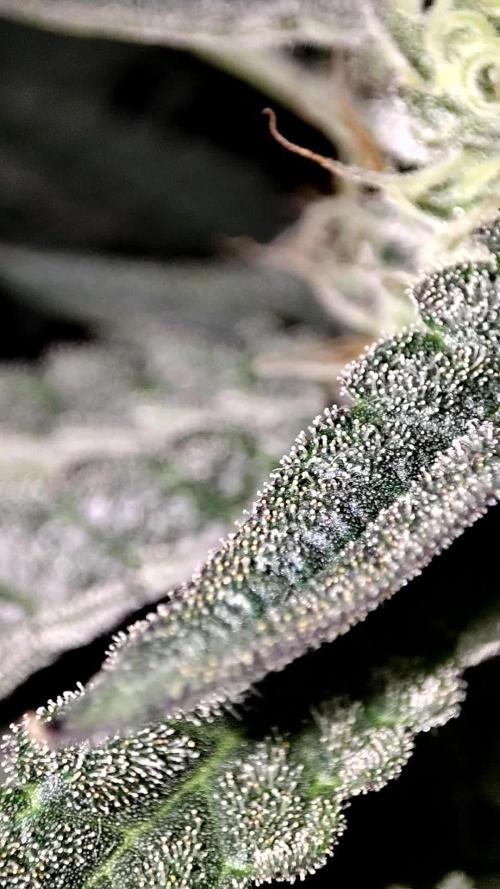
Entrando en la semana 8 de floración, según el banco son 60 días de floracion pero guiándome por los tricomas, y los peritos se nota que la maduración se habrá retrasado por la temperatura del indoor.
Likes
3
Share
@skipakz
Follow
Eine Pflanze Mitte der 11. Woche teilweise weggeschnitten (Pflnaze hing in der Blüte stark hinterher, war seit Steckling heller als alle anderen trotz gleichem cut, sah ungesund aus, wenig trichombildung etc. - man siehts auf manchen Bildern an den Blättern) so kann ich den freigeschnittenen Platz für untere Triebe nutzen… seit letzter Woche nun Athena PK und Calmag dran. Habe nochmal ordentlich entlaubt + nutzlose Blüten weggeschnitten das die unteren Triebe nochmal richtig Gas geben können.
Processing
Likes
32
Share
Saludos, por aquí mis hijas, que opinan amigo? Estoy muy deseoso de cambiarlas a floración. Buenos humos
Likes
54
Share
Hey guys :-) The ladies are developing really well 😊. I'll decide spontaneously whether I'll do topping again because I hardly have any space in the flower tent and I'll soon have to set it to 12 / 12 h due to time constraints :-( . But this week they will definitely get the veggie phase. Was poured 2 times with 1 l each (groundwater see description at the bottom) Everything was made clean. Fresh osmosis water is applied and the plants are sprayed and checked. Stay healthy 💚🙏🏻 👇🏼👇🏼👇🏼👇🏼👇🏼👇🏼👇🏼👇🏼👇🏼👇🏼👇🏼👇🏼 ‘Powered by GreenHouse Feeding’ Copy the link for 10% off all Nutrients 👇🏼 https://shop.greenhousefeeding.com/affiliate/MadeInGermany_PassionGrower 👇🏼👇🏼👇🏼👇🏼👇🏼👇🏼👇🏼👇🏼👇🏼👇🏼👇🏼👇🏼 You can buy this strain at : https://www.amsterdamgenetics.com/product/choco-cheesecake/ 👇🏼👇🏼👇🏼 Use the coupon code: madeingermany for 10% on all Amsterdam Genetics seeds Water 💧 💧💧 Osmosis water mixed with Cal/Mag (24 hours stale that the chlorine evaporates) to 290 ppm and Ph with Ph- to 5.8 - 6.4 MadeInGermany
Likes
19
Share
Legend Timestamp: 📅 EC - pH: ⚗️ Temp - Hum: 🌡️ Water: 🌊 Food: 🍗 pH Correction: 💧 Actions: 💼 Thoughts: 🧠 Events: 🚀 Media: 🎬 D: DAY, G: GERMINATION, V: VEGETATIVE, B: BLOOMING, R: RIPENING, D: DRYING, C: CURING ________________________________ 📅 D63/B01 - 17/01/24 ⚗️ EC: 0.1 pH: 7.4 🌡️ T: 23 °C H: 58% 🌊 Flushing 🍗 💧 💼 Added CO2 dispenser system 🧠 🚀 🎬 Added 1 pic ________________________________ 📅 D64/B02 - 18/01/24 ⚗️ EC: 0.9 pH: 7.2 🌡️ T: 21 °C H: 53% 🌊 Res changed 🍗 Added CalMag - Bloom A-B - B-52 - Bud Candy - Rhino Skin - Voodo Juice 💧 🧠 pH is still too high, I'm evaluating to use pH- 🚀 🎬 Added Timelapse video ________________________________ 📅 D65/B03 - 19/01/24 ⚗️ EC: 0.8 pH: 7.4 🌡️ T: 20 °C H: 45% 🌊 Added a little bit of pH- 🍗 💧 💼 LST 🧠 🚀 🎬 Added Timelapse video and 1 pic ______________________ 📅 D66/B04 - 20/01/24 ⚗️ EC: 0.8 pH: 7.4 🌡️ T: 21 °C H: 51% 🌊 🍗 💼 LST 🧠 🚀 🎬 Added Timelapse video ________________________________ 📅 D67/B05 - 21/01/24 ⚗️ EC: 1.2 pH: 7.4 🌡️ T: 21 °C H: 50% 🌊 Added 6L 🍗 Added Calmag - Bloom A-B - B52 - Bud Candy 💧 💼 🧠 🚀 🎬 Added Timelapse video and 2 pics ________________________________ 📅 D68/B06 - 22/01/24 ⚗️ EC: 1.2 pH: 5.9 🌡️ T: 21 °C H: 51% 🌊 🍗 💧 Added pH- 💼 🧠 🚀 As I would join this contest : https://growdiaries.com/giveaways/TrolMaster-Tent-X-Ultimate-Grow-Challenge I asked for a Tent-X device and they accepted to borrow it to me until the contest ends. 🎬 Added 1 pic ________________________________ 📅 D69/B07 - 23/01/24 ⚗️ EC: 1.2 pH: 5.2 🌡️ T: 22 °C H: 51% 🌊 Added 4L of water 🍗 Added Calmag - Big Bud - B52 - Bud Candy 💧 💼 🧠 pH is finally stable on the lower side (hopefully) 🚀 🎬 Added 4 pics
Likes
100
Share
Una semana más les muestro como avanza mi cultivo actual. Tras corregir los problemas con la humedad las plantas están avanzando genial, iremos viendo como siguen creciendo
Likes
35
Share
Bueno familia ya finalizamos, estas red hot cookies son una cepa bestial. La verdad que el secado muy bien 7 días en Malla y a los botes, 45% humedad y 23 grados es la temperatura ambiental que han tenido en el secado. 4 plantas que se cultivaron en un armario de 1.20 pero estos ejemplares solo ocuparon 80x80. Así que ya está cultivada esta gran variedad que es novedad este 2020, americana de la familia Cookies, la Tropicanna Cookies (Girl Scout Cookies x Tangie) con un porcentaje de thc entre los 17/25%, una bomba. Que decir de Agrobeta, lo peta 💪 en cuanto a nutrientes. Un saludo y buenos humos.
Likes
8
Share
@Max1973
Follow
Day 14 - Clay balls arrived, all looks good.... 😎 **the rust and damage on the first leaves is nothing to worry about, the ice cream container water level dropped below the root level, fixed it, but was cool to learn how fast hyrdo dmg can occur.... 👍 Day 17 - Lookin good... vid.... 👍😎👊
Likes
9
Share
Warunki raczej stabilne temperatura w dzień ca. 24-26C w nocy 17-19C wilgotność ok.50% Lampa 75% ,60cm od szczytów. Podlewane w cyklu woda-woda-odzywki... Zastanawiam się czy nie dołożyć lampy UV (mantis od grow the jungle) na 1 godzinę dziennie. Pozdrawiam oglądających.
Likes
24
Share
Zweite Blütewoche. Diese Woche gibt es das erste mal Blütedünger. Bio PK 5-8 von Biotabs. Ich habe mich mit 8ml leicht unterhalb der Angabe des Herstellers (10ml) orientiert. Außerdem habe ich einige Blätter entfernt um Platz für verdeckte Triebe zu schaffen. Die Blüten fangen an sich zu bilden. Ich hoffe das Höhenwachstum ist zuende.
Likes
6
Share
Likes
1
Share
Week 7 of flowering 10/30/24 Changed nutrients to fit week 7 Buds are getting even bigger and thicker. Last week PH drop happened again a couple of days after the major flush. PH in rootzone is getting lower every day. Runoff still at 10-20%, so no salt buldup, EC same as intake or litttle higher. Flushed again with FloraKleen and watered with TriPart Micro, Grow, Bloom with CalMag. Bought Potassium Bicarbonate and Calcium Carbonate as suggested by "Aqua Man", to buffer coco in the future. (https://www.thcfarmer.com/threads/ph-dropping-from-5-8-to-3-9-overnight-what-is-causing-this.87011/post-2329509) changed nutes on 11/2/24, to FinalPart at 1.3 EC. Checking runoff PH and EC daily.
Likes
39
Share
@G4NJAG4NG
Follow
Day 28 - well it's the beginning of week 5 and I have now got the nutes finally tuned for my girls, all of them are looking gorgeous, nice green and healthy ✊ showing some great growth this week and the new growth just keeps on coming, I think another 2-3 weeks vegging and then its time to make the switch and see the stretch 😎 laughing buddhas are doing so well, considering a few were running slow at the start but they always catch up! Zkittlez OG auto at the top right is coming along nicely, currently week 4 of vegging for that girl, cookies kush at the top left is also doing well, showed some yellow leafing but managed to recover nicely. Also the HPS coverage is perfect for this tent, was using LED before which yes if far cheaper to run but I can already picture great results for these 😍 fingers crossed! Day 31 - I'm going with a sea of green and scrog method but without topping, I want these girls to grow out naturally but I can now organise the bud sites thanks to the scrog net, I will be putting the net in in week 7 if all goes well. Changed water amount to 1.25 litres, saw some nute burn so going a little easier on the nutes, will feed just Ph'd water in next feed in 2 days time. Thanks for tuning in! 😎 Day 32 - lower d the HP's light to about 60cm above to help with growth, lowered scrog net as well. Bud sites are starting to show, will organise them when ready. Switching to 12/12 on week 8. Found silver tails in Coco, must be watering too often, will let Coco dry out - not showing any damage to the plants as of yet. Hopefully drying out Coco will get rid of them.