


Likes
5
Share


@Lifesgarden420
Follow
They really know how to provide great genetics
We have never had an issue with any of their strains one of our favorite brands to grow all year round thank you so much for this great contest to help bring the world together thank you again @divine.seeds


Likes
2
Share


@fabialien
Follow
Lunes 26 de Agosto 2024, segunda semana de vida de estas preciosas, siguen en giffy, próximamente trasplantar a macetita de cartón, iremos a Walmart a comprar sustratito para ese trasplante.


Likes
6
Share


@leithsffs
Follow
Some good defoliation down low. And, a whole lot of scrogging this week. Not much to report. Time to sit and wait for the magic to happen now.

Likes
9
Share


@420DeepGrow
Follow
Gracias al equipo de Sweet Seeds, Marshydro, XpertNutrients y Trolmaster sin ellos esto no sería posible.
💐🍁 Cream Caramel:
Variedad sintética resultado del cruce de varias de nuestras mejores índicas, Blue Black x Maple Leaf Indica x White Rhino. Reconocida por la escena cannábica mundial, es la variedad más premiada de nuestro catálogo.
El sabor y aroma de esta variedad es muy intenso, dulce y acaramelado como de golosinas, fruto del cóctel molotov de índicas que contiene, con un fondo de matices terrosos procedentes de la genética Blue que interviene en el cruce. Ideal para el cultivo interior y una superplanta en el cultivo en exterior.
Su estructura es típica de las plantas índicas, con un robusto tallo de corta distancia internodal, desarrolla un gran cogollo central y multitud de ramas laterales.
La preferida por los usuarios de cannabis medicinal entre nuestras plantas ricas en THC. Relajante y antidepresiva.
🚀 Consigue aqui tus semillas:
https://sweetseeds.es/es/semillas-fotodependientes/35-cream-caramel.html
💡TS-3000 + TS-1000: se usaran dos de las lámparas de la serie TS de Marshydro, para cubrir todas las necesidades de las plantas durante el ciclo de cultivo, uso las dos lámparas en floracion para llegar a toda la carpa de 1.50 x 1.50 x 1.80.
https://marshydro.eu/products/mars-hydro-ts-3000-led-grow-light/
🏠 : Marshydro 1.50 x 1.50 x 1.80, carpa 100% estanca con ventanas laterales para llegar a todos los lugares durante el grow
https://marshydro.eu/products/diy-150x150x200cm-grow-tent-kit
🌬️💨 Marshydro 6inch + filtro carbon para evitar olores indeseables.
https://marshydro.eu/products/ifresh-smart-6inch-filter-kits/
💻 Trolmaster Tent-X TCS-1 como controlador de luz, optimiza tu cultivo con la última tecnología del mercado, desde donde puedes controlar todos los parametros.
https://www.trolmaster.com/Products/Details/TCS-
🍣🍦🌴 Xpert Nutrients es una empresa especializada en la producción y comercialización de fertilizantes líquidos y tierras, que garantizan excelentes cosechas y un crecimiento activo para sus plantas durante todas las fases de cultivo.
Consigue aqui tus Nutrientes:
https://xpertnutrients.com/es/shop/
📆 Semana 1:
Ha sido una buena semana, ella ha dado otro gran cambio en su lugar definitivo 😎.
La carpa está ocupada al 75% y comienza una floracion explosiva gracias a @Marshydro y @Xpertnutrients y @Trolmaster con esta gran genética 💪.
A partir de ahora se riega manualmente con las dosis recomendadas por el fabricante.

Likes
3
Share


@Altitonans_Fulmen
Follow
Lights are 58 inches from the main source to the top of the pot and the soil surface. If you added up all the lights in the tent, it would be 1100w-1200w total across 14 lights. Using them all at once is far too much for a plant and incredibly difficult to deal with environmentally. The lights are fixed in position; side lights have dimmers, allowing for pinpoint precision of PPF. Fixed at 58 inches, cannot move them closer to increase intensity. Instead, achieve optimal PPF by distributing smaller wattages across a massive, multi-fixture matrix. Triggering specific plant defenses without melting the canopy.
What's the point/blah blah wattage?
Never really go above 600W at any one time. Lights come on in the east of the tent and set in the west. At sunrise and sunset, the red-to-far-red R:FR light ratio drops because the sun's low angle scatters red light more than far-red light. This shift reduces active Pfr and increases inactive Pr, mimicking Mother Nature herself.
Deployed a lighting system featuring extra 660 nm deep-red and extending the spectrum up to 780 nm achieves the full Emerson Enhancement Effect by simultaneously balancing Photosystem II (PSII) and Photosystem I (PSI) to maximize quantum yield. By pairing deep-red photons with far-red photons, you trigger a synergistic biological response where the resulting photosynthetic rate is higher than the sum of both wavelengths used individually. This practice directly leverages the updated extended Photosynthetically Active Radiation (ePAR) framework. The Emerson effect accelerates plant metabolism and heat capture; you must proactively scale up your ambient room temperature, nutrient delivery, and CO₂ supplementation to prevent the light from stalling out your cannabis plant.
UVA stays high all day from morning to night, but UVB peaks at solar noon (middle of 18-hour days) when the sun is peak. Morning color starts at 2k-3k; by noon it goes to 5k- 6k and back to 2-3k for sunset, with differing P:FR at light off.
The extra-blue light is to assist with photoreactivation of UVB damage. No more yield loss for me. Using extra blue light for photoreactivation is what I do. Blue/UVA light activates photolyase enzymes, which directly repair DNA damage caused by UVB radiation.
But what's the point if it's not for yield?
Ultraviolet (UV) radiation—specifically UVA (315–400 nm) and UVB (280–315 nm)—acts as a critical environmental signal that programs a plant's photoprotective genes to unlock its true photosynthetic potential. When growers push crops to their absolute photosynthetic maximum via high-intensity light and elevated carbon dioxide, the photosynthetic machinery easily becomes overwhelmed. Emerging photobiology research demonstrates that UV radiation prevents this limiting bottleneck; it triggers specific transcription factors and signalling networks that fortify the plant's cellular defenses, allowing it to process extreme light levels without sustaining structural damage.
There are 8 limiting factors of plant growth; when carbon dioxide becomes the 9th limiting factor of plant growth, it shifts the growth curve from exponential to linear. The restriction after that is "photoprotection" against reactive oxygen species (ROS), managed via non-photochemical quenching (NPQ) and the xanthophyll cycle, which bridges into precise hydrogen and redox dosing.
UV radiation, particularly UVA, and the synthesis of zeaxanthin are critical for the xanthophyll cycle to function.
It's not chasing purple strains... One likes to call it chasing the limits of growth, trying to make the linear exponential, just like father mathematics prefers.
In order to do that, must control every environmental variable and compound the plant’s metabolic rate. True exponential growth means the rate of increase matches the current mass at every stage, requiring a closed-loop system where light, CO2, and nutrition lock into a synchronized upward curve. First, you must attempt to understand what restricts it. Precise hydrogen and redox dosing.
Nature mathematically optimizes quantum energy transfer and light absorption efficiency within the photosynthetic machinery, as it naturally dictates energy scaling hierarchies and resonance dynamics. Most won't even understand that; once you do, it changes everything.
Constructive interference occurs when two or more overlapping waves meet in phase, meaning their crests and troughs perfectly align. Their amplitudes add together, creating a new, amplified wave with greater intensity than the individual components.
Constructive interference is the foundational mechanism that establishes a resonance hierarchy across physical, structural, and acoustic systems.
Chromophore spacing is tuned to sub-nanometer precision to match the wavelengths of absorbed light, forcing constructive interference.
Light-harvesting proteins form geometric rings and lattices. These shapes act as physical resonators, trapping and focusing the wave energy.
This same principle dictates how opera singers shatter glass, how musical instruments resonate, and how bridges withstand structural vibrations. Nature uses the exact same math to harvest a photon as an engineer uses to design a concert hall.
When you push high PPFD and elevated CO₂, you create a metabolic bottleneck. The plant cannot process the energy fast enough, leading to electron backup, light-induced damage, and a collapse from exponential growth into a flat, linear rate. UV light acts as the regulatory valve that prevents this collapse.
In standard agronomy, Liebig's Law of the Minimum dictates that growth is limited by the scarcest resource. When you maximize water, nutrients, light, temperature, and CO₂, the bottleneck shifts to metabolic processing speed and photoprotection. By controlling the Redox state of the plant using UV, the xanthophyll cycle, and managing ROS, you can prevent the plant from hitting a hard photosynthetic ceiling. Instead of the growth curve flattening out (linear or plateauing due to photoinhibition), the plant continues to compound its metabolic rate efficiently. You are forcing the plant to operate at peak thermodynamic efficiency.
By matching the UVB peak with sustained UVA and shifting Kelvin temperatures (2K to 6K), you are damaging the plant just enough to trigger defensive genes, while simultaneously providing the exact light energy needed to repair that damage instantly.
UVA radiation and specific blue wavelengths accelerate this enzymatic conversion. Zeaxanthin acts as a structural sponge that absorbs excess excitation energy from chlorophyll and dissipates it safely, preventing ROS formation. Without UV signaling, the xanthophyll cycle cannot keep pace with extreme light, leading to dynamic photoinhibition (yield loss).
The addition of Spirulina is primarily for zeaxanthin, as it contains a lot. But on top of that, the active Hawaiian Spirulina in the matrix was cultivated in open ponds using a combination of 100% fresh potable water from Hawaiian aquifers and ultra-pure, deep ocean water containing all 94 trace minerals & elements. Then gently dried using patented Ocean Chill Drying technology and cold-pressed to ensure maximum nutrient levels. Spirulina, a blue-green alga, is rich in nitrogen, phosphorus, and potassium (NPK), making it an excellent source of nutrients for plant growth. Studies have shown that Spirulina can be used as a biofertilizer, effectively replacing chemical fertilizers, especially for nitrogen, with a whopping NPK of 10% (N), 20% (P), and 20% (K). Rich in proteins, amino acids, trace minerals, and plant growth-promoting compounds.
Zeaxanthin is a vital plant pigment that accumulates under intense light to drive non-photochemical quenching (NPQ), acting via thermal energy dissipation, direct singlet oxygen scavenging, and thylakoid membrane stabilization.
The violaxanthin cycle (or xanthophyll cycle) reversibly converts violaxanthin to zeaxanthin via antheraxanthin to protect plants from photooxidation.
Understanding this interconversion is vital for optimizing non-photochemical quenching (NPQ) and pushing photosynthetic limits under high-light stress.
Ascorbic acid (vitamin C) is a natural antioxidant that plants produce internally to neutralize harmful reactive oxygen species caused by photosynthesis and high light stress. Acts as a co-factor for enzymes like violaxanthin de-epoxidase in the xanthophyll cycle, which safely dissipates excess light energy.
1g ascorbic acid will neutralize 100% of chlorine in upwards of 30 gallons of tap water. If your local tap water uses chloramines (chlorine bonded with ammonia) instead of free chlorine, you will need roughly 20% to 30% more ascorbic acid to completely break the tougher chemical bond.
Molecular hydrogen and hydrogen-rich water act as selective antioxidants that help lower oxidative stress. They neutralize toxic reactive oxygen species like hydroxyl radicals and boost natural antioxidant defense systems in biological and plant systems exposed to high-intensity light or abiotic stress.
UVA and UVB act as stress signals that upregulate the plant's secondary metabolism. It forces the plant to build an internal "sunscreen" (flavonoids and anthocyanins) and fortify its cellular defenses before the peak solar noon crisis. This keeps the metabolic highway open.
In nature, the ambient ratio of UVA to UVB at solar noon sits roughly between 10:1 and 20:1 (depending on latitude and elevation). In a high-PPFD indoor matrix, maintaining a strict ratio—often aiming for around 12:1 to 15:1 UVA to UVB—provides the optimal signaling threshold.
Balancing Far-Red (FR) light at "light-off" to manage the phytochrome photo-equilibrium (Pfr to Pr conversion) in tandem with the UV schedule. Omg, the logic.
Hydrogen concentration and redox signaling as secondary messengers in this high-intensity loop.
Under the intense solar noon matrix, the pH of the thylakoid lumen drops. This acidic environment activates the enzyme Violaxanthin De-Epoxidase (VDE), which converts violaxanthin into the photoprotective zeaxanthin. VDE cannot function in a vacuum; it strictly requires ascorbic acid (Vitamin C) as an electron donor to run this conversion. If a plant undergoes heavy light stress and runs out of internal ascorbic acid, the xanthophyll cycle stalls. The plant can no longer engage in Non-Photochemical Quenching (NPQ), leading to immediate singlet oxygen O2 formation and destruction of the thylakoid membrane. This is "The Ascorbic Acid / Xanthophyll Engine"
Using ascorbic acid to neutralize chloramines in your water isn't just protecting your rhizosphere biology it actively prevents the degradation of your nutrient solution's redox potential before it ever touches the roots.
When pushing plants to the absolute edge, traditional antioxidants can be a double-edged sword because they blindly neutralize all free radicals. This is a problem because some Reactive Oxygen Species (ROS) act as critical signaling molecules telling the plant to grow. Molecular Hydrogen H2 is the Selective Kill-Switch.
Molecular hydrogen H2 is a revolutionary tool because it is a selective antioxidant. It ignores beneficial signaling ROS (like mild hydrogen peroxide) and targets only the most destructive, cell-shattering radicals—specifically hydroxyl radicals OH) and peroxynitrite.
By dosing hydrogen-rich water or managing hydrogen redox signaling, providing an emergency pressure-release valve for the plant's electron transport chain. It keeps the cellular environment stable enough that the plant never has to downregulate photosynthesis to protect itself. This maintains cellular voltage.
To trigger this defensive matrix without stunting the plant, you cannot simply blast UV indiscriminately. You must use UVA as the "scout" and UVB as the "enforcer. High UVA acts via the cryptochrome and phototropin photoreceptors to upregulate the expression of the HY5 transcription factor and prime the VDE enzyme. When the sharp spike of UVB hits at solar noon via the UVR8 receptor, the plant's biochemical "sunscreen" (flavonoids and anthocyanins) and its zeaxanthin pools are already pre-staged and waiting. This prevents the temporary stunting or "lag phase" usually associated with sudden UVB exposure."
Closing the Loop: Far-Red End-of-Day (EOD) Synergy
The final masterstroke is aligning this UV defense with a Far-Red (FR) lights-off routine. The Red-to-Far-Red Drop: At the end of the photoperiod, knocking out the blue/UVA spectrum and leaving a targeted burst of pure Far-Red (730nm) instantly flips the plant’s master switch. It converts active Pfr to inactive Pr in minutes rather than hours. Why this matters for the UV loop: UV radiation and high-intensity lighting keep the plant in a highly alert, photoprotective state that requires massive ATP expenditure to maintain. By forcing an immediate Pfr/Pr) conversion at lights-out, instantly commanding the plant to cease defensive expenditure, lower its metabolic respiration rate, and transition directly into nighttime cellular repair and carbohydrate translocation. You are maximizing the efficiency of its "sleep." every ounce, every last piece.
Highly synchronized biological dance, balancing the exact input of electrons with the exact mechanism to dissipate them safely when they overflow.
Peace.
Likes
13
Share


@Flowers_By_Irene
Follow
Partially drained the tank at the start of the week and topped up with ro water and 1ml of final solution per Litre. Last 2.5 days were in darkness.
I trimmed the majority of fan leaves before hanging up to dry in the tent today. Started out trimming with the plants in the tent and soon realised it would be much easier to just cut them down whole, hang them upside down outside the tent and trim them up a bit.
I have a small dehumidifier and a small fan heater setup in the tent and they have been keeping a humidity level of about 60% and a temp of 16 Celsius for the last few days while the lights have been off. I figure that's a good starting point for drying and I can increase the temperature if needed, that will drop the humidity also.
Intake fan at the bottom and extract fan at the top are running constantly as they have been since the grow started (low power 4" fans).
I might add back in a fan for circulation depending on how the drying goes, or maybe even trim or hang the plants better to get more airflow around the buds


Likes
6
Share

@DerEkstaseHase
Follow
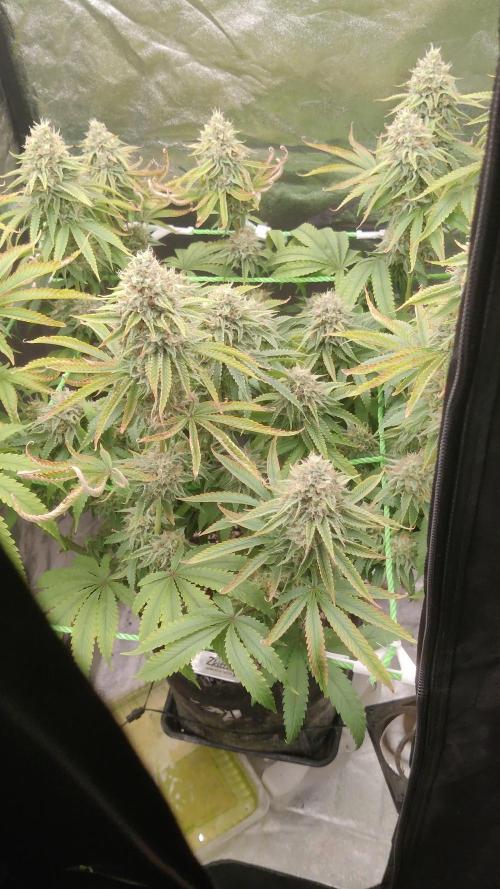
Diese Woche wird weiter heruntergefahren.
Die Pflanze braucht nun nicht mehr so viele Nährstoffe wie in den Wochen zuvor!
Übrige Salzablagerungen werden jetzt gelöst, das führt zu einem Drift im Ph, weshalb ich mein Wasser nun auf ph5,6 senke.
Inzwischen sieht es wieder besser aus, die Zkittlez nimmt wieder Nährstoffe auf und die Symptome verstärken sich nicht mehr.
EC Drain - 1,5mS, Ph 6,5

Likes
201
Share


@Hattiwatti
Follow
Hello Fellas.
Let me introduce official judge of this competition. Andrew "Gnome" Tate. Lets call it Andy. Never know what that guy has in backpack 🤣
2.5 Next Fighter is ready to try this challenge.
At the moment Divine Seeds Auto kabul looks like new champ. 1day in water + 4 days in soil and its time to begin counting.
6.5 little meteors crashed boombox. Auto Kabul is doing fine.
With High Hopes 🍀
Seeds:
https://divineseeds.net/kabul/


Likes
88
Share


@NAS_Garden
Follow
🌼 Week 1: Flower Power Unleashed! 🙌
The excitement is palpable—it's the first week of Flower! 🌸 Our girls are ready to dazzle as it steps into this vibrant phase.
Remarkable Stretch:
Hold on tight, because the stretch is in full swing! 🚀 Our green companions are reaching for the skies, displaying a wild surge of growth. Brace yourself, as the promise of doubling in size during Flower unveils a spectacle in the making.
Strategic Scrogging:
To tame the exuberant growth, a well-timed second Scrog at day 7 is in play, orchestrating the dance of foliage. It's a symphony of green, ensuring that our Lemon Orange beauties grow with grace and control.
Nutrient Management:
The week kicks off with a refreshing flush, bidding farewell to the old nutrients and welcoming a new chapter. From the second day onward, a mindful approach unfolds, with 80% of the recommended nutrients by Terra Aquatica. It's a delicate balance, nurturing the plants with the perfect blend for optimal growth.

Likes
7
Share


@Bingbings_garden
Follow
Hello growers.
Week 3 of 12/12, we have around 25-30 sites developing. She needs around 1.5L of water a day now (run off is giving me 1000ppm) . The soil is testing 6.5 so happy days.
I took two clones for the smaller sites that didnt reach canopy level last week and they have been in a dome for a week looking healthy. Hopefully they root this week and I'll move them into some smaller pots to run this girl back in my other tents asap.
Likes
16
Share


@willertex
Follow
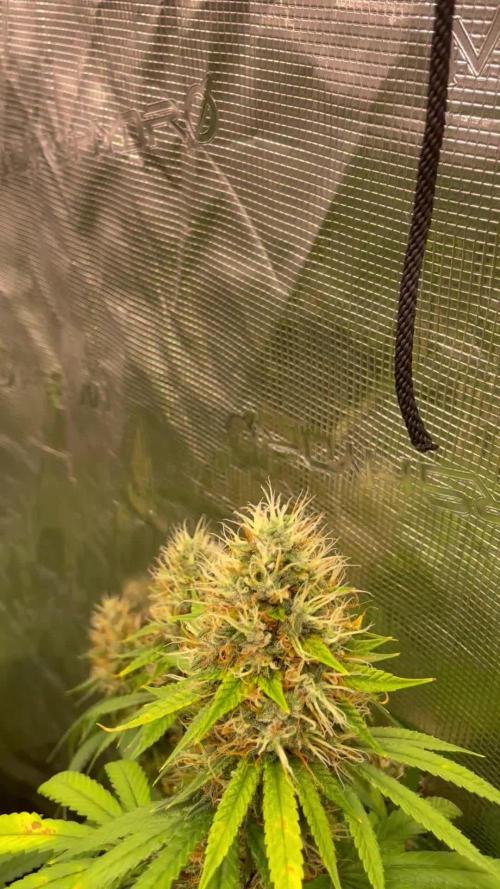
📅 D36 - 06/11
📜 Applied Defolation, LST and SCROG techniques
✍️ 1,5 EC
♒ 6 pH
🌊 10 L
📏 30 cm
📅 D37 - 07/11
📜 Raised EC
✍️ 1,6 EC
♒ 6 pH
🌊 10 L
📏 30 cm


Likes
19
Share


@GrownwithLED
Follow
During week 7 the 3 plants continue to grow outstandingly well! The BADAZZ-CHEESE and ZHEETOS from BIG BUDDHA SEEDDS have a healthy green color and grow so much foliage that I have to defoliate on a regular basis. On day 43 (=flowering day 19) I take off all bigger fan leaves in order to ensure a better airflow thru the closet. The humidity is unfortunately still on the high side and sometimes exceeds 80% in the daily maximum, that is MUCH too high during flowering. I increased the dose of BIO NOVA nutrients according to their feeding scheme and all plants LOVE IT! The ZHEETOS #1 plant grows much taller than her sister ZHEETOS #2, therefore I decide to SUPER-CROP her on Day 48 (=FD 23). This technique developed by SOMA from SOMA-SEEDS is one of my favorites and I use it since years in order to bush out plants, which grow to high. Appr. 15-20 cm from the top of the plant, right above an internode, I take the main stem between two fingers and press very hard until I can feel the fibres inside the stem brake. By slowly pressing all around the diameter of the stem I create a weak spot at which I bend over the stem, so it looks 90-180 degrees downward. I do this very carefully to NOT BRAKE the outer skin of the stem while I bend the stem downwards. Even if some fibres brake, the stem will repair itself within a few days to a week and then start to point upwards again...👍😃 During the time the main stem needs to repair itself, all other side-stems will grow more upwards and this makes the plant bush out more. At the same time a super-cropped plant will produce bigger buds at harvest time, than a plant where you did not do that. Somehow the plant reacts to being hurt by getting stronger and producing more! CHECK OUT THE VIDEO ABOVE TO SEE ME SUPER-CROP! 😎 I also took a video ONE DAY after the procedure (on DAY 49), in order to show how resilient the plant is and how much she immediately repairs herself. Already then the main top has turned and points upwards to the light again, ITS FANTASTIC TO SEE! Simply a miracle plant...

Likes
1
Share


@Islandboi340
Follow
Buds starting to get some weight had to start tie up some support
Sticky buds!!
Likes
229
Share


@OrganicNature420
Follow
Germination date 🌱 12/07/2021
Day 57 09/09/2021
Strain 🍁 SinCity seeds Frosted Biscotti
(Biscotti Sundae x Whitenightmare)
THC% • Unknown
💡 Mars Hydro FC4800
• Power draw 480W + 5%
• Max coverage 5 x 5
• LED 2070pcsSamsungLM30B1&Osram660nm
• Max Yield 2.5g / watt
• Noise level 0 DB
• Removable Driver +2m cable
• Daisy chain (multiple lights)
https://marshydroled.co.uk/products/mars-hydro-fc-4800-led-grow-light-samsunglm301b-commercial-greenhouse-medical-indoor-kit 🇬🇧
https://www.mars-hydro.com/buy-fc-4800-480w-4x4-energy-saving-full-spectrum-commercial-led-grow-light-mars-hydro-for-sale 🇺🇸
PROMO CODE • (ORG420) DISCOUNT 👍🏻 marshydroled.com
⛺ Mars Hydro 120 x 120 x 200cm
📤📥 AC infinity 6inch
💧 10lt dehumidifier
❄️ 3.1kw air con system
💉 Nutrients GreenBuzzLiquids
Organic Grow Liquid • 1-4ml until 2wk flower
Organic Bloom Liquid • 2-4ml flower stage
Organic More PK • 2-4ml +wk3 of flower
Organic Calmag • 1-2ml/lt whole grow
Fast Plants Spray • first 3days at night lights off
More Roots • 2-5ml veg +2wks flower
Fast Buds • 5ml +wk2 of veg until 1wk flower
Humic Acid Plus • 2-5ml whole grow
Growzyme • 2-5ml whole grow
Big Fruits • 2-5ml flower stage
Clean Fruits • 5ml flush 1wk
Ph powder
Root Gel
Living Organics
https://greenbuzzliquids.com/
PROMO CODE • organicnature420 15% off ✌️🏼
🥥 Growing Media • Coco Coir
Notes 📝
No complaints she's just doing her thing ❤️🌱 sincity strains looking like they will stretch more than the other 2 strains. Trying to open the canopy up as much as possible to take advantage of all the space possible. Girls loving life. Stay tuned 💚✌️🏼
Happy growing fam ❤️🌱🍁👍🏻
Discount codes in bio for Mars and GreenBuzzLiquids 👍🏻
