


Likes
Comments
Share


@Theia
Follow
A very nice week of growth. Light schedule has been flipped so I gave them a dose of organic grow at an EC of 0.9.
I am pulling them flat across the net atm and hope with the stretch to fill out the net quite nicely .
Thanks for looking.
Stay safe 😷😷
Grow well 🌿🌼🙏🏻

Likes
13
Share


@Andres
Follow
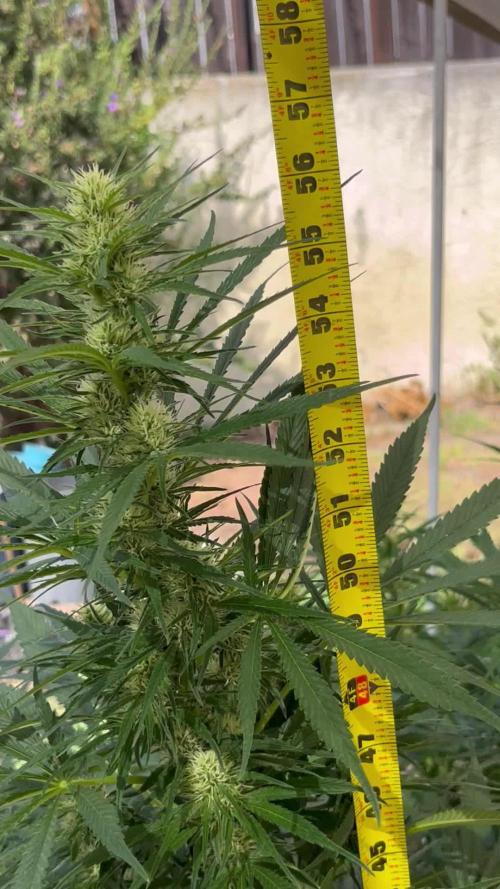
She is a monster measuring 1.94 cm 6'4 ft the same as me. She grew slow due to cloudy days. she is 2 different processes the bottom is the list and with big buds ready to be cut. The upper part has just begun flowering. her buds were cut at the bottom with 5% 15% amber in different buds. There are some big buds. I hope almost all ready as soon as possible this spring

Likes
Comments
Share


Likes
5
Share


@MadeInGermany
Follow
Flowering day 57
since time change
to 12/12 h.
Hey guys :-)
The lady is slowly coming to an end 😍.
The buds start to swell extremely .
The trichomes mature day by day.
This week she was given a very light flush with Clean Fruits so that she can use up her remaining nutrients in the coming days 👍.
It will be harvested in the next 10-14 days 😍.
I can't wait to try them all :-) .
Otherwise everything was cleaned and checked.
Have fun and stay healthy 💚🙏🏻
👇🏼👇🏼👇🏼👇🏼👇🏼👇🏼👇🏼👇🏼👇🏼👇🏼👇🏼👇🏼
You can buy this Nutrients at :
https://greenbuzzliquids.com/en/shop/
With the discount code: Made_in_Germany you get a discount of 15% on all products from an order value of 100 euros.
👇🏼👇🏼👇🏼👇🏼👇🏼👇🏼👇🏼👇🏼👇🏼👇🏼👇🏼👇🏼
You can buy this strain at :
https://gardenofgreenseedbank.com/candyland/
Water 💧 💧💧
Osmosis water mixed with normal water (24 hours stale that the chlorine evaporates) to 0.2 EC. Add Cal / Mag to 0.4 Ec Ph with Organic Ph - to 5.8 - 6.5
MadeInGermany


Likes
27
Share


@adam_pawloski87
Follow
This week went really well ! Today we are at day 79 from seed an looking beautiful! One Forbiddin Runtz got chopped an hung to dry out an the rest are still flushing out through the rest of this week! Very nice looking fades coming along on the fan leafs from purple to green , so beautiful ! So happy with these genetics from @fastbuds_genetics! Super sticky an smell is so amazing, room full of purple punch’s an Forbiddin Runtz the smell you can’t beat, so many berries!!! Well stay tuned for next week! Cheers y’all

Likes
80
Share


@Mrs_Larimar
Follow
May, 8th
OMG, those Stawberry Cough
As you can see In the Video they are still Bulkng up the Flowers
On the one Pheno the Buds are Fistsized... they are loosing fluffyness and getting dense
The other Pheno showing Cotton Caandylike Flowers
Pistils are getting darker, and Trichomes are already Milky/ with some Amber
Plant is discloring
That means all Signs for Harvesting soon
If I open thee Tent i have a strong Scent of pine and fruits......
Stay tuned

Likes
24
Share


@DeepRootsGrowTrees
Follow
GORILLA COOKIES 🍪 FF / FASTBUDS
WEEK #17 OVERALL
WEEK #9 FLOWER
This week she's doing good buds are looking good they are mostly dense decent trichome coverage and she's got a nice aroma to her and her buds are looking good she's got a few big buds going on. Stay Growing!!
Thank you for stopping by and taking a look it's much appreciated!!
Thank you FASTBUDS!!
FASTBUDS / GORILLA COOKIES 🍪 FF
Likes
9
Share


@Kominest
Follow
There’s a big variety of budshapes on the Q1 which I really like the dos si dos buds all have the same shape and look big and stacking
Unfortunately one of my mates spotted a banana on the Q1 maybe caused by calmag deficiency so on Monday to Tuesday night I decided to harvest her . Trichomes were most milky and with an expected blooming time from 5-6 weeks harvesting her starting of week 5 hurts a little but should be fine . Dos si dos now solo in the tent with no bananas or seeds spotted yet
Likes
1
Share


@Barzenegger
Follow
Pretty uneventful so far, the seedlings are growing. Humidity could be higher, I guess. Light is at 40%.
I am planning on moving the plants over into the Autopots maybe in the coming week, maybe the week after.
In the green box are still some clones from the previous run, which are just being kept alive at the moment in case one of them is a keeper, but they will move to a different place when the seedlings are transplanted into the Autopots.

Likes
47
Share


@AsNoriu
Follow
Day 9. All is running very nice. Happy with light performace a lot.
Girls missed wind a bit, but i cant make it faster, because of neighbours and sound, so i took humidity dome away.
TSL2000 runs 40 cm away and on 40% output.
Girls get daily shower , try to keep some wet cloth to maintain humidity.
Happy Growing !!!

Likes
18
Share


@BlueSmokeFarms
Follow
Bud sites are producing black/purple spot in leaves. Bud growth is producing as the days go by. Really excited with this being my first grow
Nitrogen boost really helped with the deficiencies. Plants are starting to look really heathy... Prunes lower colas that weren't stretching past the canopy and receiving energy so more energy can be used towards the top buds

Likes
77
Share


@SooSan
Follow
3eme semaine de température trop hautes (30-35°)
Dans l'ordre:
1) Afghan Peach x Blue Monkey
2) Gelato Cake
3) Fast Critical Poison
4) Tropical Fuel
5) Hindu Kush
6) (Blueberry x Black Domina) X (Kosher Kush x Mk-Ultra)
7) Blueberry (Cut = 4g)
8) Herz OG (Cut = 5g)
9) (Blueberry x Black Domina) X (Kosher Kush x Mk-Ultra) (Cut)


Processing
Likes
2
Share


Likes
47
Share


@Growdaddy420
Follow
The plants are starting to swell with dense buds and a pungent earthy aroma.
I harvested one blueberry I had in a container. Had a bit of bud rot, probably 5%. None the less the buds were ready, heavy tight dense nugs. Wet weight trimmed off the stem was 978gs.
Do si dos is almost done. She is small in comparison to the other plants, but she will be ready soon and looks like to be incredibly potent.
Everything else is coming along, Fingers crossed for good weather.

Likes
5
Share


@MG2009
Follow
03/08/2021
2nd transplant for Blue Dream, roots growing fast, might use her for a multiple strain clone mom, her sativa like root system I think would be ideal for this project.
Reppoting GSC in am and will post some pics these are before Reppoting,
Likes
26
Share


@DrRobeRt
Follow
This week they both shot up and got stronger. Wendy's broken stem made no difference and the two of them are sucking up nutes. Next weeks feed will be adding cal mag and heavier nutes as i can see pre flower, generative looks. Small white hairs appearing. Started tucking leaves back - scrog is coming too.
Hold on 2 your wigs!


Likes
57
Share


@ClubRiot
Follow
Start week 9 , Bio Bloom 4 ml/L + Sensi Cal-Mag Xtra 2 ml/L + CarboLoad 2 ml/L + Top Max 4 ml/L + Overdrive 2 ml/L (Ph 6.7).
Likes
21
Share


@Ultraviolet
Follow
Heyókȟa
I desire to study nature, and to know better the mind of God, the creator, Holy art thou, O Father.
12x12=144, A dodecahedron is a polyhedron with 12 faces, and in coordination chemistry, it refers to a geometry where ligands surround a central metal atom (in this case, Magnesium) in a specific, 8-coordinate arrangement. Dodecahedrane is a hydrocarbon, meaning it's composed solely of carbon and hydrogen atoms. The carbon atoms are arranged at the corners of a dodecahedron, a 3D shape with 12 pentagonal faces. The water molecules in the dodecahedron form hydrogen bonds that are individually slightly weaker than in either the dimer or the tetramer. However, because three-quarters of the O -H groups in the dodecahedron form hydrogen bonds, it has a more negative energy per molecule than has either the dimer or the tetramer. Magnesium (Mg2+) is the essential, central metal ion in the chlorophyll molecule, crucial for photosynthesis by enabling light absorption and energy transfer. It is chelated by four nitrogen atoms within the porphyrin (or chlorin) ring structure. Chlorophyll appears green because it reflects light in the green region of the visible spectrum, specifically between 490 and 570 nm. The main resonance electronic frequency of a neutral Magnesium (Mg) atom corresponds to the transition from the ground state to the first excited state. Resonance Line Wavelength of Mg2+: 285.1nm (UVB light). The central atom of the chlorophyll molecule is Magnesium (Mg2+), which is coordinated within a porphyrin ring. The electronic "resonance frequency" of this central atom—meaning the frequency at which its electrons absorb energy—is primarily driven by the electronic transitions (ETR) of the surrounding conjugated chlorin ring structure, rather than a discrete atomic transition of the Magnesium atom itself. The resonant electronic frequencies of the chlorophyll porphyrin (technically, a chlorin) ring are determined by the energy required to promote π-electrons within its conjugated system, primarily appearing in the blue and red regions of the visible spectrum.
In standard physics, Chloryphyll b has peak absorption at 460nm (Blue). If we take the peak wavelength 460nm and a UV-B, UVR8 peak absorption wavelength 285nm Tryptophan-285 (W285) Sensing protein. 460/285=1.618 Φ, "natural harmony" and the "structure of light". The cryptochrome photoreceptor (CRY) is a UV-A/blue light receptor that shares this dual sensitivity with several other biological structures and functions, including significant sequence similarity and a common evolutionary ancestor with DNA photolyase enzymes. These are light-activated enzymes that use blue/UV-A light to repair DNA damage caused by UV-B radiation in plants.
Dodecahedrane (C20H20) is a hydrocarbon with a cage-like structure where carbon atoms form 12 pentagonal faces (a regular dodecahedron). It is highly symmetric (icosahedral), contains no delocalized electrons (no aromaticity), and has minimal angle strain, but significant torsional strain. Water Dodecahedron (H2O) forms hydrogen-bonded cages. While individual hydrogen bonds in this structure are weaker than in the linear dimer or tetramer, it has a more negative total energy per molecule. This is because three-quarters (75%) of the groups are involved in hydrogen bonding, creating a very stable, closed-shell configuration. a 3D carbon hydrocarbon (C20H20) to stable water clusters in hydrate, while the Magnesium ion acts as the central activator within a conjugated ring in biological systems, with its electronic absorption dominated by the ring, not the atom itself.
Effective quantum efficiency of photosystem II, often denoted as ΦPSII
In horticultural lighting, adding 730 nm (far-red) LEDs alongside standard red/blue lights has been shown to increase canopy photosynthesis by 20–30% in several crops by acting synergistically with shorter wavelengths. However, the limitation is that excessive, pure IR/Far-red light (without accompanying red light) can trigger the "shade avoidance response," causing plants to grow tall, weak, and spindly rather than robust. Knowing is half the battle however, engineering or utilizing infrared light (specifically the 700-750 nm far-red range) is a viable method to boost photosynthetic efficiency. It acts as a bridge to allow PSII to utilize a broader spectrum of light, breaking the traditional 700 nm barrier.
Extend, then multiply.
UVR8-mediated signaling (often in conjunction with CRY proteins) triggers protective mechanisms that maintain the stability of the photosynthetic apparatus (including LHCII and reaction center proteins), thus ensuring that the efficiency of Photosystem II remains higher in UV-B-exposed plants compared to plants lacking this receptor. ΦPSII indictates the rate of electron transfer from water to plastoquinone, which drives the production of ATP and NADPH. There is a close link between ΦPSII and the true rate of CO2 fixation (Φ*co2), particularly in C4 plants.
Effective quantum efficiency of photosystem II, often denoted as ΦPSII, represents the proportion of light absorbed by Photosystem II (ΦPSII) that is actually used in photosynthetic electron transport. It is a key indicator of how efficiently a plant is using light for photosynthesis, as opposed to losing it as heat or fluorescence. ΦPSII (effective quantum yield of photosystem II) functions primarily as a "multiplier" (a coefficient of efficiency) rather than an additive factor when estimating the overall photosynthetic electron transport rate (ETR). Multipliers are considered far more beneficial than additions because they generate exponential growth, leverage existing resources to their full potential, and create sustainable, self-multiplying capacity, rather than just incremental, linear increases.
Humans, and most other mammals, rely on other mechanisms, such as nucleotide excision repair, to manage and repair UV-induced DNA damage. As such, humans do not have the direct, light-driven repair mechanism that photolyase offers in plants.

Likes
15
Share

@Ultraviolet
Follow
Human Body
65% Oxygen (in all liquids and tissues, bones, and proteins)
18% Carbon (everywhere)
10% Hydrogen (in all liquids and tissues, bones, proteins
3% Nitrogen (in all liquids and tissues, proteins
1,5% Calcium (lungs, kidney, liver, thyroid, brain, muscles, heart, bones)
1% Phosphorus (urine, bones, DNA)
0,35% Potassium (enzymes)
0,25% Sulphur (proteins)
0,15% Sodium (in all liquids and tissues) (in terms of salt)
0,05% Magnesium (lungs, kidney, liver, thyroid, brain, muscles, heart)
The average adult male contains about 140 g of K(Potassium); the level varies with body weight and muscle mass. We ingest about 2.5 g per day of K from our food and excrete about the same amount. 0.0118 % of that is K40
The answer is that they were present when our earth was formed. Any radioactive material originally present at the formation of the earth would have decayed and disappeared if its half-life was short compared to the age of the earth. However, if its half-life were long, close to or greater than the age of the earth, then such materials would not have disappeared but are still with us today.
There are several radioelements in this category, such as the well-known elements uranium and thorium. Thorium (Th232) has a half-life of 14,000,000,000 years, uranium has two long-lived radioisotopes; U238 has a half-life of 4,500,000,000 years, and U235 has a half-life of 710,000,000 years. These give rise to the radium and thorium atoms found in all humans, acquired from the food we eat. That food, of course, obtained these materials from the soil in which it grew or on which it grazed.
Potassium is also in this category. There are actually three potassium isotopes: K39, a stable isotope, is the most abundant, at 93.26 % of the total; K41 is next in abundance at 6.73 % and is also a stable isotope. The potassium isotope of interest is a radioactive isotope, K40. It is present in all potassium at a very low concentration, 0.0118 %. It has a very long half-life, 1,260,000,000 years. When it decays 89 % of the events give rise to the emission of a beta ray with maximum energy of 1.33 MeV. The other 11 % of the decays produce a gamma-ray with an energy of 1.46 MeV
The forces required to forge thorium 232 can only be harnessed when traveling close to or at the speed of light, so essentially what I'm getting at is 0.0118% of every person alive is formed of the same element that was forged in the anvil of creation itself. We are all one & the same
German chemist Johann Wolfgang Dobereiner attempted to classify elements with similar properties into groups of three elements each. These groups were called ‘triads’. Dobereiner suggested that in these triads, the atomic mass of the element in the middle would be more or less equal to the mean of the atomic masses of the other two elements in the triad.
An example of such a triad would be one containing lithium, sodium, and potassium. The atomic mass of lithium 6.94 and that of potassium is 39.10. The element in the middle of this triad, sodium, has an atomic mass of 22.99 which is more or less equal to the mean of the atomic masses of lithium and potassium (which is 23.02). 9 controls the 6 and 3.
The Limitations of Dobereiner’s Triads are :
All the elements known at that time couldn’t be classified into triads.
Only four triads were mentioned – (Li,Na,K ), (Ca,Sr,Ba) , (Cl,Br,I) , (S,Se,Te).
2. Newland’s Octaves
English scientist John Newlands arranged the 56 known elements in increasing order of atomic mass in the year 1866. He observed a trend wherein every eighth element exhibited properties similar to the first.
Azomite contains 180ppm of thorium.
Your plant will thank you, you are welcome.
Most farmers do have not a proper understanding of what is Azomite and how to use it in gardening, especially if they practice organic farming. Continuous propagation and leaching effects of water deplete the essential minerals and micro-nutrients from the soils. Such soils remain weak, not able to support the production of fruits and vegetables. Azomite mineral contains micronutrients that supplement the soil. It also balances the minerals for growth and overall productivity. Constant use of this mineral rejuvenates your soil renewing its potency again. Azomite is a naturally mined mineral product that is ready to use. It’s a unique rock that comes from a mine in central Utah. Azomite requires no mixing or special preparation before use. It is derived from volcano ash that spewed out millions of years ago. It contains the widest range of minerals of all the rock dust in the world. Azomite provides plants with 70% essential elements. These elements include magnesium, calcium, potassium, and silicon for plant growth.
Facts About Azomite Fertilizer
It’s a natural mineral – 100% natural with no fillers or additives
Does not contain any harmful elements
Requires no special preparation before use
It’s odorless – very friendly to use
Does not restrict water penetration or aeration
Is easily broken down and absorbed into the soil
Does not burn plants.


