Likes
Comments
Share
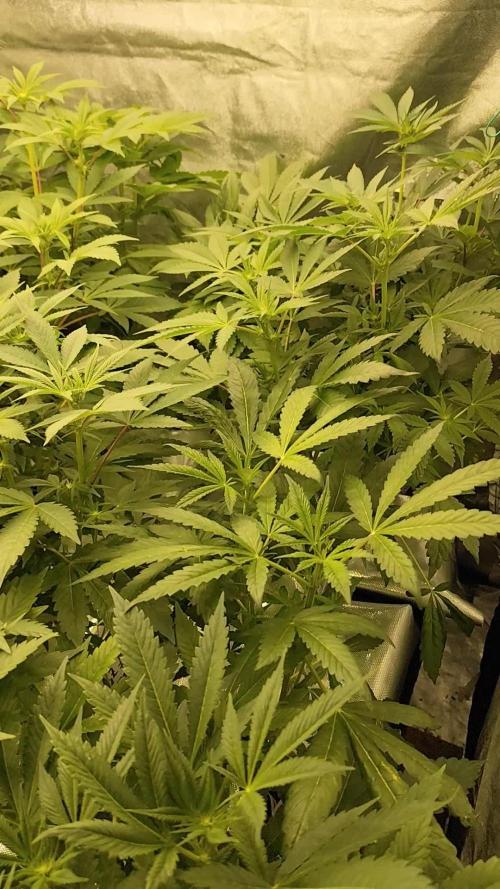
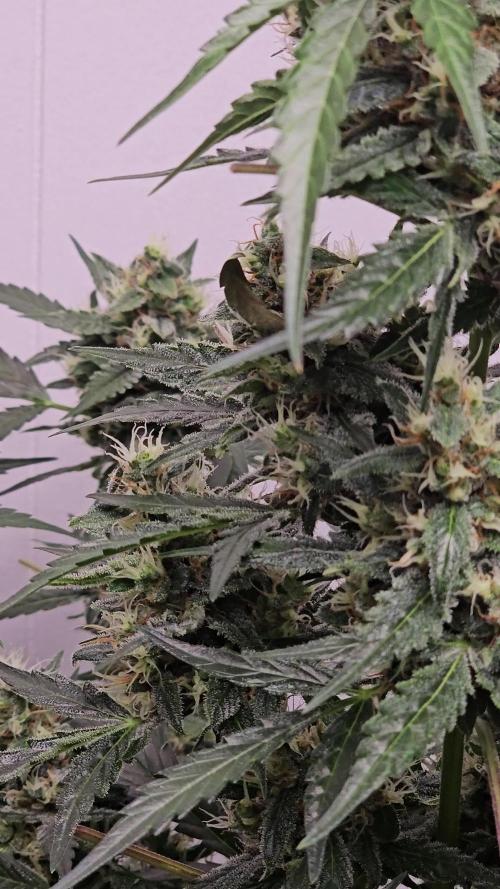
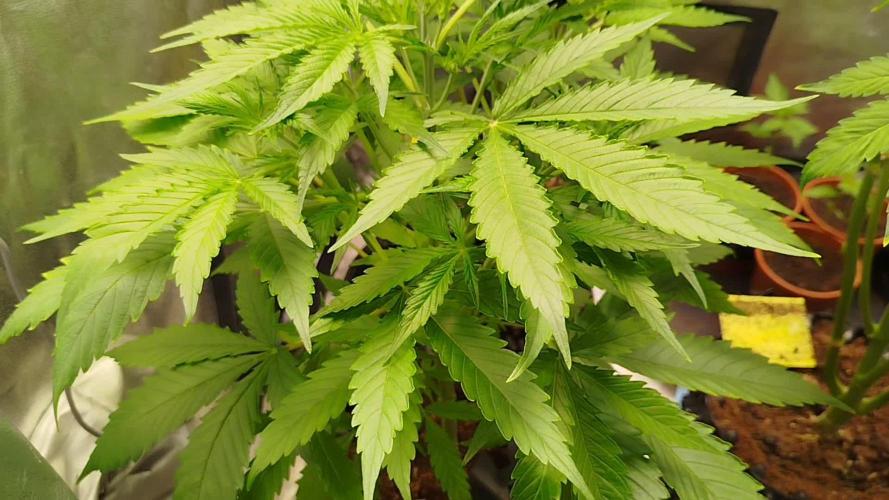
Hi growers. It's end of week 5 of flowering. So far, all girls looks quite well, only OG is showing that he is missing some zink.. Hope to heal her... Red mandarine is showing her true color as well.. Live that purple!! Stay stoned and keep growing! One love!
Likes
11
Share
@Guaxi
Follow
My cats messed up with one of my Chocolopes when I turned my back for 1 second. I don't if its still on the vase. All the others seem to been going fine.
Likes
32
Share
Soooooo... I think I really fucked up haha. It's week 6 and they are huge... I didn't anticipate the stretch well and now I'm panicking. Any advice would be great because aside from getting an extra 8 inches from mounting all the way to the ceiling I'm at a loss. They are doing well aside from that though. a lot of dark spots where I could have trained better are just becoming more prevalent and I'm really seeing where I should have filled gaps and trained for a better light footprint. Adding top shooter for the first time at half strength this week, hoping to see results like the canna pk boost in the personal grow which is doing great. Oh and guess whos dumb pump started working for no reason after I got the replacement in the mail lol smh.
Likes
19
Share
I participate in the dutch passion master grower with this 3x auto duck dutch So vote for me. And follow this crazy breeding of the autos duck🦆🍀💯
Likes
52
Share
Once again she passes my expectations, late to the show with trichome production. I'm surprised there is purple on the bud, maybe Purpinator does work. I thought I could see hints under the grow lights and thought my eyes were deceiving me, I was just being hopeful. But nah 2 of the 3(under the UV) have developed a beautiful tone of purple. I was never going to bother with a deep freeze but maybe the whole bud will change given conditions, that would be something, fingers crossed. 🤔 was a little skeptical that reducing temps humidity would change density, but it does, buds are solid something I've not been able to achieve before. Rule of thumb is never to surpass 60% RH in the flowering phase and try to progressively reduce it down to 40% in the last 2–3 weeks before harvest. The plant will react as it seeks to protect its flowers, responding by producing denser buds and a higher concentration of resin. Cannabis plants are sensitive to sudden temperature changes, especially in the flowering stage. Extreme heat or cold can impact bud density and overall yields. In nature as a defense mechanism from cold, the plant sensing sudden dips in temperature will attempt to remove the pockets of air within the bud, it achieves this by compacting itself in doing so to better protect itself from cold snaps which are normally indicators in nature that worse weather is on the way. Terpene levels are the highest just before the sun comes out. Ideally, you want as many terpenes present in your plants as possible when you harvest. Cannabis plants soak up the sun during the day and produce resin and other goodies at night. The plant is at its emptiest from "harvest undesirables" so to speak right before the lights on. Boiling cannabis roots during harvesting slows down the drying process. When you boil cannabis roots, it shocks the plant, closing the stomata on the leaves. This prevents massive moisture loss through the leaves, leaving only the floral clusters actively losing moisture at a reduced pace. I've always run a strict 60/60 and it took almost twice as long to dry to a snap than previous grows where I didn't boil for what it's worth. Chlorophyll is good for the plant but not for you. When you harvest the buds, even after you flush them, if you flush them, they’re still filled with chlorophyll. Freshly cut buds are greener than dried buds because they still contain loads of chlorophyll. However, when rushed through the drying process, the buds dry but retain some chlorophyll, and when you smoke it, you will taste it. Chlorophyll-filled buds are smokable, but they aren’t clean. Slow drying gives the buds enough time and favorable conditions to lose the chlorophyll and sugars, giving you a smoother smoke. How the plant disposes of the chlorophyll and sugars by a process of chemically breaking them down and attaching the decomposed matter once small enough to water molecules which then evaporate back into the ether. Time must be given to the process to break down the chlorophyll and sugars. Think of it like optimizing the environment for decay. All the nutrients it could ever need are in abundance, it eats nutrients based on its demand for growth, which is dictated primarily by available light. Plant growth and geographic distribution (where the plant can grow) are greatly affected by the environment. If any environmental factor is less than ideal, it limits a plant's growth and/or distribution. For example, only plants adapted to limited amounts of water can live in deserts. Either directly or indirectly, most plant problems are caused by environmental stress. In some cases, poor environmental conditions (e.g., too little water) damage a plant directly. In other cases, environmental stress weakens a plant and makes it more susceptible to disease or insect attack. Environmental factors that affect plant growth include light, temperature, water, humidity, and nutrition. It's important to understand how these factors affect plant growth and development. With a basic understanding of these factors, you may be able to manipulate plants to meet your needs, whether for increased leaf, flower, or fruit production. By recognizing the roles of these factors, you'll also be better able to diagnose plant problems caused by environmental stress. Water and humidity *Most growing plants contain about 90 percent water. Water plays many roles in plants. It is:* A primary component in photosynthesis and respiration Responsible for turgor pressure in cells (Like the air in an inflated balloon, water is responsible for the fullness and firmness of plant tissue. Turgor is needed to maintain cell shape and ensure cell growth.) A solvent for minerals and carbohydrates moving through the plant Responsible for cooling leaves as it evaporates from leaf tissue during transpiration A regulator of stomatal opening and closing, thus controlling transpiration and, to some degree, photosynthesis The source of pressure to move roots through the soil The medium in which most biochemical reactions take place Relative humidity is the ratio of water vapor in the air to the amount of water the air could hold at the current temperature and pressure. Warm air can hold more water vapor than cold air. Relative humidity (RH) is expressed by the following equation: RH = water in air ÷ water air could hold (at constant temperature and pressure) The relative humidity is given as a percent. For example, if a pound of air at 75°F could hold 4 grams of water vapor, and there are only 3 grams of water in the air, then the relative humidity (RH) is: 3 ÷ 4 = 0.75 = 75% Water vapor moves from an area of high relative humidity to one of low relative humidity. The greater the difference in humidity, the faster water moves. This factor is important because the rate of water movement directly affects a plant's transpiration rate. The relative humidity in the air spaces between leaf cells approaches 100 percent. When a stoma opens, water vapor inside the leaf rushes out into the surrounding air (Figure 2), and a bubble of high humidity forms around the stoma. By saturating this small area of air, the bubble reduces the difference in relative humidity between the air spaces within the leaf and the air adjacent to the leaf. As a result, transpiration slows down. If the wind blows the humidity bubble away, however, transpiration increases. Thus, transpiration usually is at its peak on hot, dry, windy days. On the other hand, transpiration generally is quite slow when temperatures are cool, humidity is high, and there is no wind. Hot, dry conditions generally occur during the summer, which partially explains why plants wilt quickly in the summer. If a constant supply of water is not available to be absorbed by the roots and moved to the leaves, turgor pressure is lost and leaves go limp. Plant Nutrition Plant nutrition often is confused with fertilization. Plant nutrition refers to a plant's need for and use of basic chemical elements. Fertilization is the term used when these materials are added to the environment around a plant. A lot must happen before a chemical element in a fertilizer can be used by a plant. Plants need 17 elements for normal growth. Three of them--carbon, hydrogen, and oxygen--are found in air and water. The rest are found in the soil. Six soil elements are called macronutrients because they are used in relatively large amounts by plants. They are nitrogen, potassium, magnesium, calcium, phosphorus, and sulfur. Eight other soil elements are used in much smaller amounts and are called micronutrients or trace elements. They are iron, zinc, molybdenum, manganese, boron, copper, cobalt, and chlorine. They make up less than 1% of total but are none the less vital. Most of the nutrients a plant needs are dissolved in water and then absorbed by its roots. In fact, 98 percent are absorbed from the soil-water solution, and only about 2 percent are actually extracted from soil particles. Fertilizers Fertilizers are materials containing plant nutrients that are added to the environment around a plant. Generally, they are added to the water or soil, but some can be sprayed on leaves. This method is called foliar fertilization. It should be done carefully with a dilute solution because a high fertilizer concentration can injure leaf cells. The nutrient, however, does need to pass through the thin layer of wax (cutin) on the leaf surface. It is to be noted applying a immobile nutrient via foliar application it will remain immobile within the leaf it was absorbed through. Fertilizers are not plant food! Plants produce their own food from water, carbon dioxide, and solar energy through photosynthesis. This food (sugars and carbohydrates) is combined with plant nutrients to produce proteins, enzymes, vitamins, and other elements essential to growth. Nutrient absorption Anything that reduces or stops sugar production in leaves can lower nutrient absorption. Thus, if a plant is under stress because of low light or extreme temperatures, nutrient deficiency may develop. A plant's developmental stage or rate of growth also may affect the amount of nutrients absorbed. Many plants have a rest (dormant) period during part of the year. During this time, few nutrients are absorbed. Plants also may absorb different nutrients as flower buds begin to develop than they do during periods of rapid vegetative growth. 432 Hz is said to be mathematically consistent with the patterns of the universe. Studies reveal that 432 Hz tuning vibrates with the universe’s golden mean PHI and unifies the properties of light, time, space, matter, gravity and magnetism with biology, the DNA code and consciousness. When our atoms and DNA start to resonate in harmony with the spiraling pattern of nature, our sense of connection to nature is said to be magnified. Another interesting factor to consider is that the A=432 Hz tuning correlates with the color spectrum while the A=440 Hz is off. Audiophiles have also stated that A = 432 Hz music seems to be non-local and can fill an entire room, whereas A=440 Hz can be perceived as directional or linear in sound propagation. Once you adopt the idea that sound (or vibration in general) can have an equalizing and harmonizing effect (as well as a disturbing effect), the science of harmony can be applied to bring greater harmony into ones life or a tune to specific energies. There is a form of absolute and of relative harmony. Absolute harmony can for example be determined by the tuning of an instrument. The ancients tuned their instruments at an A of 432 Hz instead of 440 Hz - and for a good reason. There are plenty of music examples on the internet that you can listen to in order to establish the difference for yourself. Attuning the instrument to 432 Hz results in a more relaxing sound, while 440 Hz slightly tenses up to body. This is because 440 Hz is out of tune with both macro and micro cosmos. On the contrary, 432 Hz is in tune. To give an example of how this is manifested micro cosmically: our breath (0,3 Hz) and our pulse (1,2 Hz) relate to the frequency of the lower octave of an A of 432 Hz (108 Hz) as 1:360 and 1:90. It is interesting to note that 432 Hz was the standard pitch of many old instruments, and that it was only recently (19th and 20th century) the standard pitch was increased. This was done in order to be able to play for bigger audiences. Bigger audiences (more bodies) absorb more of the lower frequencies, so the higher pitch was more likely to “cut through”. One of the oldest instruments of the world is the bell ensemble of Yi Zeng (dated 423 BC), tuned to a standard F4 of 345 Hz which gives an A= 432 Hz. The frequency of 345 Hz is that of the platonic year! Similarly many old organs are tuned in an A=432 as well; for example: St. Peter’s Capella Gregoriana, St. Peter’s Capella Giulia, S. Maria Maggiore in Rome. Maria Renold’s book “Intervals Scales Tones and the Concert Pitch C=128 Hz” claims conclusive evidence that 440 Hz and raising concert pitch above scientific “C” Prime=128 Hz (Concert A=432 Hz) disassociates the connection of consciousness to the body and creates anti-social conditions in humanity. The difference between concert pitch A=440 Hz and Concert A=432 Hz is only 8 cycles per second, but it is a perceptible difference of awareness in the human consciousness experience of the dream we share called existence.
Likes
Comments
Share
Vamos familia, actualizamos la cuarta semana de crecimiento de estas Black Rainbow de Seedstockers, salieron las 3 de 3, 100% ratio éxito. Aplicamos varios productos de Agrobeta, que son increíbles para aportar una buena alimentación a las plantas. Temperatura y humedad dentro de los rangos correctos dentro de la etapa de crecimiento. La tierra utilizada es al mix top crop, por cambiar. De 3 ejemplares seleccioné los 2 mejores para completar el indoor y trasplanté directamente a macetas de 7 litros, se ven bien sanas las plantas, tienen un buen color y progresan a muy buen ritmo por el momento. Agrobeta: https://www.agrobeta.com/agrobetatiendaonline/36-abonos-canamo Hasta aquí todo, Buenos humos 💨💨💨.
Likes
20
Share
@Densko
Follow
Medusa 2/5 is starting to get fatter. I decided to Lollipop and remove the lower growth. Im curious to compare the colas and see if lollipopping really increases bud size. This plant really grows beautifully, two main colas in top from the topping, and all the other colas around the two main colas. I started giving green sensation PK booster this week I reckon another 4 weeks before harvest.
Likes
9
Share
Comienza el engorde en algunas cepa. Se cambió el sistema de extraccion de temperatura (cooltube) y de olor y aumento distancia de foco, logrando reducir temperatura de 31-32 a 27-29. Primer doblés a LSD 25, primeros signos de entrar a prefloración.
Likes
9
Share
She's got beautiful orange hairs very very beautiful orange pistils,and she's got a great resin production,very sticky, very powerful aroma,she looks super mature,I'm gonna give her a couple more watering and she'll be done,amazin strain to grow,beutiful flower producer. 🤤🌱💚
Likes
129
Share
Hi Growers! And that’s a wrap! It was a great grow and I really enjoyed the whole journey. A big thank you to everyone who followed the diary, supported me, left comments and shared their experience. See you in the next diaries. I’m already looking forward to it! ------------------------------------------------------------------------------------------------------------------------------------------------ A je tu konec! Byl to skvělý grow a celou cestu jsem si opravdu užil. Velké díky všem, kteří můj deník sledovali, podporovali mě, psali komentáře a sdíleli své zkušenosti. Uvidíme se u dalších deníků. Už se těším! Peace and happy growing! ✌️
Likes
11
Share
Likes
6
Share
The plant has recovered well from the last capping and defoliation🏻‍♀️ A few leaves have yellowed a little, but that's not so bad🏻‍♂️ It will get a compost tea🍵 in a few days when it is sent into flower and then everything will be fine again😊💪🏻🏻 The compost tea is brewed and was given to the Watermelon Runtz at day 49 of Veg🍉🏃‍♂️
Likes
46
Share
@MrJones
Follow
OSS Sherbet Moonrocks 🔹⊱╮🔹╰⊰🔹 GROW Started 03.10.24 INFORMATION 🔹╰⊰´🔹⊱╮🔹 🌞Environment - Maintaining 80F and 65%Humidity 🌾Training - Nothing this week just letting the seedlings veg out. ⚱️2-Gallon 📊6.2 PH 💧 Feeding - Using Horti Grow 8-11-21, Bloom 5-15-26, Late Bloom 0-24-26, Cal 12-0-0 🌞Medic Grow Smart 8 760 Watts 🕷️ IPM - CannControl from Mammoth and Mosquito Bits as needed 🔹⊱╮🔹╰⊰🔹 PLANT UPDATES 🔹╰⊰´🔹⊱╮🔹 📝 Notes - These girls have completely transformed into their new buckets and have started to drink up, increasing the amount of fertigation, (Nutrients and H20), and defoliation to expose the lower growth. 🗓️03.29.24 Maintaining Temps and Humidity - Plants are Looking Great! 🗓️03.30.24 Today fed with Hort-Grow @ 3.3 GRMS Per Gal, and Horti-Cal @ 2.5 GRMS Per Gal. I defoliated the plants to water them better and the middle growth could get more light and develop. 🗓️03.31.24 Maintaining Temps and Humidity 🗓️04.01.24 Today fed with Hort-Grow @ 3.3 GRMS Per Gal, and Horti-Cal @ 2.5 GRMS Per Gal. Check out the amazing growth and recovery after the defoliation! 🗓️04.02.24 Maintaining Temps and Humidity, watching these ladies are just nailing the veg phase. 🗓️04.03.24 Today fed with Hort-Grow @ 3.3 GRMS Per Gal, and Horti-Cal @ 2.5 GRMS Per Gal 🗓️04.04.24 Maintaining Temps and Humidity, closing out week 2 of veg and these ladies will need to be defoliated again, this new nutrient line from Greenpnaet is killing it, and so easy to use! ╰⊰🔹╰⊰´🔹⊱╮🔹╰⊰🔹╰⊰🔹STRAIN INFORMATION🔹⊱╮🔹╰⊰🔹╰⊰🔹╰⊰🔹⊱╮ Introducing our latest powerhouse Sherbet Moonrocks one of our strongest weed strains to date setting a new bar for potency and effect. A combination of US genetics Sherbet Cake and Purple Moonbow create this potent sedative with THC levels, above 30% that will take you to celestial bliss. An exquisite terpene profile offers a tempting treat of sensational fruity tastes, flavors, and aromas that will seduce your mind and body and take you to a serene place of pure tranquillity. Ocimene, Caryophyllene, and Limonene are the predominant terpenes they produce a wonderful array of sugary berry fruit flavours with floral hints and spicy undertone. Growing these feminized seeds is effortless and straightforward regardless of your growing skills and at harvest time you will be generously rewarded. Plants will mature to a manageable height with a flowering period of 65 - 70 days and will develop thick dense buds glossed in thick layers of THC resin crystals packed with indica power that will lure into a deep relaxation. Expect an indoor yield of 600 - 700 gr m2 and outdoor production of over 1 kilo per plant. Indulge yourself, add Sherbet Moonrocks to your shopping cart today, and explore the outer spheres!
Likes
12
Share
@Donbehzad
Follow
I tried defoliating two days ago but just the leaves that are underneath and started to bend toward the soil, 1-2 leaves per plant not that serious defoliating because its an autoflower and I won’t stress it to much. I did another defoliating an hour ago, 1 leaf per plant again just those trap inside the bottom part. Low stress training still on going but no new tie, i’ll try to leave it like that until the end i’ll just tuck the leaves blocking the developing pistils. I noticed that out of 3 plants, 1 is taller and bushier than the rest. Looks like the other two stunned their growth or just slow in growth. Seriously I don’t have an idea same nutrient and care are given to all plants. I feed them twice a week every 3-4 days, no negative reactions or whatnot. Nutrients adjusted in this week. Same temperature and humidity level as last week, keeping an eye daily to adjust if its not in desire level.
Likes
13
Share
Week 11, As you can see with the pictures, she has some nutrient burn :( I unfortunately gave her too much nutrients. I knew this strain was sensitive to nutrients because of the 2Fast4buds strain video but I did not know what was too much or not. If I was to grow this strain again ,I would probably switch up nutrients every other watering and not every watering as I did. As a result of the burn, I used some ClearEx in hopes that the leaves will turn back to green. The plant seems to be responding well to the treatment being on 2/17 and all. My plan is to water the plant on 2/19 with only water to flush the plant some more. Hopefully by 2/22 I can give the plant some finishing bud density nutrients for a week or two and then flush time. I am nowhere near a master grower and every mistake is a learning experience :) Let me know if you have any questions/ comments/ concerns. Good luck with everybody grow! (hopefully they don't get burned like mine did this week) lol
Likes
14
Share
The flowers have started to swell and increase in size nicely. She's not stretching much, so I guess, these 18cm will be it. She's getting a really shimmery purple colour. I tried capturing it in a video. I removed some of the older leaves to optimize for light and optimized fertilizer for bud size (Hi PLAGRON Alga Bloom!). Give us all your CBD goodness, purple lady!
Likes
9
Share
Already set to 12/12 photoperiod; I have watered several times, aerating the water beforehand, and will continue like this until flowering begins. I also performed FIM pruning.👍
Likes
3
Share
I was too busy in last weeks and forgot to take some photos to growDiaries but this is the last video before start the flowering time. This girl have been growing health and beautiful.