


Likes
Comments
Share


@LaraCroft
Follow
Поменяла воду полностью, так как узнала что seaweed не работает в гидро, помыла корни.

Likes
10
Share


@Autoflowergirls06
Follow
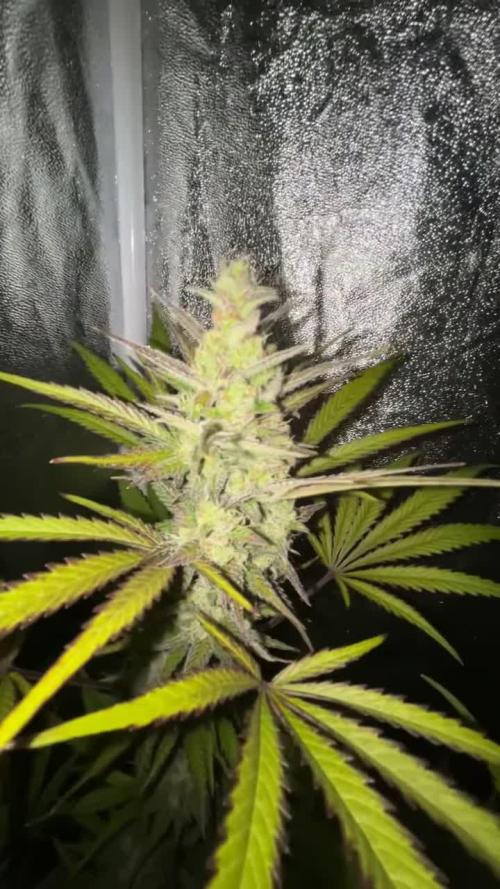
They look good so far. I mixed a teaspoon of mega crop into the bottom half of soil prior to planting these babies hope things work out.



Likes
16
Share


@OrganicBuds030
Follow
Das ist Weltklasse. Damit könnte ich international an Cups teilnehmen.


Likes
29
Share


@TheCannaProphet
Follow
------------------------------------
~SEEDSMAN PEYOTE GORILLA~
------------------------------------
Peyote Gorilla is a cross of Gorilla Glue #4 (Chem Sister x Chocolate Diesel) and Peyote Purple, a colorful phenotype of Bubba Kush. The potent, medicinal effect of the Gorilla meets the stimulating and uplifting high of the Peyote Purple.
With a flowering time of around 70 days Peyote Gorilla has a typically Indica structure, medium-sized with large, broad leaves. Yields are exceptionally good; indoors growers can expect to yield between 500 - 650 gr/m2 while outdoors as much as 1500 gr/m2 can be realized. Resin levels are very high and this means that it is very suitable for making extracts and concentrates with.
This strain's scent is sour with lemon, petrol, earthy and woody notes and these properties are reflected back in the taste. THC production is very high at between 22 - 26% with CBD at just 1%. The effect is a very potent, uplifting high which gradually evolves into a physically relaxing state that will be almost certain to ease any aches and pains.
__________________________________________________________________________________________________________________________________________________________________________________________________________________________________________________________________________________________________________________________________________________________________________________________________________________________________________________
-Strain Characteristics-
BREEDER/BRAND: Seedsman
PRODUCT TYPE: Seeds THC
GENETICS: Gorilla Glue #4 (Chem Sister x Chocolate Diesel) x Peyote Purple (Bubba Kush purple pheno)
VARIETY: Mostly Indica
FLOWERING TYPE: Photoperiod
SEX: Feminised
THC CONTENT: 22 - 26%
CBD CONTENT: 1%
YIELD: Indoor: 450-600 g/m2; Outdoor: 1500 gr/plant
PLANT HEIGHT: 80-160 cm
GROWS: Indoors, Outdoors
FLOWERING TIME: 70 days
HARVEST MONTH: September
MEDICAL CONDITIONS: Fatigue, Insomnia, Pain, Stress
TASTE / FLAVOR: Berry, Earthy, Fruity, Petrol, Sweet
EFFECT: Euphoric, Powerful, Relaxing, Uplifting
_________________________________________________________________________________________________________________________________________________________________________________________________________________________
_________________________________________________________________________________________________________________________________________________________________________________________________________________________
THE SETUP:
~Planted into Jiffy Peat Pellets that were hydrated with de-chlorinated water with SuperThrive added then ph'd to 6.0 @ 80℉
~Grown 100% organic in 10g fabric pots with Mother Earth 70/30 Coco/Perlite medium amended with 2tbs/g of Down To Earth 4-4-4 / 2 cups/g of Earthworm Castings / 1tbs/g of Dr. Earth Flower Girl 3-9-4, 1tbs/g of Dr. Earth Bat Guano, 3/4 cup of Down To Earth Azomite and 1 tsp/g Down To Earth Fish Bone Meal.
~24hr light cycle during Germination / 19/5 light cycle for Vegetation and 12/12 for Flower
~Straight water ph'd @ 6.2-6.8 when needed and weekly Compost Tea's.
__________________________________________________________________________________________________________________________________________________________________________________________________________________________________________________________________________________________________________________________________________________________________________________________________________________________________________________
Weekly Updates:9/20- 💥BOOM!💥 Week Six of flower is here and my girl's in high gear, stacking her flowers and pumping out trichomes!
Today I watered her with 1.5g de-chlorinated water with 5ml/g of Botanicare CalMag+ added, then ph'd to 6.2 @ 72℉. I turned her pot and plucked a couple of yellow shade leaves...the basic daily maintenance.
9/22- I didn't water her yesterday as she looked great and was 'praying' hard. Today she was given 1.5g of de-chlorinated water which was ph'd to 6.2 @ 72℉ which I gave her through her drip pan (bottom chuggin) and I also gave her pot a turn.
She continues to pile on the trichomes and is taking on a exquisite purple hue to her flowers! She is definitely one of the most photogenic cultivar's I've grown and is looking lovelier by the day! 😍
9/24- We're getting close to wrapping up Week Six of flower in a couple of days and she'll be around four more weeks from finishing, with the most exciting weeks yet to come!
I didn't water yesterday and today I went ahead and Top Dressed her with 2 tbsp/g Dr. Earth Flower Girl 3-9-4, 1 tbsp/g Dr. Earth Gold Premium 4-4-4, 1/2 cup Down To Earth Bio-Fish, 1/3 cup Down To Earth High Phosphorus Bat Guano and 2 cups of Worm Castings.
I watered in the Top Dress with 1.5g of de-chlorinated water which was ph'd to 6.2 @ 72℉ and let her enjoy her meal! 😜
9/26- After her heavy watering on the 24th I didn't water yesterday and when I checked her today at 'lights on' and she still had some weight to her pot and her leaves were praying hard so I held off on watering today and will hit her tomorrow with her usual 1.5g watering.
~Thanks for stopping in! Things should be getting a lot more interesting in the coming weeks...Stay lifted and be Blessed! 😎🙏~

Likes
4
Share

@GREENPHOENIX6262
Follow
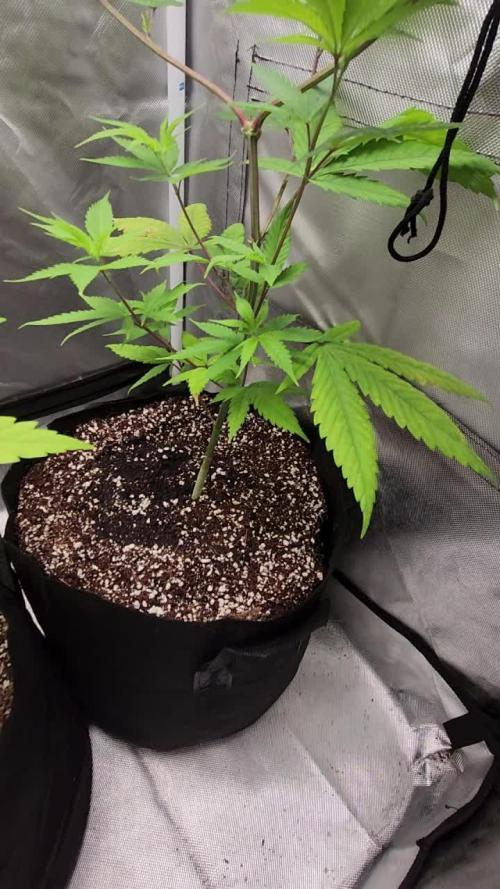
05/17 - Both are vegging accordingly - applied a hard LST to even out the canopy and distribute light coverage around the plants - Both are currently
in 1 gallon pots - Both will be transplanted into 5 gallon pots by the end of the week - I will begin micro-dosing their nute feeds to negate transplant shock.
05/18 - Both ladies are doing great after transplant (5 gall pots) - No transplant shock - I gave them both a heavy hit of silica to assist in the transplant recovery - They will be will be in the 2x2 until next and then both moved into the 4x4.
05/23 - Both of the ladies have blown out and top colas are healthy and tall - In an effort to expose more light coverage to the middle both plants will be moved into the 3x3 and a net will be dropped on them today or tomorrow - They will be ran in the same conditions as the nursery tent (High Temp/High Humidity) - Both ladies will also be hooked up to the Vivosun drip emitter system for more consistent and efficient feeds.
Likes
5
Share


@Dunk_Junk
Follow
Still going through flowering.
She has stayed short and stocky throughout since week 3/4 actually. About that time I remember watering her with nutrients that must have been too acidic. I'm pretty sure I omitted add ph up. 😭 The damage was done, growth all but stopped. As she is an auto flower there is no time to 'save' her and grow a big plant, so we will go to the end with what we've got.
Likes
31
Share


@JeyGanesha
Follow
Questa gorilla cookie cresce ben forte..spero arrivi al termine senza nessun intoppo....
Siamo arrivati alla fine della3 settimana. Tt procedere alla grande
Likes
27
Share


@Silverback_Guerilla
Follow
4/5:
Took 4 cuttings from the shortie
4/12:
All 4 are rooted and growing!
5/1:
Transplanted from 1gallon pots to 5 gallon pots.
5/3:
Decided to grow one of them in my tiny tent and the other 3 will go outdoors.
5/4:
Took 2 of them outdoors under the 270w and sunshine.
5/6:
Trained all of them today and fed some boomerang along with the kelp, molasses, big bloom, and silica. Foliar fed and took the last one outdoors.
The one in the tent is really flourishing!
5/7 - 5/17:
Excellent growth! The supplemental lights are making all the difference.👍
Did some more training on all of them early in the week.
The one in the closet is spreading out nicely and budding up pretty quickly...but what's very cool is that all 4 clones outdoors are flowering?!?!? I sure hope they go ahead and finish rather than starting to revegetate as the days continue to get longer.
Much rain for the past few days, but it let up long enough for me to install another 200w of waterproof 3000k LED lights a couple of feet above them. Very intense lighting, great bang for the buck. So now, I've got 350w of 3000k and 120w of 6500k in the outdoor garden. That's gonna have to do it, as I also am using 1400w in my indoor gardens, plus a/c..bills are getting ridiculous.
5/18 - 5/28:
The clone in the tent is still stacking up really well. I guess the ones outdoors are too, but next to the seedling plants, they seem puny. Many buds though...
Since they decided to flower early, I sprayed them all down with a product that is loaded with hormones and auxins and stuff that's supposed to retard vertical growth and promote branching. It's also supposed to speed arvest time by as much as a week. I hope they can finish before the summer solstice (June 21), otherwise they might try to reveg instead of finishing..
Hopefully it helps keep them from stretching so much that I'll have to supercrop them. Their mamma was a shortie, so they really shouldn't get too tall anyway.
I also foliar fed them several times this week with something called MicroLife Maximum Blooms, Pow! They love the stuff!
5/28 - 5/31:
I did some training on a two of the outdoor clones early in the week between rain showers, and foliar fed with Microlife maximum bloom formula. She was looking a little N deficient, so I assume the dry amendments have petered out. They were dry enough, so I top-fed her with another couple tablespoons of cavern culture and on the 31st. I gave them big bloom, tiger bloom, grow big, beastie bloomz, silica, endoboost, signal, humic acid, liquid kelp/fish emulsion, and liquid molasses. The indoor clone is looking awesome. I fed her heavily on the 30th.
It just feels so strange that I'll be harvesting outdoor photos in June!?!
That's it for week 8-
6/1 - 6/8:
Early in the week I gave them about a half gallon of water with liquid molasses, cal-mag, silica, and beastie bloomz only.
I foliar fed them a couple of times during the week, right at daybreak.
I fed them on Saturday, the 6th..about a gallon each..beastie bloomz, microlife maximum blooms, cal-mag, humic acid, grow big, big bloom, sweet & sticky, and signal.
They are looking very good..buds galore. The indoor clone got the same nutes, but on different days. She's also covered in buds, and they are beginning to fatten up.👍
6/9-7/4:
Busy with other gardens, so not many updates...
Indoor clone got to spend the last 2 weeks of her life in my closet under the quantum boards and UVB. I harvested and washed her buds on 6/28, let her hang dry and weighed and jarred her up on the 4th of July. She came in a 111g of cola and 45g of lower bud with only about 5g of larf. Nice!👍
She smells just like her mommy and has the same uber-dense buds. She was topped, so the buds aren't as mighty as the mamma's, but much more plentiful.👌
Outdoor clones:
I had a massive spider mite attack, and during the same week, I had a grasshopper invasion...I lost a few plants, one of which as a FFT1 clone.
I had just harvested my autos and my indoor clones from the closet, so I moved the remaining two clones in under the quantum boards. I treated them for spider mites several ways for several days and have given them much TLC. Hopefully their buds fatten up some more. They stanky, but they kinda slim...
7/11:
I harvested the last two clones tonight. So sticky!!! I washed them and hung them to dry.

Likes
47
Share


@blazin_skywalker
Follow
Day 44 - Today it's time to say sayonara to the undergrowth as I clear away a lot of the fan leaves and make room to further shape the canopy.
I took each of the 8 branches that I previously cuffed off to fan leaves, and tied them down into their final resting place - rounding out the final shape of the plant.
Day 47 - Defoliation ✂️ - over the course of 3 days, this lady bushed out like woah - causing me to dive back in the the scissors.
Ermahgerd! 😱 She showed me a ♥️!
Likes
20
Share


@GrowinHome
Follow
Day 18:
The canopy is developping nice and evenly. I wonder how much mire they will stretch. I think that ill do some defoliation at the beginning of week 4
Day 20:
Today I did a big defoliation right before the third flowering week ends. It was a tough job reaching all the leaves in the back because I cant move the plants.😅 But we made it!
Now the light can reach much further down the plants for better/bigger buds and better aeration.

Likes
11
Share

@Enki_Weed
Follow
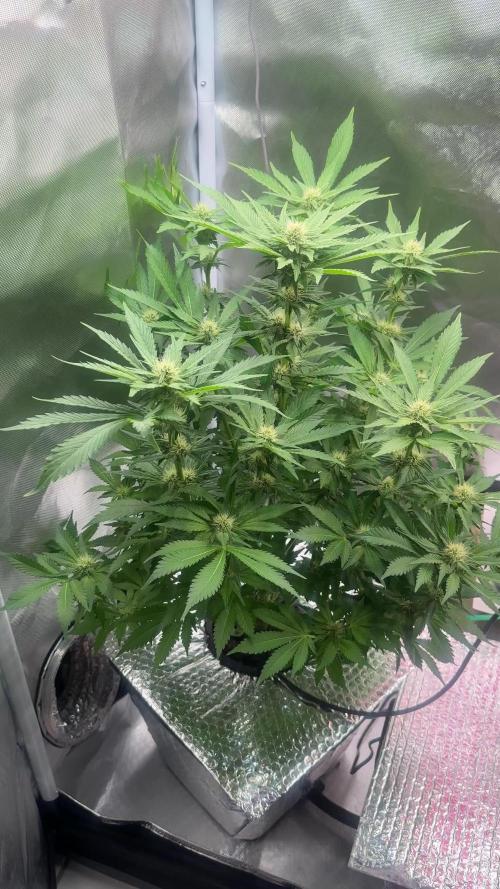
🌸 Woche 5 der Blüte
Die Early Skunks sind jetzt mitten in der Blüte und entwickeln sich richtig stark. Der Stretch ist so gut wie durch und die Pflanzen haben ein schönes, gleichmäßiges Blätterdach aufgebaut. Die Blüten werden von Tag zu Tag sichtbarer und setzen schon ordentlich Harz an.
Das DWC-System läuft stabil: frische Nährlösung, klare Werte und die Wurzeln strahlend weiß. Genau so soll es in dieser Phase aussehen. Die Pflanzen nehmen sehr gut auf und zeigen keinerlei Mängel oder Stress – Farbe, Struktur und Wachstum sind voll im grünen Bereich.
Das Klima bleibt konstant und das Setup arbeitet sauber zusammen. Licht, Luft und CO₂ greifen perfekt ineinander, wodurch die Pflanzen richtig Tempo machen.
Fazit:
Sehr starke Woche. Gesunde Pflanzen, satte Farbe, stabile Blütenentwicklung. Alles bereit für die nächsten Wochen, in denen die Buds jetzt richtig zulegen werden. 🌱🔥

Likes
5
Share


@hinterhofgrower
Follow
🌱 :
💧 : 4l day 70, 4l day 74
💡 : Dli: 45 mol/m²/d
🤔 : One week to go?
Likes
28
Share


@cyberkyd
Follow
Okay So still only 2 Plants are truly in veg.
OG Kush Seedsman #1
Gelato Auto Fastbuds.
The Run OFF came at 6.3-6.4 during week 6 So I'm still feeding at 5.5.
Feeding every 2-3rd Day only with the Nutrients.
Feeding Nutrients only with every feed because plants were stunted already. And I already flushed them in the midway because of crazy ph and TDS, And since using only Cal-mag ph water is like 4-5 days of wait for the nutrients feed and this is flowering time plants like as much feed as possible. Maybe I'm wrong. But I'll flush again if needed but I don't think I'll be needing that anymore. So.
Likes
5
Share


@Ninjabuds
Follow
This will be my 1st auto run. Other than one time I was sent some free f1 autos from rqs and I started some but I ended up tossing them for some reason or another. I am actually super excited to try out fastbuds. I have been wanting to try out fastbuds for over a year now. I'm not the greatest with seedlings so I am doing a test run with a 2x2 tent I'm gonna try and grow the best plant I get out if the 3 seeds hopefully it doesn't out grow my small 2x2 tent . Pound cake thou looks like a killer strain with some fat buds can't wait to see how fast fast buds really are. Here we go.


Likes
6
Share


@Tetri_Temo
Follow
Super <font style="vertical-align: inherit;"><font style="vertical-align: inherit;">👍</font></font>

Likes
1
Share

@Ninjabuds
Follow
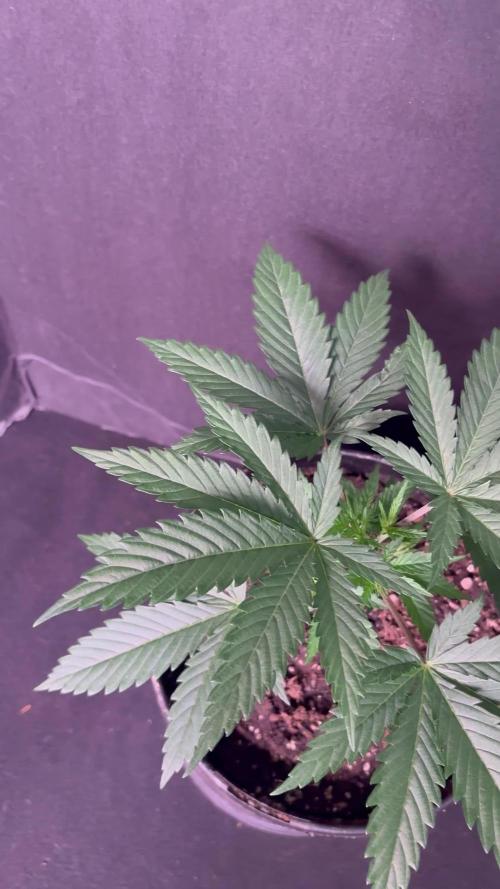
It’s day 27 from seed for all the plants in the photo sea of green. Let’s call it the battle of the strains summer 2025. All of the plants are starting to have visible differences. I’m already starting to tell witch plants are more sensitive than others.
Likes
2
Share


