






Likes
12
Share


@Skunkiest_bender39
Follow
Der Harvest war erfolgreich, alle bis zum maximalen Ende stehen lassen. Alles gleichzeitig zu ernten war ein bisschen unentspannt, da der Indoorgrow gleichzeitig zum trocknen hängt! Dennoch mega glücklich!!! Jetzt beginnt das Aushärten, die meisten Behälter sind zwischen 67-73% bleiben aber noch 1-2Tage offen.☮️


Likes
14
Share


@Mr_Dior21
Follow
Another slow week. I increased light schedule to 13/11. I’m going to slowly lower the time of light until by the time harvest day comes it’ll have a longer dark period. I’m also going to stop feeding the bottle nutrients my soil is moist still so I gotta wait. I’m predicting a couple ounces this grow.


Likes
62
Share


@Herbz_Unkraut
Follow
Spoted some herms, removed all i could see...only few were already fully grown...didn't spot any seeds yet...so not too bad i hope..
Increased lights to 12.2h, perhaps it gives them a little boost..
3 weeks to go
Likes
4
Share


Processing
Likes
41
Share


@Wicked_Stix
Follow
This auto ghost OG loves her little home. She's doing well. Had some calcium deficiency last week since I ran out of calmag. I was hesitant to use organic calmag, but that was all I could find locally. It is doing the trick though. pH has held stable with no adjustments and the leaf color is looking great. No water change this week since since everyone seems to be happy with the nutrient levels. She popped her first pistils on day 25 so I am hoping she will enter flower soon. Only issue at this point is she is a lot bigger than I ever thought she would get. I will probably have to figure out a way to get them further away from each other. And yes....this plant is 28 days old in a 16 oz cup. At no time have any roots grown out of the cup. Happy growing everyone!

Likes
33
Share


@Mrs_Larimar
Follow
Hulkberries are easy to grow.
All seeds germianted, all Seedlings showed up
and then they went into overdrive.
Turned out as Big Plants, with sticky and dense Nugs on the COlas
NO Training on them.
Super structured Plants
perfect Ratio from Leaves to Buds

Likes
9
Share


@Rizik86
Follow
Day 58 - Checked PPM 1,300.
Day 59 - Checked PPM 1,300. Got lucky <<<
Day 60 - Checked PPM 830. buds are swelling.
Day 61 - Added 10 mL of 10 mL of CalMag Micro Grow and Bloom. Added 5 mL of Bud Candy Sensizym Big Bud Nirvana Rhino Skin and B-52. PPM is 1,560.
Day 63 - Checked PPM 667.
Likes
4
Share


Likes
10
Share


Likes
21
Share


@puffin_ganja
Follow
Added a second trellis for additional support since they are starting to pack on more weight. Will update more info later...

Likes
226
Share


@HighTV
Follow
| 📅 Week 10 | Days 64 - 70
| 💡 750w 📏25' |
| ☔ 38%-50% |
| 🌡️️🌞 72 - 74 |
| 🌡️️🌑 68 - 71 |
1/11 The reservoirs were swapped out with fresh nutrients and topped off at 5.8PH. I will give them another day or two before flushing I think. The smell is currently fantastic
1/12 There really isn't much to do with these girls anymore other than PH every day and make sure their water levels are consistent to maintain their nutrient levels. Tomorrow I will begin the Flushing
1/13 I decided on one more day of nutrients. I Topped off the Reservoirs and adjusted their PH's to 5.8 as usual. I cleaned out the tent today as well. I can't wait to harvest these buds they are looking great.
1/14 Today is Flushing Day! I will flush them for about 6 days which is very fairly long for a typical DWC grow. I will only PH the water from here on out.
1/15-19 I Flushed these plants while maintaining a stable PH and humidity the best I could. The water level is not important during this because without nutrients you don't need to worry about ratios as long as you just keep the PH stable you will be fine. With a longer flush like this one, you should expect to see death in leaves its ok. I only did this for life reasons, I suggest a 3-5 day flush in DWC.
These plant's Trichomes matured fast and harvest time approached quickly. The smell in the tent is very potent and gloves are going to be an absolute must on this chop! I will be hang drying the plants inside the dark grow tent with ventilation to maintain humidity levels. I don't personally have a preference between a slow or fast drying process. This time I will be looking at 3-5 days of hang drying before chopping them into jars for a few weeks of cure using Boveda packs. I'm very pleased with the bud color and smell even though the overall weight will be less than desired I will be growing this strain again immediately. There isn't too much more to add to this week other than the grow is complete and the Dry/Cure process is all that is left. Be sure to look out for the harvest update with the final weight and smoke test!
_______________________________________________________________________
Feel free to leave comments/questions below or give me any feedback to improve my diaries. If you like this Diary follow along and check out my others as well 😎
Likes
58
Share


@GermanGrow182
Follow
Wetter war gut, nur einmal Regen, 3 fat banana sind im trockenraum, die anderen beiden kommen in den nächsten Tagen dazu.sind fast fertig. Die zz legen an buds zu, wie sie sollen, Nr.5 schon im fading... special queen macht sich langsam. Toppen war die richtige Entscheidung. Critical verzweigt sehr gut 👍. Lst funktioniert. Nächste Woche kommt der erste erntebericht... ich freu mich. Bis nächsten Freitag ✌️
Likes
48
Share


@TheCannaProphet
Follow
~ WEDDING CHEESECAKE FAST FLOWER by FastBuds ~
Well fam, here we go again with another epic strain from FastBuds Fast Flowering stable. After having such tremendous success growing their Gorilla Cookies Fast Flower outdoors last year, I've decided to run another of their fast flowering strains outdoors this year... Wedding Cheesecake Fast Flower!
The best description of this awesome cultivar comes directly from my friends at FastBuds which is as follows:
"A delight for the mind and body: Wedding Cheesecake FF (Fast-Flowering) is a delicious strain that offers XXL yields in a 7-8 weeks flowering cycle. This terpene powerhouse produces loads and loads of mouth-watering vanilla-creamy-cookie-scented terps with hints of citrus and cinnamon. In addition to its delicious aromas, this variety grows very well in both indoor and outdoor setups, yielding up to 650 g/m2 without extra maintenance, making it the ideal strain for beginners as it allows you to maximize yields while minimizing work. This super-fast feminized photoperiod version offers upbeat and energetic yet deeply relaxing effects that are perfect for consumers looking for a heavily focused, motivating, and creative high. It’s the ideal strain for those needing that extra energy boost to start a busy day on the right foot.
Wedding Cheesecake FF boasts chunky, large-sized buds with a thick layer of silvery-white resin and bright orange hairs scattered all over: that just screams ‘quality’. The lime-green flowers sparkle with an array of hues ranging from dark to light green, to magenta and purple, and reek of a delicious aroma that’ll remind you of fresh store-bought cheesecake.
This is an XXL hybrid that grows extremely tall in height, reaching up to 3m with one huge main cola and multiple long side branches that can withstand enormous yields of up to 650 g/m2 with ease. Wedding Cheesecake FF is extremely resilient to the elements and can be grown in almost every climate as long as you’ve got the space and basics covered, making her an excellent choice for those looking for large-scale harvests with a quick turnaround time without much effort."
________________________________________________________________________________________________________________________________________________________________________________________________________________________________________________________________________________________________________________________
The Setup:
This is going to be an outdoor grow, but I have started the Wedding Cheesecake FF indoors as our weather is still too cold to put her outside (nighttime temp's dipping regularly into the 30's℉).
The plan is simple... let her grow inside under a 19/5 light schedule until the nighttime temperatures stay above the mid 40's℉, at which point she'll be moved outside and transplanted into the soil which I have already setup and inoculated with beneficial microbes, and then let the fun begin!🤪💚
________________________________________________________________________________________________________________________________________________________________________________________________________________________________________________________________________________________________________________________
Weekly Updates:
6/26- Can you believe that it is now Week Thirteen since breaking ground for the FastBuds Wedding Cheesecake Fast Flower???
This lady has turned into a genuine beast of a plant and continues to remain healthy with great color and vigor!
6/28- Our weather is HOT now with heat indexes over 100℉ so I'm watering the Wedding Cheesecake FF every day with 5-8g of straight well water from the garden hose in the late afternoon once the plant is in the shade.
Other than the ever present leaf hoppers, which love the leaves but leave the flowers alone, and an occasional Japanese Beetle there aren't any serious pest issues currently. The Wedding Cheesecake FF continues to have excellent color and vigor and continues to add vertical growth!
6/30- The weather continues to be hot and humid and the daily watering continues. I also removed a few shade leaves that were below the canopy, as well as some in the middle of the plant that were blocking a lot of light to new shoots.
7/2- Thirteen weeks of veg behind her now, the FastBuds Wedding Cheesecake Fast Flower is on her way to stardom... see you next week!🤩
Thank you for checking out my diary, your positive comments and support make it all worthwhile! 💚Growers Love!💚😎🙏
Likes
82
Share


@TheFoxFarmer
Follow
Week 8 Flower
This was the last week in The Fox's Den for this stunning Pineapple Kush girl by Royal Queen Seeds. She smells dank asf and still super gassy (which is something I absolutely love ⛽) she was flushed all week with 6pH water for each flushing (I use tap water between 150-190ppm). She was taken down on Day 56 to finish off a great 8 weeks. Her fan leaves were taken off and she was hung in a box, where she'll dry as slowly as possible for between 6-10 days. The slower the dry the better the buds will taste/smell. Once she's dry enough she'll be trimmed and jarred for curing.
Thank you to everyone who's been following and showing support, it's always greatly appreciated ✌️ I'll be uploading the harvest update a soon as possible so keep an eye out!
Happy growing! 🐺
Processing
Likes
2
Share


@BigHorn
Follow
Week has gone very well. Growth has exploded will be trimming back some fan leaves this coming week to help the light reach the bottom stocks that have now come in. You can see the growth explode after I transplanted the plant.

Likes
3
Share

@skipakz
Follow
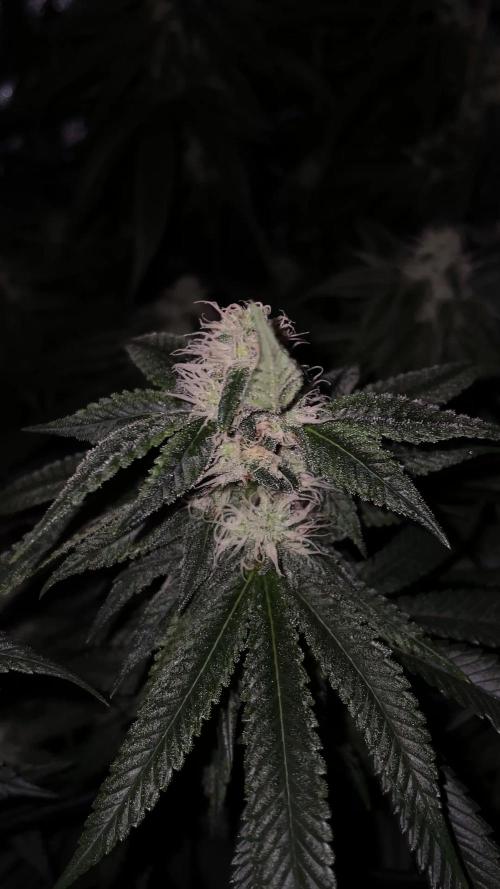
Eine Pflanze Mitte der 11. Woche teilweise weggeschnitten (Pflnaze hing in der Blüte stark hinterher, war seit Steckling heller als alle anderen trotz gleichem cut, sah ungesund aus, wenig trichombildung etc.
- man siehts auf manchen Bildern an den Blättern) so kann ich den freigeschnittenen Platz für untere Triebe nutzen… seit letzter Woche nun Athena PK und Calmag dran. Habe nochmal ordentlich entlaubt + nutzlose Blüten weggeschnitten das die unteren Triebe nochmal richtig Gas geben können.