





Likes
9
Share


@Bread_n_Buds
Follow
And off we went, the adventure with Zamnesia's F1 Hybrids started off great, with a stunning 100% germination 8/8 born without any hesitation after a very short time in water and subsequently in soil.
She is precisely at the 10th, she is the Pineapple Express, she grows well regularly and very similar to the little twin. One of the characteristics of the F1 Hybrids is stability and for now it has been thoroughly demonstrated since day 10.
For the rest we have to say everything is going very well, the parameters are in order, the girls were born in a biodegradable jar which biodegraded a little earlier than expected and I proceeded with the potting, no repotting, be careful the seedling never came out of the jar biodegradable the roots pass it at a certain point of decomposition. So we are now in a comfortable 11 liter house that is perfect for autoflowering in my opinion. Unfortunately, the Zamnesia pots are about to arrive but I didn't have them in time, I preferred to repot them for the sake of the plants, we need to photograph them of course but first and foremost I'm a grower and I care about the health of my little girls.
Something tells me we will be growing a lot of Zammi plants so we will use them in the Official Grower version next time.
Zamnesia is the best online shop in the situation, you can find everything from seeds, to mushroom kits, through vaporizers and a thousand other things https://www.zamnesia.io
Pineapple Express F1 seeds specifically
https://www.zamnesia.com/10681-zamnesia-seeds-pineapple-express-f1-automatic.html
Site Description
ZAMNESIA SEEDS - PINEAPPLE EXPRESS F1 HYBRID AUTOMATIC: FRUITY FLAVORS AND ENERGETIC EFFECTS
Combining Trainwreck with Hawaiian, Pineapple Express F1 Hybrid Automatic brings a beloved strain to new heights. This autoflowering F1 hybrid cultivar ensures exceptional uniformity, reliability, and stability, making it well-suited to growers of all experience levels. If you've not checked out Pineapple Express F1 hybrid Automatic for yourself just yet, now is the time.
GROWING PINEAPPLE EXPRESS F1 HYBRID AUTOMATIC
All it takes is 8–9 weeks from germination before Pineapple Express F1 hybrid Automatic is ready to harvest. Thankfully, very little effort is required throughout the growing process, aside from a bit of maintenance, to ensure ample, high-quality harvests. Thanks to its F1 genetics, Pineapple Express F1 Automatic offers superb resilience and uniformity, meaning all plants will have a similar height and appearance, and will churn out comparably large yields. Reaching heights of 50–70cm, Pineapple Express F1 Automatic is not an overbearing plant and can effortlessly slot into any setup. Once ready to yield, growers can see a return in the region of 400–550g/m² indoors and up to 200g/plant outdoors.
AROMAS, FLAVORS, AND EFFECTS OF PINEAPPLE EXPRESS F1 HYBRID AUTOMATIC
Just one hit of Pineapple Express F1 hybrid Automatic treats users to a rich assortment of flavors and aromas. This strain offers strong pineapple notes alongside moments of citrus, spice, and pine, making for a mouth-watering blend that's extremely moreish. Bolstered by 21% THC and an array of cannabinoids, Pineapple Express F1 Automatic showcases an energetic and uplifting high that will have you feeling chatty in no time. So if you've been looking for a strain to enjoy with friends, Pineapple Express F1 Automatic could be just the thing.
As for fertilizers, I'm doing a small comparative experiment to finish off the fertilizers I had at home, it's not 100% indicative, it's only on two specimens but given the stable genetics I decided to try to compare the results of Plagron Vs Aptus, both excellent brands which they will certainly produce beautiful plants which are already of excellent stable genetics. In the next few weeks the comparison will be more evident now the seedlings are still very small and just potted.
So seeds of all brands, in addition to these great F1 Hybrids and the entire Zamnesia line, fertilizers and everything related to the world of cannabis, you should buy them from the best online store in the sector www.zamnesia.io

Likes
12
Share


@GREENPHOENIX6262
Follow
*Early Flower 09/10*
(2) Fastbuds - Mimosa Cake Auto
Aggressive LST was applied for even light coverage.
Smaller-Lagging budsites and bigger fan leaves under net have been removed.
Slight increase in nutrient feeds, thus far 0 signals of deficiencies.
*Mid week update - 09/13*
Both plants have grown approximately 6 inches in height
Early flowering continuing to progress accordingly
Half a gallon increase in water feed (Nutes included)
*End of week recap 09/16*
Mimosa Cake (Auto) - Both in week flowering accordingly
Small increase on nute feeds - Moderate increase in filtered plain water feed (1.5 gallons )
*SEE END OF WEEK RECAP VIDEO*

Likes
2
Share


@HighOhioAn
Follow
Rainbow melon has stolen my heart From day one the plant was bigger as nice strong stock handles low stress training well some of the biggest buds I’ve ever had. I am truly in love with this plant fade is absolutely one of the Most beautiful like an Indian summer Cannot wait to see what they come up with next💪🔥💯
Likes
13
Share


@CalGonJim
Follow
11/20 Monday she’s doing really good she won’t need water today I moved the light pretty far away I may even turn the temperature down even more I am flowering three blackjacks in the other tent of the same size at 90 W with the Mars Hydro light so for the last week I may just take it down even more two weeks
I smoked some after just drying it for two or three days and it is completely different from smoking blackjack. It is a very intense sedative smell. Smells like gum smells great, but I’m kind of astounded at how strong it is. After smoking just a little bit I was moving super slow motion. . . Took me over two hours to pour one cup of coffee. That’s how slow time became. It was greatest day of my life.
11/21 Tuesday. I just squeezed the buds a little bit and these are the most dense buds that I have grown in the three years that I’ve been learning to do this. The only difference is I used the Boombastic and I used fruit infusion by General hydroponics yesterday, so I really think that one nutrient supplement the Boombastic has made all the difference. I’ve never had that before. It’s so great greatest day of my life.
11/22 gave half gallon of water with nutrients and supplements
11/24 I gave her just plain water today. I think I’m just gonna do water for the last couple of weeks. She is looking spectacular really starting to take off now. I think she has enough nutrients in the soil so I shouldn’t eat any for the last couple of weeks I always put too much.
11/25 Saturday morning. I gave her a little bit more water this morning i’m going to keep her nutrient free I think for the rest of the grouch she only has maybe two more weeks and I don’t wanna make the mistake of doing this too long on critical. She’s doing really good. This is one of my best ones I think maybe two weeks more.

Likes
19
Share


@GoldenWeedGrower
Follow
YESTERDAY BAD THINGH HAPPENED. I realized that the PH meter was broken and the PH res were very much lower than what I guessed!! The roots was immerged from many days in a really acid solution.
So I completely changed the res and eliminated all the rotten branches (that was many). I hope my girl will survive to this bad stress. Finger crossed
New Res:
11/06
EC: 1,24
PH: 5,97
12/06
EC: 1447
PH: 6,38
13/06
EC: 1335
PH: 6,16
14/06
From now on, I will give only GHE Ripen (Final Part) to her.
Planning to change the res on Friday, for the last two weeks of ripening with only ripen and bio bloom, adjusting the PH whenever above 6 to give some relief to her after 13 days in an acid solution.
she seems to recover now (fingers crossed)
Today I added 1L with 5ml of ripen and 4 drops of Bio Bloom and PH+ to raise up until 6,4.
Now the res is:
EC: 1403
PH: 6,45
15/06
The girl is survived and this is the only news I would like to hear!
Now the PH is stable and the acid solution should be finally gone.
From now on I will dispense only RIPEN: added 1l with 4 ml of ripen.
On Friday night I will add florakleen for 24 hours and then on Saturday night new res with only ripen and Bio bloom before the final flush.
Today situation is:
EC: 1494
PH: 6,25
👍👍👍👍👍👍👍👍👍👍👍👍👍👍👍👍👍👍
Lesson Learned:
CHANGE THE SOLUTION EVERY 10 DAYS AT MOST (BETTER EVERY WEEK)
BEFORE TO CHANGE THE SOLUTION LET FLASH CLEAN RUNS FOR A COUPLE OF HOURS IN THE OLD SOLUTION
PAY ATTENTION WHEN THE FLOWERING STOPS AND THE RIPENING STARTS
👍👍👍👍👍👍👍👍👍👍👍👍👍👍👍👍👍👍
16/06
Finally the PH restarts raising. Maybe this means the roots have finished to drain the previous acid res. I'm happy of that !
The EC is still raising, so I put less Ripen in the new added water.
She's drinking a lot. I added 4 L of water today
EC: 1655
PH: 6,26
17/06
Added 1L with only Ripen and Hydroguard
Ready to change the solution the next week
EC: 1684
PH: 6,17

Likes
9
Share


@Rizik86
Follow
Day 22 - Plant is 6 inches tall. Tons of roots sticking down into the water. Checked PPM 215. PAR/PPFD ranges from 200 to 270 at the height of the plant.
Day 25 - Plant is 9 inches tall and 12 inches wide. Water dropped a lot. PPM was 100. Added 2 gallons of RO. Added 10 mL of CalMag. Added 10 mL of the 3 base nutes Micro Grow and Bloom. Added 5 mL of each of the additives. PPM was 515.
Day 26 - Plant is 11 inches tall. Fast growth! Short and bushy. Roots are thick as spaghetti noodles and formed a thick rootball. Nearly a dozen budsites. Stem is thicker then a pencil.
Day 27 - PPM is 415 in am. Afternoon PPM is 370. Plant is 12 inches tall. PAR/PPFD is 400 to 450 near the top of the plant. DLI is 27 based on 20 hours on and 4 hours off. Late night checked PPM 375. Added 10 mL of Micro Grow and Bloom nutes. PPM is 810.
Day 28 - PPM is 775. The plant is getting huge. The stock is about as thick as a Bic lighter. Plant is 13 inches tall.
Likes
8
Share

@PurpleBeen
Follow
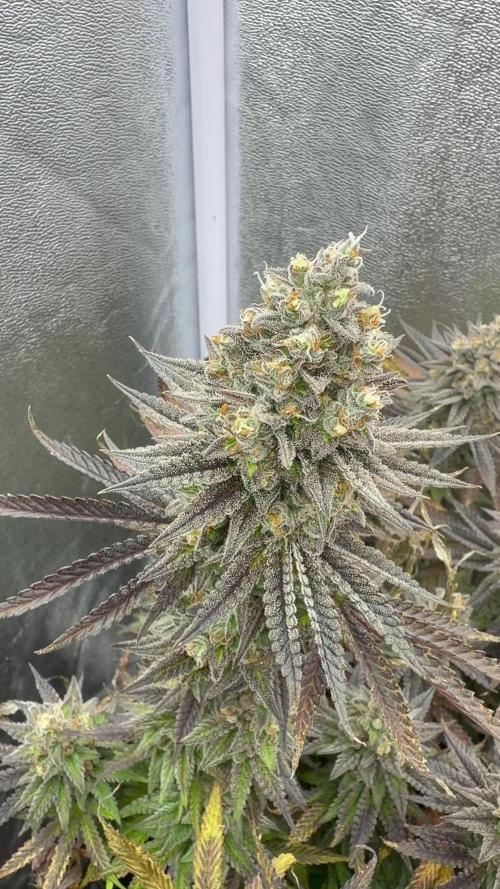
Week 7 Flowering /
Everything is looking great! The plants are well developed and covered in trichomes.
Last week or close to it: about 50% milky trichomes on the Critical Widow and Amnesia Lemon, with some still clear and a few amber.
I’m thinking about harvesting either in the next few days or in about a week while continuing feeding.
Aroma-wise:
Critical Widow of the lower buds has a really unique profile — like a sweet candy
Amnesia Lemon slightly salty, with a subtle background of peanut and a hint of lemon.
24 February start flo ≈
69-70 days in 12/12 , harvest ≈ 9-10 weeks ✅
Flush plan 69-70 days in 12/12
FINAL FLUSH + HARVEST (2x16L SCROG)
≈
Apr 21: Drain 20L → 10L FlashClean✅
Apr 22-27 DRY-BACK (do nothing)✅
Apr 28: CUT whole plant d → hang dry 7-10 day🔨


Likes
42
Share

@wolfvb
Follow
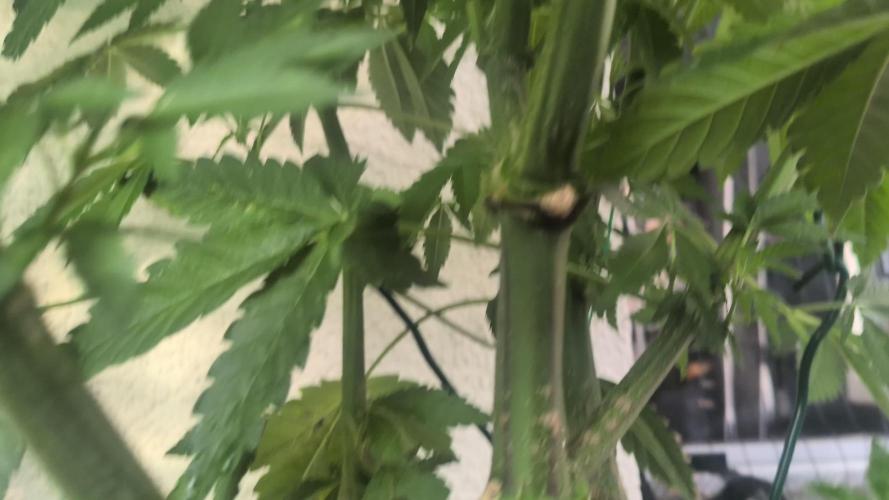
🌿 Week 14 Update: Khalifa Kush - Preventative Strikes & Airflow! 🛡️✂️
Let's go! Welcome to the new week for the Khalifa Kush. She is absolutely loving the balcony life, but after the recent battles indoors, I had to make some tactical moves this week to keep her safe and thriving.
📈 The Details / Progress Report:
Preventative Warfare: After dealing with that brutal thrips infestation inside the tent, I am taking absolutely zero chances out here! I had to bring out the neem oil and give her a thorough foliar spray just in case. I definitely don't want what happened to the indoor girls to happen to this massive bush. You can actually see the fresh oil and water droplets resting on the lush green foliage in the close-up shots! 💦🌿
Opening Her Up: To go hand-in-hand with the pest prevention, I got in there and did some much-needed defoliation. She was getting incredibly dense, so taking off some of those larger, light-blocking fan leaves really helped open her up a bit. It drastically improves the airflow through the center of the plant and makes sure the neem spray can actually penetrate the whole canopy. ✂️🌬️
Vibrant Health: She took the pruning and the spray perfectly. As you can see from the overhead shots, the leaves are rocking that deep, rich, leathery green, and the structure is looking incredibly strong. She is looking super lush and happy!
💧 Next Steps:
With her canopy opened up and a protective layer of neem oil applied, we are in a fantastic spot. The main goal now is to just keep her well-fed, monitor the leaves to ensure no pests try to bypass our defenses, and let her keep building that massive frame in the sun.
Let's keep it growing! 🌱💨
Likes
80
Share


@Mrs_Larimar
Follow
Saturday, Feb.20th.
That Girls had bad Luck
My Boy got them a Haircut, I call it " Dogcropping"
He is very Picky in Cannabiseating.... thats aQuality Sign!!.....but its Sad too
But Iam sure they will look great Next Week
Plants were Transplanted into 11L Smartpots, filled with my Soilmix and "Living Organics"
They moved into the Vegetation Tent ( 120x60x180)
Under the Marshydro SP-3000
Light is Dimmed to 50 Percent


Likes
5
Share


@OnlyTomatoes
Follow
[ Information ]
For all grow information, including strain and room details, please see the first week of veg.
[ Updates ]
(Flower) Day 1 - Light intensity increased to 65%. C02 increased to 1300ppm average. Day temp/humidity 85/70 (1-1.2VPD), night temp/humidity 75/65 (.8-1VPD). Fed a diluted compost tea mixture before lights on. Base water was R/O and tap water mixed lightly with silica and Tribus microbes. Tea was a mixture of Fish Hydrolysate, Bat Guano, Molasses, Fulvic/Humic, Kelp, and Earthworm Castings. 8 gallons of tea were added to 72 gallons of water mixture for an 80gal batch total. The batch was mixed for a half hour before feeding to the room. I did not PH or PPM test the mixture, organic material is hard to get an accurate PPM reading so the numbers are useless to me. I will be working to bring the lights to 100% power over this first week of flower.
Day 4 - Light intensity increased daily, currently at 90%. Will raise to full power tomorrow. C02 increased to 1800ppm average. Temp and humidity for day and night are still the same. Lights were raised slightly to maintain 12 inches from canopy height, and a few growth nodes that were above the canopy got topped. Watered today with an 80gal (1.25gal p/pot) mixture, 10% tap 90% r/o water. 6.8 PH, 2.2ec. Foliar sprayed yesterday before lights off with a neem mixture for weekly IPM. Canopies are stretching relatively evenly, though I will be adding in support nets within a few days to help maintain the even spread. I've run this strain before so I'm fairly confident that I know what to expect during these few stretch weeks.
Day 7 - Lights have been at 100% since day 5. C02 still 1800-2000ppm on average. Plants are stretching quickly into the lights, I have yet to readjust their height. The best growth usually happens when I do nothing, and I've done almost nothing the past couple days besides enjoy the unusually warm spring weather my area is currently experiencing. Watered today, 100gal (1.5gal p/pot) mixture, <1ec. Mainly an organic feeding for microbe health, also wanted a bit more runoff than normal due to the high ec feeding previously.
Likes
88
Share


@ILoVeThiSpLaNt
Follow
Avevo staccato due cime per pianta delle kmintz. Mantengono quello che sentivo mentre le toccavo. La prima pianta sa di caramelle zkittlez con un fumo che nell aria non è il classico odore di erba ma qualcosa di incensato e mi fa impazzire.La seconda è decisamente più complessa. Zkittlez/frutti di bosco/nocciola/gas. Ho scritto oggi a Ripper Seeds facendo vedere un po di foto e mi hanno detto di tagliarle pure anche se manca qualche giorno rispetto ai 63 dichiarati dalla casa.Ho già ricomprato 5 semi perché le rifarò sicuramente se non il prossimo ciclo quello dopo. Le due Watermelon Zkittlez proseguono la fioritura. A settimana prossima coltivatori 💪🤞

Likes
42
Share


@Zurban_Poison
Follow
Hi people!
who was surprised that I had to tie it?)) the buds are just huge! and already at this stage they are strong as stone! and they still keep growing! and yes! I also gave her overdrive !!!))) probably my favorite fertilizer! I love her effect! how it affects the buds! and how quickly you can see its effect. I'll show you Overdrive's work next week! if you haven’t dealt with this booster yet, you will be pleasantly surprised!


Likes
24
Share


@CanarianGrow92
Follow
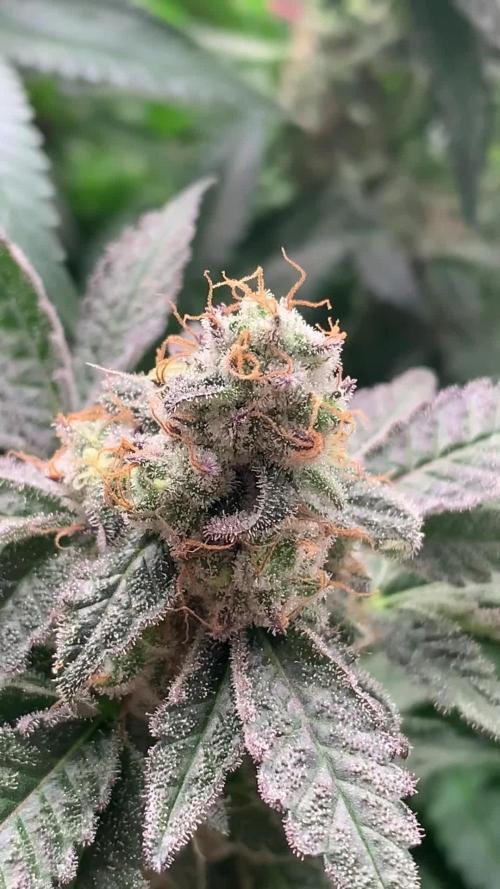
Quite good result considering that she only got around 6h of sunlight, the buds didn't grew too big but they have a lot of THC, this is perfect for people who live in the city and just want to grow some small plants on the balcony without getting too much attention, the smell was really sweet and she offers a good resistance against bugs, and i didn't even applied any insecticide.
We are going to use this plant to do a fresh frozen extraction 😁




Likes
6
Share


@Kolakk420
Follow
Very good strain selection, good quality,easy to grow, recomended this strain, thx dutchpassion seeds company for good strain choices and thx for watching!!!
