


Likes
Comments
Share


@BB_UK
Follow
So after topping all single heads into doubles she outgrew her space for me to continue the autos and other young plants in there so as the weather is aiding I took her out and out her in my room near the window and she is loving it! She’ll remain there for now as the females in bloom finish and then I’ll trim her down a little and place her in with the clones by then and bloom all together is the plan! And the clones are an amazing size so should be like 3-4 weeks ahead with them when they root and I’ll transfer them into 12l pots too! Even the outside other plant has set in and started to really grow! Even after her trim she has so much re growth

Likes
10
Share


Likes
10
Share


@ThatsmyGrow
Follow
She did not get soo huge like the other but i love how the buds turn. They will be soon ready

Likes
28
Share


@AlpAge_Cino
Follow
2024/01/19 : plant looks healthy, 5th node is deploying, I can see 6th, even tiny 7th... so I decided to top.
Back to 10 cm...
2024/01/20 : mainlining starts today,
2024/01/22 : ML's going on, watered with elycitor (1 g/L).
2024/01/23 : sprayed with Foliar Spray from B.A.C. last night to help a little
2024/01/24 : blueberry takes all this like a champ, it has 2 bodybuilded main stems. Now waiting for 4th nodes on each stem for 2nd top...
2024/01/25 : watered with molasses (1 mL/L), I can see baby 3rd nodes...😀

Likes
11
Share

@DE_BW
Follow
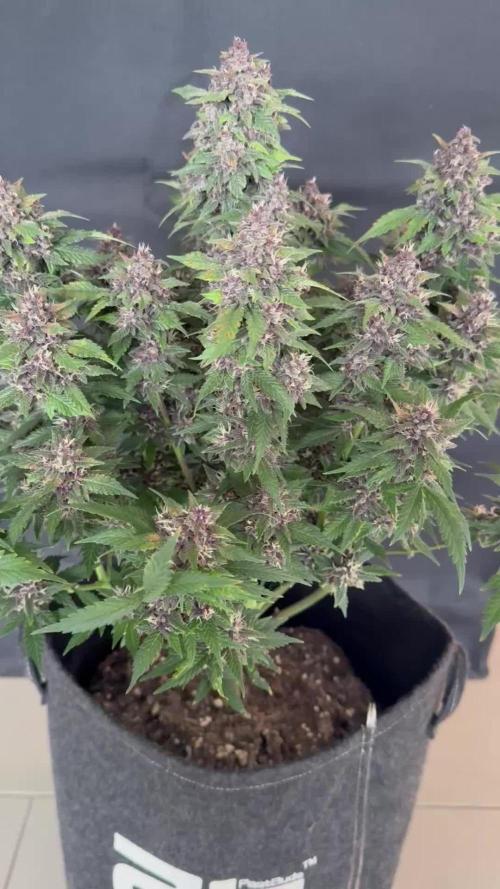
The buds keep stacking steadily and resin production is increasing noticeably across the entire plant. A light fruity aroma is starting to come through, becoming more distinct with each day. Bud structure is very uniform, with every branch carrying solid, well-formed flowers and a beautiful dark purple-black coloration. I estimate the plant will need around two to three more weeks to fully finish.
Likes
2
Share

@Black_Widow
Follow
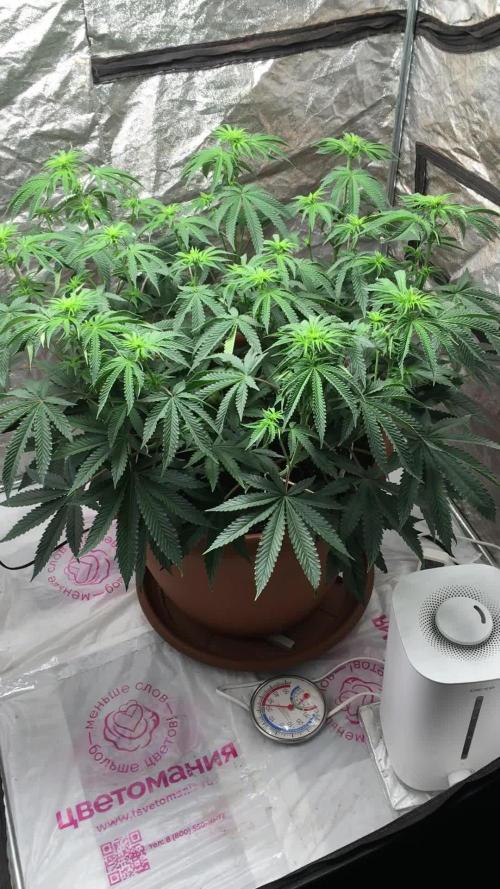
Привет садоводы и огородники !!!
Растение чувствует себя хорошо
оно зачвело и вытянулось до 50 сантиметров
цвет листьев отличный


Likes
2
Share

@MrLahey
Follow
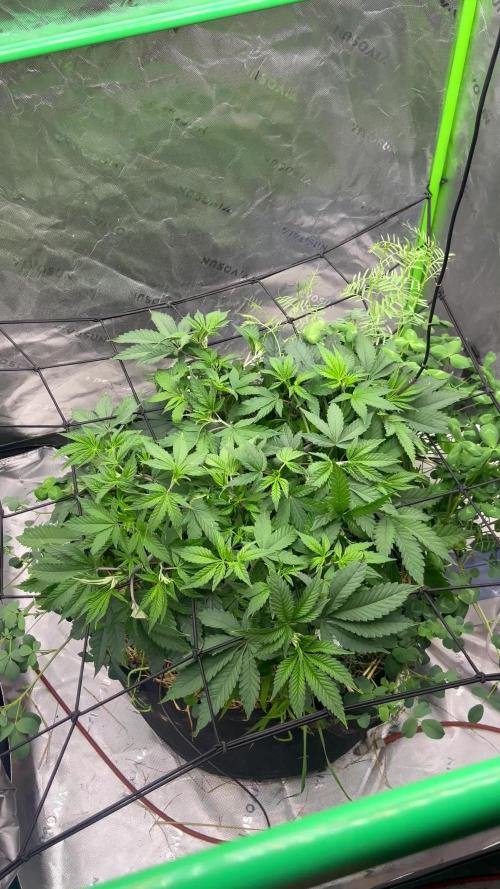
Flipped her to 12/12 lighting a couple days ago. Gonna continue to tuck her for the next week or so and then let her grow upwards. Looking forward to a good flower phase!

Likes
38
Share


@Oyziphar
Follow
DAY49
7 Weeks
Buds are hard. Smell is extreme.
Very limited amount of spidermites under some leaves. No reason to exterminate them, because next week I'll probably harvest the plants.
The smell of the Triple G is fanastic, Big separated buds. The Cookies Gelato are more sativa style of buds than I'm use of them. There leaves are turning purple.
The Liberty Haze has a lot of small leaves in the buds, and thet got amasing blinking white flowers. Probably this will be the plants I'll harvest the last, because they need some extra flowering time.
The Wedding Gelato is creamy, lots of trichomes and is fast flowering. But some flowers got budrot. I'ts hard to get the humidity low because of the rainy and misty autumn outside.


Likes
37
Share


@420DeepGrow
Follow
En la cuarta semana he tenido un problemilla, he acercado demasiado el foco y he estresado a las plantas por lo que no han estirado como deberían, se ha decolorado la punta por exceso de luz. También hay retraso en la floracion y puede ser por un de cortes de luz que he tenido mientras cocinaba.
📅 Dia 29:🔹Descanso
📅 Dia 30:🔹 Descanso
📅 Dia 31:🔹Riego según la tabla de nutrientes EC 2800 pH 6.4. He notado que las plantas se han estirado mucho y se han retrasado en la formacion de flores debido a la proximidad de la luz led, una planta perdió pigmentacion y está recuperandose al incrementar la distancia con el foco. Creo se recuperaron de este estrés y la floración sigue en marcha. No se si me quedo corto con un led de 65w full espectrum.
📅 Dia 32:🔹Poda de alguna rama bajera y defoliacion.
📅 Dia 33:🔹Descanso.
📅 Dia 34:🔹Riego según la tabla de nutrientes con el PH a 6.3. Aplicaré 1 litro por planta para retirar las sales sobrantes y tenga una buena explosión de cogollos.
📅 Dia 35: 🔹Tras poner todos los parámetros en orden, han dado un gran cambio. El ventilador había dejado de dar aire y no me había dado cuenta, he comprado otro nuevo y ahora explosionan por días

Likes
17
Share


@Buddyhighs
Follow
Day 48: 21 degrees 57% humidity 4l water
Day 49 : 22 degrees 62% humidity 1l water
Day 50: 22 degrees 57% humidity 1l water
Day 51: 21 degree 61% humidity 1l water with feed
Day 52 : 21 degrees 60% humidity 1l water
Day 53. : 21 degrees 57% humidity 1l water
Day 54 : 21 degrees 61% humidity 1l water
Day 55: 20 degree 62% humidity 1l water
Day 56 : day of pics 20 degree 61% humidity 1l water
I can’t really see much difference this week but I this these lady’s are ready to swell up more bloom feeds I think 💪🏽


Likes
146
Share


@Natrona
Follow
Harvest Week. I hope all my North American friends had a wonderful and safe Thanksgiving. I harvested on Tuesday, so due to Thanksgiving prep. I'm late posting the harvest report. Apollo is a wonderful plant to grow. She stayed short. I tried to lst by tying down. Apollo limbs pushed up the pins many times. She is strong and resilient.
After watering only 2 liters with Vit B, Recharge and Signal yesterday, I put her in the 3#x3tent in the dark. The leaves were showing the fade using up the nutrients.
11/21 is day Apollo's 71 day and 43 in flower. The harvest window per RQS is 70-75 days from seed.
Apollo's buds are thick, dense, stinky citrus floral and sticky. As she hangs to dry, she is pungent and stinky.
I am so proud of this grow. I didn't overfeed so I have experienced the color fade to yellow as foods are used up and the delicate colors emerge in the sugar leaves. I am very impressed with Royal Queen Seeds F1 genetics. So much so I bought Milky Way F1 and Medusa F1. I will definitely have another Apollo grow in January. Thank you @James at RQS.
After hanging to dry 13 days and a little bit more trim, Smokable bud 128 g or 4,5 oz. Wow this is my best harvest and grow ever. I put her in the jars to cure.
Apollo F1 had a huge base stem and was multi branching-even the side stems had side stems. The stems were sturdy. No support is needed for her branches She stayed short at 26 inches tall. I definitely pushed her on the watering.
When I saw no runoff after 2.5 liters of water, I upped to 3 ltr. Then 3.5, then 1 gallon. I watered 2 liters, let the water absorb, then slowly add another 2 liters. There was a small amount of run off at the time of watering but was all gone by the next day. It could have been evaporation, but I really think it was consumption. Consumption is an indicator of yield. As densely bushy as she is, I'm estimating at least 90 grams.
So for future grows, especially for very bushy plants, I will defoliate at least 2x during early and midflower to open up the canopy and let the plants bulk up more. She did show some nutrient (cal-mag) deficiency and for the next Apollo grow, I will push the feed a bit. I'm excited and a bit sad to see this grow come to an end at the same time. I really want to sample the smoke and feel the effect. Apollo is a balanced Hybrid.
Thanks for the visit. Apollo and I appreciate the likes, views and comments. Be sure to check out my Recipe diary for some tasty edibles, basic infused sugar, butter, honey recipes to kickoff your edible making experience. Also some health and beauty recipes as well.
Have wonderful week. Happy growing and have fun.
Natrona
********************************
Apollo F1 is a vigorous auto flowering hybrid that boasts a strong structure and delicious aromas. Created from inbred lines descending from Lemon, Black Domina, and Sugar Magnolia, Apollo F1 inherited premium genetics from her predecessors. Like the ancient Greek deity she's named after, Apollo F1 produces balanced, creative effects that might inspire your perception of music, dance, poetry, and more!
Mature and well-dried Apollo F1 flowers boast an upfront fresh aroma that combines crisp pine and herbal notes with the invigorating kick of ripe citrus peels. Accentuating these notes is a rich backdrop of dark vanilla and hints of lavender, reminiscent of modern cannabis varieties descending from Cookies and other US lineages. Apollo F1 produces a resin loaded with plenty of cannabinoids (predominantly THC) and a complex mix of terpenes including myrcene, terpinolene, farnesene, caryophyllene, ocimene, limonene, and linalool. As a result, Apollo F1 produces a balanced effect very typical of a well-bred hybrid—expect a powerfully relaxing physical sensation (characteristic of myrcene, farnesene, and linalool) mixed with a notable euphoria and motivating kick produced by terpinolene, ocimene, and limonene.
Apollo F1 is a robust cultivar with the telltale compact structure of an indica-dominant hybrid. Plants reach a medium height with many tightly spaced branches that quickly become loaded with bud sites and thick, dark-green foliage. Apollo F1 flowers automatically, and her entire life cycle lasts roughly 80 days. Come harvest time, Apollo F1 will reward you with big, dense flowers bearing a thick layer of trichomes.
Variety: F1 Hybrid auto
Genetic Background: Lemon x Black Domina x Sugar Mangolia
THC: Very high
Yield: XXL
Height: 55 - 75 cm
Flowering time: 45 - 50 days
Harvest: 75 - 80 days after sprouting
Effect: Calming, Creative, Motivating , Physically Relaxing
Flavor: Citrus, Herbal, Lavender, Pine, Vanilla
Major terpenes: Caryophyllene, Farnesene, Myrcene, Terpinolene
Climate: Short Summers
Friends, Royal Queen Seeds Is offering a discount on purchases
👉**GROWERS20** for 20% 👈
Https://www.royalqueenseeds.com
Link to Apollo
https://www.royalqueenseeds.com/us/56-f1-hybrid-cannabis-seeds
====================================
Equipment: AC Infinity
CLOUDLAB 844 – Advance Grow Tent 48”x48”x80”
CONTROLLER 69 PRO – Grow Tent Controller
CLOUDLINE LITE 6 - Inline Fan 6"
IONBOARD S44 – LED Grow Light Board 400W
CLOUDRAY S6 – Oscillating Circulation Clip Fan
Carbon Filter 6”
Pots: 5 gallon Air pots
Soil Fox Farm Happy Frog amended with worm castings, perlite, dolomite lime and mycorrhiza.
Seeds provided by Royal Queen Seeds Check them out 😎
Https://www.royalqueenseeds.com
Link to the seeds
https://www.royalqueenseeds.com/us/56-f1-hybrid-cannabis-seeds
use Discount Code
👉 **GROWERS20** for 20% discount 👈
Nutrients: Total Plant Solution
>TPS1
>Canopy
>Signal
>Recharge
Amended soil recipe #2 used for soil prep.
https://www.paramountseedfarms.com/super-soil-recipes.
Likes
53
Share


@cheetah844
Follow
I tried to move a couple plants over to the smaller tent to get a little more air circulation in there because I had only a passive air intake. With this many plants in this space I didn't think they're getting quite enough fresh air. But upon moving them over to the tent the light even at the highest position slightly started light bleaching the tops of a few plants. So I then moved them back to this bigger grow space and bought an intake fan. The Zkittlez are fighting me the whole way, I don't know if she likes to be cloned or not. Only the Zkittlez often seem to look a little sad even with everything dialed in for them.
Likes
16
Share


@Naujas
Follow
107 days!! Here is another great experience :) The girl has matured, 330 grams of wet, full of sticky, resinous shiny, pleasantly smelling flowers :) I think it will be about 90 dry :) although the girl is definitely not the biggest, but she looks great, the smell is also amazing :) I also got some sugar leaves from which I will make bubble hash, For me personally it is really beautiful and good growth, which I think will definitely be confirmed by the dried and cured flowers :) there will be a smoke review, as well as the total dry weight. good luck to everyone :).


Processing
Likes
15
Share


@AK1210
Follow
Things are going really well for this lady. She has continued to produce copious amounts of tricombes and the smell is just unbelievable. I've had to source some air fresheners to hang around the garden to try and mask it.
I've removed a few of the new growth at the bottom of the main stem a some they are only going to suck energy that can be better used.
Likes
1
Share


Processing
Likes
15
Share


@420Consinc
Follow
- WEEK 8 -
----- Day 50 -----
Woo hoo. End is in sight and the plants are still PACKING the pounds on.
Big Bertha is 11 inches long, 2 inches wide.
The hidden massive Gertha is 8 inches in circumference in the middle in just bud alone and isn't even the largest part of this 8 inch long nug...
Fed 1150ppm 13L 6.4pH
5-15+ days left.
2-4 days till I start looking into trichome finish period.
Forgot to take a regular full shot and shots of tropicanna glookies. oh well. Later tonight if I remember.
I stopped bud candy cause I'm using a lot more molasses and its literally a sugar in itself so why put in bud candy which is just sugars... seems redundant.
----- Day 51 -----
Easy day of watching.
Some nice bud shots today. The whole basement smells of weed candy. Back right Tropicanna is pineapple gummy bear, front right is just gummy bear.
Wedding Cake is like sweet weed, you get the regular smell of pot but instead of skunky its sweet but that Tropicanna is just alllll candy no weed smell at all.
I did the first 60x shot today. 5% cloudy 95% clear on the Tropicanna. Long ways to go.
I'll be doing the Wedding Cake later tonight, got side tracked.
----- Day 52 -----
Fed 1200ppm 6.4ph 12 Liters
Tropicanna Glookies is going full blown purple. Should be covered in dark purple coloration within the week.
Wedding Cake is just fat. Super fat large nugs.
Easy day. Forgot to take trichome pics of Wedding Cake will do that later today probably.
Well, the largest bud is 1 foot in circumference now... rofl
----- Day 53 -----
Easy day. Fed some water, they're getting thirsty again.
I'm going to do a 13L feeding , then next day 5L water. So that's what I did today.
I'll be dropping the Kool Bloom Powder & CaliMagic by day 56 and only feed 1/2 strength molasses only.
Will pick the buds off as they finish, not gonna do 1 big chop unless it manages to turn out that way.
Colors are going wild.
Will check Wedding Cake & Tropicanna trichomes before lights out will update pics then.
----- Day 54 -----
1300ppm 13L 6.4ph fed
Here's some pics.
Wedding Cake is nowhere near ready by the trichomes. Barely any cloudy, no amber.
----- Day 55 -----
Tropicanna really turning purple now starting to infect the leaves at top of canopy.
Can't wait for what Day 63 holds for all these ladies.
Not going to check trichomes till probably day 58
Easy day, last fert feed with chemical nutrients tomorrow, after that its just molasses.
----- Day 56 -----
Didnt even bother with ppm/pH.
Molasses. roughly 30-50ml in 13-15 Liters.
Smoked a tester of the Tropicana Glookies (Sativa)
God daaaamn. Shits fire. Extremely strong. Very Cerebral and its not even at its peak yet...
I've chosen Tuesday as Harvest day for both Tropicana Glookies plants (they're clones of each other)
A single Wedding Cake testing nug is drying right now, I'll judge when it gets harvested based on the high, and if not sufficiently near my level i'll give it 2 days before drying another nug and trying again. I want heavy ass couch-lock.
6 days for Tropicana.
Probably 8 for Wedding Cake.
Will send samples off to Canvas Labs for testing like I've done in the past and will be making both edibles and bubble hash and will post those here as they happen.
Once thats done I will see if I can restart veg mode in this grow, and if so I will keep this going until the plants die (and just make side diaries for each individual plant variety grow).
Should be interesting.
*** update ***
Where'd the 1.5 Liter water bottle go?
rofl
