


Likes
Comments
Share


@DreamIT
Follow
-Sponsored by:
🌴SPLIFF SEEDS🌴-💡VIPARSPECTRA💡-💐GREEN BUZZ LIQUIDS💐-🛠️WEDRYER🛠️
8/7 After several days of Growdiaries making it difficult for me to write and respond to comments, I found that I can still update the journals. I apologize to everyone for the non-replies but I have replaced the main email and the email to confirm the account never arrives, and Growdiaries' customer service seems to be non-existent.
10/7 everything is going well, nothing special to add🤘🦄
12/7 surprising how humic acid speeds up the growth of these wonders
__________________________________________
Personal advertising (contains affiliate links)
__________________________________________
🦄 Are you new to the world of cultivation and don't know where to safely buy your seeds?
Fast and anonymous shipping. Check out their hilarious graphics. (no affiliate links)
✅https: //bit.ly/spliffseeds_
__________________________________________
Did you know that Green Buzz Liquids fertilizers are 100% vegan? A complete line of products ready to give the best to each of your plants! Visit the site and see my journals to see how they work 🦄
🤯 And with the code "dreamit" you will immediately receive a 15% discount on your purchases
✅https: //bit.ly/GreenBuzzLiquidsPro
__________________________________________
👀 Are you looking for a good lamp to start with? 👀
🌞Viparspectra has something more than the others, take a look at their site.
⏩ Use "GDVIP" for an extra discount or "DREAMIT3" for an extra 5 %% discount
👀 Search for it on Amazon
✅Amazon USA: https://amzn.to/30xSTVq
✅Amazon Canada: https://amzn.to/38udUVe
✅Viparspectra UE: bit.ly/ViparspectraUE
✅Viparspectra USA: bit.ly/ViparspectraUS
______________________________________________
🌈 Tired of blowing on your weed hoping it dries quickly? Check out the Wedryer website! You will find a well-made accessory that will help your weed dry in just 8-10 days without the annoying risk of finding mold or other annoyances! (no affiliate links)
✅https: //bit.ly/Wedryer_
______________________________________________
📷🥇Follow the best photos on Instagram 🥇📷
https://www.instagram.com/dreamit420/
Backup
https://www.instagram.com/dreamit4200/
🔻🔻Leave a comment with your opinion if you pass by here🔻🔻
🤟🦄💚 Thank you and good growth 💚🦄🤟

Processing
Likes
20
Share


@PureMedicin
Follow
They are growing really well. Added a humidifier at day 9. I have a seedling in rockwool still it is growing super slow. Root still not sticking out even tho it have been in the cube for 7 days now. Im feeding very light 40% strenght. I see how light green the leafs are and thats what im going for. I will up the strenght abit the following days. I been watering almost everyday. Started the first week with 0.1 liter now upped it to 0.2 liters per plant. I had the HPS light just a bit too close to the plants so i have some very slight curling on a few of the leafs. No problem i just move the light up 5cm. So far im very pleased with the growth rate

Likes
37
Share


@Cheeba_Inu
Follow
As of day 63, the Blue Dream'Matic is bulking up well and getting closer to what may be a really great harvest. The smell off the plant has gotten unreal, both powerfully sweet and distinctly of blueberry. The buds are completely frosted with trichomes, and some of the pistils are turning orange, so the plant is getting closer to harvest by the day. I am sticking with this current nutrient profile until the final few days of ripening when I will run extra enzymes and perform a short flush.
Thanks for reading!

Likes
228
Share


@StarLorr
Follow
Welcome to my Pablø Escøbar diary.
In this diary:
Seeds: sponsored by Ðivine Șeeds
Media: Promix HP
Nutrients: Advanced Nutrients, Diablo Nutrients.
Light and Weather: Şun☀️and Mother Earth.🌎
___________________________
Feeding:
Tue 18Jun: 12L water not pH'd
Wed 19Jun: 10L water not pH'd
Thu 20Jun: 5L nutrients pH'd 6.5
___________________________
We went through a heatwave from Monday June 17th to Saturday June 22nd with temperatures of 34°Celsius with humid factor of 44°Celsius girls got thirsty and finally it poured rain from Saturday afternoon to Monday morning witch was more than welcome for the girls and our garden. Temps are back to normal now🌤️
___________________________
Thanks for stopping by, likes and comments are appreciated!👊🏻😎
Keep on growin!
Keep on tokin!!!
😙💨💨💨💨💨

Likes
3
Share


@el_cultivito_colombia
Follow
Semana 3 (1/8/22 - 7/8/22)
Plantulas mostrando un buen enraizamiento.
Se preparo una solucion de Elite 91 Myco Jordan iniciando la semana con:
-PPM : 80
-pH : 5.8
3/7/2022 se transplanto a cubos de lana de roca de 15cm x 15cm.
Los cubos fueron submergidos bajo una solucion de Mills Start R con:
PPM : 100
pH: 5.7
En el transplante se uso Elite 91 Myco Jordan en forma de polvo para cubrir el hueco del cubo y cubrir las raizes de las plantulas para reducir el estres del transplante.



Likes
10
Share

@Prilyfe13
Follow
10/28/2025
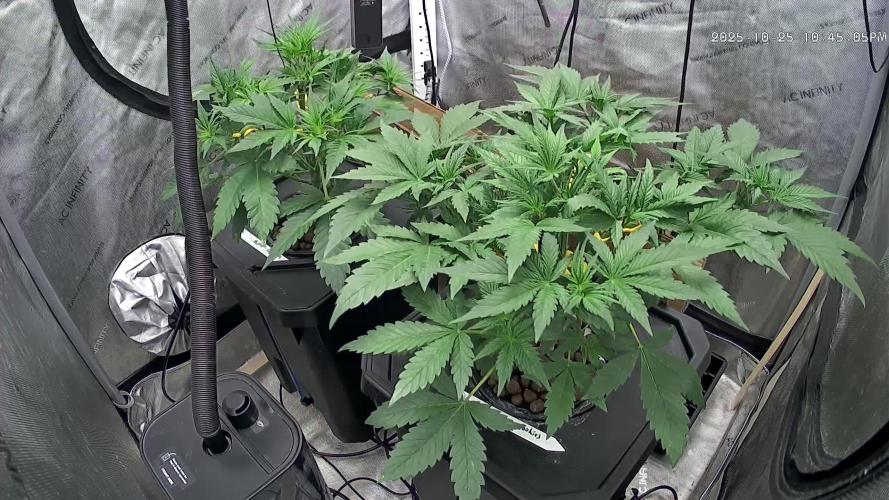
What a day! We have started the Bloom Nutrients, cleaned out the reservoir... To be honest, I don't know what people are talking about with dirty things. My whole bucket was super easy and fast to clean. Frankly it really wasn't dirty at all. Kinda like reusing a cup. Nothing wrong with it. Just had something else in it. Anyway, quick and easy.
I used distilled water. 4 gallons per bucket.
I think my TDS meter is broken. Either it's really that high or these plants love it, but the reading is 1020 ppm and the EC is at 2000. That's really high... I think. I have no idea. I've read that people couldn't get over 300 ppm without burning their plant. While I'm at 1020 ppm. Something is wrong here and I can't figure it out. I've watched them like a hawk for the last 5 hours. And they look super happy and healthy. Not a single sign of toxicity. Just follow the instructions. Lol. So why am I looking at numbers that should burn them? Maybe I'm wrong. But I think they can just handle it. No idea how, but these are tough plants. I'll update with any signs of stress.
Anyway, moving on. Ahem...
So I definitely need to do another clip traing on Papaya Cookies. Not really sure if Lemon Cherry Cookies needs it. I'll see tomorrow.
Also, these 2 are finally showing real traits of what they are. Papaya Cookies is definitely sativa as the description says. Like seriously sativa. Thin leaves, skinny branches. At first I thought it was the stem issue, but then I realized that this is what it's supposed to look like. Skinny but strong. Anyway, she is starting to grow too tall in the middle, so I need to pull down some branches with those clips I got.
Lemon Cherry Cookies is certainly showing her indica traits. Wide leaves, bushy stature. Thick strong branches. Beautiful green color. (Papaya Cookies leaves are much lighter.)
Lighting: 27" away from the canopy. Power 90% 278 watts. 615 PPFD I might have to dim the light a little when they grow closer to it. Maybe. It all depends on how much higher I can get the light up. I think there's 8 inches of space between the light and the ceiling. I'll figure it out.
The environment is still perfect. The humidifier and heater barely run. And if they do, it's like level 1 or 2 of power. Not much going on in there to change the environment. But I did get my new exhale 365 bag. It's supposed to take a few days to get going, so we'll see what it looks like in a few days. The CO2 level is around 900 ppm. I'd like it a bit higher, but it's ok.
I don't think I'll record the environmental readings. They are generally all the same. And it's honestly getting a bit redundant. Especially when they are already recorded in the list thing.
See you tomorrow.
10/29/2025
No picture day. I assure you they look wonderful. Both plants are starting to show buds. They should start stretching any day now. Each of them is 12". Very green, very healthy.
I'll have to pull down 2 top branches on Lemon Cherry Cookies after lights on. Just 2. They are sticking up too high above the others. Also, it'll help fill in a hole in the center of the plant. Still looks pretty bushy. That's nice.
Papaya Cookies looks awesome! Even after her little infection. Definitely stunted and I would have expected her to be taller than her counterpart. But she isn't. However. That's not stopping her from producing tons of bud sites. I may have to go with the scrog net after all. Unless she hardens up and can hold the buds. I don't think so. I'm gonna have to use the net as a support.
Lighting:
So I lowered the light to increase the DLI currently it's sitting at about 42.5 mol. The PPFD is around 630. Something like that. I'm going to double check when the light is at full power. I was going to increase the intensity to 100% but I decided I should wait a few days since I lowered the light. I'll get a measurement after the lights turn back on. Honestly, my goal is to have the light as high as it can go with max intensity. I'm not sure I can actually do that with this 300 watt light. I also have the CO2 exhale bag I can consider soon enough. If it works as they say, I can probably increase the DLI to 50 mol. We shall see.
Environment:
There's actually something to talk about. So I live in an apartment converted from a house. There's a total of 3 apartments. Someone, not me, cranked the heat this morning and the tent hit like 78°. I know it's not a lot, but still not within my precision mastered range. Lol. Hell, my AC isn't doing the job. The lowest it's been is 71° in the house. Back up to 72° but yah, in the house it was like 75°.
Anyway, that's it for the day. I'll check in later with any changes.
10/31/2025
I'm sorry everyone. I've been super busy the last couple days and didn't have time to add to my plants adventure tale. So I noticed at light level 9, the plants were praying pretty hard. I thought to myself well then a bit missing light. So I turned up to max level 10. Watt output is 310 watts. I don't remember the DLI, but it's like 44 mol. Anyway, I checked on them about an hour later. They were still slightly praying, but that's good. It just means they needed a bit more light. I'll keep an eye out for light stress. Also, I think I figured out a thing. Cannabis grows trichomes when it is stressed out as a defense mechanism, no? As in a strong aroma coming off in the veg stage. Isn't that a sign of stress. In particular light stress? Obviously when flower hits, it will smell from the flowers. But as a vegging plant, it should smell like a leafy green plant and not strongly of trichomes. It's just a theory, but could be useful if I'm right.
To summarize, veg stage should smell like a plant. Flowering should smell like weed. And as it's known. It builds trichomes to protect against light stress and a few others I can't think of at the moment. Wind burn too I think. More like environmental stresses. Something the plant would have to protect itself against. If you have an idea in regards to this theory, I would be glad to talk about it. Send a comment and we can maybe start a discussion.
Anyway, I let the pH float yesterday. Today it was dangerously close to 6.5. I don't understand why it increases so much. It doesn't swing either. Just spikes. It's seriously annoying not knowing why. I will learn thos somehow.
Back to 10/31/2025
Happy Halloween everyone. 🎃
So today I will be taking some of the training clips off. They are starting to get too small for the bigger branches. I'd like to take them all off now, but I have a lot of small branches that need to be woody and thick. But yah, all of those are coming off. I've also decided to see if the light at 90% will still cause major reaching. And if so, maybe I should let it be. They can stretch right into the light. Or I'll leave it at 100%. I'm not sure yet. Any suggestions? Feel free to comment on that no matter how old this diary is.
The temp seems to be perfectly ok, but the humidy is starting to climb with the plants getting bigger. So it's dehumidifier time. I'm planning on buying the AC Infinity one that connects to the system. But I have as small one for now. Environmentally speaking, everything is going great! Not too much wind, decent air exchange and bouncy CO2. Not sure how to fix that. I was considering routing the end of the exhaust duct back into the tent. I think I will. When I get these vent port caps. They are light proof but also provide air exchange. So I was thinking of taking the duct. Sticking it in the top vent port and letting that air flow through. If it works, I should have plenty of CO2 in the tent, the temp should stay pretty constant as well as the humidity. Well, kinda. The dehumidifier would have to work double time, but the other accessories, like the heater and the humidifier won't need to run as much. And considering this AI is keeping my tent spot on, I'm guessing spot on to spot on would make a perfect mix. We shall see. I have to wait a week or so for the port covers, which sucks. Because this is the very beginning of flower and I would love for the CO2 levels to be in the 1200s. I think.
Lemon Cherry Cookies looks absolutely wonderful. Lush broad leaves. She'll definitely need a trim at the end of the stretch. Speaking of stretching, she hasn't done much of it. Like an inch or so. Not sure what I'm doing wrong or if I'm just being impatient. But I have had plants with the greatest care only get to like 18" tall. This Lemon Cherry Cookies looks like it might be one of those plants. Super bushy, but really short. Trimming after the stretch should open up some much needed air space. But as I said the leaves look great! No signs of any issues whatsoever. And the root ball! It's huge! I can't take pictures because I have to hold the lid up. Believe me, it's big.
Papaya Cookies looks pretty good as well. She's actually taller than her counterpart. By a good inch or 2. But that is most likely because she's a sativa. Where Lemon Cherry Cookies is an indica. In that aspect everything is perfect. And! The stem isn't getting big big, but it's definitely expanding. Not like the other one, but still. She still definitely needs to be supported, but I expect good things. Maybe not big things, but good ones. Her root ball isn't all that big either. Kind of expected. However, I do have 1 more seed I think. Maybe I'll pop that after the next run. Hopefully I'll be in a bigger place with space for a 4x4 tent and my 3x3. That would be pretty bad ass. 3x3 for autos and vegging photoperiods. The 4x4 for the flowering phase. Autos stay in the 3x3. An endless supply of weed right there.
That's all for the day.
11/01/2025
So I wake up this morning to a legit bush. Lemon Cherry Cookies seemed to go PUFF and blew up like a balloon. I'll definitely be taking out some leaves after her stretch. I think that's the best time to trim an autoflower. But only once. Small snippets, in my experience, are fine. But like just a few leaves here and there.
Papaya Cookies is starting to stretch more. She's also starting to fill out now. I'm expecting a much larger plant in the coming week or so. She's still a very healthy plant. No idea how, but even her lower stalk is fattening up. She might be a little bit behind, but she's starting to become more active. Honestly, she should be taller and a bit larger than Lemon Cherry Cookies. The way the stalk looks on both of them, Papaya Cookies wins. Up top anyway. But the bottom is small, so less production I think.
The environment is spot on still. I think I'll leave the light at level 9 for now. I might turn it up after the stretch. But for now, level 9 it is.
The CO2 is pretty low in the tent. I forgot to tell you all. The new exhale 365 bag came in and is already in place. That was nearly a week ago. My bad. Anyway, it works, but then it stops. I might route the exhaust duct back into the tent above the canopy after I get the port vent caps. I think that'll work. This is good. Because winter is coming and it gets cold here. So I'll need as much heat as I can get. Well, not really, the heater I have is fantastic. But you get it. The heater also brings in a ton of air. Enough where it balloons the tent.
I'm having trouble getting the pH to stay at 5.8. it jumps to 6.3 daily. So I guess I'll just keep fixing it. Lol.
Anyway, that's all for today. I'll update with any changes.
11/02/2025
Well well well. Look who came out to play! Both ladies are doing quite well. Lemon Cherry Cookies is by far the winner of this run. But you never know. Papaya Cookies might shoot up but I'm pretty sure she won't get that big. Her root ball is kind small. At least compared to Lemon Cherry Cookies. Hers is huge. I can't take a picture because I have to hold the top and the roots. So big.
Anyway, I had to top off both ladies today. They were about a half gallon low. I added a little bit more bloom to help prepare them for the next water change and then bloom goes up. And we add the p/k boost. So I figured exposing them to a very small extra dose would probably do good.
Other than that and the huge root ball, nothing much else to report. The environment is perfect, as usual.
I'll definitely be trimming after the stretch. They are getting really bushy.
That's all for now.
10/03/2025
Good stuff happening today and possible bad stuff as well. Good things first. These 2 plants are getting nice and plump. Well Lemon Cherry Cookies is. Papaya Cookies has a few lower spots. Her canopy isn't very even at all. Thelmouter half just stopped growing. She's also showing signs of nutrient deficiency. She definitely has enough nutes. It's because of her smaller trunk. I could be wrong, but that's the only thing I can think of. I checked for bugs with my microscope. Nothin. Checked everywhere for signs of rot, root rot and anything else that could potentially be causing the yellow spots. They are burning through it looks like.
Likes
24
Share


@Firepharmer
Follow
Rock hard buds Miicrobialmass for the win and the new led is killer. The knobs like knots grow out of the sides of the buds are something to look at wow !!! Monkey berries is in flushing mode , slurricane won’t be far behind in the next week or 2 I’ll flush


Processing
Likes
16
Share


@Andres
Follow
they are 2 purple afghan kush and it shows the difference .. the second one measures 130 cm and started its flowering process ... they always feed organically .. as well as only with fish tank water...

Likes
107
Share


@Afterglow
Follow
Вначале недели пришлось 8 основных колл согнуть вбок, чтобы они не убежали сильно вверх. Это привело к тому, что этажи ниже вырвались вперед и теперь у меня получился какой-то огромный забор из колл. По сути у меня получился SoG без использования сетки, а только лишь с помощью подвязок. Мало того, растишка стала наращивать зеленую массу и заняла все свободное пространство бокса. Если честно, я сам в небольшом ахуе. Я знал что у меня будет супер-скоростной гров, но чтобы еще и такой массивный - даже не представлял. Мало того, шишки начали расти прямо из листьев. 😂
Мы абсолютно здоровы. Специально сфотографировал кончик старого листика. Ни единого намека на дефицит или профицит веществ.
Увеличил дозу до 850 PPM, в дренаже такой же. Перешел на чистое Bloom питание с добавкой Bud Ignitor. Вообще я прям очень рад этим удобрениями. Растет на нах прям отлично, за PH не смотрю. Одни из причин - лень пойти купить батарейки. С другой стороны TDS показывает постоянный PPM, поэтому уверен, что PH нормальный. Ну и сами листья об этом говорят.
Как станет теплее на улице, вытащю бокс на балкон, потому что чувствую, что с таким большим урожаем не справится ни один фильтр, хотя у меня их два. Недавно отключился свет и буквально за пару часов вся квартира наполнилась ароматом.
Вот такие вот дела...
Спасибо что заглянули!

Likes
5
Share


@BerlinBaal
Follow
October 10th she started her 9th week and got her last nutrition. i will harvest her next week or even this weekend.

Likes
19
Share


@TopNotchBud
Follow
Very easy strain to grow. I grew the White Critical Express previous to this grow, I really liked it and wanted to try growing an Autoflower so I went for the Critical 2.0 and it was worth the grow.


Likes
7
Share


@desade9
Follow
just started watering with easy pk formula from plagron, and did a realy easy tuck under net and that is it, i expected more from this plant let see.
I started another plant this is photoperiod Bubba island Kush from Dutch passion, i realy hope this will go good,soil is the same as the other/the first plant, i ordered Digital Luxmeter , and this is going to be cool- Gardena smart Sensor for soil humidity coz i really want to dial in everything otherwise its a lottery.

Likes
7
Share


@Lucyfer
Follow
So, what's new?
water levels seems to be a pain in my assholes that hasn't had a great success, however it matters little becuase roots are very long now so no need for the levels to be even steven, great success.
have had some mistakes were the LST was so strong i actually broke one stem and was about to break another but noticed in time and manage to save it
been speakign with how weed grow in regards to the grow and so far so good, really recomend his patreon in cae you're seeking peace of mind with your grows.
Just recived my SCROG!!!!, so will be managing plant training with the net and also got my new viparspectra 1500xs pro, whatever name is, looks fancy and feels fancy so greta success there too.
not much to add other than my mistakes and that it's week 4.
wish you all great things with y'all grows, thanks for stopping by.


Likes
13
Share


@knicko
Follow
Wie sie funkeln ein Traum bin gespannt wie lange sie noch brauchen wobei sie alle unterschiedliche Stadien haben 😅 aber wird immer saftiger


Likes
41
Share


@bypado_farm
Follow
Day 63:
Watered the plants 0.5L with nuts, 4L total, 919 ppm, 1955 us/cm, PH 6.4
Day 65:
Watered the plants 0.5L with nuts, 4L total, 780 ppm, 1661 us/cm, PH 6.4
Day 67:
Watered the plants 0.5L with nuts, 4L total, 729 ppm, 1563 us/cm, PH 6.4
Day 69:
Watered the plants 0.5L with nuts, 4L total, 905 ppm, 1925 us/cm, PH 6.4
Next irrigation's without nuts, flushing next week
1 plant with foxtails (good ones)(small too)
Processing
Likes
3
Share


@Iop420
Follow
Hi guys 👋. Also this week I let the pictures and grow log to speak. Thanks for watching. Peace and patience ✌️
Likes
19
Share


@Black_Widow
Follow
Привет Садоводы !
дело близится к концу
есть конечно и минусы , стали портиться верхние листья , но я думаю она достоит еще пару недель
а в общем выглядит не плохо и пахнет приятно сладостями !
