




Likes
47
Share


@AsNoriu
Follow
Day 15 since seed touched soil. All is going amazing.
Yesterday topped them up a bit. Stems looks lanky, would expect stronger by now, but generally girls fly ! Off course i watered them straight after goodies were rubbed into top soil.
Great White - 4 g sprinkled around for each plant
BioSys same amount.
Ecothrive Bio Blend - 200 grams added to each pot.
Cookie is racing Devil for the win ;) my back up plan is the only slow runner ;))) That's my luck this summer in EVERYTHING ;)))))
Lights are still on 40%, Mars as always has great products for growers.
Think this week i will start some training.
Day 19. Yesterday girl got 800 ml oh 6.3 phed water. She tries to win this grow, very nice girl, not giving up and chasing Devil for biggest girl of this grow award ;))) Think to start training her tomorrow.
Day 20. First LST. Watering straight after, plus Biobizz Leaf Coat shower. Approx 2.5 liters went in, first big saturation.
Happy Growing !!!




Likes
12
Share


@Archieballs
Follow
The nutrient measurements are for week 7 this week they just got PH water at 2 liters. She’s a beautiful plant!!! Her colors are amazing!!! The inner part of the flower is like a deep blackberry color and the inner parts of the sugar leaves are as well. Amazing plant!!! I have 2 more beans of her and want to do one in a 5 gallon and see how she does just don’t have the space at the minute. She will get one more feeding in 3 days time and then on to her flush.
Likes
9
Share


@Nebula
Follow
Going into week 3. looking forward to seeing some more progress this week to hopefully get this girl transplanted into 3 gal fabric pot and under a veg LED light. Popped two other seeds. One is doing great and the other one seems like it had a hard time penetrating the sub, the leaves opened but the root looks like it is coming up out of the sub.


Likes
12
Share


@Jerma_grow
Follow
Day 10 from planting the seeds directly in the soil. Wedding Cheesecake is going pretty fast! Only PH water for now, temperature around 22°. Started plagron power roots at day 10, with 1ml/L of water.
Likes
422
Share


@Crashoverite
Follow
Hi all,
Welcome to my🍌💜👊 week update
Thank you so much for all support on this bananas journey. Much appreciate all your likes, follows and comments. 🙏💚❤️💜
Week 14
Jan 15- Jan 21
Flushing and preparation for harvest 😁 on Jan 15 feed girls for the last time with nutrients. It was reduced dose by 60% 5ltr no runoff. Following morning topped up with 6ltr of ph down and only fish shit. Runoffs PH 6.2. Second watering Jan 18 6tr and 7ltr on Jan 21. It was last watering. Week went very well. No white pistils hairs on Athena for a good while and barely few left on Xena. Many buds have different shapes and colours but all of them are equally hard as rocks, sticky and smelling so deliciously. This week trichomes development was just like I wish for. Just milky and amber in play Status on Jan 22. Mostly of buds 20-50% amber. It's just perfect for my needs🤤 On Jan 21 lights were on for the last time and girls will be harvested after 48 or 72h of darkness.
Stay tuned for the final week update!
Peace and love brothers and sisters ✌️💚👨🌾
Links
https://2fast4buds.com/seeds/banana-purple-punch-auto
https://plagron.com
https://www.biobizz.com/
https://fishheadfarms.com/
Likes
14
Share


@ExterminatorX
Follow
The 2 Mixed seeds are well ahead and I can tell they have 2 weeks left. I hope they keep progressing and im gonna keep treating them like they are my Lily or Rose plant. Happy 2024 for all the real ones
Likes
4
Share


@KirbyFarm
Follow
Now into flowering the girls are growing many white hairs and slowly chunking up. Some look urhter along than others into the actual forming oi buds. Looking good.

Likes
28
Share


@Pogosvk
Follow
COMIENZO LA 6 SEMANA CON OPTIMISMO PERO CON UNAS TEMPERATURAS ALTISIMAS DE 32 GRADOS ( RECUERDO QUE TENGO TODO EN EL TEJADO DE MI CASA EN LOS HUECOS DE ARRIBA JEJEJE) Y ESTA PEGANDO DE LO LINDO Y POR LA NOCHE 14 GRADOS FUERA Y 18 EN MI CULTIVO NO SE Q SALDRA....
dia 37 abro el armario y me encuentro las plantas muriendo hermanos casi lloro estaban a 32 grados hay arriba en el tejado voy a pensar que hago si dejarlo o buscar otro sitio
dia 38 despues de discutir con mi mujer coloco el armario en el baño de la habitacion consiguiendo que mis niñas esten a unos grados constantes y templados sigo con agua fresquita y a ver si resucitan de 32 grados de antes ahora max 26 y minimo 22 yeahhh
dia 39 estan de puta madre joder que alegria las quick one son increiblemente resistentes a todo impresionante jejejeje se las recomiendo para gente extrema como yo jajajjaaja da gusto verlas
dia 40 temperaturas ok , buenos pelos blancos largos poco a poco va fluyendo jejejej ,la kritical le esta costando empezar a florecer pero hay va
dia 41 hoy e vuelto a sufrir con las temperaturas hasta 30 grados dentro del indoor se me apago el intractor de abajo y no entraba aire fresco pero bueno van genial o eso creo
dia 42 se acaba la segunda semana de floracion ,de momento todo ok formandose flores de las quick one y la kritical gb va avanzando a pegado estiron y parece q comienza a echar pelitos o eso creo ejjeje


Likes
18
Share


@Coughy
Follow
DAY 62
1 day early of start of new week, just waiting for some more ambers, nearly ready🎉
Still running RO only, 40 PPM.
Still keeping it pH’d, it likes to drop slowly still. However, I don’t get why pH is important during flush tho. Not like I need to keep nutrients available for plant to suck up... 🤷♂️
I’ve been considering drilling some holes into the base of the main stem as to simulate the stalk-splitting technique. Maybe it’ll help speed things up...
I’ll check trichs again tonight when lights kick on and make an executive decision and post updated pictures if it’s a go ahead.
Day 63
I split me some stalks! Uploaded a video of the procedure.
Day 64
This phenotype is developing purple leaves?
Photos uploaded.
Day 65
Harvesting...
Day 66
More Harvesting...
Day 67
Taking clones, moving veg plants to bloom tent. This grow is drying.

Likes
2
Share

@Sakub
Follow
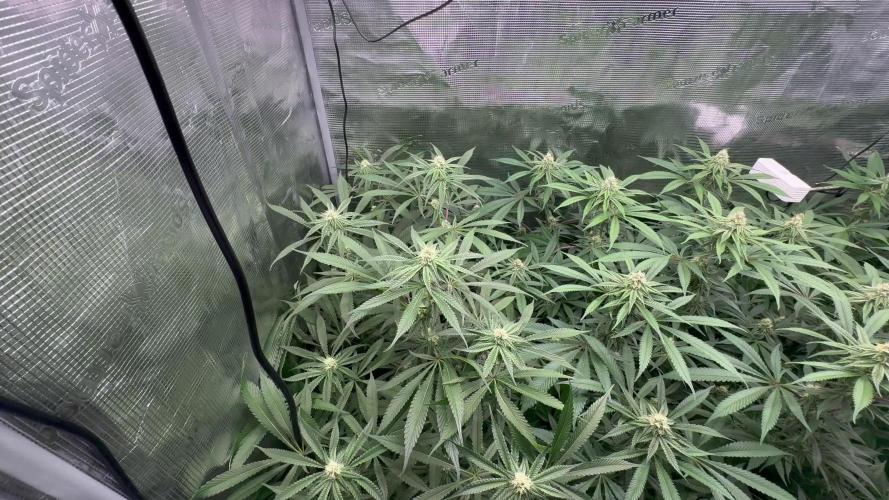
The first month of growth is behind us, and we’ve still got almost a month and a half to go. The girls are starting to smell like crazy and getting pretty sticky. Honestly, I can’t wait to see how they turn out. Looks like Christmas is coming a little early this year! 🎄

Processing
Likes
4
Share


@Green_Thumb
Follow
My o my, what can I say... These ladies are gorgeous! Along with adding in the 2000W along side my 600W, I cut out the grow solution in my nutes contrary to the instructions and my ladies are booming! We'll see how the rest of the week continues! I started a majority bloom with some added glucose for my feed to help with bud weight but they are really packing on. Hopefully next week will be my last week of feeding as trichrome production increases and I can start my 2 week flush!
Likes
2
Share

Likes
20
Share


@EvilGrower
Follow
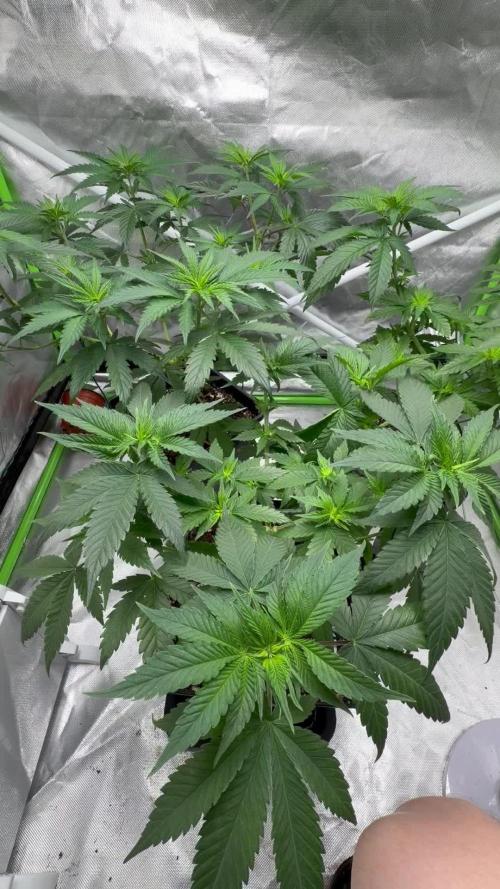
Attached is a timelapse of this past week! GSC in the foreground.
This week has seen some of the most dramatic changes. She's in flower! Its a beautiful sight to see the bud sites develop so quickly.
When I realized this plant is in flower, I've focused more of the grow light on her, sacrificing some of the blueberry's light. This is because the light absorbed during flower will be directly put towards the buds.
Another change is I've lowered the light to about 12 inches, providing stronger light during flower.
I've noticed that to maintain an even canopy, I have to tie down this plant every day. My priority is to maintain and even canopy, allowing each bud site to receive ample light. I am constantly focusing attention towards the main stem of the plant because I don't want the plant to favor it over the other bud sites.
After tying down the plant, I take the time to adjust near by leaves to cover any significant gaps I've created in the canopy. I do this to ensure light is not wasted.
At the end of the week, my pH dropped considerably to around 5. Early signs of calcium deficiency are showing. Should be under control after nute change.
My nutrients this week were balanced for the transition between veg and flower. In the coming weeks I will provide more flowering nutrients.

Processing
Likes
34
Share


@LockDownGrow
Follow
My first time making alcohol tintcure
Using the c1 ,
Hold on tight gonna be a trip

Likes
59
Share


@Jsammy09
Follow
Not a lot happened last week, just monitoring, feeding, and keeping everything in check while the girls did their thing. I did switch over to my finishing nutrients and have cut out calmag according to feeding chart I have been following. I think we are gettting pretty close to harvest though! The trichomes are starting to get a little milky. I am going to wait until about 30% amber to harvest though. I am getting super excited to finish this one and start my next run!
9/2 - The girls have been doing great and are starting to pack on the size and frost nicely! Nothing to do to them really except monitor and keep checking and making sure everything is running at an optimal level. The closer it gets I start to get a little nervous for the dry. I am prepared and have a plan, just hopefully I can get my dry set up as dialed in as I was able to get my grow tent. I will try to post more updates this week. Last week I had company from out of town, so it was difficult to get around to it.
9/5- Just continuing to monitor and check the trichomes, once about 25-30% turn amber I will be harvesting! They are starting to get pretty cloudy right now. When I did the res change yesterday, I switched to just root drip and full tilt and have started flushing, hopefully not too early, but im following my feeding chart.
As always tips and recommendations always welcomed and appreciated! Thanks for checking out my diary!
Likes
66
Share

@wolfvb
Follow
The Final Countdown 🥦✨
Strain: Sticky Broccoli Automatic (Zamnesia Seeds)
General Observations:
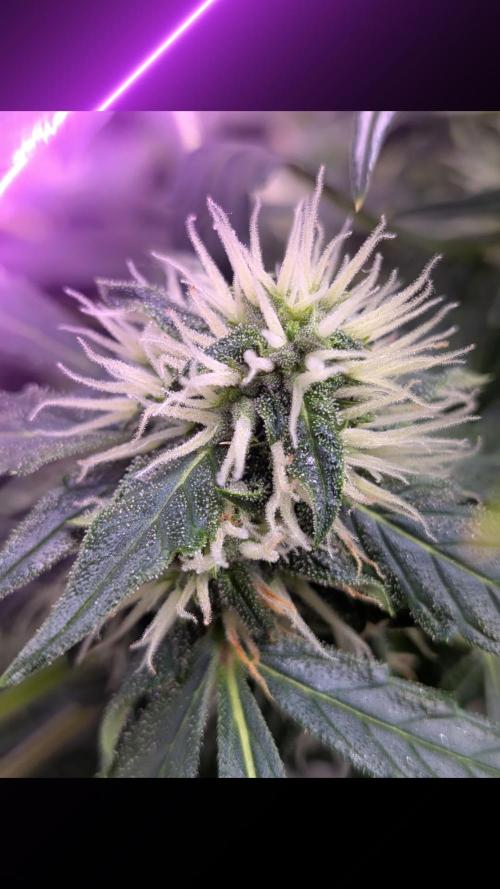
We have officially hit Week 11, and the "Sticky Broccoli" is living up to its name! The buds are now noticeably denser and covered in a thick layer of frosty trichomes. The scent in the tent has intensified expecting those signature sweet and spicy floral notes to really pop now. Most of the pistils are beginning to turn that deep orange/brown and curl inward, signaling we are getting very close to the finish line.
Plant Health:
The canopy remains a healthy dark green, though I'm starting to see some natural "fading" (senescence) as the plant directs all its remaining energy into the flowers. The minor nutrient tip burn from last week hasn't progressed, so dialing back the feeding slightly was the right move.
Nutrients & Environment:
Nutrients: Following the Eternity Cup requirements, I’m still utilizing Plagron Green Sensation to maximize the bloom and resin production. I have reduced the base nutrients (Nitrogen) and am focusing on P-K to help the buds put on their final weight.
pH: Keeping it steady at 6.0.
Training/Maintenance:
No more LST at this stage; she’s locked into her shape. I’m just doing some light "leaf tucking" to ensure the lower bud sites are getting as much light as possible for the final swell.
Next Steps:
I’ll be watching the trichomes closely with the loupe over the next few days. I’m looking for that perfect mix of milky and a hint of amber before I start the final flush.
but first let those buds cook they are now gaining weight fast and fatten up.
Grower Note: The Kewpie guards are still on duty and the vibes in the tent are at an all-time high! 👶✌️

Likes
15
Share

@MyLittleGarden
Follow
Ernte
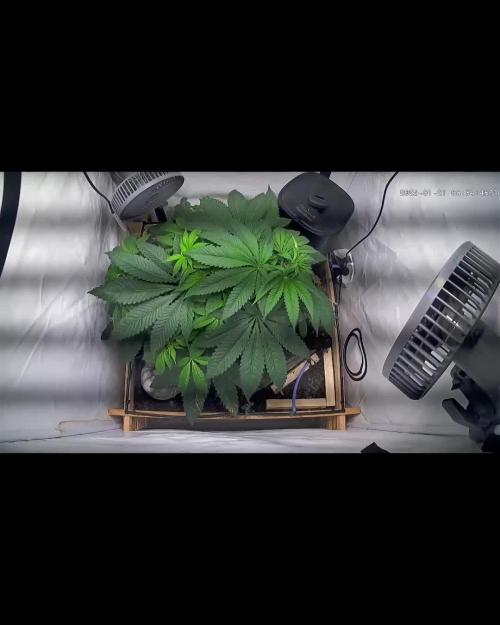
Die Pflanze wurde kurz nach der neunten Blütewoche geerntet, etwa drei Tage später, als die meisten Trichome milchig waren und vereinzelt schon bernsteinfarbene zu sehen waren. Ziel war ein eher euphorisches, klares High – und das wurde auch erreicht.
Die Trocknung lief über etwa zehn Tage bei Temperaturen zwischen 15 und 21 °C und einer Luftfeuchtigkeit von rund 55 bis 62 %. Die Bedingungen waren stabil, und die Buds konnten langsam und schonend trocknen.
Nach dem Trocknen wurden die Blüten manikürt und anschließend in Gläser mit Feuchtigkeitspacks gelegt, um das Curing zu starten. Die Buds waren zu diesem Zeitpunkt sehr klebrig, harzig und haben stark geglitzert, mit einem intensiven, süß-zitronigen Geruch.
Update nach 4 Wochen:
Trocknung & Curing
Nach der Ernte wurde die Amnesia Lemon insgesamt etwa 10 Tage lang langsam getrocknet. Die Temperaturen lagen dabei meist zwischen 15–21 °C bei einer Luftfeuchtigkeit von ungefähr 55–62 %. Durch die eher kühlen Bedingungen konnten die Blüten langsam und kontrolliert trocknen, ohne zu schnell auszuhärten.
Bereits während der Trocknung entwickelte sich ein sehr intensiver Geruch. Besonders auffällig waren starke Zitronen- und süßliche Terpennoten, kombiniert mit einer leicht würzigen Frische. Anfangs war noch ein leichter Heugeruch vorhanden, der sich im Verlauf des Curings jedoch deutlich abgebaut hat.
Nach dem Trocknen wurden die Buds manikürt und anschließend in Braungläser mit 58 % bzw. 62 % Feuchtigkeitspacks gelagert. Während der ersten Wochen des Curings veränderte sich das Aroma nochmals deutlich. Der Geruch wurde tiefer, runder und deutlich angenehmer. Beim Öffnen der Gläser kommt inzwischen ein extrem intensiver süß-zitroniger Duft entgegen, der sich sofort im Raum verteilt.
Die Blüten besitzen mittlerweile eine sehr gute Konsistenz: außen trocken, innen noch leicht elastisch und insgesamt sehr kompakt und harzig. Das Raucherlebnis wurde über die Wochen ebenfalls spürbar angenehmer und weicher.
Eine spätere Messung mit einem Purpl Pro bestätigte schließlich ein sehr gelungenes Endergebnis:
21 % THC
10,3 % Restfeuchtigkeit
0,4 AW Wasseraktivität
Besonders positiv hervorgehoben wurden dabei die optimale Trocknung sowie der intensive Geruch des Samples.
Insgesamt ein sehr erfolgreiches Endergebnis mit starkem Aroma, angenehmem Rauchverhalten und einer klaren, kopflastigen entspannten Wirkung. 😋
