


Likes
Comments
Share


@J_Law
Follow
this cycle will be godzilla glue#4 and sunset sherbet, both females. and although you see 2 sunset sherbets in the video, 1 of them was later transplanted for outdoor, which is in my other post. the GG4 was germinated 1 month AFTER the SS.
i will be feeding with BluePlanet FarmersPride organic 3-part high yield system
24 hrs in 5.5ph water and then directly into grow plug they go. 👍


Likes
36
Share


@Xpie77
Follow
Nothing much, now the flowering started I've changed from P20 phosphore to pk13/14 ~ 2 ml a liter.

Likes
10
Share


Likes
7
Share


@bro8006
Follow
Hi. Just defo The older leaves and letting it grow, starting to motive some white hairs...


Likes
50
Share


@SlowerLowerGrower
Follow
Another week just fattening up. Runoff dipped a little low this week causing some yellowing but its been handled. That 2nd led did take the temps up around 6-8 degrees. I'm waiting on the lowers to mature on the larger girl before I start the flush probably around Wednesday. The other looks a lot farther behind and I don't know why.

Likes
2
Share


@TTerpz
Follow
Start of week 12: 4/29/25
Fed with nutrients: 4/29/30
Fed with plain ph water : 4/30/25
Fed with nutrients: 5/2/25
Fed with ph water: 5/5/25
End of week 5/5/25
Likes
6
Share


@xmackobox
Follow
Hola amigos arrancamos nuevo cultivito, por ahora os traigo los videos que subo a YT como ya sabéis le estoy dando caña al canal, buscarme allí, me llamo como aquí, xmackobox.
Poco mas, se empezaron a germinar el día 14/02/24. Algunas se pasaron a maceta el día 16, otras en 17 y se terminaron de plantar en maceta definitiva de 11 L el día 18/02/24.
Para la primera semana de crecimiento ya meto fotos detalle de todas.
**ACTUALIZADO**
26/02/24 llevamos 12 días desde que se empezó a germinar, todas brotadas perfectas excepto 1 que como veis parece atrofiada o con algún problema, no desarrolla el ojo principal es decir su punta apical.
Esperaremos a ver que hace esta plantita :D


Processing
Likes
15
Share


@LittleBigTrees
Follow
Topped them end of last week, still not given them feed as the farmyard manure they were planted straight into seems to be giving them what they need so far, I've given them rain water when they needed it.
Hopefully the sun will return this coming week 🌞

Likes
7
Share


@Chubbs
Follow
Weekly update. Sorry it was a late update this week I was out of town (Bizcon2024). Wow have they grown, I'd say doubling in size. I've upped the watering to 1000ml daily, this week I'll do a major defoliation and lollipoping. All in all Happy
Likes
3
Share


@ROY4L_GU4RD
Follow
Branches couldn't manage the weight so everything caved in like dominoes smh. I decided to chop on rainbow cake to help with air flow. Humidity is at 45 degrees steadily but im not risking mold or mildew this late in the grow. I added Ripen to the nutrient regimen at 5ml per gallon.


Likes
12
Share


@brosef_b_baggin
Follow
Week 4: Started adding Humboldt Secret Golden Tree at 600 ppm. The plant started bushing out from the LST so I defoliated whatever green wasn't getting any light and to expose light to smaller nodes. I was planning on topping this week but to my surprise the plant had created a third axil/node and axillary branch.
Processing
Likes
2
Share


@EL_MANDARINO
Follow
estas plantas las conseguí por los viveros cerca a mi casa, no se genetica exacta pero cuando las consegui estaban con 2 pisos de hojas, cuando estaban en el 4to a los 15 dias hice el FIM, las fotos q se ven aho son 15 dias despues despues de hacer una poda de hojas
Likes
14
Share


@420DeepGrow
Follow
Gracias al equipo de MSNL Seeds, Marshydro, XpertNutrients y Trolmaster sin ellos esto no sería posible.
💐🍁RS11:
RS11 es uno de nuestros nuevos híbridos 50/50 perfectamente equilibrados. Creamos RS11 cruzando Pink Guava x OZK x Sunset Sherbet con la intención de crear una variedad que ofrezca medidas iguales de efectos edificantes y relajantes. Aclamada como una de las variedades más sabrosas del mercado, su sabor agrio y dulce a bayas viene con un potente rango de THC del 27% al 31%.
💡TS-3000 + TS-1000: se usaran dos de las lámparas de la serie TS de Marshydro, para cubrir todas las necesidades de las plantas durante el ciclo de cultivo, uso las dos lámparas en floracion para llegar a toda la carpa de 1.50 x 1.50 x 1.80.
https://marshydro.eu/products/mars-hydro-ts-3000-led-grow-light/
🏠 : Marshydro 1.50 x 1.50 x 1.80, carpa 100% estanca con ventanas laterales para llegar a todos los lugares durante el grow
https://marshydro.eu/products/diy-150x150x200cm-grow-tent-kit
🌬️💨 Marshydro 6inch + filtro carbon para evitar olores indeseables.
https://marshydro.eu/products/ifresh-smart-6inch-filter-kits/
🍣🍦🌴 Xpert Nutrients es una empresa especializada en la producción y comercialización de fertilizantes líquidos y tierras, que garantizan excelentes cosechas y un crecimiento activo para sus plantas durante todas las fases de cultivo.
Consigue aqui tus Nutrientes:
https://xpertnutrients.com/es/shop/
💻 Trolmaster Tent-X TCS-1 como controlador de luz, optimiza tu cultivo con la última tecnología del mercado, desde donde puedes controlar todos los parametros.
https://www.trolmaster.com/Products/Details/TCS-1
📆 Semana 5:
Comienzan a formarse los cogollos, las hojas se llenan de resina cada dia y el olor es bastante fuerte. Parece que ha terminado de estirar. Practico una defoliación intensa para airear los futuros cogollos y dejar mas espacio en el cuarto de cultivo.
Agrupo de nuevo las macetas en su lugar optimo para asi rellenar por completo la carpa @marshydro.
Me quedé algo corto de nutrientes pero estoy muy contento con los resultados, cada vez le voy encontrando mas su punto optimo. Siempre es mejor quedarse corto que pasarse.

Likes
12
Share


@Charly_grower
Follow
Vamos bien el olor es dulce fuerte afrutado y de flor muy prensada. Esta casi listo todo para poder disfrutar de estas deliciosa hiervas..muchos tricomas
Regadas con amor y mucha felicidad
Charly Grower 👨🌾

Processing
Likes
56
Share


@Master_weeda
Follow
Bonjour à tous les padawans et maîtres jedis
stretch 15 centimètres
(Stretch explanations more)
EXPOSURE TO LIGHT
One of the main culprits in abnormal stretching of cannabis plants is the lack of light. Plants that are too far from an adequate light source will respond by accelerating stem growth in order to get closer to the lamp themselves. Especially when there are many other plants. A lack of lighting can easily cause overcrowding in a growing chamber, reducing the steady progression of your crop and the distance ratio between your bulbs and your plants.
To address this problem, be sure to provide enough light to your plants to prevent stem growth. At the same time, you should not position your lights too close to your plants either since this would also result in an over-stretching of the stems and in some cases, the loss of your crop.
In addition to the distance between the light source and the plant, the type of light you will use also affects the size of the stretching of your crop. The orange and red lights encourage stretching and result in thinner, larger stems. And conversely, blue light stimulates a growth of thicker stems and a smaller size. When a species is ready to enter the vegetative phase and undergo its most drastic stretching period, metal halide lamps can be used to deter far too long stems.
THE HEAT
Heat is another essential element that can determine the stretch size of your plants during vegetation. Temperatures above 27 degrees push the stems to lengthen more and more and will propel the potential of sativas to push as high as possible. Heat lamps that are positioned too close to plants create an intolerable environment that will grow large, soft plants that will potentially wobble until they fall and lose flowers in its fall.
OTHER CAUSES OF STRETCHING
There are multiple variables that can lead to the stretching of plants beyond what could normally be expected of the plant. Environmental stressors resulting from transplantation (when a plant passes from one pot to another) can cause the plant to return to shock. This will eventually trigger a reaction causing a stretch. Cannabis plants that are not grown in decent conditions or do not receive enough nutrients will respond in a variety of ways and this includes stretching.
Crops that are not spaced far enough apart are likely to stretch to sting the light to other plants. Due to extreme proximity, the plants will fight among themselves to reach the light, forcing them to expand as much as possible throughout the crop.
HOW TO CONTROL STRETCHING DURING FLOWERING
Stretching during flowering, you guessed it, takes place when you move your plants from the vegetation stage to the flowering stage. This is a completely normal reaction, as your plants are preparing to bear the weight of their heads.
Stretching of a plant at the beginning of flowering varies widely; some plants can double in height while others grow only a few centimetres. There are, however, two main variables that can give you at least an idea of how your plants are stretching during flowering, and how much. Here are these two variables:
Variety: Genetics has the greatest impact on the size of your plant. In general, sativa varieties stretch more than indicas and tend to develop long, slender stems.
Light: Some lights, such as HPS, are more likely to encourage stretching. In addition, great distances between your canopy and your lights will cause the plants to stretch as they try to get closer to the light source.
Stretching during flowering usually lasts the first two weeks of the phase. To minimize stretching, keep your lights between 10 (for CFL) and 30 centimetres (for HID) of your canopy. Finally, choose indica varieties if you have a smaller growing space.
HOW TO AVOID STRETCHING
In many cases, you can expect your cannabis plants to stretch during the flowering phase. Keeping that in mind helps to make a plan in case your species ends up growing much more than you could have imagined. If the information is available, get information on the standard size of your species and compare it to the size of your growing space taking into account the necessary distances between the bulbs and the plants.
TRAFFIC
While outdoor crop operations benefit from natural air to naturally limit stretching, indoor crops must assume the maintenance of air circulation within a confined space. Basic ventilation is enough to help the cannabis stems strengthen and become thicker rather than too high. In this way, the plants continue to grow vigorously without reaching heights and at the same time, your tolerance ceiling.
MANUAL INTERVENTION
For growers who want to get their hands dirty, there are physical procedures that can be done to reduce stretching. Similar to the natural effect that the wind has on cannabis plants, manually bending the leaves and stems will cause tiny cracks in the plant's tissues that will cause the plant to focus on regenerating its wounds instead of its vertical growth.
THE TOPPING
Topping is a form of manual intervention on cannabis to influence its performance, shape or size. In essence, topping is a process in which a new node is cut, growing from the plant to reduce its size and create a "v"-shaped notch that will eventually form two heads. Topping may be an effective measure to combat stretching, but it is important not to do so when the flowering phase begins.
In most cases, an abnormal stretch of cannabis plants will not completely destroy your crop. In fact, stretching can indeed help increase your performance. For growers with a growing operation large enough to contain tall plants, stretching can increase the total yield of a species with more vertical space for head formation. In both cases, stretching can easily be planned in advance and there are multiple solutions to help you with this problem which is all too common.
Jour49 arrosage
Jour51 arrosage 2 litres d'eau
Jour 54 légère defolliation arrosage avec deux litres d'eau ph6.3 à laquelle j'ajoute 0.6 gramme de feeding enhancer greenhouse
Good luck for your grow 🤞🌱
May the force be with you 💪

Likes
6
Share
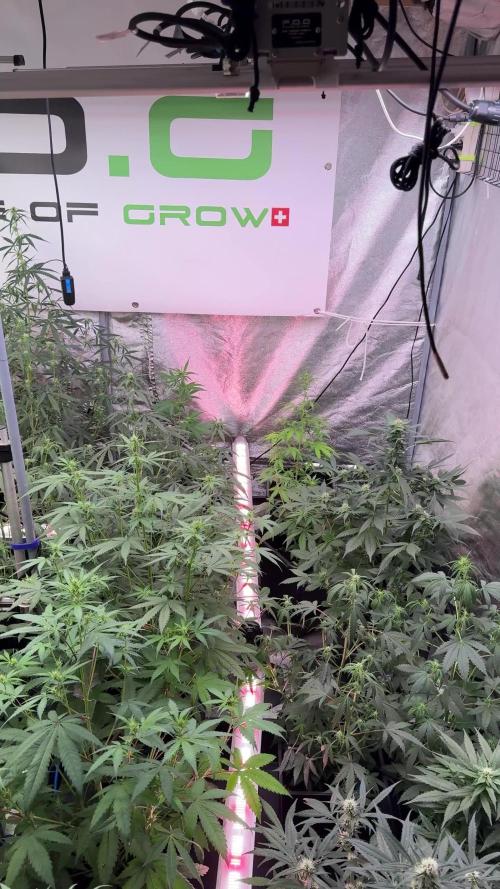

@DogDoctorOfficial
Follow
🌸 Pink Rosay Auto by Zamnesia | Pheno A | Week 7 (Flowering)
🌱 Sometimes the Quiet Ones Steal the Show
One of the things I love most about growing is that plants don't compete with one another.
They simply become the best version of themselves.
Pink Rosay has never been the biggest lady in the room.
She hasn't stretched toward the ceiling.
She hasn't demanded constant attention.
Instead, she's quietly transformed into one of the most elegant and captivating plants in this entire 8×8 Adventure.
Standing at approximately 111 cm, she remains beautifully compact while filling her own little corner of the tent with an incredible number of perfectly formed flowering sites.
She's one of those plants that makes you stop for a second every time you walk into the room.
Not because she's loud.
Because she's beautiful.
🌸 Week 7 – Finding Her Spotlight
This week she's truly beginning to shine.
The stretch is now almost completely behind her, allowing nearly all of her energy to be redirected toward flower production.
Every branch seems alive.
The flowers are stacking rapidly, calyxes continue swelling, and every cola is crowned with an explosion of brilliant white pistils that make the entire canopy glow beneath the lights.
There is something incredibly clean about her appearance.
Every branch is organised.
Every flower seems perfectly positioned.
Every day brings noticeably more substance.
She's developing with confidence.
And she's moving surprisingly fast.
✨ Already Frosty Before Her Time
One detail that's impossible to ignore this week is just how quickly resin production has begun.
For this stage of flowering, she's already wearing an impressive coating of trichomes.
The sugar leaves are becoming increasingly dusted with sparkling resin glands, surrounding each developing flower with that unmistakable frosted appearance that every grower loves to see.
It's still very early.
These aren't finished flowers.
They're only just getting started.
Yet the genetics are already hinting at the incredible resin production waiting later in bloom.
It's like watching winter slowly arrive, one crystal at a time.
🌼 The Language of White Pistils
Everywhere you look...
White.
Fresh.
Healthy pistils.
One of the most rewarding parts of early flowering is watching these bright white hairs emerge across every flowering site.
For newer growers, it's worth remembering that these aren't the flowers themselves.
They're part of the female reproductive structure, growing from each calyx as the plant continues building her buds.
They're essentially the roadmap of flower development.
Today they're long, soft and brilliantly white.
Over the coming weeks they'll slowly mature, change colour and retreat back into the swelling calyxes as each bud becomes larger, denser and more mature.
For now, they're telling us exactly what we want to hear.
"This plant is building flowers."
And she's doing it beautifully.
🍃 Healthy Leaves, Vibrant Colour & Perfect Balance
The foliage continues looking absolutely outstanding.
The leaves display a rich, healthy green from top to bottom, maintaining excellent posture throughout the day without signs of stress or nutrient imbalance.
Everything feels incredibly balanced.
The stems have become thick enough to support future flower weight, while the internodal spacing remains open enough to allow excellent airflow throughout the canopy.
Nothing feels crowded.
Nothing feels wasted.
The plant simply looks comfortable.
Comfortable with her feeding.
Comfortable with her environment.
Comfortable becoming exactly what her genetics intended.
💡 Lighting From Every Angle
Although Pink Rosay isn't the tallest plant in the room, she's receiving approximately 1,000 PPFD across the canopy from the Future of Grow Black Series LED.
That level of light provides more than enough energy to support vigorous flower production while allowing this compact phenotype to maximise every square centimetre of her canopy.
Below the canopy, the Lumiflora under-canopy lighting continues adding another layer to the lighting strategy.
As the flowers become larger and the canopy naturally thickens, those lower branches often receive significantly less light.
The additional illumination helps maintain energy deeper into the plant, giving secondary flowering sites the opportunity to continue developing alongside the upper canopy.
The true difference will reveal itself at harvest.
But watching the room evolve under this combination of top and under-canopy lighting has been incredibly exciting.
💧 Hand Watering – Every Plant, Every Day
Like the rest of the garden, Pink Rosay is now completely hand watered.
It certainly takes more time.
Every plant needs individual attention.
Every watering means preparing nutrients, checking EC, adjusting pH and carefully delivering exactly what each lady needs.
It's more work than automation.
But it's also one of my favourite parts of the day.
It forces me to slow down.
To observe.
To notice small changes before they become big ones.
And honestly...
I wouldn't have it any other way.
Current feeding:
• Terra Grow — 2 ml/L
• Pure Zym — 1 ml/L
• Sugar Royal — 1 ml/L
• Power Buds — 1 ml/L
• Green Sensation — 1 ml/L
Maintaining:
• EC: 1.95 mS/cm
• pH: 5.8
Consistency continues to be one of the biggest reasons this garden keeps performing so well.
🌡️ Environment
The environment remains stable, allowing Pink Rosay to focus entirely on producing flowers.
Current conditions:
• Day temperature: 29°C
• Night temperature: 25°C
• Relative humidity: 60%
• Solution temperature: 21°C
• Root zone temperature: 21°C
• CO₂: Approximately 529 ppm
Healthy roots, stable temperatures and consistent environmental control continue allowing these genetics to express themselves naturally without unnecessary stress.
👀 Looking Ahead
Over the next week I expect the pace of flower development to accelerate even further.
The calyxes should begin stacking much more aggressively, individual flowers will gradually merge together into larger colas, and resin production should spread rapidly across the sugar leaves surrounding every bud site.
The pistils will continue multiplying before eventually beginning their slow journey toward maturity later in flower.
She's still far from finished.
But every single day she's becoming more impressive.
If she continues evolving like this, I genuinely believe she'll become one of the standout plants of this entire project.
🙏 Final Thoughts
Pink Rosay continues proving that elegance doesn't need to shout.
She has grown with remarkable balance from the very beginning, requiring very little intervention while rewarding that trust with beautiful structure, exceptional health and flowers that seem to become more attractive every single day.
Her compact frame, brilliant white pistils and rapidly increasing layer of resin make her one of those plants that's impossible to walk past without stopping for another look.
Some plants ask for attention.
Others simply earn it.
Pink Rosay has definitely earned hers.
A huge thank you once again to Zamnesia for these incredible genetics, Plagron for providing outstanding nutrition throughout the grow, Future of Grow for powering the garden with exceptional lighting, Lumiflora for bringing additional energy beneath the canopy, TrolMaster for maintaining precise environmental control, and to everyone following this journey here on GrowDiaries.
Your support, encouragement and shared passion continue making this 8×8 Adventure something truly special.
Until next week...
Growers Love and happy growing! 🌱💚

Likes
47
Share


@Ultraviolet
Follow
Gave her a cocktail to help with stress. Added 1st net for lateral support, not so much now, but for later. Blue light is absorbed by photoreceptor proteins called phototropins, which trigger a hormonal response that causes cells on the shaded side to elongate, making the plant bend toward the light. Try and fill this side a little. She is quite big already, just needs to find her stride again after the undue torture.
The mind is constantly working and producing, just like a factory. It's not just a passive recipient of information but an active producer of ideas, attitudes, and beliefs. The "ingredients" in this factory are the information you consume, such as books, conversations, and the media you engage with. The "products" are your thoughts, beliefs, and actions. The quality of the ingredients directly influences the quality of the output.
5 apex stems with 20-30 mini cola, let them develop a little, with the apical dominance shattered, all those 20-30 will all compete with each other as soon as that stretch is initiated. Key to a good stretch is making sure the plant is cycling efficiently, with large ATP conversions occurring lights out.
For now, keeping light intensity high. A plant will slow its vertical growth in very high light intensities, leading to a more compact form with thicker stems and leaves. This response is a protective mechanism against light stress, which can damage the photosynthetic apparatus and lead to symptoms like leaf scorching, yellowing, and brittleness. Instead of growing taller, the plant invests its energy into creating a more robust, stress-tolerant structure.
Providing plants with necessary antioxidants helps protect the photosynthetic apparatus by scavenging reactive oxygen species (ROS) that cause damage from excess light.
UV light exposure can impact the xanthophyll cycle by either enhancing its photoprotective role or causing damage, depending on the intensity and type of UV radiation. UV exposure can trigger the synthesis of more xanthophyll cycle pigments to increase the plant's capacity to dissipate excess energy, but it can also cause direct damage, particularly to Photosystem II, and may lead to a decrease in the de-epoxidation state (DEPS ratio) which indicates a reduced capacity to dissipate excess energy.
Plants can respond to UV stress by increasing the synthesis of xanthophyll cycle pigments, such as violaxanthin and zeaxanthin, to improve their photoprotective capacity. UV-induced changes in xanthophyll cycle pigments can be linked to a plant's overall tolerance to high radiation stress. The xanthophyll cycle helps protect against photoinhibition, which is especially important when the plant is exposed to high levels of both UV and visible light. High doses of UV radiation can directly damage photosynthetic components, including the proteins, lipids, and pigments in the thylakoid membranes. Exposure to UV radiation can have a mixed effect on the de-epoxidation state (DEPS ratio) of the xanthophyll cycle pigments. In some cases, UV can inhibit the conversion of violaxanthin to zeaxanthin, resulting in a lower DEPS ratio and a reduced capacity for energy dissipation. However, the total pool of xanthophyll cycle pigments may increase, and this enhanced pool size could provide a greater potential for photoprotection despite a lower DEPS ratio.
The xanthophyll cycle works alongside other mechanisms, such as the accumulation of flavonoids (UV screens), to protect the plant from UV-induced damage.
Blue light repairs 100% UV-induced damage in plants through a process called photoreactivation, which uses a light-dependent enzyme called photolyase. This enzyme uses energy from blue and UV-A light to directly reverse the damaging pyrimidine dimers in the DNA caused by UV-B radiation, a key mechanism for maintaining the plant's genetic integrity.
After carbon, light, water, temperature, and nutrients, the limiting factor of a plant's growth is often its own internal factors or the amount of a key ingredient. Chlorophyll concentration is one such factor, as the amount of this pigment limits how much light can be captured for photosynthesis. Other factors include chloroplast number, respiration rate, and the concentration of carbon dioxide in the atmosphere, as plants are often in a CO2-deficient condition.
60x60x18=64800seconds x 700 = 45,360,000moles. 45DLI
Exposure to 165 µW/cm² of ultraviolet-B (UV-B) light for 3600 seconds = 1 hour, a extremely high, acute dose triggering stress responses and protective mechanisms.
.
The plant's photoreceptor protein, UVR8, senses the UV-B radiation. This triggers a signaling cascade that activates specific genes to protect the plant from damage. In response to the UV-B signal, the plant ramps up the biosynthesis of protective compounds like flavonoids, phenolic acids, and anthocyanins. These compounds absorb UV radiation and accumulate in the epidermal layers of leaves to shield inner photosynthetic tissues. The plant may increase leaf thickness or deposit more cuticular wax, creating a physical barrier to the radiation. The plant will produce more enzymatic and non-enzymatic antioxidants to neutralize the reactive oxygen species (ROS) produced by the UV-B radiation. The plant activates enzymes, including photolyases, to repair DNA damage caused by the UV-B. These repair mechanisms are critical for preventing permanent genetic mutations.
While protective measures are activated, a high dose delivered over a short period can cause stress that overwhelms the plant's defenses.
Photosynthesis is highly sensitive to UV-B. A high dose can inactivate Photosystem II (PSII), damage thylakoid membranes within the chloroplasts, and reduce chlorophyll content, which lowers the plant's overall photosynthetic capacity. Despite repair mechanisms, high UV-B doses can inflict persistent damage on the plant's DNA. The overproduction of reactive oxygen species can cause oxidative stress, leading to the oxidation of lipids and proteins and disrupting cellular function.
I am playing in the enchanted forest. A shift in perspective is what changes perception over time. By deliberately considering a situation from another point of view (perspective), you can challenge your initial, knee-jerk interpretation (perception). This is a valuable skill in both personal and professional life for fostering empathy, improving problem-solving, and making more informed decisions.
Move the mind off perception into perspective.
Thank you.
Likes
7
Share


@Dargaville_Dukes
Follow
Awesome! Went away for 10 days over Christmas and was not sure what to expect when I got back. Obviously re-potting them and letting them dry out has been effective. I've started adding a little Fish Mix to their water. I don't think they need it but I'll go really slow and try it out on my tomatoes to see what effect it has on them. I'm cautious about drowning them in nutrients as I have no experience with this and don't want to slow the grow down any more than I already have.

Likes
9
Share


@Grileon
Follow
Started giving nutrients, up to 300-350 ppm.
Having temperature problems, it's too hot outside 34-36 degrees Celsius. This causes problems inside the box, mostly for water inside hydroponics.
Have to use frozen bottles of water two times per day.
