Likes
18
Share
Oh lovely looking plant. Straight up looks a Cali girl. Have a lot less Complicated grow this time with just tipping - kinda miss the trellis…but all good have too much work to do
Likes
58
Share
@AsNoriu
Follow
Day 48. They look as sad as pitty UK summer. Days are in low 20, nights as low as 11.... constant rain .... Have doubts about that strain, but #1 is getting somewhere ;))))) others in shade and dont grow as big as they should by now. Picky strain in my mind. My friend has last bean in greenhouse and she is weakest from 3 strains he tries . #1 lost two sets of bottom branches , #2 and #3 lost three sets each. They needed good clearing from worthless sides. Cleared all garden from fresh grow, aerated soil, put slug pellets and thats it. Came late so leaves are droopy. Plus i think heavily represent overwatering ;))) but with such air ..... I see some preflowers, so count this as last veg week. Will visit in two weeks to top up with PK boost. Have some crazy person in city , look what he does to one post box ;))) Happy Growing !!!
Likes
7
Share
@LACREME
Follow
Agora na fase de engorda estou regando duas vezes ao dia, uma vez 4 horas após as luzes acenderem e outra 4 horas antes das luzes apagarem. ppm beirando 1700 e pH em 5.8
Likes
19
Share
@Comfrey
Follow
Tropicana flowers 🌞☀️🌤️🌦️🌧️ Plant is 15 cm high because of low stress training. The length is 31 cm. Day 36: Sun is shining, 15-23 degrees, high humidity. Tropicana gets two liters of pure rainwater. Spend the day in my veggie garden working. In the evening I brought some 🐞for Tropicana because I spottet a few lice. My mood changes drastically as I find spider mites eggs, first and second stadium. Don‘t overthink that and decide to defoliate the plant immediately. I prepare a tee out of the leaves which brings fast relaxation. My mood is much better now. Day 37 In the morning with better light I find more spider mites and decide to wash the plant with rainwater. Can‘t find after any more of these little killer dwarfs. I decide to bring more beetles and check the leafs more often. Temperature is felling under 20 degrees, it‘s raining and the humidity is 87%. Day 38 In the early morning I couldn‘t find any mites on Tropicana. Got to continue controlling this in the next weeks regular. I‘m sure they are still there somewhere hidden in a dark spot. 🌦️ 13 - 21 degrees and humidity is around 60-70%. Day 39 🌦️🌧️ Very rainy day. Just let Tropicana enjoy life and tie down the top one more time. 🐞 stay since some days. One on every plant. I think the mites are a result of their start inside and no hygiene at all. Have the same with my peppers some years. 14 - 21 degrees, humidity around 84% Day 40 🌧️☁️🌤️☀️15 degrees, humidity 83% We listen to Roots Reggae, Tropicana is happy and quite busy with producing new roots, I guess. Don‘t understand when to stop low stress training. I think it’s enough now. She needs a rest. Day 41 🌧️⛈️🌧️🌧️ 15 - 19 degrees, humidity up to 89% We had rainfall today around 65 liters of water. I collected enough of it for the next weeks. Day 42 ☀️ 6 - 23 degrees. Humidity is falling. Tropicana enjoys the morning sun while she drinks and drinks and drinks…. Coffee. 😅
Likes
7
Share
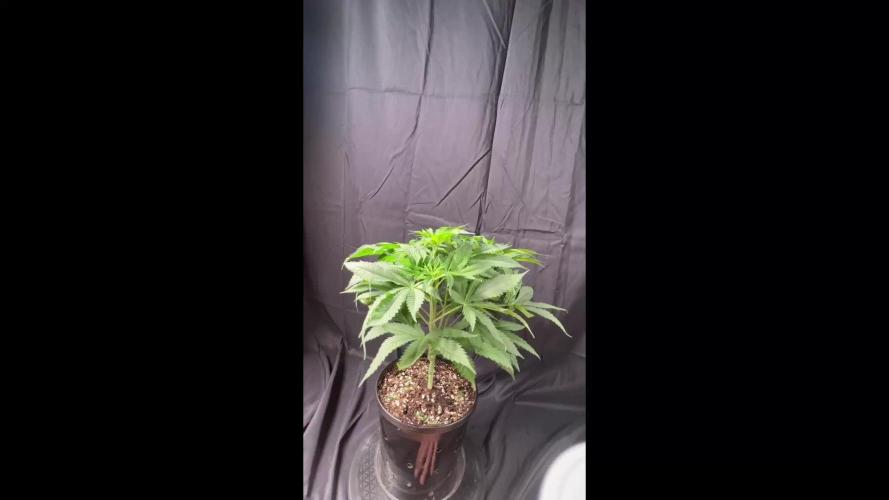
Plant is growing awesome. Tying down as she grows along with the idea she'll stay nice and short in my cramped tent. Watering every two or three days by removing from tent and placing in tub overfull of water - letting it feed from the bottom for a couple hours. Central stem/trunk looks strong and vigorous. Excited to see how the next week shakes out, should start flower 👽🤗🤗
Likes
30
Share
@DrGruen
Follow
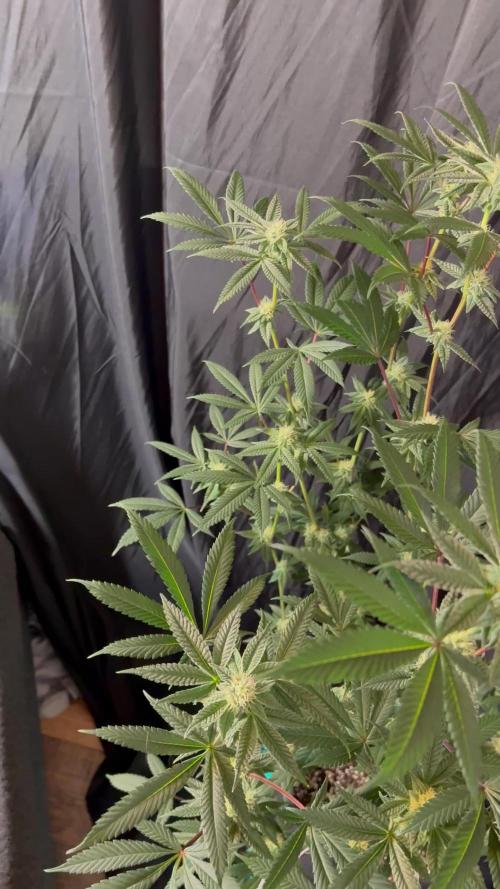
Diese Woche hatten wir mega Wetter und die beiden Ladies sind richtig abgegangen...😜 Eine der beiden hat diese Woche locker 50 cm zugelegt und der Stretch ist noch nicht zu Ende.....😗 Bin echt gespannt wie hoch sie werden ........😁 Die Blütenstände kann man jetzt schon deutlich erkennen und ich hoffe, das daraus richtig fette Buds werden......😎 Hoffentlich ist der Wettergott uns weiter hold und macht uns keinen Strich durch die Rechnung........😎
Likes
102
Share
@Hashy
Follow
Week 10 6th week of flower. Light settings 12/12 on at 9.00am off 9.00pm Light power= 75% 184w Radiator settings LIghts on Turn on if temp drops below 22.5c Turn off if temp goes above 22.5c Lights off Turn on if temp drops below 18.5c Turn off if temp goes above 18.5c Extractor settings temperature 23c with 1c steps Humidity 50% with 0% steps Max speed 10 Min speed 4 VPD aim 0.8-1.2 DLI aim 30 Wednesday 29/3/23 Day 64 (Day 36 flower) Nothing Thursday 30/3/23 Day 65 (Day 37 flower) Nothing Friday 31/3/23 Day 66 (Day 38 flower) Autofeed 5 15 minute runs Normal pump 4 drops ph d Feed 10L Ec=1.58 Ph=6.4 3L left Roughly 3.3L each. #3 Height= 63CM Dist= 30CM DLI= 36 Went away and left on autopilot Saturday 1/4/23 Day 67 (Day 39 flower) Away Sunday 2/4/23 Day 68 (Day 40 flower) Away Monday 3/4/23 Day 69 (Day 41 flower) Away Autofeed 4 15 minute runs Normal pump 5 drops ph d Water 30L Ec=0.22 Ph=6.3 Est. 24L left Roughly 2L each. Tuesday 4/4/23 Day 70 (Day 42 flower) Away I was only around for the 1st part of this weeks grow and most of that the tent was just running on autopilot. #3 Gorilla Cookies FF all I can say really is what a great strong plant. Power used for week Light (2.22+2.22+2.21+2.22+2.22+2.22+2.31)=15.62Kw Extractor (0.58+0.58+0.57+0.58+0.58+0.58+0.67)=4.14Kw Fans (0.97+0.96+0.98+0.98+0.97+0.99+1.01)=6.86Kw Dehumidifier (++++++)=Kw Radiator (1.41+0.67+0.92+3.24+2.08+2.71+2.69)=13.72Kw Water pump. (0+0+0.01+0+0+0.01+0)=0.02Kw Total for the week=40.36Kw Back in a week. Thanks for stopping by.
Likes
24
Share
@BearBuds
Follow
This plant needs some SERIOUS love from me. I am starting to think her loss of leaves is coming from a pH issue that is caused by her being slightly under-watered. Watering every other night leaves the pot bone dry by the time I get to it. I have been allowing this to happen because the humidity here has been so crazy. Starting tonight though I am probably going to move to watering here nightly, but with a lower PPM somewhere around 500. I think this should help both my pH issue and my nutrient lock out a lot. Compounding my trouble in this tent is her overall structure. I didn't want to do a heavy defoliation or lollipop with her until I got her issue figured out. Now that I think I have, I am going to give her a really big haircut tonight after she gets watered. Overall so far I can't complain, this tent is also looking very good despite minor issues.
Likes
7
Share
Starting out good... going in the tent soon. I still have to buy 2 components for ventilation... the inline fan and charcoal canister to cover what I hope will be smellin earthy and stinky and sweet very very soon. 6am 4/1 - Putting the tent up.. might not fit though.
Likes
25
Share
@Mosi420
Follow
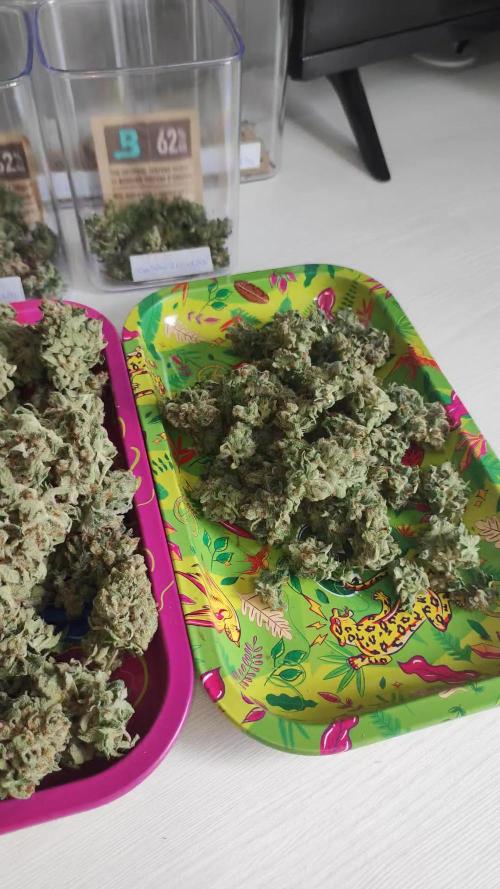
16 g trocken für meine erste Pflanze recht zufrieden
Likes
54
Share
Hey guys :-) The lady is developing very well. She made a nice push. In the coming days they will be repotted in 8 l fabric pots :-) . After repotting, I spontaneously consider whether I will use training or not. It's all a question of how full the flowering tent will be :-) Watering was done twice this week with 0.4 l each. Have fun with the update and stay healthy 💚🙏🏻 👇🏼👇🏼👇🏼👇🏼👇🏼👇🏼👇🏼👇🏼👇🏼👇🏼👇🏼👇🏼 ‘Powered by GreenHouse Feeding’ Copy the link for 10% off all Nutrients 👇🏼 https://shop.greenhousefeeding.com/affiliate/MadeInGermany_PassionGrower 👇🏼👇🏼👇🏼👇🏼👇🏼👇🏼👇🏼👇🏼👇🏼👇🏼👇🏼👇🏼 You can buy this strain at : https://www.amsterdamgenetics.com/product/choco-cheesecake/ 👇🏼👇🏼👇🏼 Use the coupon code: madeingermany for 10% on all Amsterdam Genetics seeds Water 💧 💧💧 Osmosis water mixed with Cal/Mag (24 hours stale that the chlorine evaporates) to 290 ppm and Ph with Ph- to 5.8 - 6.4 MadeInGermany
Processing
Likes
92
Share
@Penguin
Follow
Day 64. Another week on the calendar! Time is flying but also feels like an eternity. Still can't tell if there is any signs of light stress from swapping to the QB this late in the grow. I do think the bag seed in veg sharing the tent is possibly showing signs of trouble (https://imgur.com/a/9Sn0gEZ) and would love if someone reading this could take a look and let me know. Other than that, nothing new today, won't water again until tomorrow maybe the day after. I've noticed the environment in my tent has become very consistent since swapping out the blurple. Not sure if it's connected but the RH has dropped to a steady 44% ish and the temp never climbs over 25. Loving it so far! Day 64 update, my loupe and PPM meter arrived. Tested the run off and found it was over 2200 PPM. Flushed her with around 5L of pH'd water, got the run off to 1000. Leaving it there for now as it seems to be a recommended amount for late flower. Will probably only give her plain water for the rest of her time, maybe one more light feeding, then continue to flush it down in the next couple of weeks. Took some test shots with the loupe but sadly I don't think the magnification is strong enough to clearly identify the stages of individual trichomes. Maybe I can play around with it when I take her out of the tent again but that won't be for some time. Let's see how it goes! Day 65. It's almost been 24 hours since the panic flush. She seems to be doing fine other than showing stronger signs of yellowing in the fan leaves. Not sure if its something to worry about or part of the end of life fade? Tried to get a few different trich shots from various flowers but again, the loupe is probably not strong enough to accurately tell. Wondering whether I should try to treat the yellowing or leave it. Day 66. The yellowing continues but at this point there is probably not much to do about it. Gave her a small feeding PPM'd to 300 to see if it helps get her over the finishing line. Tried checking trichomes and can't really tell if some are cloudy or all still clear. Definitely no amber yet though. Hoping for a couple more weeks at most before the chop! She puts off different levels of smell day to day as well. Was a bit more pungent today, very nice smelling. Day 67. She hasn't lost as much leaf as I was expecting considering the last few days progress. Trichomes still look a while away from turning and mostly looking clear. Still has lots of white pistils too. Humidity has been a bit higher than I'd like since watering but I try to keep good air movement and a negative pressure in the tent which will hopefully reduce risk of bud rot. Smelling good but wish she'd have covered herself with some more trichomes! Day 68. All the yellowing/dying leaves have given up and fell off. Not worried as I think I have spotted the first signs of amber trichomes on the main cola and one other. Would love someone to take a look and let me know! Day 69 (nice). Going along fine. The fading seems to have slowed a bit and haven't noticed it spreading to the remaining sugar leaves. Definitely going to give her another 7 days and assess then if she needs to be chopped. Thank you to everyone who replied to my question regarding that. As someone said, if I had already started flushing, the timing was perfect, and luckily I had already been flushing her, so I will continue to do so. I gave her a heavy watering today with some runoff and I might do once more before she finishes? She isn't the frostiest bitch out there but she's mine and she taught me a lot. Hopefully some of what I've learned with her will transition well to photoperiods and the bag seed that is vegging next to her. I'll flip her into flower once this girl is done. Day 70. All her leaves are starting to fade now. There are still a lot of white pistils that concerns me about the timing. I feel like the plant will fade and yellow before it fully matures. The trichomes still look the same to me but I need to get better close ups really. She doesn't seem too frosty in recent days, not sure if it's in my head or not though. Still, hoping for a chop at the weekend if she finishes up, otherwise I might be forced to due to how fast she is fading. I think I also see some purpling on the leaves? Is that from the temps or from the nutrients being used up?
Likes
45
Share
@Theia
Follow
Another not much to say week I'm afraid. She still eats she grows. Flower sites are out and the flowering begins. Coco is magic and I'm converted. I have them on an auto feed that gives water every 3 hrs 200ml. Then I manually feed them with nutes every other day. 3 clones of the cough are looking good. May do another diary for those or I might gift them to some friends. Thanks for stopping by. I hope all your grows are successful 👍 Stay safe from the Vid 19.😷😷 Be happy❤️🌿🌱
Likes
Comments
Share
Estas fotos son finalizando la semana 3 cambié algunas de macetero y comenze el primero riego con fertilizantes.
Likes
10
Share
Voltage, also known as electric pressure, electric tension, or (electric) potential difference, is the difference in electric potential between two points. In a static electric field, it corresponds to the work needed per unit of charge to move a test charge between the two points. In the International System of Units (SI), the derived unit for voltage is named volt. The voltage between points can be caused by the build-up of electric charge (e.g., a capacitor), and from an electromotive force (e.g., electromagnetic induction in generators, inductors, and transformers). On a macroscopic scale, a potential difference can be caused by electrochemical processes (e.g., cells and batteries), the pressure-induced piezoelectric effect, and the thermoelectric effect. Since it is the difference in electric potential, it is a physical scalar quantity. A voltmeter can be used to measure the voltage between two points in a system. Often a common reference potential such as the ground of the system is used as one of the points. A voltage can represent either a source of energy or the loss, dissipation, or storage of energy. Dropping the temps will slightly raise the humidity, air holds less % water the colder it is. Lights on 25-35rh% the same water content will spike to 50rh% + at night just by dropping the temps. At night all the juice photosynthesis has been storing up is mashed and mixed up to make all the goodies we need for bud, water is used to transport all these things everywhere, like little solvent transport devices, once a nutrient/protein has been delivered to destination the plant needs to get rid of all this excess water molecules it was using to transport. The only solution at night is to spit it back out into the air at night. During the peak of flower, this can catch a grower unaware, with a 4x4 full tent it can be a challenge to control all that moisture exhaust overnight especially if you're really pushing the limits. We live in a water world, above or below, our misconception is we live on dry land, we don't live in less watery conditions than above or below. We fit into a very narrow band of moisture that just so happens to be full of lots of air and everything else required for life. Got my first full whiff of the smell of purple lemonade, always surprises me how accurately the smell fits names, the dominant terpenes in the Purple Lemonade weed strain are carene, linalool, limonene, and myrcene. Carene gives this strain its sweet, citrus flavor and some woody notes, whereas the linalool I recognize so well from Granddaddy Purp. Myrcene has been shown to have sedative qualities while bringing musky, earthy elements to the flavor profile. Trichome production started to ramp up, and the plant that grew taller/closer to UV showed noticeably thicker coatings. The taller plant shows slight yellowing of lower leaves, and the smaller plant is green and lush but the buds are slightly less progressed, interesting. I super-cropped the main stem of the tall one just over a week ago (clean). I expected it to be the one slightly behind in development. The plant has roughly 10-15% "Total resources" that it keeps in case emergencies arise. Reserves if you will. My rationale behind breaking anything goes hand in hand with slowing things down as production is lost due to the time it takes to repair damage. I recall watching a YouTube video, where a curly hair gentleman would super crop in a manner to damage but not disrupt using a twisting method, using fingers and thumbs placing them close together one goes clockwise other counter clock this varies a lot depending on the thickness of stem but what you wait for is a tiny snap, it may take several rolls to weaken if walls are tough I found. No snapping or bending of the stem, you want just to fracture it but not puncture this way the xylem and phloem channels remain flowing,the damage is repaired almost instantly and the 10-15% is dispatched with very little repair time. Everything in the general vicinity of the stress will now grow stronger so as to prevent further similar damage. This is why I had expected the tall one to lag behind in development once I had cropped it but low and behold it worked and the tall one has slightly more developed buds. The effects of birdsong on plant life may at first glance be far-fetched. Nigh on ten years ago an article appeared in Nexus Magazine on the discovery or invention of a method of growing plants using bird sounds. Christopher Bird and Peter Tompkins describe the development of Dan Carlson’s Sonic Bloom in their book The Secret Life of Plants. Many others have, it seems, recognized the role of birdsong in the growth of plants, and influenced or directly helped Carlson to develop his invention. Dan Carlson’s desire to see that no one need be hungry through shortage of food sought to understand the optimum growth of plants. He discovered that plants also feed from ‘the top down’ as well as the roots. Underneath all leaves are pores called stomata which open to take in nutrients and moisture from the air. Carlson’s observation that the more bird life there is on the farm, the more abundant is plant life, has been echoed by farmers throughout history, except in modern times. Where there is little bird life, plants are stunted, and dwarfed. Nature has the birds sing at dawn and dusk, which dilates the stomata, and so feeds the plants. One can immediately see the importance of trees. The development of Sonic Bloom was to create birdsong, which is played to the plants, while a foliar nutrient is sprayed onto the plants at the same time as they are being stimulated by the sound, to enhance their growth. This method produced fantastic results in the amount of abundantly nutritious produce from one plant, often in poor soils and in drought conditions. Carlson showed that the breathing leaves of plants are the source of the nutrient intake for growth. This of course is also true for humans—the breath is food. We shall discourse on this on another occasion. Plants transfer nutrients to the soil via this breathing, and Carlson showed that his plants improved the soil and helped earthworms proliferate. The secret of Sonic Bloom was the development of the music of the same frequency as the dawn chorus of the birds. With the help of a Minneapolis music teacher, Michael Holtz, a cassette was prepared. It seems that both birds and plants found Indian melodies called ragas delightfully suitable. This is actually quite profound, although the American farmers, especially women, who had to endure this music whilst it was played to the plants, found it irritating. Holtz found the “Spring” movement of Vivaldi’s The Four Seasons appropriate and concludes: “I realized that Vivaldi, in his day, must have known all about birdsong, which he tried to imitate in his long violin passages. Holtz, it is related by the authors Bird and Tompkins, also realized that the violin music dominant in “Spring” reflected Johann Sebastian Bach’s violin sonatas broadcast by the Ottawa University researchers to a wheat field, which had obtained remarkable crops with 66 percent greater yield than average, with larger and heavier seeds. Accordingly, Holtz selected Bach’s E-major concerto for violin for inclusion on the tape. “I chose that particular concerto,” explained Holtz, “because it has many repetitions but varying notes. Bach was such a musical genius he could change his harmonic rhythm at nearly every other beat, with his chords going from E to B to G-sharp and so on, whereas Vivaldi would frequently keep to one chord for as long as four measures. That is why Bach is considered the greatest composer that ever lived. I chose Bach’s string concerto, rather than his more popular organ music, because the timbre of the violin, and its harmonic structure, is far richer than that of the organ. Birdsong has long been loved but also studied with reference to the musical scale and harmonics. As Holtz deepened his study he said, “I began to feel that God had created the birds for more than just freely flying about and warbling. Their very singing must somehow be intimately linked to the mysteries of seed germination and plant growth. The spring season down on the farms is much more silent than ever before. DDT killed off many birds and others never seem to have taken their place. Who knows what magical effect a bird like the wood thrush might have on its environment, singing three separate notes all at the same time, warbling two of them and sustaining the others. Tree and bird life are essential to Earth's existence, which Carlson, Holtz, and others have shown, but indeed others see and feel. “Plants”, says Steiner, “can only be understood when considered in connection with all that is circling, weaving, and living around them. In spring and autumn, when swallows produce vibrations as they flock in a body of air, causing currents with their wing beats, these and birdsong, have a powerful effect on the flowering and fruiting of plants. Remove the winged creatures, Steiner warns, and there would be stunting of vegetation. Nothing more needs to be added here. It has been said that you cannot hurt the humblest creature or disturb the smallest pebble without your action having a reaction upon something else...You cannot think of an evil thought, no matter how private, without it having an effect upon somebody else. Whatsoever you do in life sets up some form of resonance. When I say the morning chorus of the birds awakens the earth I mean that the characteristic song of the birds sets in motion a series of vibrations which react upon other forms of life. Remember, the soil of the earth is full of living microorganisms. The plants are also living organisms. You, yourselves, are living organisms. Now, this is the beauty and wonder of it all—when one aspect of nature has been moved into a state of resonance it immediately relays its vibrational motion to something else. So when I say the dawn chorus awakens the earth I literally mean what I say. I do not suggest that the earth would come to a standstill without the bird song, but I do mean that life on earth would be sluggish and ineffectual without that first instigating outburst of vibrational power poured forth at just the right pitch and tone to set off a chain effect. I know some of you will say, what happens in those parts of the world where there are no birds? Well, what does happen? Very little, I assure you. The hot deserts and the polar regions where there are few, if any, birds are not renowned for their wonders of nature. It is as though they are asleep. Nothing grows, few things live. Little resonates and there is a great stillness over everything. You see, that outburst of sound just before dawn is like the little lever that works the bigger lever which turns the wheel which moves the machine…and so on. Never underestimate small things. Animals are blessed with instantaneous and unthought-out wisdom. They are in direct contact with God and they act and live as though they are fully aware of it. Men are also in contact with God, but most of them act as though they have never heard of God because they are largely veiled from their divine center by their own thinking minds of which they are so proud.