


Likes
Comments
Share


@Sunstonedgrows
Follow
We are ROARING into week 4. It's time for our first feed, and I can't wait yo see how this plant comes along. This will be the last week of veg and this coming Friday will be the start of flower!
So far we haven't done much feed besides the soil itself and now its time to give her a boost. It's also time for a name so that is gonna be nice too 😁.
For the time being though, we are gonna do a feed with Dr. Earth, monitor development and then move on over to the flower tent.
Really excited to see how the small pot plant comes out after flowering!
Cheers, til next time
-DJ Sunstone

Likes
8
Share


@Oldwied
Follow
Day 23
The third week of flowering is complete. Most of the height growth is finished. Time for a radical defoliation.
The girls look great.
Unfortunately, Kush has formed hermaphrodites on the flowers in the shade. I hope that I have removed them all.
The lamp will be raised to 100% output in two stages.

Processing
Likes
12
Share


@Jay419
Follow
So far so good. 3 plants all m39xgdp photo periods. All in Pro Mix HP under 240w quantum boards 3500k. Middle one was actually from a seed that popped 2 plants it was growing slow at first but is now catching up nice. I took clones from all 3 a week ago. All topped and some lst. The one on the right I damaged the roots on it transplanting but it seems to be bouncing back well these last 2 weeks. Plant on the left has been great had slight nute burn early but corrected it. Also the b52 I swap every other feeding woth cal mag. Will be feeding big bud in 2 weeks and also will use overdrive in the last 2 weeks.
Day 7 of 12/12 decided to strip the lowers off the plants , branches that will never make it to the top. May strip again in week 3. I just hacked it all in 1 shot to give them stress in 1 go rather then over multiple days . Hopfully this has a positive impact.
Likes
4
Share


@MistaOC
Follow
17.04. Day 36
Grow Diary Entry – Day 36 (Flower Day 16)
Strain: Sour Frootz by Karma Genetics
Plants: 4 clones
Training: HST + SCROG
Today is Flowering Day 16, and the Sour Frootz ladies are officially deep into the early-to-mid bloom stage. Bud sites are now well-defined, and the pistils are stacking up nicely. The stretch phase has slowed down slightly, giving a good window for structural management.
To keep the canopy even and under control, I applied high-stress training (HST) by bending and tucking the taller tops through the SCROG net. I also reduced overall plant height by about 25 cm, evening out the top layer across all four plants. This should help maximize light penetration and bud development across the entire canopy.
The plants handled the stress well—no signs of wilting or shock so far. With this structure locked in, the SCROG net is now fully supporting the horizontal spread, allowing more light to reach secondary bud sites. The aroma is intensifying slightly, a sweet, fruity tang starting to build up when brushing against the leaves.
Everything is on track. From here on, the focus shifts to flower bulking, maintaining stable environmental conditions, and avoiding excess humidity as the flowers start to pack on mass.
*******************************************
6L RO Water // ph 6,4 // 0,6ml Aptus Regulator // 12ml BioBizz CalMag // 6g Greenhouse Feeding BioEnhancer // BioBizz ph-
*******************************************
Likes
4
Share


@Mo_Powers
Follow
there's not much to tell, the sun shines almost every day, sometimes over 25 degrees during the day. which of course she likes. the autopot system also works well.


Likes
29
Share


@Smokwiri
Follow
Welcome to week 6 of my Zamnesia seeds - Wedding cake diary
I hst'd it last week to prevent the main bud to rocket into the sky.
Plant is loving the light and looks great and is starting to show the first signs of budformation. Cant wait to see coming weeks development.
10% discount on these seeds at Zamnesia site with code GROWITGD


Likes
18
Share


@Ultraviolet
Follow
Green light is radiation with wavelengths between 520 and 560 nm and it affects photosynthesis, plant height, and flowering. Plants reflect green light and this is why they appear green to our eyes. As a result, some growers think that plants don’t use green wavelengths, but they actually do!
In fact, only around 5 – 10% of green light is reflected from leaves and the rest (90 – 95 %) is absorbed or transmitted to lower leaves [1].
Green wavelengths get used in photosynthesis. Chlorophyll pigments absorb small amounts of green wavelengths. Light that doesn’t get absorbed is transmitted to leaves that are shaded out from direct light. This means that leaves at the bottom of the canopy get more green light than leaves at the top. A high proportion of green wavelengths compared to other colors tells lower leaves that they are being shaded out, so they are able to react accordingly. Lower leaves may react by opening or closing their stomata or growing longer stems that help the leaves reach brighter light [1, 2, 3].
When it comes to growing cannabis, many cultivators are interested in the quality of light used for the flowering stage. In many plants, flowering is regulated by two main photoreceptors: cryptochrome and phytochrome. Both photoreceptors primarily respond to blue light but can also respond to green, although to a lesser extent. Green can accelerate the start of flowering in several species (although cannabis has yet to be tested) [1, 4, 5]. However, once flowering has begun, it’s important to provide plants with a “full spectrum” light that has high amounts of blue and red light, and moderate amounts of green, in order for photosynthesis to be optimized.
Green light mediates seed germination in some species. Seeds use green wavelengths to decide whether the environment is good for germination. Shade environments are enriched in green relative to red and blue light, so a plant can tell if it is shady or sunny. A seed that senses a shaded environment may stay dormant to avoid poor growing conditions [1]. Some examples of plant species where researchers have documented this response are: ryegrass (a grass that grows in tufts) and Chondrilla (a plant related to dandelion) [1, 6].
Although green wavelengths generally tell plants NOT to germinate, there are some exceptions! Surprisingly, green wavelengths can stimulate seed germination in some species like Aeschynomene, Tephrosia, Solidago, Cyrtopodium, and Atriplex [1, 6, 7].
Of course, light is not the only factor affecting seed germination – it’s a combination of many factors, such as soil moisture, soil type, temperature, photoperiod, and light quality.
When combined with red and blue light, green can really enhance plant growth [1, 8]. However, too much green light (more than 50% of the total light) can actually reduce plant growth [8]. Based on the most current research, the ideal ratio of green, red, and blue light is thought to be around 1:2:1 for green:blue:red [9]. When choosing a horticultural light, choose one that has high amounts of blue and red light and moderate amounts of green and other colors of light.
Not many studies can be found about the effect of green light on cannabis growth or metabolism. However, if one reads carefully, there are clues and data available even from the very early papers.
Mahlberg and Hemphill (1983) used colored filters in their study to alter the sunlight spectrum and study green light among others. They concluded that the green filter, which makes the environment green by cutting other wavelengths out, reduced the THC concentration significantly compared to the daylight control treatment. It has been demonstrated that green color can reduce secondary metabolite activity with other species as well. For example, the addition of green to a light spectrum decreases anthocyanin concentration in lettuce (Zhang and Folta 2012).
If green light only reverses the biosynthesis of some secondary metabolites, then why put green light into a growth spectrum at all? Well, there are a couple of good reasons. One is that green penetrates leaf layers effectively. Conversely red and blue light is almost completely absorbed by the first leaf layer.
Green travels through the first, second, and even third layers effectively (Figure 2). Lower leaf layers can utilize green light in photosynthesis and therefore produce yields as well.
Even though a green light-specific photoreceptor has not yet been found, it is known that green light has effects independent from the cryptochrome but then again, also cryptochrome-dependent ones, just like blue light. It is known that green light in low light intensity conditions can enhance far red stimulating secondary metabolite production in microgreens and then again, counteracts the production of these compounds in high-intensity light conditions (Kim et al. 2004). In many cases, green light promoted physiological changes in plants that are opposite to the actions of blue light. In the study by Kim et al. blue light-induced anthocyanin accumulation was inhibited by green light. In another study it has been found that blue light promotes stomatal opening whereas green light promotes stomatal closure (Frechilla et al. 2000). Blue light inhibits the early stem elongation in the seedling stage whereas green light promotes it (Folta 2004). Also, blue light results in flowering induction, and green light inhibits it (Banerjee et al., 2007). As you can see, green light works very closely with blue light, and therefore not only the amount of these two wavelengths separately is important but also the ratio (Blue: Green) between these two in the designed spectrum. Furthermore, green light has been found to affect the elongation of petioles and upward leaf reorientation with the model plant Arabidopsis thaliana both of which are a sign of shade avoidance symptoms (Zhang et al. 2011) and also gene expression in the same plant (Dhingra et al. 2006).
As mentioned before, green light produces shade avoidance symptoms which are quite intuitive if you consider the natural conditions where the plants grow. Not all the green light is reflected from the highest canopy leaves in nature but a lot of it (50-90%) has been estimated to penetrate the upper leaves at the plant level ((Terashima et al., 2009; Nishio, 2000). For the plant growing in the understory of the forest green light is a signal for the plant of being in the shade of a bigger plant. Then again, the plants growing under unobstructed sunlight can take advantage of the green photons that can more easily penetrate the upper leaves than the red and blue photons. From the photosynthetic pigments in higher plants, chlorophyll is crucial for plant growth. Dissolved chlorophyll and absorb maximally in the red (λ600–700 nm) and blue (λ400–500 nm) regions of the spectrum and not as easily in the green (λ500–600 nm) regions. Up to 80% of all green light is thought to be transmitted through the chloroplast (Terashima et al., 2009) and this allows more green photons to pass deeper into the leaf mesophyll layer than red and blue photons. When the green light is scattered in the vertical leaf profile its journey is lengthened and therefore photons have a higher chance of hitting and being absorbed by chloroplasts on their passage through the leaf to the lower leaves of the plant.
Photons of PPFD (photosynthetic photon flux density) are captured by chlorophyll causing an excitation of an electron to enter a higher energy state in which the energy is immediately passed on to the neighboring chlorophyll molecule by resonance transfer or released to the electron transport chain (PSII and PSI). Despite the low extinction coefficient of chlorophyll in the green 500–600 nm region it needs to be noted that the absorbance can be significant if the pigment (chlorophyll) concentration in the leaf is high enough.
The research available clearly shows that plants use green wavelengths to promote higher biomass and yield (photosynthetic activity), and that it is a crucial signal for long-term developmental and short-term dynamic acclimation (Blue:Green ratio) to the environment. It should not be dismissed but studied more because it brings more opportunities to control plant gene expression and physiology in plant production.
REFERENCES
Banerjee R., Schleicher E., Meier S. Viana R. M., Pokorny R., Ahmad M., Bittl R., Batschauer. 2007. The signaling state of Arabidopsis cryptochrome 2 contains flavin semiquinone. The Journal of Biological Chemistry 282, 14916–14922.
Dhingra, A., Bies, D. H., Lehner, K. R., and Folta, K. M. 2006. Green light adjusts the plastic transcriptome during early photomorphogenic development. Plant Physiol. 142, 1256-1266.
Folta, K. M. 2004. Green light stimulates early stem elongation, antagonizing light-mediated growth inhibition. Plant Physiol. 135, 1407-1416.
Frechilla, S., Talbott, L. D., Bogomolmi, R. A., and Zeiger, E. 2000. Reversal of blue light -stimulated stomatal opening by green light. Plant Cell Physiol. 41, 171-176.
Kim, H.H., Goins, G. D., Wheeler, R. M., and Sager, J. C. 2004.Green-light supplementation for enhanced lettuce growth under red- and blue-light emitting diodes. HortScience 39, 1617-1622.
Nishio, J.N. 2000. Why are higher plants green? Evolution of the higher plant photosynthetic pigment complement. Plant Cell and Environment 23, 539–548.
Terashima I., Fujita T., Inoue T., Chow W.S., Oguchi R. 2009. Green light drives leaf photosynthesis more efficiently than red light in strong white light: revisiting the enigmatic question of why leaves are green. Plant & Cell Physiology 50, 684–697.
Zhang, T., Maruhnich, S. A., and Folta, K. M. 2011. Green light induces shade avoidance symptoms. Plant Physiol. 157, 1528-156.
Wang, Y. & Folta, K. M. Contributions of green light to plant growth and development. Am. J. Bot. 100, 70–78 (2013).
Zhang, T. & Folta, K. M. Green light signaling and adaptive response. Plant Signal. Behav. 7, 75–78 (2012).
Johkan, M. et al. Blue light-emitting diode light irradiation of seedlings improves seedling quality and growth after transplanting in red leaf lettuce. HortScience 45, 1809–1814 (2010).
Kasajima, S., et al. Effect of Light Quality on Developmental Rate of Wheat under Continuous Light at a Constant Temperature. Plant Prod. Sci. 10, 286–291 (2007).
Banerjee, R. et al. The signaling state of Arabidopsis cryptochrome 2 contains flavin semiquinone. J. Biol. Chem. 282, 14916–14922 (2007).
Goggin, D. E. & Steadman, K. J. Blue and green are frequently seen: responses of seeds to short- and mid-wavelength light. Seed Sci. Res. 22, 27–35 (2012).
Mandák, B. & Pyšek, P. The effects of light quality, nitrate concentration and presence of bracteoles on germination of different fruit types in the heterocarpous Atriplex sagittata. J. Ecol. 89, 149–158 (2001).
Darko, E. et al. Photosynthesis under artificial light: the shift in primary and secondary metabolism. Philos. Trans. R. Soc. B Biol. Sci. 369 (2014).
Lu, N. et al. Effects of Supplemental Lighting with Light-Emitting Diodes (LEDs) on Tomato Yield and Quality of Single-Truss Tomato Plants Grown at High Planting Density. Environ. Control Biol. 50, 63–74 (2012).

Likes
2
Share


@Kirsten
Follow
9.2.25:
The plants had a good watering, they're all still drinking a lot. Which is great, as that means growth, which, at this stage, we desperately need!
I went ahead and gave all the plants a thorough watering each with:
2ltrs of dechlorinated water, PH'd to 6.5 with:-
♡ 4ml of Xpert Nutrients Bloom Booster
♡ 4ml of Xpert Nutrients Cal-Mag amino acids
♡ 4ml Seaweed extract liquid
I don't know how this scrog net is going to work out.
I think the squares are too big. It's elasticated, which I like. However, I'm extremely cautious with watering and moving the net. It's only a matter of time before I break more branches. It's such a hassle with it in there, honestly. I can't get in the tent properly to even check the weight of pots, as it's all weaved through, and again, I will snap branches.
I did have a free net with the tent, which I think was smaller squares. I think I will use some other training next run.
It's really not my kind of setup. I'm too interested in moving things and inspecting the plants constantly.
The net is driving me up the wall. 😣 I'm considering removing it and trying something else, but it's also a bit too late for oldest plants.9.2.25:
Gave the plants another good soak.
I used 2ltrs of dechlorinated water PH'd to 6.4. It contained the following nutrients;
♡ 4ml of Xpert Nutrients Bloom Booster
♡ 4ml of Xpert Nutrients Cal-Mag amino acids
♡ 4ml Seaweed extract liquid
♡ 0.5g of Ecothrive Biosys.
The plants are undergoing explosive growth at this stage, which I'm thrilled by!
Purple Lemonade is turning purplish hues.
Pink Mist has so many bud sites and is looking very healthy.
Do-sì-dos is growing vigorously and looking promising, especially considering all my unfortunate mishaps! 😅
Watermelon also has considerable growth. However, my training has made a mess out of the structure. Which I consider another valuable take away.
Bubble

Likes
4
Share


@Mrgrecoa
Follow
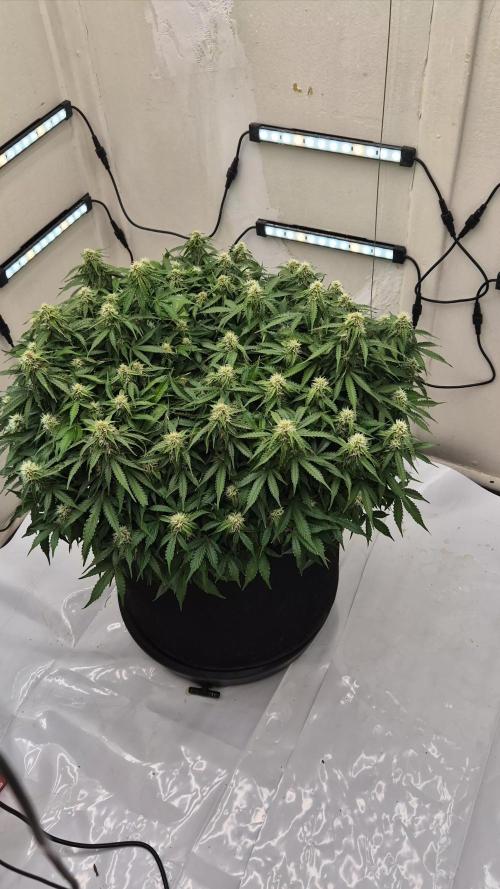
Flipped, start flowering, 02/04
Sour diesel
Somango
Super lemon haze
Harlequin


Likes
11
Share

@RBGreenry
Follow
So far on my first grow, I did exactly what fast buds had told me to do, until half way through flowering where I started giving full nutrients.
All my others were full blasted nutrients from start to finish.
This lady here, I did exactly what fast buds told me to do during veg but I started full feed flowering nutrients as soon as i noticed flowering, instead of flowing stepping up week by week.
Out of everything, I believe the third way is the best in my experience. I thought I might experiment and dabble throughout the whole grow. Still please with fastbuds genetics, terps, resistance and resilience to pest or other things
Still have a handful of weeks to go maybe more but she'll be the biggest one yet


Likes
38
Share


@TrueNorth
Follow
Flowering has beyond started, looks beautiful and healthy, smells fantastic lol. Hope these continue to bring me happiness. Just put the netting in, she is budding i believe hopefully i get some juicy nugs out of this


Processing
Likes
14
Share


@Reforced
Follow
Been trying to keep the humidity between 40-60%. Likely going to purchase a humidifier.
Plants seem to be loving the Elite Nutrients though.

Likes
24
Share


@Jays_Not_Here_Man
Follow
The girls have survived another week ❤️ I did a light defoliation and have been monitoring the RH closely. We have had a very damp week here, and the RH kept climbing and had my fan working hard.
They are starting to plump up and fill in 😋. They have also started to slow their drinking habits, instead of watering every three days, it has moved to every 4 now. Just a couple of weeks left, I think I will be harvesting these over Christmas 🎄, and will have some great bud ready for the new year! 🎉🎊🍾

Likes
21
Share


@TheGanjaFarmer
Follow
Very good week hopefully will start packing on the buds soon, giving bio bizz bloom now. Defoliating a lot and the seems to be working well, watering everything 3-4 days. Daytime temp going from 20-26 and dropping from that to 19 at lights out

Processing
Likes
3
Share


@Longmountain
Follow
Super skunk clone taken 3/11 added to my last soil mix was to hot had to flush a few time after transplant