Likes
Comments
Share
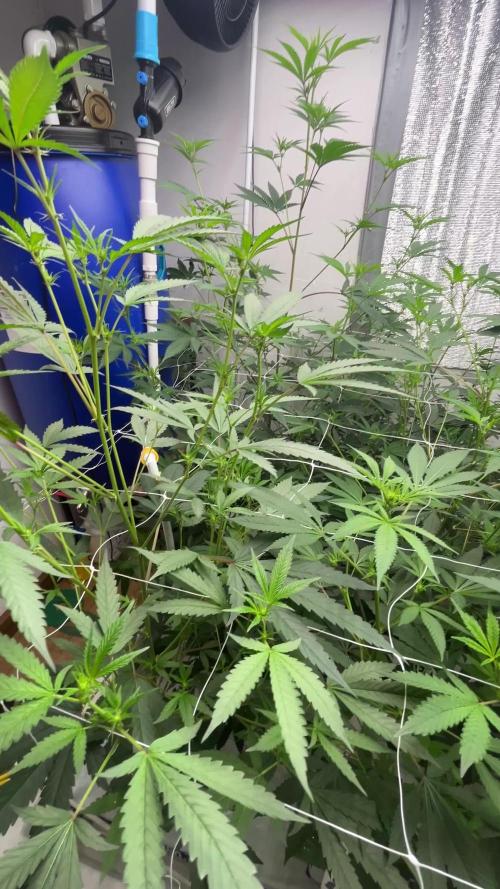
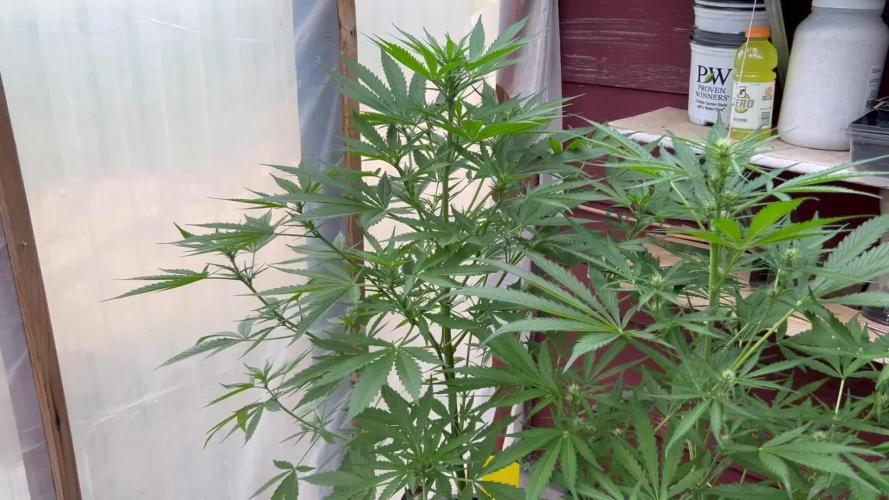
12/9: Fed today...I feel better and my plants are looking better....whew! 12/10: Will switch to 12/12 tonight. and turn on the extra reds. Will also begin UVB stressing immediately. 12/11: Flipped to flower. 12/12: Fed today and sprayed with boom boom spray and axiom harpin proteins. I also added a tablespoon of Happy Frog Cavern Culture to the pots before watering it in. Got the DIY CO2 generator going with a fresh batch of sugar and yeast. 12/16: Fed today. Good week in the garden...plants are looking great...stretching has commenced.
Likes
14
Share
Everything is running smoothly. Nothing really to report on. I added a second trellis for support and I switched from feeding every 4th day, to every 3rd day.
Likes
2
Share
The growth in week two was explosive…I look forward to her continued stretch into flower.
Processing
Likes
20
Share
1/14: This morning, I did a foliar application of big bloom and fulvic acid, then about 5 hours later I watered them with about a half-gallon of rainwater each and added armor si, humic acid, endoboost myco/tricho, liquid molasses, and a bunch of cal-mag. Today, I also I wired up and mounted my new samsung sun board strips (660nm/730nm) and my Solacure FlowerPower UVB fixture. I'm running the deep red/far red bud boosters a few hours per day right now, but will run them for the entire photoperiod once I start flowering them. I'll run the UVB for 4 * 15-minute sessions a day for the full flowering cycle, and if they don't protest too much I'll increase each session by 5 minutes and evaluate again. Some strains are more forgiving than others and I've got 5 different strains in this space...so really not sure much time I'll get away with exposing them to the deadly rays without damaging them too much...😈 1/15: I received one of the rapid led/growmau far red initiator pucks today. With the placement of my UVB light, I'm realizing I'll need another far red puck to have even and intense far red coverage, so I'm ordering another with Prime delivery and waiting to start flowering until I receive it. I sprayed them down really well with ph adjusted rainwater tonight to rinse off nutrient build-up from foliar applications. 1/16: I'm really excited to try flowering under 14/10. I grew photos indoors on an off for 15 years before I semi-retired. If I added up all the additional flowering time I could have done through the years if LED technology existed, I'd have had an extra truckload of bud to smoke. I did another application of Axiom Harpin a|b Proteins this evening, right before dark. I'm expecting a big growth burst this week, leading up to the flower stretch. I really need them to trigger under 14/10 within 4 or 5 days🙏 ...if not, I'll switch to 13/11 and wait a few more days🙏😟..if still no pistils are poppin, I'll go to 12/12 and chalk it up as bad luck or varietal indifference to Pr and Pfr manipulation. 1/17: I fed each of them about 3/4 gallon of full strength veg nutes. This will be the last. I'll go with half-strength veg and half-strength bloom for a week, then go with full strength bloom nutrients until I start flushing them in 6-8 weeks. 1/18: I installed the second far-red flowering initiator today and got all my timers configured for flowering: ========================================= timer#1 - power strip with qb's and red boosters 10:00am -12:00am timer#2 - (dual/independent setting) sideA- 3-way cube with uva bars 10am - 3pm 7pm - 11pm sideB- flowerpower uvb 1pm - 1:15pm 4pm - 4:15pm 7pm - 7:15pm 11pm - 11:15pm timer#3 - far red pucks 11:00pm - 12:15am timer#4 - sub-canopy tube 10am - 1pm 3pm - 6pm 8pm - 11pm ======================================== I also did some testing on the timers and sealed myself into the closet to check for any light leaks. All good.👌 1/19: Tonight is their first long night. It's ON!👍 1/19: Looks like the FIM job didn't take on one of them..but she's got perfect symmetry. WIll probably have to just top her again next week...gonna be a tall one I think. Tonight is their first long night. It's ON!👍 1/20: I watered them today with about a half gallon each. I'm seeing calcium and magnesium deficiences here and there, so added some boomerang and heavy cal-mag-Fe along with liquid molasses, humic acid, and endoboost myco. I also foliar fed with big bloom and fulvic acid. That's it for week 4-
Likes
17
Share
Tops rock rock hard .had to put strings cos they was falling cos of the weight. I think is comimg to the end and stressing me out cos first time doing it .dont wona start to flush to early ....any help would be much pri...started looking at the trichomes every day now
Likes
20
Share
@DrGanj
Follow
Tapering nutes off for the flush. Also added a small amount of Barley as a top dress to help her finish off.
Likes
21
Share
Thank you. Growing cannabis is an art that seems to evolve as you learn it. While it may only take a little knowledge to get started, It seems that this may take a life-time to perfect (doubt I'll ever make that category, but I will certainly try). So thank-you to the community that Shares, Comments, Follows, and Likes. Your efforts in any of these actions make these journals a worth-while and perfect way for us all to learn. I personally appreciate it. Also a huge Thanks has to go out to Grow Diaries for making this community even possible. Your efforts to supply the data storage alone is more than enough, but you the fact that you dont stop there and constantly try to improve the experience even more makes this my favorite community to to share on. And then lastly, but certainly not least, a heartfelt Thank-you to Fast Buds for selecting me as 2nd place in a photo contest and making these seeds available, I'll try my best to honor the gift and opportunity to grow these. Your sponsorship in keeping the community active here is an in-valuable learning tool of its own. And then your branding/research helps give me confidence in knowing that I am working with great genetics before I even start my grow. ---------------------------- Germination Start 2/13/24 to 2/18/24 2/19 to 2/25 Veg Days 1 to 7 Week 0 to 1 Germination took 6 days from dropping in water to transplanting into 1 gallon pots. 29hours in a glass of 6.3ph room temp RO water. Something I would only attempt if they were both floating. They were,so leaving them that long they were able to crack open. I then placed both in paper towels wet with the glass water and pasted to the sides of the glass for 3 days (1 day too long in retrospect). I placed in rapid rooter pods and closed with toothpick tips. They popped out from the pods 1 day later but I gave them 2 days before transplant. Video: Incubator water level is key for rapid rooter pods to wick properly during incubation. Transplant to 1 gal pots: I am using a 50/50, 50%perlite/50%soil with a .5lb of dolomite lime and a .5ml of flora micro added to .5 gallon of RO water (Im mixing 2 gallons of soil total so the water to soil ratio is 1/4 of the total medium volume) to achieve a soil tested ph of 6.4. I am using a 50/50 soil/perlite mix because I plan to use these in auto pots. I also used about 1 cup of the same soil mix water to pour around the plant after transplant; you can see how the perlite rises to the top where I did this. I sprayed two domes and covered - I plan to leave covered for the first week. Feed: I kept them under the domes and sprayed every day that I didnt feed them, to keep humidity up while I let them find water in the soil. By the end of the week I took the domes off and took pictures. Feed this week was another 1 cup of 6.3ph water 5 days after transplant. Feed plan next week will increase the amount to 2 cups of plain-no-nute water with about 4 days between feeds. I want to see the water run through so if I need to use more than 2 cups I will. The idea is to water deep and through, but then make them search for more before the next feed, hopefully spreading the roots out while doing it. Veg Plan: I plan on 8 colas for each plant. So that will be 3 topping days and a total of 7 cuts. I will want to cut the first time on day 21 if I have 5+ nodes. I will transfer to 5 gallon auto pots with-in 1 week of the first topping. Once I have 3 nodes of new growth past the first topping, I will top those two branches to the first node again. (that's 3 cuts total by this point) Then, after 3 new nodes of growth after that, I will do a last topping on the 4 branches. (4 new cuts added to make a total of 7 cuts and 8 colas) I will train the branches using LST/HST with tie downs as soon as I can after the first topping day to help maintain the branches growing where I want them to. I will also introduce an adjustable tomato ring after they have settled into the 5 gallon forever pots to provide support and mobility Hopefully all goes well, and I will have 1 to 2 weeks of growth before flip after week 8. I think it sounds more ambitious than it really is, but if you follow this journal, we will see together.
Likes
21
Share
Welcome growfessors to another episode of growfessor theatre 👽💚 Week 6F begins for the ladies of the 4x4, Green Crack, LSD and Mandarin dreams are rocking! Buds a bulking up, getting sticky, frosty and stanky!! Do-si-dos is a bit behind the other ladies as this strain will take an extra week to finish, but she's also packing on size, frost and stickyness. The Mars-Hydro TSW2000 light is rocking the grow, lighting up the 4x4 really well! Thanks for stopping by growfessors, stay tuned for another episode! 👽🌳💚
Likes
21
Share
Heyókȟa I desire to study nature, and to know better the mind of God, the creator, Holy art thou, O Father. 12x12=144, A dodecahedron is a polyhedron with 12 faces, and in coordination chemistry, it refers to a geometry where ligands surround a central metal atom (in this case, Magnesium) in a specific, 8-coordinate arrangement. Dodecahedrane is a hydrocarbon, meaning it's composed solely of carbon and hydrogen atoms. The carbon atoms are arranged at the corners of a dodecahedron, a 3D shape with 12 pentagonal faces. The water molecules in the dodecahedron form hydrogen bonds that are individually slightly weaker than in either the dimer or the tetramer. However, because three-quarters of the O -H groups in the dodecahedron form hydrogen bonds, it has a more negative energy per molecule than has either the dimer or the tetramer. Magnesium (Mg2+) is the essential, central metal ion in the chlorophyll molecule, crucial for photosynthesis by enabling light absorption and energy transfer. It is chelated by four nitrogen atoms within the porphyrin (or chlorin) ring structure. Chlorophyll appears green because it reflects light in the green region of the visible spectrum, specifically between 490 and 570 nm. The main resonance electronic frequency of a neutral Magnesium (Mg) atom corresponds to the transition from the ground state to the first excited state. Resonance Line Wavelength of Mg2+: 285.1nm (UVB light). The central atom of the chlorophyll molecule is Magnesium (Mg2+), which is coordinated within a porphyrin ring. The electronic "resonance frequency" of this central atom—meaning the frequency at which its electrons absorb energy—is primarily driven by the electronic transitions (ETR) of the surrounding conjugated chlorin ring structure, rather than a discrete atomic transition of the Magnesium atom itself. The resonant electronic frequencies of the chlorophyll porphyrin (technically, a chlorin) ring are determined by the energy required to promote π-electrons within its conjugated system, primarily appearing in the blue and red regions of the visible spectrum. In standard physics, Chloryphyll b has peak absorption at 460nm (Blue). If we take the peak wavelength 460nm and a UV-B, UVR8 peak absorption wavelength 285nm Tryptophan-285 (W285) Sensing protein. 460/285=1.618 Φ, "natural harmony" and the "structure of light". The cryptochrome photoreceptor (CRY) is a UV-A/blue light receptor that shares this dual sensitivity with several other biological structures and functions, including significant sequence similarity and a common evolutionary ancestor with DNA photolyase enzymes. These are light-activated enzymes that use blue/UV-A light to repair DNA damage caused by UV-B radiation in plants. Dodecahedrane (C20H20) is a hydrocarbon with a cage-like structure where carbon atoms form 12 pentagonal faces (a regular dodecahedron). It is highly symmetric (icosahedral), contains no delocalized electrons (no aromaticity), and has minimal angle strain, but significant torsional strain. Water Dodecahedron (H2O) forms hydrogen-bonded cages. While individual hydrogen bonds in this structure are weaker than in the linear dimer or tetramer, it has a more negative total energy per molecule. This is because three-quarters (75%) of the groups are involved in hydrogen bonding, creating a very stable, closed-shell configuration. a 3D carbon hydrocarbon (C20H20) to stable water clusters in hydrate, while the Magnesium ion acts as the central activator within a conjugated ring in biological systems, with its electronic absorption dominated by the ring, not the atom itself. Effective quantum efficiency of photosystem II, often denoted as ΦPSII In horticultural lighting, adding 730 nm (far-red) LEDs alongside standard red/blue lights has been shown to increase canopy photosynthesis by 20–30% in several crops by acting synergistically with shorter wavelengths. However, the limitation is that excessive, pure IR/Far-red light (without accompanying red light) can trigger the "shade avoidance response," causing plants to grow tall, weak, and spindly rather than robust. Knowing is half the battle however, engineering or utilizing infrared light (specifically the 700-750 nm far-red range) is a viable method to boost photosynthetic efficiency. It acts as a bridge to allow PSII to utilize a broader spectrum of light, breaking the traditional 700 nm barrier. Extend, then multiply. UVR8-mediated signaling (often in conjunction with CRY proteins) triggers protective mechanisms that maintain the stability of the photosynthetic apparatus (including LHCII and reaction center proteins), thus ensuring that the efficiency of Photosystem II remains higher in UV-B-exposed plants compared to plants lacking this receptor. ΦPSII indictates the rate of electron transfer from water to plastoquinone, which drives the production of ATP and NADPH. There is a close link between ΦPSII and the true rate of CO2 fixation (Φ*co2), particularly in C4 plants. Effective quantum efficiency of photosystem II, often denoted as ΦPSII, represents the proportion of light absorbed by Photosystem II (ΦPSII) that is actually used in photosynthetic electron transport. It is a key indicator of how efficiently a plant is using light for photosynthesis, as opposed to losing it as heat or fluorescence. ΦPSII (effective quantum yield of photosystem II) functions primarily as a "multiplier" (a coefficient of efficiency) rather than an additive factor when estimating the overall photosynthetic electron transport rate (ETR). Multipliers are considered far more beneficial than additions because they generate exponential growth, leverage existing resources to their full potential, and create sustainable, self-multiplying capacity, rather than just incremental, linear increases. Humans, and most other mammals, rely on other mechanisms, such as nucleotide excision repair, to manage and repair UV-induced DNA damage. As such, humans do not have the direct, light-driven repair mechanism that photolyase offers in plants.
Likes
19
Share
This plant is ready and I flush it RN, pretty pink dress with a lotta tricomes makes her beautiful Not a big girl so I really hope buds will be good, tasty like the smell she has
Likes
9
Share
Settimana 11 di lavaggio radici aspetto di arrivare alla 12 e taglio tutto sono molto contento se avete consigli su una buona essiccazione e concia vi ringrazio ragazzi 💚
Likes
101
Share
@TOTEM
Follow
This week I made a special video tour of the grow room, hope you like it. This Gorilla is feeling great! She’s spent this week fattening up lower colas. These colas are even frostier than bigger ones. I didn’t get them so frosty on my last growth. I still have to give her Overdrive since the soil is still wet, but will do it in a few days. See you next week 🐵
Likes
19
Share
@Wenz004
Follow
Fast schon ende der 4. Woche aber jetzt erstmal Woche 3 eintragen. EC ca. auf 1.1 Am Anfang der Woche 3 in 19 l fabric pot umgetopft. Ab Dienstag 4 Tage unterwegs daher die Schläuche für Blumat...hat ganz gut funktioniert mit Umwälzpumpe im Tank plus dass "Jemand" täglich PH korrigiert hat. Video ist ca. 19.10. bis 26.10. plus bissl vom 27.10 Schon mal vorab... Samstag bis Mittwoch (Woche 4) auch unterwegs...nur das es "Jemand" nicht gab und Blumat auch noch verstopfte...Pflanze hat gelitten aber Spoiler muss sein...die Frau mit dem fetten A.... wurde geretet. Aptus schein für Blumat ungeeignet zu sein...mit TA gabs weniger Probleme bei einem älteren grow...Aptus bleibt aber zunächst mein Favorit.
Processing
Likes
12
Share
Checkout my Instagram @smallbudz to see the Small budget grow setup for indoor use, low watt, low heat, low noise, step by step. 13/12/2019 - Change the light schedule to 12-12h after 8 weeks of no signs of flowering I think is a photo not and auto. 16/12/2019 - Fed her 1.5l of 6.5PH water with 0,5ml of each: Grow, Bloom and Max, and 1ml of each: Heaven, Alga-mic and Vera, noticed about 10% run off, I use about 1/3 of the nutrient dosage on the chart, to achieve about 200/300PPM (500 scale). 17/12/2019 - Did some defoliation on the lower branches mainly.
Likes
3
Share
@CalGonJim
Follow
MONDAY 5/26 4am put up some readings from last night. I did 10, 10 Con Bloom PLUS 2mL of Bud Factor X. 1230pm WOW I hit the gears just right on BUD FACTOR X!!!... In FIVE YEARS...NEVER GOT IT RIGHT.... This combo worked the chloroplast tanks seemed flat, the X made a visible difference in how puffy the top sugar leaves are and the amount of resin is exactly like the advertisements....finally. There was something I thought was "sludge" in using X with Con. There IS a reaction between Con Bloom Part A, the color one and X. A reaction with amino acids, and protein binding from my observation, not a spoilage or rancid issue. 245pm What a day, I hope my Cuban robot girlfriend has Frank Sinatra playing, oh wait thats Bladerunner. 5/28 The tumor on my neck is getting horrible, I dont go to doctors and I dont call 911 so im going to get several bottles of whiskey and then I will open up the cysts. if I dont die from the infection I should be ok. 350pm Mars Hydro FC1500-EVO 150W 🚨👍 soon 5/29 420am. I HAVE BEEN UPLOADING AND SCREAMING ABOUT VIDEOS NOT WORKING....they ONLY work in NEW VIEW.....goddamnit!!!!!! I just figured it out........ PLANTS LOOK GREAT 5/30 Wating for the new light, should be here soon!! plants are getting top heavy. 4 cola design means I can do a diamond wire shape and they will be self supporting no external SCREENS or messes from that. 5/31 Saturday. MARS-HYDRO got the Samsung version of this light in TENT 2!!! I put on the BLUTOOTH ADAPTER it works great. I measure the amount of WATTS not percent of light but still very very nice works perfectly. MAKE THE APP PASSWORD FIRST OR IT WONT WORK RIGHT!!!! 🚨THE NEW LIGHT IN TENT 2: FC1500-EVO 150W SAMSUNG LED FOR MY RICKY PLANTS!!! The Grimm Seeds are strong as hell and can take the new lights, even at 93W might be too much, I might get to lower the overall wattage and save even more energy that way👍 6/1 SUNDAY THE NEW LIGHT IS MAKING MASSIVE DIFFENCE NICE with the new light!!!
Likes
18
Share
@Xpie77
Follow
De planten zijn naar hun nieuwe huis gegaan. Eerste week naar 12/12. De planten kregen wel wat root max schimmels en wat melasse en zeewiervoer -----------------Purple Haze ----------------- Purple Haze Purple Haze ontstond in de jaren zeventig in de Verenigde Staten en is vernoemd naar het bekende nummer van Jimmy Hendrix. Purple Haze was de meest gerookte wiet bij Woodstock en een wereldwijde favoriet onder rokers. Ook in Nederland werd deze cannabissoort steeds populairder. Deze populaire haze soort zie je vaak in Nederlandse coffeeshops. De toppen van de Purple Haze wietplanten zijn compact met prachtige THC kristallen en hebben paarse tinten. Het roken van deze wiet maakt je euforisch, creatief en geeft je een opbeurend gevoel. Het effect is krachtig en merkbaar als een sativa high gevoel. Eigenschappen van Purple Haze wietzaden Favoriete haze soort Sativa dominantie Heerlijke smaak Mooie paarse kleur Sativa high Informatie Purple Haze wietzaden Bloeitijd: 9-10 weken Genetica: Haze x Afghan 80% sativa, 20% indica Plant Hoogte buiten: 150 – 200 cm Oogstmaand buiten: van juni t/m oktober Opbrengst binnen: 450 – 500 gr/m² Opbrengst buiten: 200 – 800 gr/plant THC: 21% Link naar de shop: https://seedsgenetics.nl/product/purple-haze-gefeminiseerd /
Likes
5
Share
@ShinWeed
Follow
. 🌱 Tag 28 - Eine Woche, die sich endlich wie Routine anfühlt Seit dem letzten Update ist eine Woche vergangen und trotz kleiner Unruhe in den letzten Durchgängen hat sich das Setup diesmal deutlich stabilisiert. Kein pH-Chaos, keine Mischfehler im Tank, einfach konstante Versorgung und gleichmäßiges Wachstum. Wir merken deutlich, dass sich unser Wachstum gerade verändert. Es geht nicht mehr nur darum, größer zu werden, sondern darum, Struktur aufzubauen. Die ersten Anzeichen der Blütephase sind da und der ganze Rhythmus verschiebt sich langsam in diese Richtung. Noch ist es kein kompletter Wechsel, eher ein Übergangszustand. Aber wir arbeiten sichtbar anders weiter als noch vor einer Woche. Wir wachsen weiterhin gleichmäßig und ohne Stresssignale. Die Blätter werden dichter, die Struktur klarer und intern passiert deutlich mehr, als man von außen direkt sieht. Diese Phase fühlt sich ein bisschen so an, als würden wir uns neu sortieren, bevor es richtig losgeht. Das Wasser und die Nährlösung passen aktuell gut zu uns. Der pH wird konsequent auf 5,7 eingestellt und driftet über ein bis zwei Tage auf etwa 6,3, wo er sich dann stabilisiert. EC liegt konstant im Bereich 1,6–1,8. Bisher kommen wir damit sehr gut klar und zeigen keine negativen Reaktionen. 👨‍🌾 Gärtner: Diese Woche war unangenehm unspektakulär. Ich hab mittlerweile den Dreh mit dem Wasser wirklich raus. pH-Management läuft inzwischen bewusst und reproduzierbar, nicht mehr nach Gefühl und Hoffnung. Die anfänglichen Probleme durch Hydrogencarbonate im Leitungswasser sind jetzt eingeplant statt überraschend. Wichtigste Erkenntnis der letzten Tage: Wenn man den pH sauber auf 5,7 einstellt und die EC-Spanne 1,6–1,8 hält, ist das System deutlich weniger anfällig. Der leichte pH-Anstieg über 1–2 Tage auf ~6,3 ist inzwischen kein Problem mehr, sondern einfach ein bekanntes Verhalten des Systems. Nichts, was Panik auslöst. Eher so ein: „Ja gut, du bist halt so“-Moment gegenüber dem Wasser. Und das eigentlich Beste: Die Pflanzen reagieren darauf bisher stabil und ohne Beschwerden.
Likes
17
Share
@Lazuli
Follow
Flowered during winter and i payed the price