


Likes
Comments
Share


@DankeyeBeaverjuice
Follow
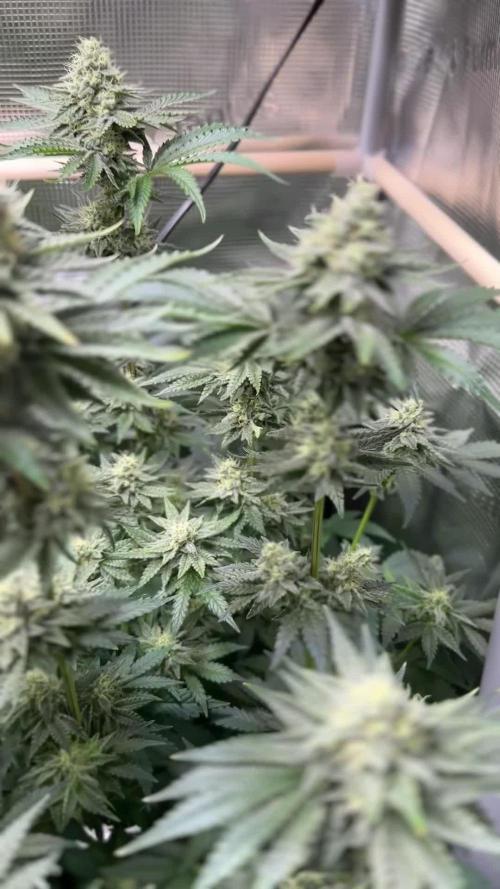
This grow gets a ten out of ten from me on behavioral attributes on how she grew through out all the stages of life. Vegging was an absolute pleasure, she thrived off the 125g of amendments, cal-mag, and kelp all the way to day 30. Once I noticed flower development I proceeded to give her, her first feeding of grow and bloom nutrients both at the same time @ a diluted mixture of 25% then proceeded to increase increments as needed into flower, cutting out the grow after two feedings. She has been to date one of the cheapest grows I've ever had, all that's left is to harvest, cure and smoke for the final conclusion on 3 bears auto from Mephisto. Hats off to the boys over there! All this did was get me excited to grow the remaining Mephistos I have stored away!




Likes
15
Share


@BLAZED
Follow
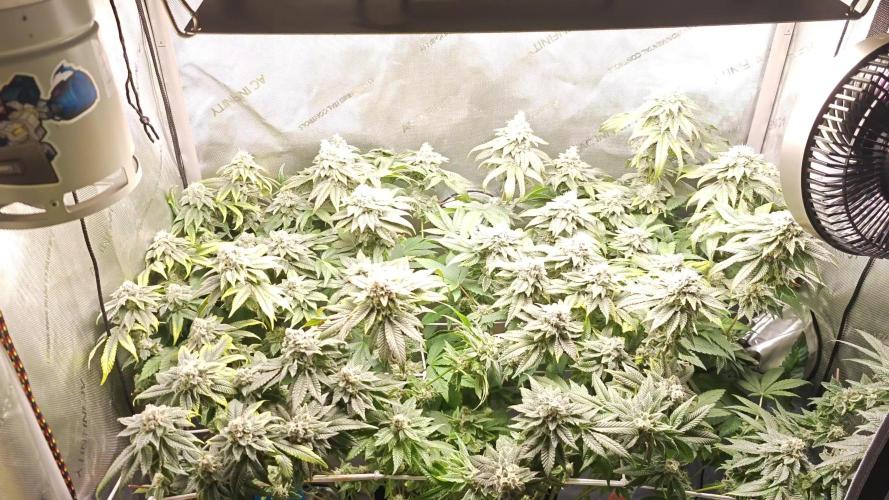
Week 16 (12-5 to 18-5)
12-5
Temps: 19.9 to 25.1 degrees
Humidity: 41% to 55%
Watering: Both 1000 ml. EC: 1.6
13-5
Temps: 19.4 to 23.8 degrees
Humidity: 42% to 49%
Watering: Both 1000 ml. EC: 0.5
14-5
Temps: 19.2 to 23.5 degrees
Humidity: 47% to 54%
Watering: Both 1000 ml. EC: 1.6
15-5
Temps: 19.5 to 23.5 degrees
Humidity: 43% to 55%
Watering #2: 1000 ml. EC: 0.5
16-5
Temps: 18.3 to 23.8 degrees
Humidity: 48% to 56%
Watering: Both 1000 ml. EC: 1.6
17-5
Temps: 18.8 to 24.5 degrees
Humidity: 49% to 57%
18-5
Temps: 19.8 to 24.2 degrees
Humidity: 47% to 56%
Watering: Both 1000 ml. EC: 0.5
You can clearly see the difference now between pheno #1, and pheno #2. Beautiful!



Likes
59
Share


@Insaniac_0
Follow
Week 6 of flower - At the end of this week I defoliated down to mostly bud and sugar leaves for the final stretch.
I fed them normal with no HP2. Feed this week was 1.25 gallons two times with about 4 days between. 750ppm total before add-ins. I used 750ppm Bloom concentrate mix (recipe week 5). However, I also added 1ml/gal of CaliMagic (General Hydroponics 1-0-0) to all feeds. PH balance this week was 6.3.
Next week I will add the HP2 back again while reducing the nutes for flush.


Likes
16
Share


@Northern_Ent
Follow
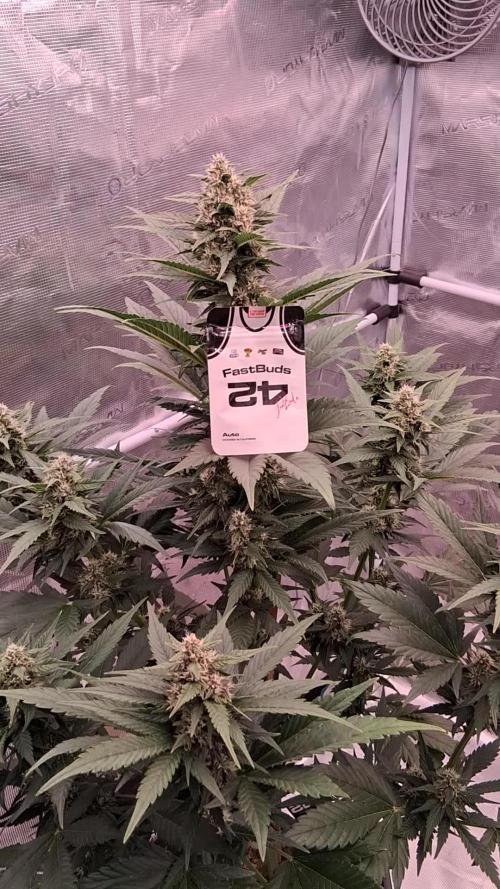
Sep 28: Overdose is packing on weight and looking to be quite a big yielder considering I only topped her once and didn’t optimize for it being a photoperiod and not actually an auto.
So far so good and flowering is picking up speed. Sunlight gets very weak into October and potentially frost but with UV lights and putting her in the garage on cold nights, this will finish strongly.
Sep 29: cool and overcast today so I got the LED light out for supplemental light during midday. Minor hassle really but I know the light is quite weak here in October and this supplemental light will likely make a big difference on a late finisher. Watered with cal-mag and potassium this morning. Went to add N and I have some fish fertilizer still…pH dropped in water and I had to use potassium silicate again to get pH back up to proper range. Oh well, she’ll appreciate it all.
Oct 1: gave her another dose of fish fertilizer and potassium silicate this morning.
Oct 3: not sure why but I gave her a partial dose of seaweed extract this morning along with the warmed water. With lower temperatures I’m upping the water temperature a bit. Now using about 28 C water in the morning when it’s still only about 5 C. That seems to help and is easy to do with a cheap kettle to boil water.
Oct 4: she’s completely purple now but flowers are still blooming and no signs of bud rot. Will try to hold off on harvest for another week.

Likes
23
Share

@BlaKX
Follow
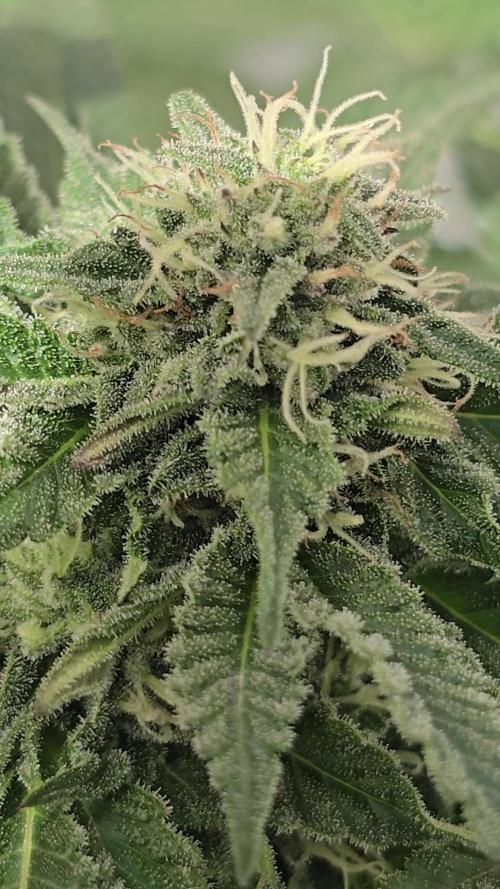
It's BPP RF3 time!
Durch des reduzieren vom Licht Zyklus auf 18/6 hat die Farbe mittlerweile gut verstärkt. Das entlauben war nochmal nötig und die Blüten sind ordentlich am dick werden samt Harz bessatz zugelegt!
Sie ist eine wahre Augenweide 😈



Likes
37
Share


@AutoCrazy
Follow
Another week of scorching heat has made this lady grow like crazy. I had to do some defoliation as she was so bushy!! I also topped her again.
I will be moving her outside this weekend and I will start to lst her to get that nice even canopy that we all love 🔥. I have started watering with Fish Shit and will be doing it weekly now.
Humboldt genetics are always a sight to behold!!
Onward!!!
😎🍿🍻

Likes
21
Share


@Ultraviolet
Follow
Heyoka.
12x12=144, A dodecahedron is a polyhedron with 12 faces, and in coordination chemistry, it refers to a geometry where ligands surround a central metal atom (in this case, Magnesium) in a specific, 8-coordinate arrangement. Dodecahedrane is a hydrocarbon, meaning it's composed solely of carbon and hydrogen atoms. The carbon atoms are arranged at the corners of a dodecahedron, a 3D shape with 12 pentagonal faces. The water molecules in the dodecahedron form hydrogen bonds that are individually slightly weaker than in either the dimer or the tetramer. However, because three-quarters of the O -H groups in the dodecahedron form hydrogen bonds, it has a more negative energy per molecule than has either the dimer or the tetramer. Magnesium (Mg2+) is the essential, central metal ion in the chlorophyll molecule, crucial for photosynthesis by enabling light absorption and energy transfer. It is chelated by four nitrogen atoms within the porphyrin (or chlorin) ring structure. Chlorophyll appears green because it reflects light in the green region of the visible spectrum, specifically between 490 and 570 nm. The main resonance electronic frequency of a neutral Magnesium (Mg) atom corresponds to the transition from the ground state to the first excited state. Resonance Line Wavelength of Mg2+: 285.1nm (UVB light). The central atom of the chlorophyll molecule is Magnesium (Mg2+), which is coordinated within a porphyrin ring. The electronic "resonance frequency" of this central atom—meaning the frequency at which its electrons absorb energy—is primarily driven by the electronic transitions (ETR) of the surrounding conjugated chlorin ring structure, rather than a discrete atomic transition of the Magnesium atom itself. The resonant electronic frequencies of the chlorophyll porphyrin (technically, a chlorin) ring are determined by the energy required to promote π-electrons within its conjugated system, primarily appearing in the blue and red regions of the visible spectrum.
In standard physics, Chloryphyll b has peak absorption at 460nm (Blue). If we take the peak wavelength 460nm and a UV-B, UVR8 peak absorption wavelength 285nm Tryptophan-285 (W285) Sensing protein. 460/285=1.618 Φ, "natural harmony" and the "structure of light". The cryptochrome photoreceptor (CRY) is a UV-A/blue light receptor that shares this dual sensitivity with several other biological structures and functions, including significant sequence similarity and a common evolutionary ancestor with DNA photolyase enzymes. These are light-activated enzymes that use blue/UV-A light to repair DNA damage caused by UV-B radiation in plants.
Dodecahedrane (C20H20) is a hydrocarbon with a cage-like structure where carbon atoms form 12 pentagonal faces (a regular dodecahedron). It is highly symmetric (icosahedral), contains no delocalized electrons (no aromaticity), and has minimal angle strain, but significant torsional strain. Water Dodecahedron (H2O) forms hydrogen-bonded cages. While individual hydrogen bonds in this structure are weaker than in the linear dimer or tetramer, it has a more negative total energy per molecule. This is because three-quarters (75%) of the groups are involved in hydrogen bonding, creating a very stable, closed-shell configuration. a 3D carbon hydrocarbon (C20H20) to stable water clusters in hydrate, while the Magnesium ion acts as the central activator within a conjugated ring in biological systems, with its electronic absorption dominated by the ring, not the atom itself.
Effective quantum efficiency of photosystem II, often denoted as ΦPSII
In horticultural lighting, adding 730 nm (far-red) LEDs alongside standard red/blue lights has been shown to increase canopy photosynthesis by 20–30% in several crops by acting synergistically with shorter wavelengths. However, the limitation is that excessive, pure IR/Far-red light (without accompanying red light) can trigger the "shade avoidance response," causing plants to grow tall, weak, and spindly rather than robust. Knowing is half the battle however, engineering or utilizing infrared light (specifically the 700-750 nm far-red range) is a viable method to boost photosynthetic efficiency. It acts as a bridge to allow PSII to utilize a broader spectrum of light, breaking the traditional 700 nm barrier.
Extend, then multiply.
UVR8-mediated signaling (often in conjunction with CRY proteins) triggers protective mechanisms that maintain the stability of the photosynthetic apparatus (including LHCII and reaction center proteins), thus ensuring that the efficiency of Photosystem II remains higher in UV-B-exposed plants compared to plants lacking this receptor. ΦPSII indictates the rate of electron transfer from water to plastoquinone, which drives the production of ATP and NADPH. There is a close link between ΦPSII and the true rate of CO2 fixation (Φ*co2), particularly in C4 plants.
Effective quantum efficiency of photosystem II, often denoted as ΦPSII, represents the proportion of light absorbed by Photosystem II (ΦPSII) that is actually used in photosynthetic electron transport. It is a key indicator of how efficiently a plant is using light for photosynthesis, as opposed to losing it as heat or fluorescence. ΦPSII (effective quantum yield of photosystem II) functions primarily as a "multiplier" (a coefficient of efficiency) rather than an additive factor when estimating the overall photosynthetic electron transport rate (ETR). Multipliers are considered far more beneficial than additions because they generate exponential growth, leverage existing resources to their full potential, and create sustainable, self-multiplying capacity, rather than just incremental, linear increases.
Humans, and most other mammals, rely on other mechanisms, such as nucleotide excision repair, to manage and repair UV-induced DNA damage. As such, humans do not have the direct, light-driven repair mechanism that photolyase offers in plants.

Likes
3
Share


@Krautbauern
Follow
papaya cookies has now completed her stretch. typical for papaya, she develops purple/pink pistils. such a beauty. hopefully the weather will stay good enough for her bulk.
Likes
10
Share


@ZweetZkittlez
Follow
Poda apical tardía pero trabajando fuerte con LST para lograr la estructura de plantas que deseamos. Además para lograr esquejar la genética y poder mantener los fenos que nos gustan.
Sumé a la carpa un feno de Zombie Bride que salió bueno y no queria perderlo. En el video se puede ver.


Likes
3
Share


@MicroHidroGrow
Follow
Día 19.
Las Tropicana han reaccionado muy bien. Aproveché para hacerle LST a una y HST a la otra. Las Polaris estaban revegetando, así que esos las demoró. Pero ya empezaron a estirar. Además a una le tuve que cortar la rama principal y dejar 2 laterales, dado que estaba muy maltrecha.
Mantuve la solución nutritiva de la semana pasada y la voy a cambiar hoy o mañana seguramente. Voy a tener que esperar para pasarlas a floración, ya que tengo una mudanza en unas semanas. Así que la floración va a ser post mudanza.
Likes
21
Share


Likes
7
Share


@TheSpoonieCrone
Follow
Starting to see some frost building up! This plant has been slower to come around but she sure shot up. I did LST a little late on the main cola so it looks a bit funky but she's living and packing on weight. I consider it a win and lesson learned <3

Likes
57
Share


@Silverback_Guerilla
Follow
1/17 - 1/24:
An excellent week for all the plants. Solid, steady fattening and frosting over. The Zenzations smell amazing.


Likes
10
Share

@eldruida_lamota
Follow
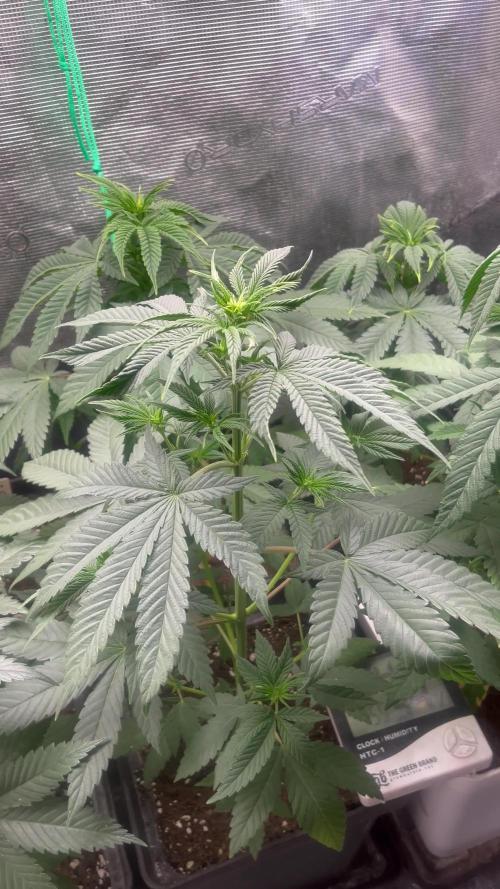
Que pasa familia, vamos con la primera semana de floración de estas Mental Rainbow F1 de Sweetseeds.
Vamos al lío, las plantas se trasplantaron a macetas de 7 litros.
El ph se controla en 6.5, la temperatura la tenemos entre 24/22 grados y la humedad ronda el 50%.
El ciclo de crecimiento puse 12h de luz, el foco está al 50% de potencia.
Me gustaría estar más encima este cultivo pero la salud me está impidiendo un poco este 100% con el proyecto. Con suerte la semana que viene andaré mejor.
- os dejo por aquí un CÓDIGO: Eldruida
Descuento para la tienda de MARS HYDRO.
https://www.mars-hydro.com
Hasta aquí todo, Buenos humos 💨💨💨