


Likes
Comments
Share


@Roberts
Follow
Was great till hplvd destroyed my prior photoperiod run, and got transferred over to this one. So destroying this run today as I have met my Spider Farmer contract date. I can now clean and start over. I will be back. 👍🏻 Thank you Spider Farmer, and AMS.
Www.amsterdammarijuanaseeds.com
Thank you grow diaries community for the 👇likes👇, follows, comments, and subscriptions on my YouTube channel👇. ❄️🌱🍻
Happy Growing 🌱🌱🌱
https://youtube.com/channel/UCAhN7yRzWLpcaRHhMIQ7X4g
Spider Farmer G300w: https://amzn.to/3S2zvsd
Spider Farmer 10X20 Heat Mat Kit - https://amz.fun/lsa0J
Spider Farmer Amazon Store: https://www.amazon.com/spiderfarmer
Spider Farmer Official Site: https://spider-farmer.com
Discount code: saveurcash


Likes
23
Share


@SonomaSungrown
Follow
Excited to get these things dried and cured.
The terpene profile is really interesting, if a bit on the lighter side.
I'll report back on the smoke report.


Likes
18
Share


@ill_noise_homegrown
Follow
At 10 oz cured, it’s not the yield I was interested in but the quality and is it ever! This shit smacks, will def be growing it again but now, on to the lemon berry candy autos from ethos for my next grow. Check it out!

Likes
226
Share


@HighTV
Follow
| 📅 Week 6 | Days 36 - 42
| 💡 562w 📏36' |
| ☔ 37%-61% |
| 🌡️️🌞 74 - 79 |
| 🌡️️🌑 68 - 74 |
12/14 All PH's adjusted to 5.6 and LST updated to give better light penetration. Bud development has begun to form on all plants now including the focus plant so I did some medium defoliation to start out the week. (Despite my attempts to slow the focus plant down with the she stretched through it anyway!)
12/15 Reservoir Swap on the 2 non-focus plants. They received only Bloom+Calmag+hydroguard for week 6, because they hate nitrogen and get nutrient burn easily. Of course all of the PHs have been adjusted to 5.8 like done daily.
12/16 Reservoir Swap on the Focus plant. Shes received only Bloom+Calmag+hydroguard for week 6, again because they hate nitrogen. All plants received an updated LST and a PH adjustment to 5.6, because its been climbing day to day.
12/17 I rotated the plants some to give a better stretch then adjusted the PH of all the reservoirs between 5.8 and 6. A small update to the LST and I maximized the height of the light so its not going up anymore. Topped off the reservoirs.
12/18 All reservoirs had their PH adjusted to 5.8 and I did an LST update like everyday. I am getting close to running out of PH test drops so I ordered more yesterday I might have to reservoir swap daily to maintain PH without being able to test it. yikes
12/19 The plants are looking healthy and the smallest plant has decided to start stretching more so that's good. The non-focus plants are clearly showing their purple phenotypes, but the focus plant is being stubborn.. or not purple.
12/20 Topped off and PHed Reservoirs to 5.8. I used my last drops of the PH testing fluid so I will be doing a reservoir swap tomorrow, really earlier, because I know the PH of my tap+nutrients. Then the PH testing fluid arrives the following day so we will be fine. Don't forget to reup your essentials!
Week 6 was a fantastic week of growth for the Focus plant especially. The other plants have really began to show their purple while our timelapse buddy is just a happy ol'e green plant. Perhaps this will change later in the flowering cycle. WE GOT A POLARIZED LENS just in time for us to increase the light to 750w, So now we can do the timelapse with a higher wattage of light and not get weird lines in the video! Overall this week was an 8/10 in terms of growth.😎

Likes
9
Share


@Headies
Follow
So I had a little less nutrient last week then i needed. Def a calcium deficiency. I think it's clearing up but this plant has spot all over it. I changed the water, gave it the right amount of nutrients and a little exra hydrated lime for calcium. Hydro is hard. I hoping It's not sick. I hope It doesn't get the other plants sick. Just a few weeks left.
Likes
16
Share


@Weedy_Shepherd
Follow
Good day guys! Well it's been a beautiful adventure with these baby's! Il be chopping them up in the coming days.. Will leave them a full 2 days in the dark to boost tricomes and then down they go! You guys have to try The great white shark guys! Unbelievable strain to grow! Thank you greenhouse genetics 👍🏻


Likes
5
Share

@Failtobi196
Follow
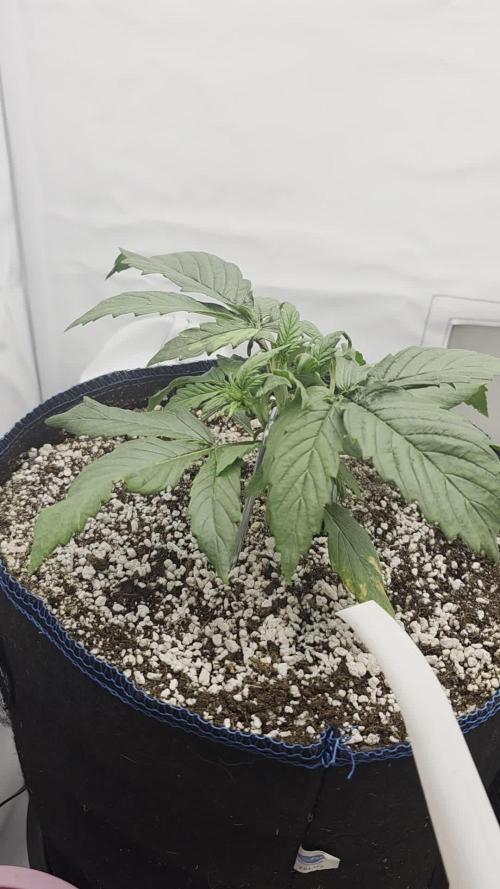
Hi Leute heute ist Tag 15 . Bin bis jetzt ganz begeistert. Ich hoffe die Genetik hält was sie verspricht....
Likes
12
Share


@The_Good_Twin
Follow
7/16/22
Today marks the 1st day of week 14, and the start of the 2nd week of the ripening stage.
Stella received a gallon of water mixed with the following nutrients:
FloraMicro - 5 ml
FloraBloom - 15 ml
Floralicious Plus - 1 ml
Dry KoolBloom - 0.5 tsp.
I seem to be having an issue with pH the last 2 feeding days. I think my gallon jugs have reached the end of their lifetimes, and THAT is what is causing my issue. It has happened to me once before, and getting new jugs cleared up the issue. I’m assuming that will be the solution to the problem.
However, we all know what “assume” stands for don’t we? If you don’t, leave a comment and I’ll explain.
The initial pH was 5.4. That is the lowest that I have ever had simply after adding nutrients. I added a total of 10 ml’s of pH UP, which in my opinion is way too much! But, I did it in 3 separate increments. Not that that makes it better.
The final pH after all that was 6.3. The runoff pH was 5.6.
She is still looking good, but you can tell she’s getting ready to start getting to her end stage. I wait with baited breath!
The tent was 81.7F, with a humidity of 56%.
We’re almost there! Happy growing everyone.
7/18/22
Today I’m going to keep this note brief… I promise.
Stella is continuing to fatten up getting ready for harvest in a few weeks. She is still doing well.
Today she received a gallon of water mixed with the ripen stage nutrients again. I changed all of my jugs, but after mixing everything up the initial pH was 5.5. I added 8 ml’s of pH UP which adjusted the pH going in to 6.2. Her runoff pH was 5.6.
The tent was 83.3F, with humidity at 58%.
See! A short note is possible!! Happy growing everyone.
7/21/22
Stella and all of her children were fed today. As usual, a day later than planned, but they got fed, and are all still doing wonderful.
We’re keeping with the ripen nutrients mixed into a full gallon of water.
FloraMicro - 5 ml
FloraBloom - 15 ml
Floralicious Plus - 1 ml
Liquid KoolBloom - 2 ml
Initial pH was 5.2. I added 12 ml’s of pH UP which adjusted it to 6.2. She had plenty of runoff with a pH of 5.8
The tent was 83.9F, and humidity was 52%.
Her buds are FAT!! Happy growing everyone!
Likes
7
Share


@Northstar_cannabis
Follow
Strawberry Gorilla has grown great given its limited space. I moved her and added supplemental lights.


Likes
22
Share


@Dankbudz84
Follow
After 48 hours, these things are beast. I thought they needed more time, I couldn’t judge how long they were.
I had to dig them out of the paper towel, learned that I need to use cheaper paper towels. 6 out of 6 germinated on my first grow. Let’s keep the same growth going.
*******************************
14 Hours After Potting
**************
TEMPS
The most recent video showing the domes is 14 hours after potting them. The temps have been very stable at 83F and 70% humidity. My ambient temp outside of the tent is 70F.
AIR FLOW
I’m currently only running a 6 inch fan above the light for circulation. I have not used the exhaust, I think the idea at this stage is to keep humidity high, any thoughts would be great.
LIGHTNING
I do have my TSW on max and lowered the height to 36 inches it was almost twice the height yesterday. I didn’t want to make the change so drastic and waited a bit before lowering the height.
WATERING
The top soil did feel a bit dry and a little moist under. Under the dome it still looks very moist. I sprayed the plastic domes, I’m using distilled ph’d water. I did some light watering on the soil but I’m not sure how much water I should be using .
Now that I lowered the height soil should dry out quicker, any thoughts?

Likes
6
Share


@GanjaDjarin
Follow
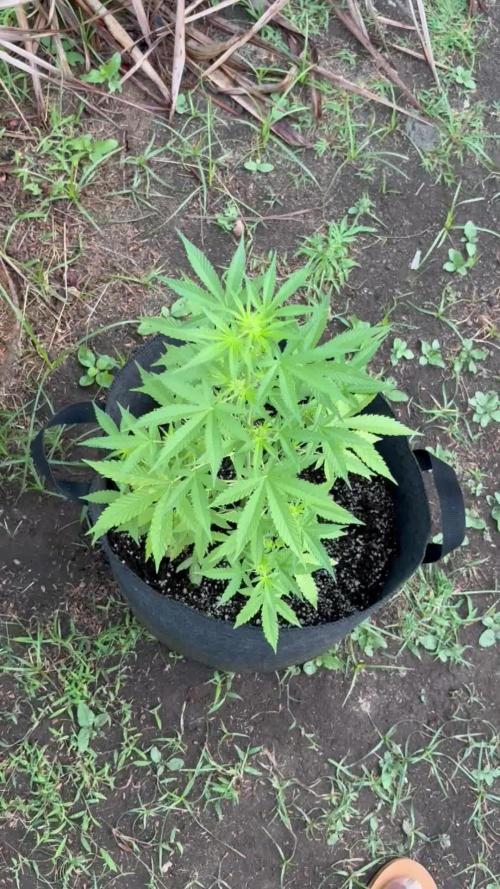
Days 15 to 17, varying by plant: My journey of experimentation, aiming to refine and perfect my cannabis cultivation methods, continues. This venture’s ultimate objective is to position myself as a preeminent cannabis cultivator in my locale. As I navigate through the labyrinth of regulatory licensing, I’m conducting a trial run with my seedlings under continuous lighting conditions and a minimal nutrient regime. My primary goal during this phase is to identify any potential hiccups that could hinder the growth process and ultimately impact the productivity of my intended commercial operation.
As I delve deeper into this exploratory phase, I draw invaluable insights from the thriving cannabis community, whose collective wisdom informs my decision-making process. Given my geographical location and available resources, I’ve opted for a strategic shift in my cultivation strategy.
Previously, I’ve been procuring seeds at an average cost of $10 to $22 per seed, with a relatively broad success rate variance, ranging from 70% to 85%. However, an alternative presents itself in the form of local cultivators. These businesses offer cannabis plants aged between 2 to 4 weeks, boasting an impressive variety of over 100 strains.
These juvenile plants are offered at a cost-effective rate: an average of $100 for eight plants. With a success rate hovering between 70% and 95%, these plants offer excellent value. Essentially, I can access pre-grown plants at a substantial discount, in turn significantly boosting my chances of success.
Consequently, I am poised to transition away from growing cannabis from seeds to harvesting. By sourcing my plants from local cultivators, I stand to significantly reduce overhead and production time—an undeniably smart move from a business standpoint. This strategic pivot signifies the end of an era and the exciting beginning of a more efficient and cost-effective chapter in my cannabis cultivation journey.
I am currently outlining a plan to expand my cultivation by acquiring several juvenile plants, which should be happening between July 1st and 3rd. The new additions to my garden will include Acapulco Gold, Gelato, White Truffle, and Runtz. These will be cultivated in harmony with the existing growth, which comprises God’s Gift, Northern Lights, and the final surviving F1 Epsilon.
My primary objective is to establish the most efficient and cost-effective supply chain possible. I aim to achieve this through the use of an off-grid system that runs solely on solar power, which will ensure complete sustainability and renewability. From a business standpoint, this approach is advantageous as it allows me to leverage the growth of high-quality plants that are already in the cultivation phase.
The new plants are expected to arrive in about a week. If the growth rate of the currently cultivated plants doesn’t meet expectations, I’ll be incorporating several of the newly arrived plants into the hydroponics systems. This methodical approach aims to ensure an optimal growth rate and the highest possible yield.
I also wish to address the cannabis grower community directly. I hope that my decision to skip the seed-to-plant stage does not cause any offense. My intentions are simply focused on maximizing quality and output, while minimizing our carbon footprint. I believe this approach is in the best interest of sustainability and efficiency, without compromising on the quality that our community values so highly.
As we proceed with this venture, we’re currently in the phase of collecting equipment and navigating through the licensing process. To help lower our overhead and assist with consulting fees, we would greatly appreciate any donations, especially in terms of lighting equipment. Your support in this endeavor will contribute significantly towards optimizing our operation and will be deeply appreciated.
Disclaimer:
Let it also be known I am completely abiding by all state laws, and do not plan on selling any of this current bud. This is for research to avoid future growing "potholes" in the growing part of the business as we have a very small team. My end goal is to help change the current stigma around cannabis and provide a useful service that can help localize and reduce the inflation on cannabis prices in socal by providing a logical supply system. Again I intend on doing all things through the legal route as there is no need to do other wise given the laws on personal use and growing.


Likes
4
Share


@Rinna
Follow
Did a strip/defoliation on all of them. She's catching up with the rest nicely and looking great. Will be feeding them all Terra Bloom from now on, still no mildew or bugs thanks to spraying cannacure weekly. Also, the subtle colors I spotted (hard to get a clear pic) are developing nicely, but some leaves are turning, twisting and curling, my first guess is that I've overwatered her, she's quite a bit smaller (more 'skinny', and flowering slower) but I've been watering here the same as the other two, might need to let her dry up a bit longer than the others.


Likes
15
Share


@NaturalMystic
Follow
Days. 99 F15 Lolipoping!
Days.102 F18 Bad news!. My medium raise to PH 7.0 but now no sign of any problem fast producing bud form. ☺️i will give her ph5.8-6.0 for next watering thank you all advice from my grow question. THANK YOU <3

Likes
35
Share


@SmokingTiki
Follow
I looked at the trichomes every 2 days this week. There are still some clear ones but they look cloudy overall. The OG Kush begins to have many amber ones.
I started to flush too soon and the plants are now struggling a bit. I will harvest everything next week!
The final grow area is around 1,1m x 1,1m.

